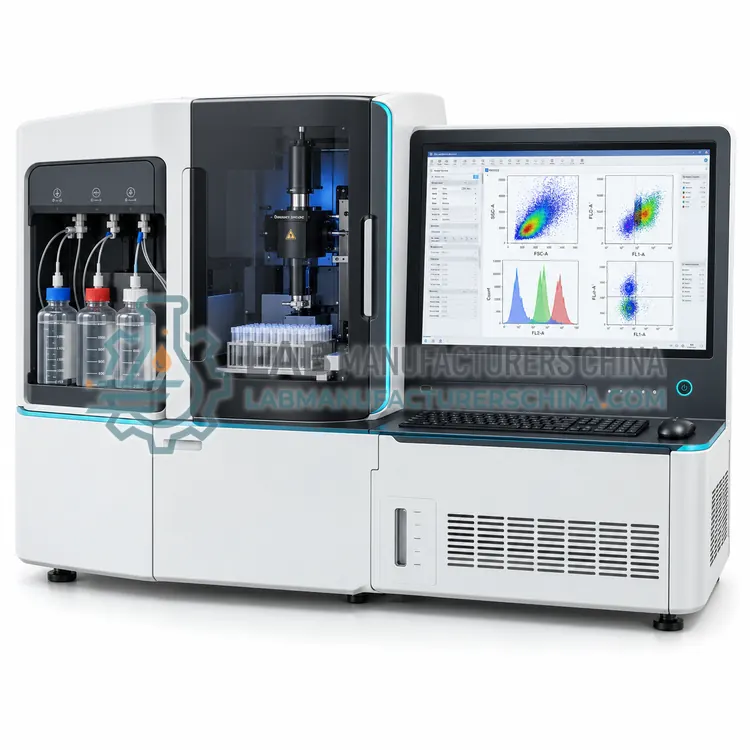
Flow Cytometer Acquisition and Control Software
流式细胞仪采集与控制软件
- ISO 13485 software lifecycle (to be confirmed)
- +2
Welcome to Lab Manufacturers China — laboratory instruments direct from a Chinese manufacturer
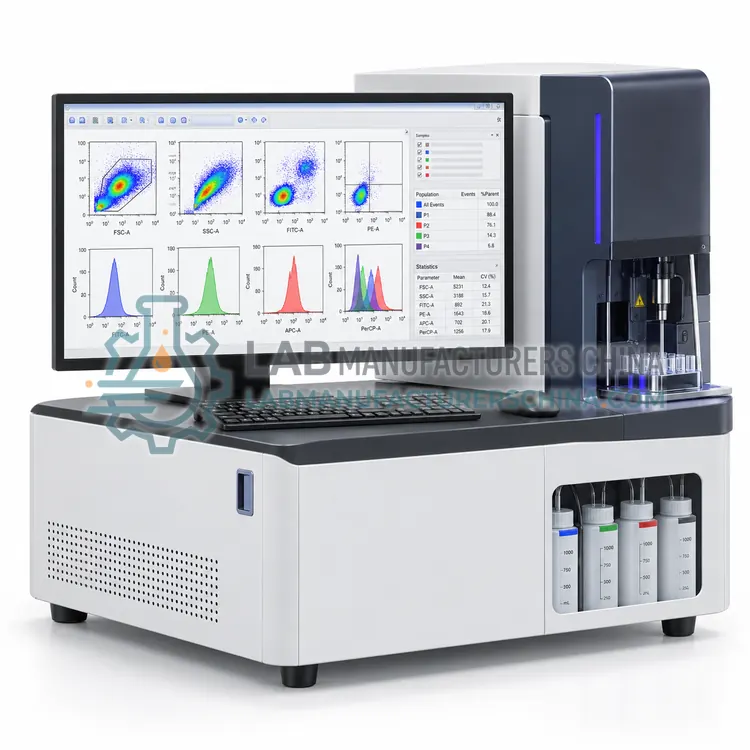
离线流式细胞术数据分析软件
Price on request — FOB / CIF quoted per order
Prices depend on configuration, quantity and destination port.
| Supported file formats | FCS 2.0, 3.0, 3.1, 3.2; CSV |
|---|---|
| Operating system | Windows 10/11; macOS (version dependent) |
| Gate types | Rectangle, polygon, ellipse, quadrant, range, Boolean |
| Scale transformations | Linear, log, logicle, arcsinh, biexponential |
| Batch processing | Template-based, hundreds of files |
| Statistics | % parent, MFI, gMFI, CV, counts |
By Lab Manufacturers China Technical TeamLast reviewed Standards: ISAC FCS 3.1 data standard, ISAC FCS 3.2 data standard, ISAC MIFlowCyt
Offline flow cytometry data analysis software opens FCS files from any cytometer to apply compensation, draw gates, calculate statistics and create publication-quality plots. It is used by researchers and analysts who process data away from the instrument, in batches, with shared templates and reporting tools.
Offline flow cytometry data analysis software opens FCS files from any cytometer to apply compensation, draw gates, calculate statistics and create publication-quality plots. It is used by researchers and analysts who process data away from the instrument, in batches, with shared templates and reporting tools.
Offline analysis packages are instrument-independent and read FCS versions 2.0 to 3.2. Workflows start with import, then compensation using matrices stored in the file or generated from single-stain controls, followed by scale transformation such as logicle, arcsinh or biexponential. Gating is hierarchical, with rectangle, polygon, quadrant, range and Boolean gates, and gate templates can be applied to batches of samples so that dozens of files are analyzed in minutes. Statistics include percent of parent, median and geometric mean fluorescence intensity, CV and absolute counts, and results export to spreadsheets. Overlay histograms, contour plots and layout editors create figures for publication, and cell cycle and proliferation modeling plugins are commonly included. Licensing may be perpetual or subscription, with single-user or site options, and Windows or macOS versions.
Cytometry software handles three stages. During acquisition it configures detector voltages, thresholds and gains, triggers on defined parameters, and writes each event's scatter and fluorescence values to list-mode FCS files with metadata. Analysis software then applies compensation or spectral unmixing to correct spillover, transforms data with logicle or biexponential scales to display negative values, and lets users draw hierarchical gates on histograms and dot plots to define populations. It calculates statistics such as percent parent, median fluorescence intensity and coefficient of variation. High-dimensional tools add dimensionality reduction with tSNE or UMAP and unsupervised clustering with algorithms such as FlowSOM or PhenoGraph. Regulated platforms add user authentication, audit trails, electronic signatures and validated templates.
A typical offline flow cytometry data analysis software configuration offers supported file formats of FCS 2.0, 3.0, 3.1, 3.2; CSV, operating system of Windows 10/11; macOS (version dependent), gate types of Rectangle, polygon, ellipse, quadrant, range, Boolean, scale transformations of Linear, log, logicle, arcsinh, biexponential, batch processing of Template-based, hundreds of files and statistics of % parent, MFI, gMFI, CV, counts. Values are indicative of the product class; the exact figures for each configuration are confirmed on the quotation and the calibration documents supplied with the instrument.
The Offline Flow Cytometry Data Analysis Software is used in immunophenotyping data analysis, cell cycle and proliferation modeling, apoptosis and viability assessment, publication figure preparation and teaching and training. Across the wider Cytometry Software class, laboratories also deploy it for instrument acquisition and quality control, offline flow data analysis and reporting and high-dimensional immune profiling.
Relevant standards and methods include ISAC FCS 3.1 data standard, ISAC FCS 3.2 data standard, ISAC MIFlowCyt, 21 CFR Part 11, EU GMP Annex 11, GAMP 5 and CLSI H62. Certification candidates for this model are ISO 9001 software development, CE and GAMP 5 documentation available; each is to be confirmed for the specific configuration before shipment, and certificates are supplied only where they have been issued.
Install acquisition software only on the validated workstation supplied or approved for the cytometer, with operating system updates under change control. Back up FCS data to network storage on a schedule and follow the MIFlowCyt guideline to record experiment metadata for reproducibility. Validate compensation matrices with single-stain controls and review gating strategies with fluorescence-minus-one controls. Standardize gating templates across users to reduce analyst variability. For regulated work, perform installation, operational and performance qualification, lock methods and templates, and review audit trails periodically. Keep license keys and software versions documented, and confirm that exported data remain readable in future software releases.
Choose offline analysis software for researchers who analyze data away from the cytometer and need batch processing, reporting and instrument independence. For regulated reporting use a Part 11 platform, and for clustering add high-dimensional tools. In an RFQ specify file version support, license type, number of users and OS.
Select software according to the task and the regulatory environment. Confirm instrument compatibility first, since acquisition software is tied to a specific cytometer and firmware. For analysis, verify support for FCS 2.0, 3.0, 3.1 and 3.2 files, compensation and unmixing matrices, batch processing and export of publication-quality graphs. For high-dimensional work, check for built-in tSNE, UMAP, FlowSOM and integration with R or Python. Regulated laboratories need 21 CFR Part 11 or equivalent functionality, meaning audit trails, electronic signatures, role-based access and validation documentation. Consider licensing model, including perpetual, subscription, floating or site licenses, data storage and cloud options, operating system support, and whether technical support and training are available locally.
| Supported file formats | FCS 2.0, 3.0, 3.1, 3.2; CSV |
|---|---|
| Operating system | Windows 10/11; macOS (version dependent) |
| Gate types | Rectangle, polygon, ellipse, quadrant, range, Boolean |
| Scale transformations | Linear, log, logicle, arcsinh, biexponential |
| Batch processing | Template-based, hundreds of files |
| Statistics | % parent, MFI, gMFI, CV, counts |
| Export formats | PDF, PNG, SVG, XLSX, CSV |
| Compensation | Matrix import, automatic from controls |
| Licensing | Perpetual or annual; single-user or site |
| Minimum RAM | 8 GB (16 GB recommended) |
Indicative values for this product class. Final specifications are confirmed on the quotation and in the calibration documents supplied with the instrument.
Nearly all packages read standard FCS versions 2.0, 3.0, 3.1 and often 3.2 generated by most cytometer brands, and may import CSV for derived data. Custom keywords from specific instruments are usually preserved in the file header.
You build gating and statistics on one representative sample, save it as a template, and apply it to many files. The software then outputs a table of statistics for every sample, which users should spot-check because gate positions may need adjustment across batches.
It is recommended because compensation can produce negative values that a log axis cannot show. Logicle or biexponential transformations display these values near zero so that negative populations and spreading error are visible and gates can be set correctly.
It controls the instrument during acquisition, records each event to FCS files, and then supports analysis by compensation, gating, statistics and plotting. Advanced software adds dimensionality reduction, clustering and batch processing, and regulated packages add audit trails and electronic signatures.
FCS is the Flow Cytometry Standard defined by the International Society for Advancement of Cytometry. It stores list-mode event data and metadata such as parameters, voltages and compensation in a single file, with versions 3.0, 3.1 and 3.2 in current use.
You need it when electronic records support regulated decisions, such as GMP release testing or clinical trial submissions to the FDA. Compliance requires audit trails, electronic signatures, access control and validation, and the lab's procedures must also support these controls.
流式细胞仪采集与控制软件
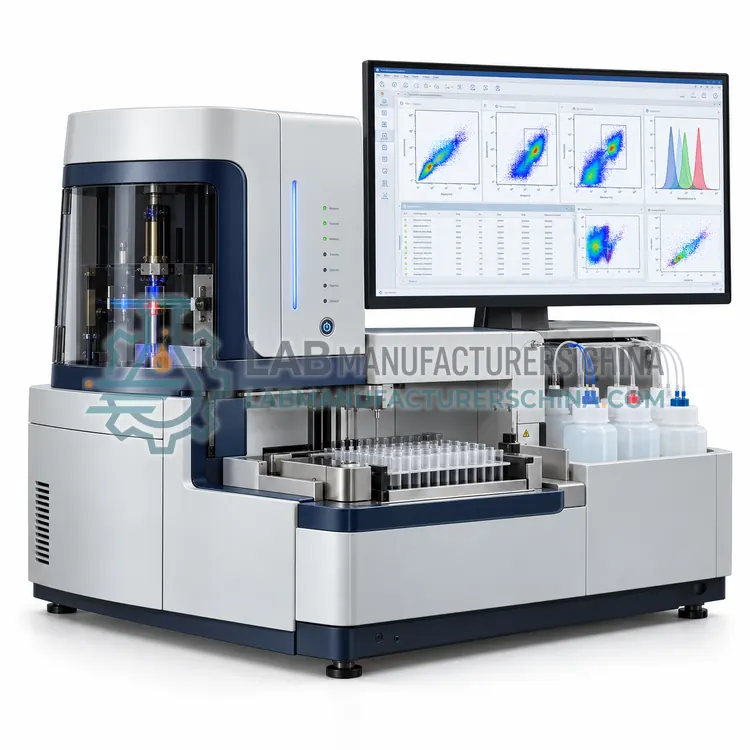
高维流式数据分析软件
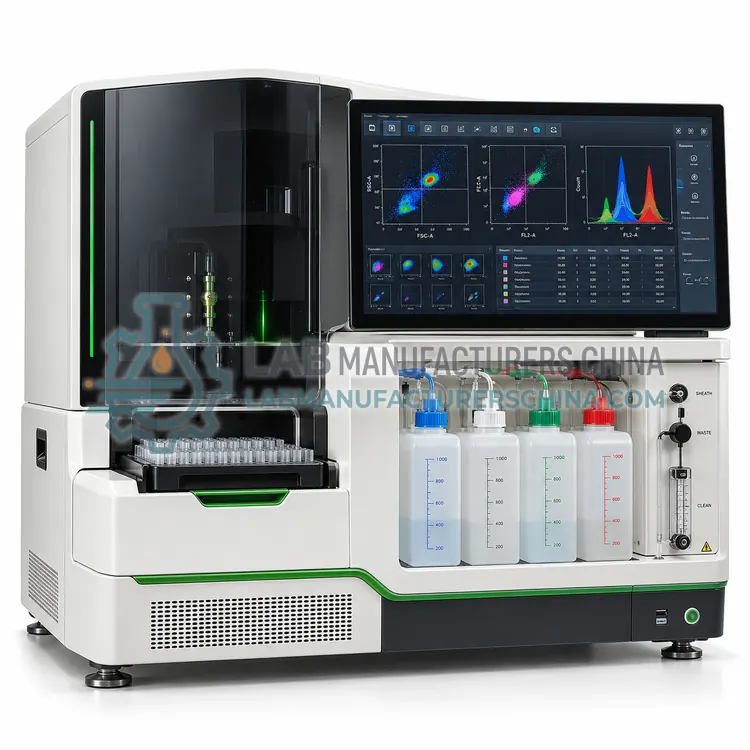
符合 21 CFR Part 11 的临床流式细胞术软件
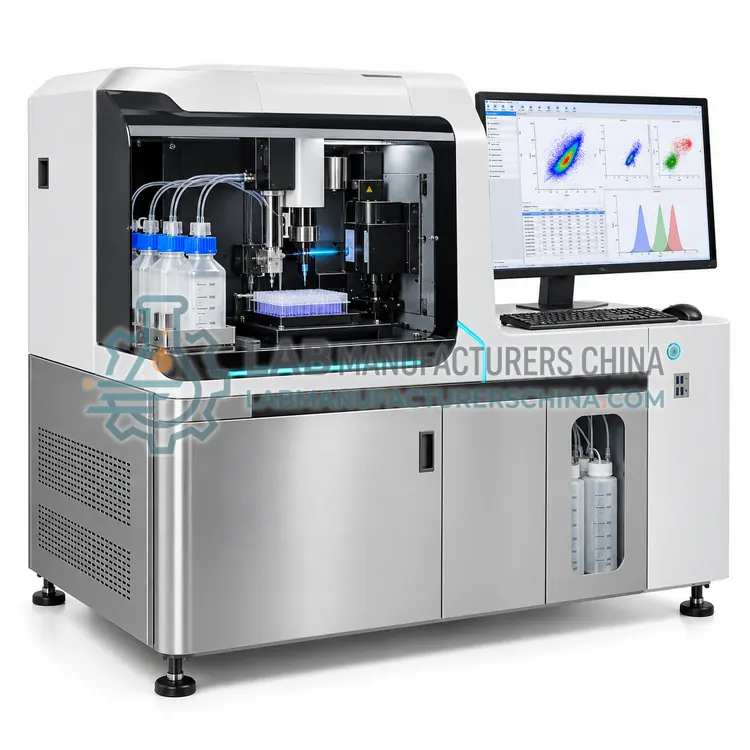
云端流式细胞术数据管理平台