Online Biomass Monitoring System
在线生物量监测系统
- SKU CUM-0002
- Culture Monitoring
- CE (to be confirmed)
- ISO 9001 manufacturing (to be confirmed)
- IEC 61010-1 safety (to be confirmed)
Price on request — FOB / CIF quoted per order
Prices depend on configuration, quantity and destination port.
Key specifications
| Measurement principle | Radio-frequency permittivity (capacitance) |
|---|---|
| Frequency range | 0.1–20 MHz multi-frequency option |
| Cell density range | approx. 1 x 10⁵–1 x 10⁸ cells/mL |
| Scan time | seconds, continuous logging |
| Conductivity range | 5–50 mS/cm (medium dependent) |
| Sterilisation | Autoclave or in-situ steam sterilisation |
Request a quote Download brochure · to be provided
By Lab Manufacturers China Technical TeamLast reviewed Standards: IEC 61010-1, IEC 61326-1, ISO 14644-1
What is the Online Biomass Monitoring System?
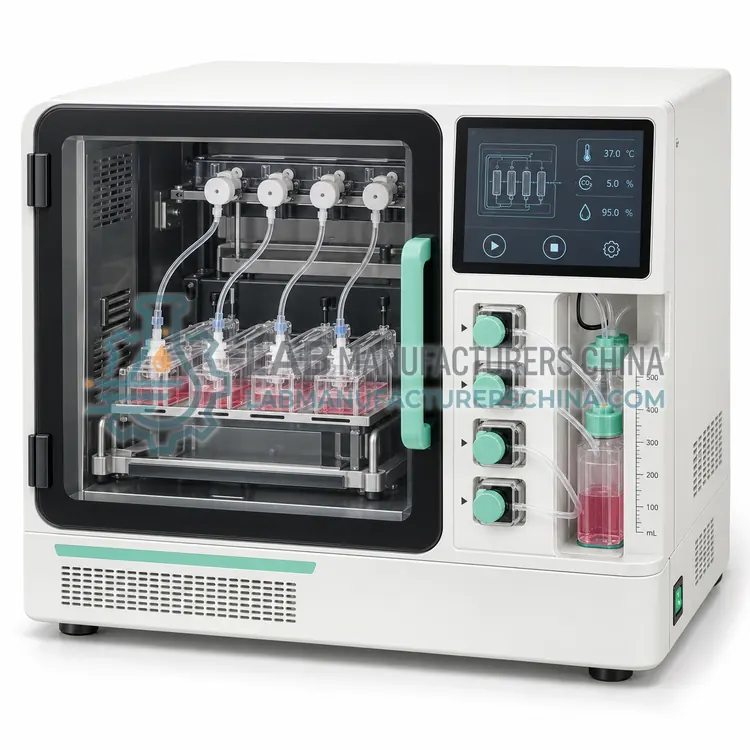
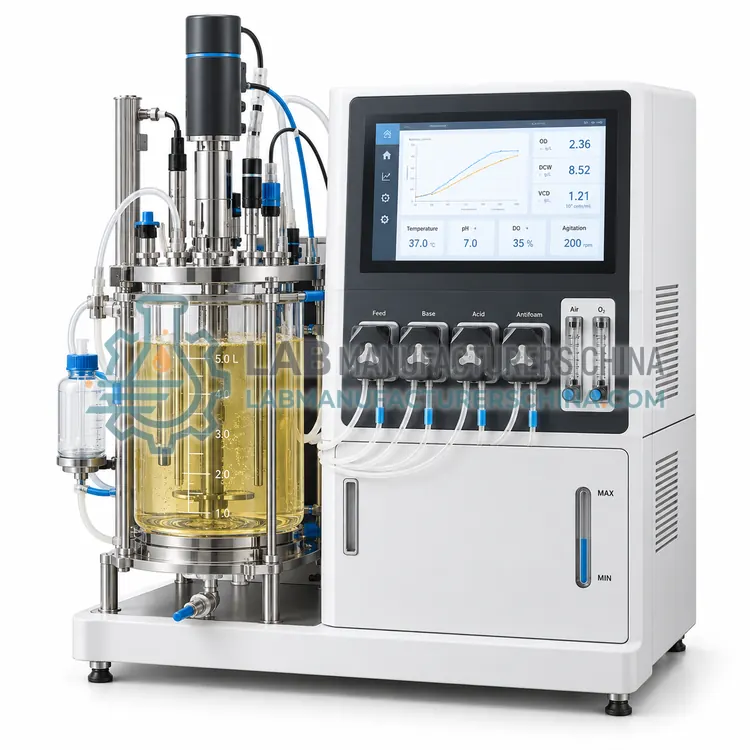
An online biomass monitoring system uses a capacitance probe to report viable cell volume in real time without sampling, tracking growth and detecting viability loss during bioreactor runs or flask-based culture processes.
What is the Online Biomass Monitoring System?
An online biomass monitoring system uses a capacitance probe to report viable cell volume in real time without sampling, tracking growth and detecting viability loss during bioreactor runs or flask-based culture processes.
Overview
The probe applies a radio-frequency field to the culture and measures the permittivity, which increases with the volume fraction of viable cells because intact membranes allow charge separation. Dead cells with leaky membranes and air bubbles or debris contribute far less, so the signal broadly tracks viable biomass rather than total particles. Readings are continuous, with a scan completed in seconds, and can be logged alongside pH, dissolved oxygen and temperature in the process control system. Because the measurement needs no sampling, it avoids the loss and contamination risk of repeated manual counts and gives a real-time signal for infection timing, feeding and harvest decisions. The probe is sterilised with the vessel and requires calibration against offline counts for the specific cell line and medium.
How does it work?
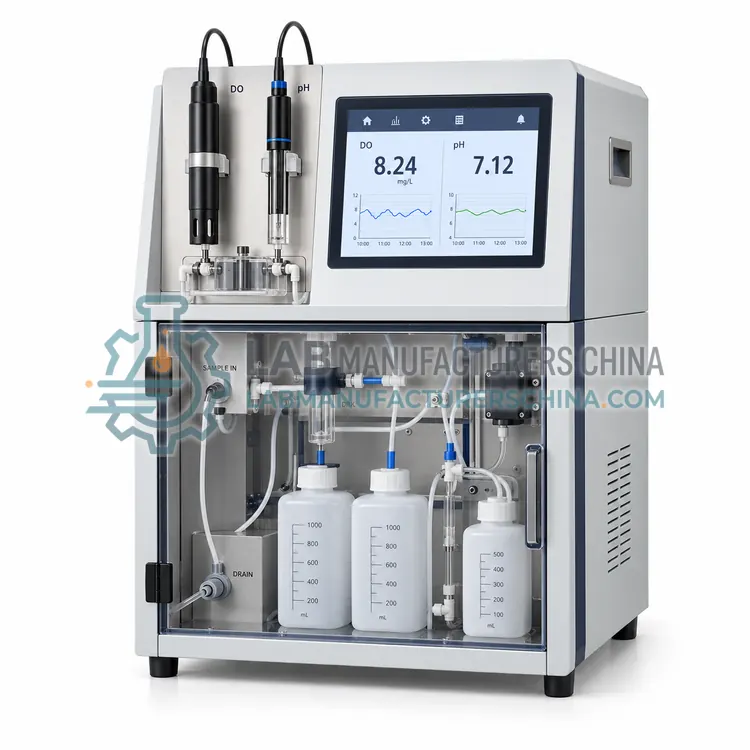
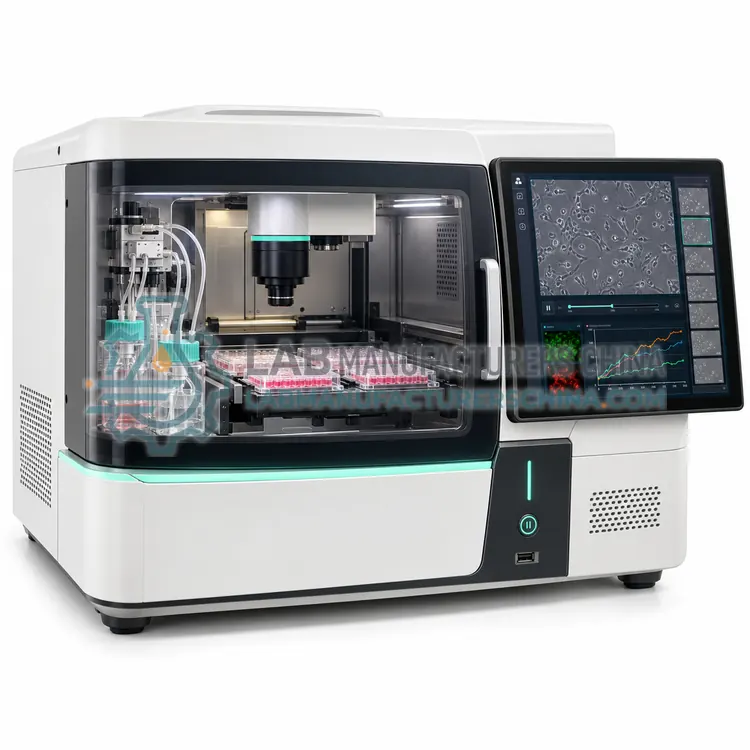
Monitoring methods translate a physical or chemical property of the culture into a usable signal. Imaging systems illuminate the culture surface and estimate confluence from the fraction of the area occupied by cells, or count fluorescent objects to give viable cell density. Capacitance probes apply a radio-frequency field across the culture; viable cells with intact membranes behave as polarisable particles whose signal is proportional to viable cell volume, while dead cells and debris contribute little. Dissolved oxygen is measured with electrochemical or optical sensors, and pH with glass or optical sensors, both of which can be steam-sterilised for bioreactor use. Metabolite analysers use enzyme-based or optical assays to quantify glucose, lactate, glutamine and ammonia in culture samples. Raman spectroscopy adds in-line multi-component measurement when a chemometric model has been calibrated for the process.
What are the key features?
- Real-time viable biomass signal without sampling
- Radio-frequency permittivity measurement of viable cell volume
- Continuous logging alongside pH, DO and temperature
- Steam-sterilisable probe for bioreactor use
- Detection of viability loss and infection events
- Calibration against offline cell counts per cell line
What are the technical specifications?
A typical online biomass monitoring system configuration offers measurement principle of Radio-frequency permittivity (capacitance), frequency range of 0.1–20 MHz multi-frequency option, cell density range of approx. 1 x 10⁵–1 x 10⁸ cells/mL, scan time of seconds, continuous logging, conductivity range of 5–50 mS/cm (medium dependent) and sterilisation of Autoclave or in-situ steam sterilisation. Values are indicative of the product class; the exact figures for each configuration are confirmed on the quotation and the calibration documents supplied with the instrument.
Which applications is it used for?
The Online Biomass Monitoring System is used in bioreactor feeding and infection timing, real-time growth tracking without sampling, viability loss or contamination detection and perfusion rate control by viable cell density. Across the wider Culture Monitoring class, laboratories also deploy it for feeding and harvest timing decisions, bioreactor process control and scale-up and contamination and stress detection.
Which standards and certifications apply?
Relevant standards and methods include IEC 61010-1, IEC 61326-1, ISO 14644-1, USP <1046> and ISO 20387. Certification candidates for this model are CE, ISO 9001 manufacturing and IEC 61010-1 safety; each is to be confirmed for the specific configuration before shipment, and certificates are supplied only where they have been issued.
Calibrate each sensor against the reference method used in your laboratory, and record the calibration coefficients, since drift differs between probe types and affects decisions. For optical sensors, check the excitation wavelength and the dye's sensitivity to pH, ionic strength and temperature, which must be matched to the culture conditions. Capacitance probes require a defined conductivity window, so the medium formulation cannot change without re-validation. Sampling for metabolite analysis should be consistent in timing and dilution, and the analyser should be checked with standards daily. Clean and sterilise probes according to the manufacturer's instructions, since residues from previous runs cause drift, and replace consumable sensors at the recommended interval rather than at failure. Keep trend data rather than single values, because rates of change are usually more informative.
How do I select the right Online Biomass Monitoring System?
Select a capacitance biomass system when real-time viable cell density is needed for control decisions and sampling is frequent or costly. Specify density and conductivity ranges, sterility requirements, probe format, multi-frequency capability and integration with the control system.
How does it compare with other Culture Monitoring variants?
Decide what decision the data must support. If the question is when to passage or harvest an adherent culture, automated confluence imaging is sufficient and simple. If viable cell density drives feeding or infection timing, capacitance biomass monitoring provides a real-time signal without sampling. For process control in a bioreactor, dissolved oxygen, pH and temperature probes are essential, and metabolite analysis adds the information needed to adjust perfusion or feed rates. Raman or near-infrared in-line analysers are justified only when the modelling effort can be sustained and the process runs often enough to benefit. Check measurement range and accuracy, response time, sterilisation method, whether the sensor contacts the culture, calibration and drift behaviour, integration with control software, and the frequency of consumable or probe replacement.
Full specifications
| Measurement principle | Radio-frequency permittivity (capacitance) |
|---|---|
| Frequency range | 0.1–20 MHz multi-frequency option |
| Cell density range | approx. 1 x 10⁵–1 x 10⁸ cells/mL |
| Scan time | seconds, continuous logging |
| Conductivity range | 5–50 mS/cm (medium dependent) |
| Sterilisation | Autoclave or in-situ steam sterilisation |
| Probe material | Stainless steel or glass with 316L steel body |
| Accuracy | within ±10% of offline count after calibration |
| Data output | Analogue or digital signal to control system |
| Dimensions (W x D x H) | probe approx. 25 x 25 x 300 mm |
Indicative values for this product class. Final specifications are confirmed on the quotation and in the calibration documents supplied with the instrument.
Applications
- Bioreactor feeding and infection timing
- Real-time growth tracking without sampling
- Viability loss or contamination detection
- Perfusion rate control by viable cell density
Key features
- Real-time viable biomass signal without sampling
- Radio-frequency permittivity measurement of viable cell volume
- Continuous logging alongside pH, DO and temperature
- Steam-sterilisable probe for bioreactor use
- Detection of viability loss and infection events
- Calibration against offline cell counts per cell line
Frequently asked questions about Online Biomass Monitoring System
Intact plasma membranes prevent ion movement, so viable cells behave as polarisable particles in a radio-frequency field. Cells with damaged membranes cannot maintain that charge separation, so their contribution to the signal is small.
Yes. Conductivity and dielectric properties of the medium determine the measurement window, so a change of medium brand, salt concentration or feed composition requires re-calibration against offline counts before the signal can be trusted.
It can flag unusual behaviour, such as a sudden rise or fall in the capacitance signal, or growth that diverges from the expected trend. Confirmation still requires a sample, but the early warning can save a run.
A camera images the culture surface in brightfield or phase contrast, and software segments cells from background to calculate the percentage of area covered. Accuracy depends on cell morphology and illumination consistency, so the same protocol should be used for comparisons.
A radio-frequency field polarises intact cells, and the resulting signal is proportional to the volume fraction of viable cells. Dead cells and debris contribute little because their membranes no longer maintain charge separation, so the reading tracks viable biomass in real time.
Glucose and lactate show the balance between supply and demand and indicate when perfusion is needed. Glutamine and ammonia track nitrogen metabolism, and their accumulation can inhibit growth. Together they guide feed rates more reliably than scheduled additions.
Related models