Cell Culture Metabolite Analyzer
细胞培养代谢物分析仪
- SKU CUM-0005
- Culture Monitoring
- CE (to be confirmed)
- ISO 9001 manufacturing (to be confirmed)
- IEC 61010-1 safety (to be confirmed)
Price on request — FOB / CIF quoted per order
Prices depend on configuration, quantity and destination port.
Key specifications
| Measured analytes | Glucose, lactate, glutamine, glutamate, ammonia |
|---|---|
| Sample volume | 10–100 µL per measurement |
| Analysis time | approx. 1–3 min per sample |
| Glucose range | 0.05–25 mmol/L |
| Lactate range | 0.05–30 mmol/L |
| Glutamine range | 0.05–6 mmol/L |
Request a quote Download brochure · to be provided
By Lab Manufacturers China Technical TeamLast reviewed Standards: IEC 61010-1, IEC 61326-1, ISO 14644-1
What is the Cell Culture Metabolite Analyzer?
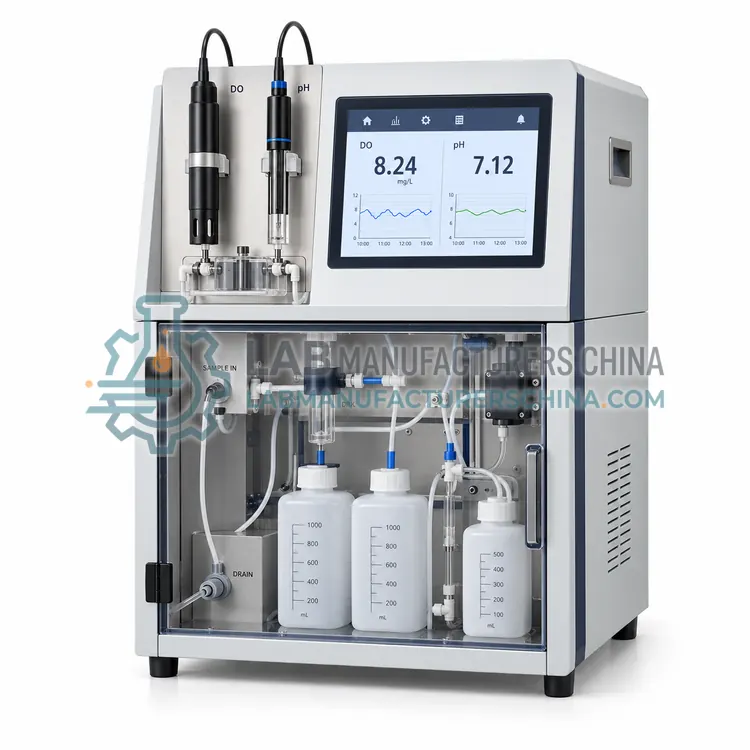
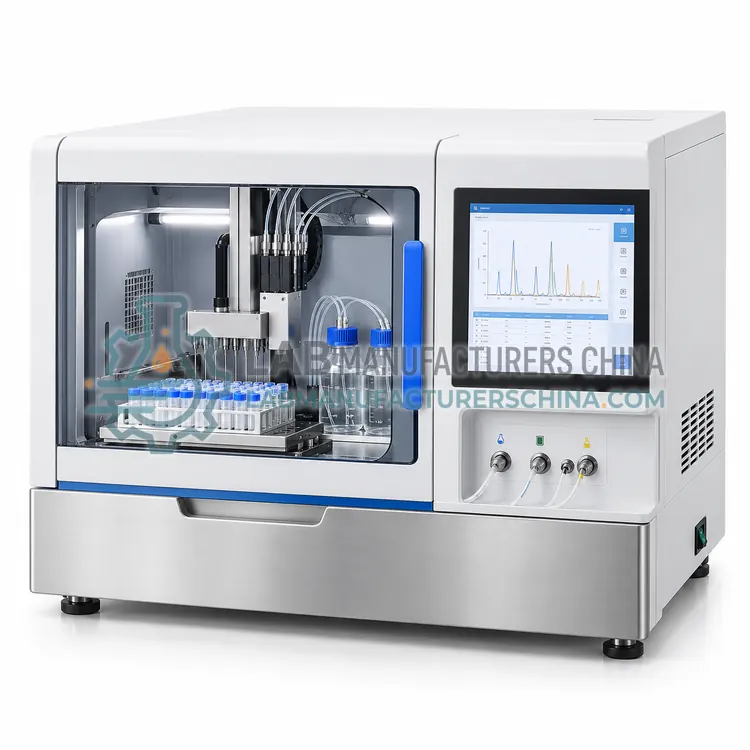
A cell culture metabolite analyzer measures glucose, lactate, glutamine, glutamate and ammonia in small culture samples using enzyme-based or optical sensors, giving the data needed to set feed and perfusion rates rationally.
What is the Cell Culture Metabolite Analyzer?
A cell culture metabolite analyzer measures glucose, lactate, glutamine, glutamate and ammonia in small culture samples using enzyme-based or optical sensors, giving the data needed to set feed and perfusion rates rationally.
Overview
The benchtop analyser accepts 10–100 µL of culture supernatant or plasma and reports several metabolites within one to three minutes. Enzyme-based sensors with amperometric detection provide high specificity, while optical and Raman-based systems offer reagent-free measurement at lower specificity. Measured values are converted into rates by comparing two time points, and the ratio of lactate produced to glucose consumed indicates whether metabolism is mainly oxidative or glycolytic, which guides feeding strategy. Glutamine and ammonia indicate nitrogen balance, and ammonia accumulation above about 2–5 mmol/L is generally inhibitory. Instruments usually store results by sample identity and export them to a spreadsheet or process database, and some models integrate with automated sampling systems.
How does it work?
Monitoring methods translate a physical or chemical property of the culture into a usable signal. Imaging systems illuminate the culture surface and estimate confluence from the fraction of the area occupied by cells, or count fluorescent objects to give viable cell density. Capacitance probes apply a radio-frequency field across the culture; viable cells with intact membranes behave as polarisable particles whose signal is proportional to viable cell volume, while dead cells and debris contribute little. Dissolved oxygen is measured with electrochemical or optical sensors, and pH with glass or optical sensors, both of which can be steam-sterilised for bioreactor use. Metabolite analysers use enzyme-based or optical assays to quantify glucose, lactate, glutamine and ammonia in culture samples. Raman spectroscopy adds in-line multi-component measurement when a chemometric model has been calibrated for the process.
What are the key features?
- Measurement of glucose, lactate, glutamine, glutamate and ammonia
- Sample volume of 10–100 µL and analysis within minutes
- Enzyme-based amperometric sensors with high specificity
- Rate calculation from two time points
- Lactate to glucose ratio indicating metabolic state
- Results stored by sample identity and exported digitally
What are the technical specifications?
A typical cell culture metabolite analyzer configuration offers measured analytes of Glucose, lactate, glutamine, glutamate, ammonia, sample volume of 10–100 µL per measurement, analysis time of approx. 1–3 min per sample, glucose range of 0.05–25 mmol/L, lactate range of 0.05–30 mmol/L and glutamine range of 0.05–6 mmol/L. Values are indicative of the product class; the exact figures for each configuration are confirmed on the quotation and the calibration documents supplied with the instrument.
Which applications is it used for?
The Cell Culture Metabolite Analyzer is used in feed and perfusion rate decisions, media and supplement optimisation, metabolic state assessment in process development and quality checks on culture supernatant. Across the wider Culture Monitoring class, laboratories also deploy it for feeding and harvest timing decisions, bioreactor process control and scale-up and contamination and stress detection.
Which standards and certifications apply?
Relevant standards and methods include IEC 61010-1, IEC 61326-1, ISO 14644-1, USP <1046> and ISO 20387. Certification candidates for this model are CE, ISO 9001 manufacturing and IEC 61010-1 safety; each is to be confirmed for the specific configuration before shipment, and certificates are supplied only where they have been issued.
Calibrate each sensor against the reference method used in your laboratory, and record the calibration coefficients, since drift differs between probe types and affects decisions. For optical sensors, check the excitation wavelength and the dye's sensitivity to pH, ionic strength and temperature, which must be matched to the culture conditions. Capacitance probes require a defined conductivity window, so the medium formulation cannot change without re-validation. Sampling for metabolite analysis should be consistent in timing and dilution, and the analyser should be checked with standards daily. Clean and sterilise probes according to the manufacturer's instructions, since residues from previous runs cause drift, and replace consumable sensors at the recommended interval rather than at failure. Keep trend data rather than single values, because rates of change are usually more informative.
How do I select the right Cell Culture Metabolite Analyzer?
Select a metabolite analyser when feeding decisions should be based on measured concentrations rather than fixed schedules, or when metabolic shifts must be documented. Specify analytes, ranges, sample volume, analysis time, calibration routine and data export.
How does it compare with other Culture Monitoring variants?
Decide what decision the data must support. If the question is when to passage or harvest an adherent culture, automated confluence imaging is sufficient and simple. If viable cell density drives feeding or infection timing, capacitance biomass monitoring provides a real-time signal without sampling. For process control in a bioreactor, dissolved oxygen, pH and temperature probes are essential, and metabolite analysis adds the information needed to adjust perfusion or feed rates. Raman or near-infrared in-line analysers are justified only when the modelling effort can be sustained and the process runs often enough to benefit. Check measurement range and accuracy, response time, sterilisation method, whether the sensor contacts the culture, calibration and drift behaviour, integration with control software, and the frequency of consumable or probe replacement.
Full specifications
| Measured analytes | Glucose, lactate, glutamine, glutamate, ammonia |
|---|---|
| Sample volume | 10–100 µL per measurement |
| Analysis time | approx. 1–3 min per sample |
| Glucose range | 0.05–25 mmol/L |
| Lactate range | 0.05–30 mmol/L |
| Glutamine range | 0.05–6 mmol/L |
| Ammonia range | 0.05–10 mmol/L |
| Precision | within ±3% (typical) |
| Calibration | Single-point or two-point standards |
| Dimensions (W x D x H) | approx. 250 x 300 x 250 mm |
Indicative values for this product class. Final specifications are confirmed on the quotation and in the calibration documents supplied with the instrument.
Applications
- Feed and perfusion rate decisions
- Media and supplement optimisation
- Metabolic state assessment in process development
- Quality checks on culture supernatant
Key features
- Measurement of glucose, lactate, glutamine, glutamate and ammonia
- Sample volume of 10–100 µL and analysis within minutes
- Enzyme-based amperometric sensors with high specificity
- Rate calculation from two time points
- Lactate to glucose ratio indicating metabolic state
- Results stored by sample identity and exported digitally
Frequently asked questions about Cell Culture Metabolite Analyzer
At least once or twice a day in batch culture, and more often when perfusion or feed rates are being adjusted. Sampling should be consistent in timing and handling, because the calculated rates depend on the interval between measurements.
It shows how much glucose is converted to lactate. A high ratio means glycolytic metabolism with rapid acid production, which may require more base addition or prompt medium exchange, while a low ratio indicates more complete oxidation of glucose.
Enzyme-based analysers use sensor chips or reagent cartridges that must be replaced at defined intervals, while optical or Raman systems measure without reagents. Consumable cost per sample should be included when comparing instruments.
A camera images the culture surface in brightfield or phase contrast, and software segments cells from background to calculate the percentage of area covered. Accuracy depends on cell morphology and illumination consistency, so the same protocol should be used for comparisons.
A radio-frequency field polarises intact cells, and the resulting signal is proportional to the volume fraction of viable cells. Dead cells and debris contribute little because their membranes no longer maintain charge separation, so the reading tracks viable biomass in real time.
Glucose and lactate show the balance between supply and demand and indicate when perfusion is needed. Glutamine and ammonia track nitrogen metabolism, and their accumulation can inhibit growth. Together they guide feed rates more reliably than scheduled additions.
Related models