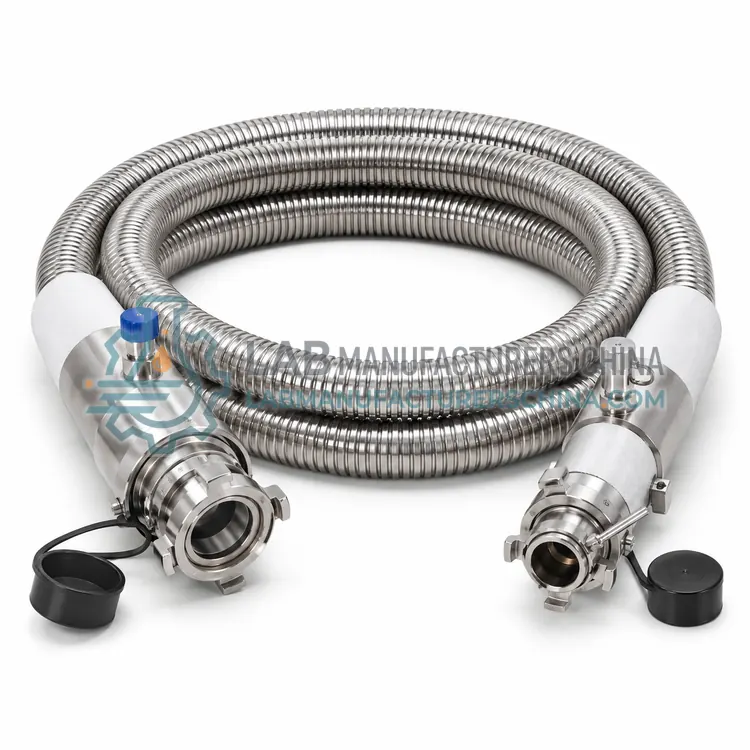
Vacuum-Jacketed Cryogenic Transfer Hose
真空夹套低温转移软管
- SKU CTE-0001
- Cryogenic Transfer Equipment
- CE (to be confirmed)
- ISO 9001 manufacturing (to be confirmed)
- PED 2014/68/EU conformity (to be confirmed)
Price on request — FOB / CIF quoted per order
Prices depend on configuration, quantity and destination port.
Key specifications
| Inner hose diameter | DN8–DN15 |
|---|---|
| Length | 1–10 m |
| Working pressure | Up to 16–25 bar |
| Minimum bend radius | 200–400 mm |
| Vacuum level (insulation) | <10⁻⁴ mbar |
| Heat leak | 0.5–2 W/m |
Request a quote Download brochure · to be provided
By Lab Manufacturers China Technical TeamLast reviewed Standards: ISO 21010, ISO 21009-1, EN 13458-2
What is the Vacuum-Jacketed Cryogenic Transfer Hose?
A vacuum-jacketed cryogenic transfer hose is a flexible stainless steel hose inside an evacuated outer jacket that carries liquid nitrogen with minimal heat gain. It is the right choice for connecting bulk tanks, dewars and storage vessels when flexible, repeatable, low-loss liquid transfer is needed.
What is the Vacuum-Jacketed Cryogenic Transfer Hose?
A vacuum-jacketed cryogenic transfer hose is a flexible stainless steel hose inside an evacuated outer jacket that carries liquid nitrogen with minimal heat gain. It is the right choice for connecting bulk tanks, dewars and storage vessels when flexible, repeatable, low-loss liquid transfer is needed.
Overview
The hose has an inner corrugated stainless steel tube, typically DN8 to DN15, inside a second corrugated outer tube. The annular space holds multilayer insulation under vacuum better than 10⁻⁴ mbar, sealed permanently and usually with a getter to maintain vacuum. End fittings are welded and may be male or female bayonet connections, threaded ports or cryogenic quick couplings compatible with the source and destination. Lengths of 1 to 10 m are available, with a minimum bend radius that depends on hose size, often 200 to 400 mm. Working pressure is typically up to 16–25 bar, and insulated end fittings reduce frosting. Compared with bare or foam-insulated hose, a vacuum-jacketed version cuts gas generation, shortens cool-down and gives stable liquid flow. A relief valve should be fitted on any section where liquid can be trapped.
How does it work?
Cryogenic transfer equipment reduces heat leak while liquid moves from a source vessel to a destination. Liquid is driven either by vessel pressure, by a self-pressurizing circuit that raises headspace pressure to about 0.5–1.5 bar, or by a cryogenic pump with a submerged or extended-shaft impeller. Vacuum-jacketed hoses and pipes suppress heat transfer with an evacuated annulus and multilayer insulation, so less liquid flashes to gas in the line. A phase separator placed at the outlet vents vapor through a float-operated valve so that only liquid flows to the receiving vessel, stabilizing filling. Auto-fill controllers combine level sensors, temperature sensors and solenoid valves that open when liquid is needed and close when level is reached, with timeout and fault alarms.
What are the key features?
- Double corrugated stainless steel construction with evacuated multilayer insulation.
- Lengths from 1 to 10 m with defined minimum bend radius.
- Welded end fittings in bayonet, threaded or quick-coupling formats.
- Insulated connectors reduce frosting and operator contact risk.
- Getter maintains vacuum over service life.
- Working pressure up to 16–25 bar for tank and pump service.
What are the technical specifications?
A typical vacuum-jacketed cryogenic transfer hose configuration offers inner hose diameter of DN8–DN15, length of 1–10 m, working pressure of Up to 16–25 bar, minimum bend radius of 200–400 mm, vacuum level (insulation) of <10⁻⁴ mbar and heat leak of 0.5–2 W/m. Values are indicative of the product class; the exact figures for each configuration are confirmed on the quotation and the calibration documents supplied with the instrument.
Which applications is it used for?
The Vacuum-Jacketed Cryogenic Transfer Hose is used in bulk tank to dewar filling, connecting storage vessels to supply, cold trap and instrument supply and cryogenic process lines. Across the wider Cryogenic Transfer Equipment class, laboratories also deploy it for filling dewars from bulk liquid nitrogen tanks, automatic refilling of cryogenic storage vessels and liquid nitrogen supply to cold traps and instruments.
Which standards and certifications apply?
Relevant standards and methods include ISO 21010, ISO 21009-1, EN 13458-2, GB/T 18442, EU Pressure Equipment Directive 2014/68/EU and EN 1252-1. Certification candidates for this model are CE, ISO 9001 manufacturing and PED 2014/68/EU conformity; each is to be confirmed for the specific configuration before shipment, and certificates are supplied only where they have been issued.
Cryogenic hoses and pipes must have pressure relief wherever liquid can be trapped between valves, since trapped liquid expanding on warming can rupture lines. Keep fittings clean and dry and avoid contamination with oil or grease, which is a hazard mostly with oxygen but good practice generally. Inspect hose outer braid and end fittings for damage, and test vacuum integrity of jacketed lines periodically. Operators should wear a face shield, cryogenic gloves and closed footwear, and work in ventilated rooms with oxygen monitors. Cool lines slowly to reduce thermal shock. Replace seals, gaskets and worn couplings on a schedule. Document calibration of level and temperature sensors on auto-fill systems and test alarm function regularly.
How do I select the right Vacuum-Jacketed Cryogenic Transfer Hose?
Choose a vacuum-jacketed hose when transfer loss, frost and cool-down time matter. Foam-insulated hoses suit short, occasional tasks. In an RFQ, specify bore, length, bend radius, end fittings matching source and destination, working pressure, insulation type and relief valve requirements.
How does it compare with other Cryogenic Transfer Equipment variants?
Match the equipment to the transfer task. For moving liquid from a bulk tank to dewars, choose a vacuum-jacketed hose with compatible fittings, pressure rating and a phase separator. For high-volume or long-distance transfer, consider a cryogenic pump, which works independently of tank pressure. For unattended filling of storage vessels, specify an auto-fill controller with level sensor, solenoid valve and alarms. For moving frozen samples within a facility, choose a transfer cart with vapor-phase capability and suitable dimensions for doors and lifts. Check hose length, bore, connection thread, maximum working pressure and temperature, material compatibility and whether a relief valve is included. Also consider operator safety features such as cold-resistant handles and splash shields.
Full specifications
| Inner hose diameter | DN8–DN15 |
|---|---|
| Length | 1–10 m |
| Working pressure | Up to 16–25 bar |
| Minimum bend radius | 200–400 mm |
| Vacuum level (insulation) | <10⁻⁴ mbar |
| Heat leak | 0.5–2 W/m |
| Temperature range | −196°C to +60°C |
| Materials | 304/316L stainless steel |
| End connections | Bayonet, NPT or quick coupling |
| Weight | 0.6–1.2 kg/m |
Indicative values for this product class. Final specifications are confirmed on the quotation and in the calibration documents supplied with the instrument.
Applications
- Bulk tank to dewar filling
- Connecting storage vessels to supply
- Cold trap and instrument supply
- Cryogenic process lines
Key features
- Double corrugated stainless steel construction with evacuated multilayer insulation.
- Lengths from 1 to 10 m with defined minimum bend radius.
- Welded end fittings in bayonet, threaded or quick-coupling formats.
- Insulated connectors reduce frosting and operator contact risk.
- Getter maintains vacuum over service life.
- Working pressure up to 16–25 bar for tank and pump service.
Frequently asked questions about Vacuum-Jacketed Cryogenic Transfer Hose
Vacuum with multilayer insulation has far lower heat leak than foam, so less liquid evaporates, cool-down is faster and frost is reduced. Foam-insulated hose is cheaper and can suit brief transfers, but it gives more gas and less stable flow.
Signs include frost or cold spots on the outer jacket, heavy gas discharge at the outlet and longer cool-down. A vacuum gauge test by the manufacturer can confirm, and failed hoses should be repaired or replaced.
The stainless steel construction is often compatible, but oxygen service requires oxygen-clean preparation with documented cleaning and approved materials. Always confirm with the supplier that the hose is rated and cleaned for the specific fluid.
A phase separator is a small device at the end of a transfer line that vents nitrogen vapor while letting liquid pass. Because the line cools and flashes some liquid to gas, separating the phases gives a steadier flow and reduces splashing and liquid loss.
Liquid trapped between two closed valves warms and expands about 700 times as gas, which can burst pipes or hoses. A relief valve or burst disc between valve pairs prevents dangerous pressure and is required under pressure-equipment rules.
A pump is better when transfer volume is large, distance is long or the source tank has low pressure. It gives constant flow independent of tank pressure and reduces vapor loss, but costs more and needs precool and maintenance.