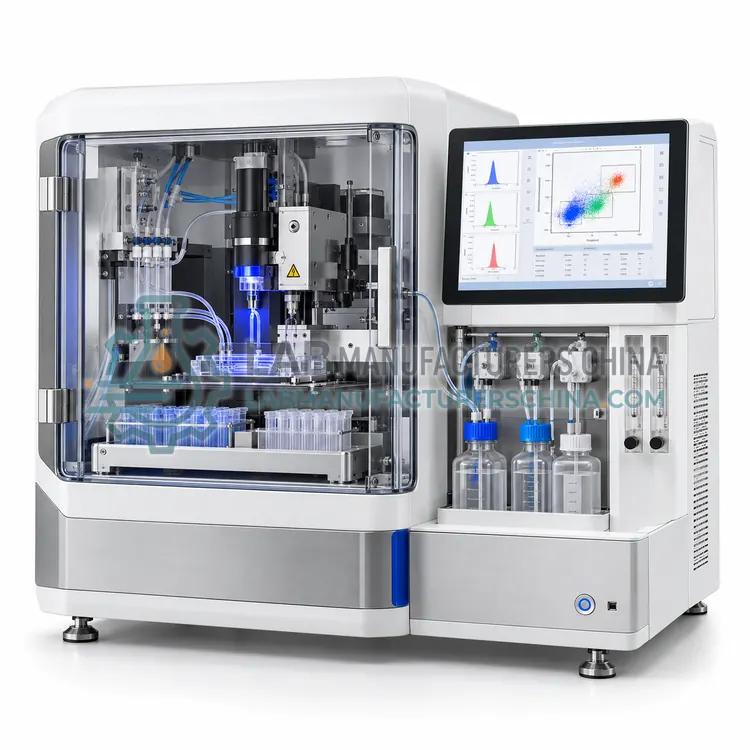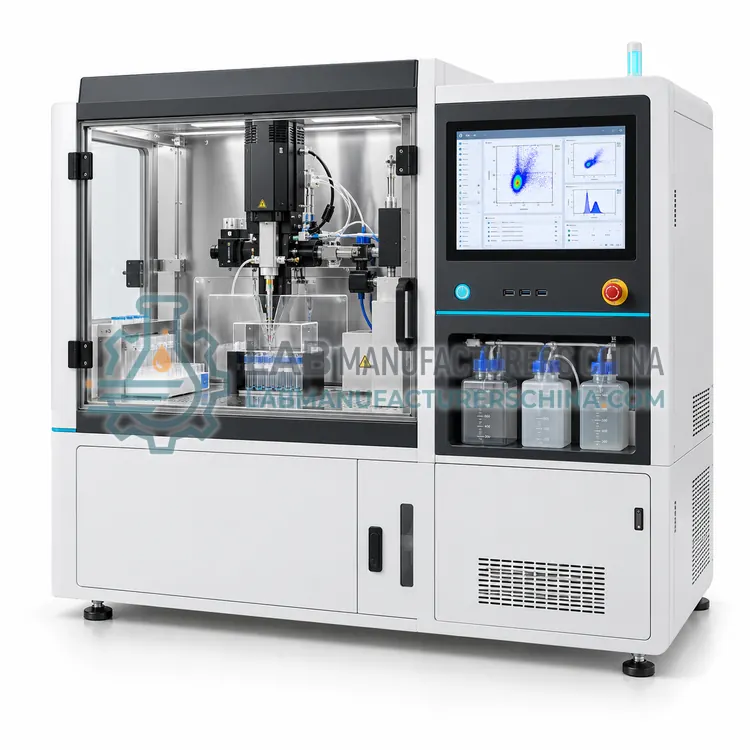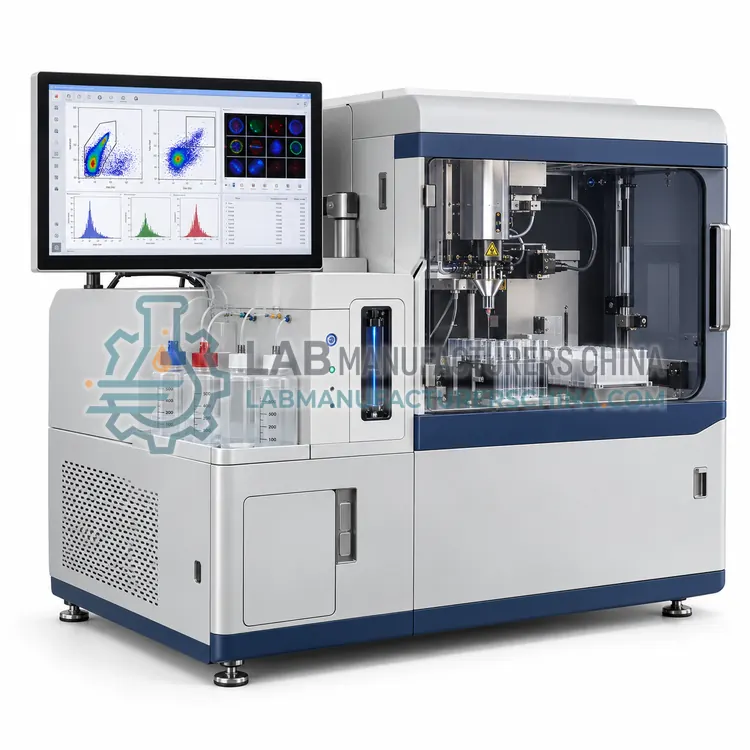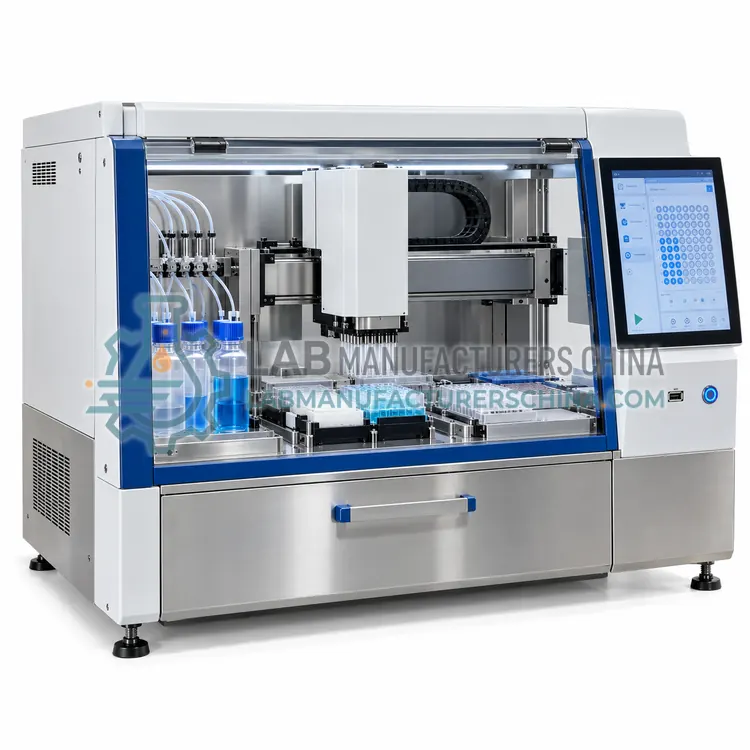
High-Speed Droplet Cell Sorter
高速液滴式细胞分选仪
- SKU CSO-0001
- Cell Sorters
- CE (to be confirmed)
- IEC 61010-1 compliance (to be confirmed)
- ISO 9001 manufacturing (to be confirmed)
Price on request — FOB / CIF quoted per order
Prices depend on configuration, quantity and destination port.
Key specifications
| Laser configuration | 4–6 (355/405/488/561/640 nm) |
|---|---|
| Fluorescence detectors | 12–30+ |
| Sort streams | 2, 4 or 6-way |
| Nozzle sizes | 70, 85, 100, 130 µm |
| Drop drive frequency | 30–90 kHz |
| Maximum sort rate | Up to 70,000 events/s |
Request a quote Download brochure · to be provided
By Lab Manufacturers China Technical TeamLast reviewed Standards: ISAC Cell Sorter Biosafety Standards, IEC 61010-1, IEC 60825-1
What is the High-Speed Droplet Cell Sorter?
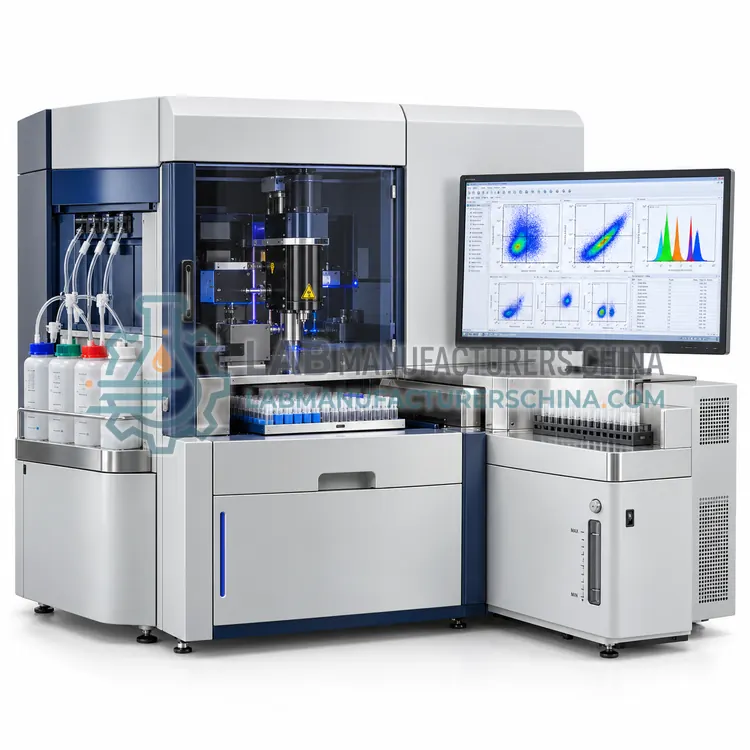
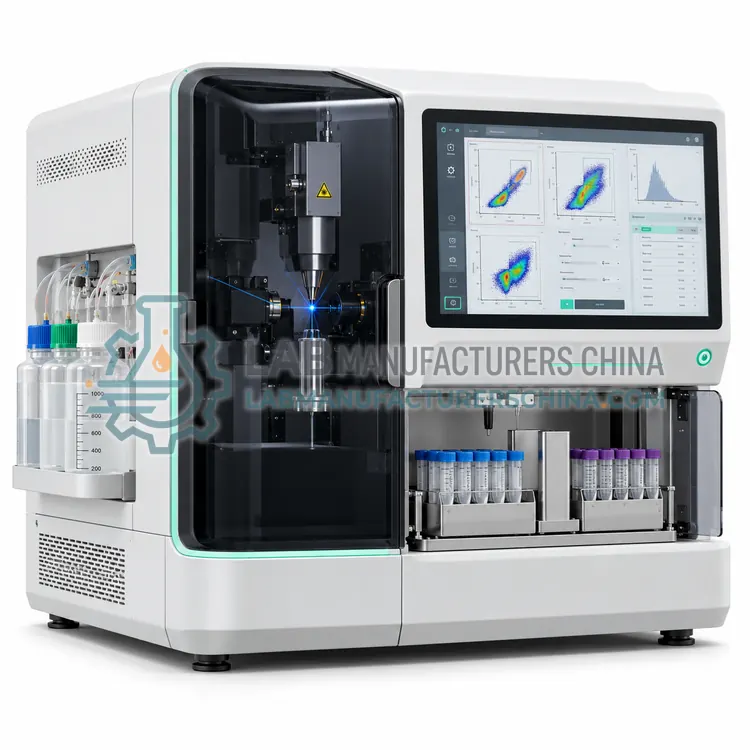
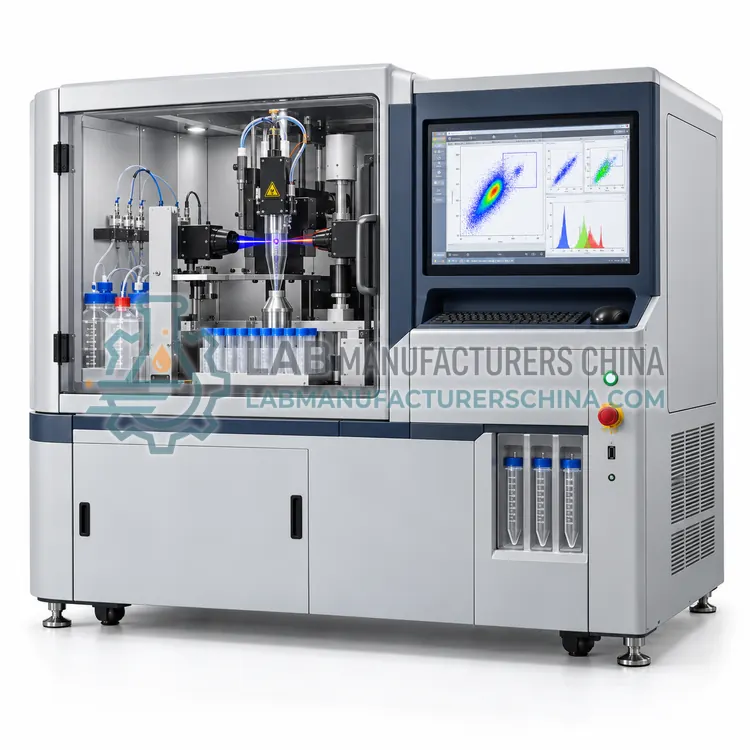
A high-speed droplet cell sorter is a multi-laser jet-in-air system that sorts up to four or six populations simultaneously at tens of thousands of events per second. It suits core facilities that need high throughput, multiple laser lines, rare-cell enrichment and demanding purity for large panels.
What is the High-Speed Droplet Cell Sorter?
A high-speed droplet cell sorter is a multi-laser jet-in-air system that sorts up to four or six populations simultaneously at tens of thousands of events per second. It suits core facilities that need high throughput, multiple laser lines, rare-cell enrichment and demanding purity for large panels.
Overview
High-speed droplet sorters are the workhorse of shared cytometry cores. A nozzle of 70 to 130 micrometers operating at 20 to 70 psi forms a stable jet that is vibrated at 30 to 90 kHz, producing tens of thousands of droplets per second. Four to six lasers and 12 to 30 or more fluorescence detectors support high-dimensional sort panels. Electrostatic deflection separates two, four or six streams into tubes or multiwell plates, and automated drop delay calibration and stream monitoring keep sorting accurate over long runs. Sample and collection temperature can be controlled from 4 to 37 degrees Celsius. Sort rates of 20,000 to 70,000 events per second are possible, but high rates reduce recovery through coincident events. Enclosed sort chambers with aerosol evacuation are offered for biosafety. These platforms are large, require compressed gas, and need trained operators.
How does it work?
Sorters analyze cells like an analyzer, then apply a decision in real time. In droplet sorters, a piezoelectric transducer vibrates the nozzle at 20 to 100 kHz so the stream breaks into uniform droplets just after the laser intercept. When a cell matching the sort gate is about to be enclosed, the electronics apply a charge to the stream, and the droplet separates carrying that charge. Charged droplets pass through high-voltage deflection plates and fall into tubes or multiwell plates, while uncharged droplets go to waste. A drop delay calibrated with fluorescent beads defines the time between detection and droplet break-off. Microfluidic chip sorters instead use valves, piezo actuators or optical forces inside a disposable cartridge, enclosing the sample away from aerosols.
What are the key features?
- Four to six lasers with 12 to 30 or more fluorescence detectors
- Two-, four- or six-way electrostatic droplet deflection into tubes or plates
- Automated drop delay calibration and real-time stream monitoring
- Sample and collection temperature control from 4 to 37 degrees Celsius
- Interchangeable nozzles from 70 to 130 micrometers for different cell sizes
- Optional enclosed sort chamber with aerosol evacuation for biosafety
What are the technical specifications?
A typical high-speed droplet cell sorter configuration offers laser configuration of 4–6 (355/405/488/561/640 nm), fluorescence detectors of 12–30+, sort streams of 2, 4 or 6-way, nozzle sizes of 70, 85, 100, 130 µm, drop drive frequency of 30–90 kHz and maximum sort rate of Up to 70,000 events/s. Values are indicative of the product class; the exact figures for each configuration are confirmed on the quotation and the calibration documents supplied with the instrument.
Which applications is it used for?
The High-Speed Droplet Cell Sorter is used in rare progenitor and stem cell enrichment, multiparameter immune subset sorting, sorting for single-cell sequencing, gene-edited cell isolation and shared core facility operations. Across the wider Cell Sorters class, laboratories also deploy it for stem cell and progenitor enrichment, single-cell cloning of engineered cell lines and sorting for single-cell RNA sequencing.
Which standards and certifications apply?
Relevant standards and methods include ISAC Cell Sorter Biosafety Standards, IEC 61010-1, IEC 60825-1, EN 12469, ISO 14698-1, CLSI H62 and ISAC FCS 3.1. Certification candidates for this model are CE, IEC 61010-1 compliance and ISO 9001 manufacturing; each is to be confirmed for the specific configuration before shipment, and certificates are supplied only where they have been issued.
Sorters need a clean, temperature-stable room, compressed air or nitrogen supply and often a dedicated operator. Perform daily setup with calibration beads to set drop delay, verify stream stability and check sort accuracy. Decontaminate fluidics with bleach or dedicated cleaning solutions before and after every sample and sterilize sheath paths for primary cell work. Sorting human or infectious material requires a biosafety assessment, with containment verified by an aerosol test such as potassium iodide or fluorescent bead methods. Nozzles, O-rings and sheath filters are consumables and should be replaced on a schedule. Laboratories should log sorts, purity checks and preventive maintenance to support reproducibility and audits.
How do I select the right High-Speed Droplet Cell Sorter?
Choose a high-speed droplet sorter for shared cores with mixed users, four-way or larger sorts, or rare populations requiring fast throughput. It is unnecessary for single-lab routine two-way sorting. In an RFQ specify laser set, number of sort streams, nozzle sizes, biosafety enclosure, plate deposition and required operator training.
How does it compare with other Cell Sorters variants?
Choose a sorter on purity, yield, viability and containment requirements. Determine how many populations you need to collect at once, since two-way, four-way and six-way sorting require different deflection hardware. Match nozzle size, from 70 to 130 micrometers, to cell size and fragility; larger nozzles and lower pressure are gentler for primary cells. Check sort speed, typically 20,000 to 70,000 events per second, against the abort rate and recovery. For infectious, human primary or viral vector samples, specify an aerosol-managed or enclosed system and a class II biosafety cabinet. Consider single-cell deposition into 96 or 384-well plates, index sorting, number of lasers, and ease of use. Also confirm sterile fluidics cleaning and availability of service engineers.
Full specifications
| Laser configuration | 4–6 (355/405/488/561/640 nm) |
|---|---|
| Fluorescence detectors | 12–30+ |
| Sort streams | 2, 4 or 6-way |
| Nozzle sizes | 70, 85, 100, 130 µm |
| Drop drive frequency | 30–90 kHz |
| Maximum sort rate | Up to 70,000 events/s |
| Sort purity | Above 95% (typical, purity mode) |
| Sheath pressure | 20–70 psi |
| Temperature control | 4–37 °C (sample and collection) |
| Plate deposition formats | 6–384 well plates |
Indicative values for this product class. Final specifications are confirmed on the quotation and in the calibration documents supplied with the instrument.
Applications
- Rare progenitor and stem cell enrichment
- Multiparameter immune subset sorting
- Sorting for single-cell sequencing
- Gene-edited cell isolation
- Shared core facility operations
Key features
- Four to six lasers with 12 to 30 or more fluorescence detectors
- Two-, four- or six-way electrostatic droplet deflection into tubes or plates
- Automated drop delay calibration and real-time stream monitoring
- Sample and collection temperature control from 4 to 37 degrees Celsius
- Interchangeable nozzles from 70 to 130 micrometers for different cell sizes
- Optional enclosed sort chamber with aerosol evacuation for biosafety
Frequently asked questions about High-Speed Droplet Cell Sorter
Modern systems can sort at 20,000 to 70,000 events per second depending on nozzle size and sheath pressure. Higher rates increase coincident events and abort counts, so purity-critical or rare-cell sorts often run at lower speeds to maximize recovery.
Use a nozzle at least four to five times larger than the cell diameter. A 70 micrometer nozzle suits lymphocytes and small cells at high pressure, while 100 to 130 micrometer nozzles are preferred for large, fragile or aggregated cells because of lower pressure.
Yes. Automated plate deposition units place single cells into 96- or 384-well plates and record index sort data linking each well to its fluorescence values. This supports single-cell cloning and sequencing, with deposition accuracy verified using fluorescent beads.
It analyzes each cell by scatter and fluorescence, then a vibrating nozzle breaks the stream into droplets. Droplets containing cells that meet the sort gate are electrically charged and deflected by high-voltage plates into collection tubes or plates, leaving unwanted cells in waste.
Purity above 95 percent is common for well-separated populations sorted in purity mode, while yield and recovery are lower at high event rates. Actual results depend on gating, sample quality, sort mode, nozzle size and the abundance of target cells.
Sorting applies shear, pressure and electrostatic stress, so some loss of viability is possible. Using larger nozzles, lower sheath pressure, cooled collection, protein-supplemented collection media and lower event rates can preserve viability and downstream function for fragile primary cells.
Related models