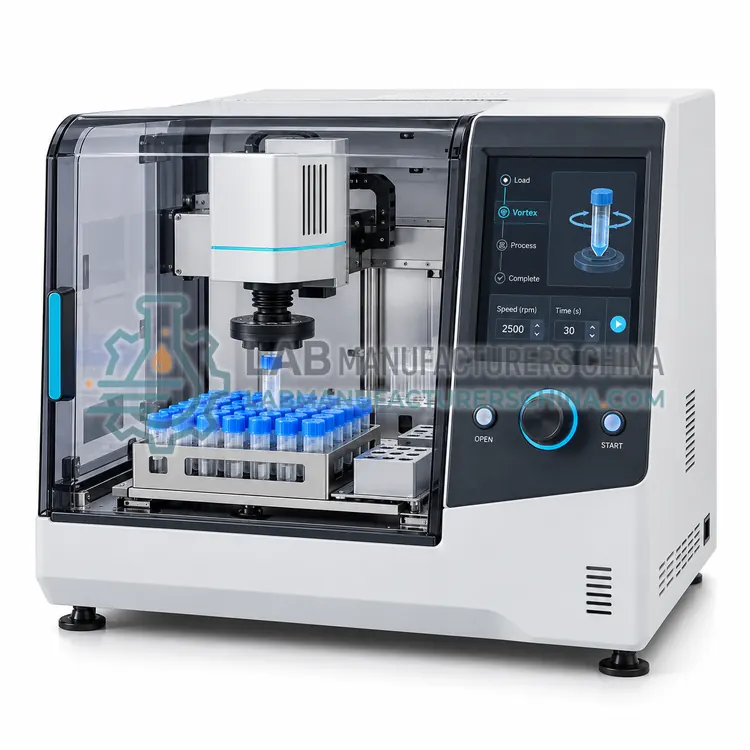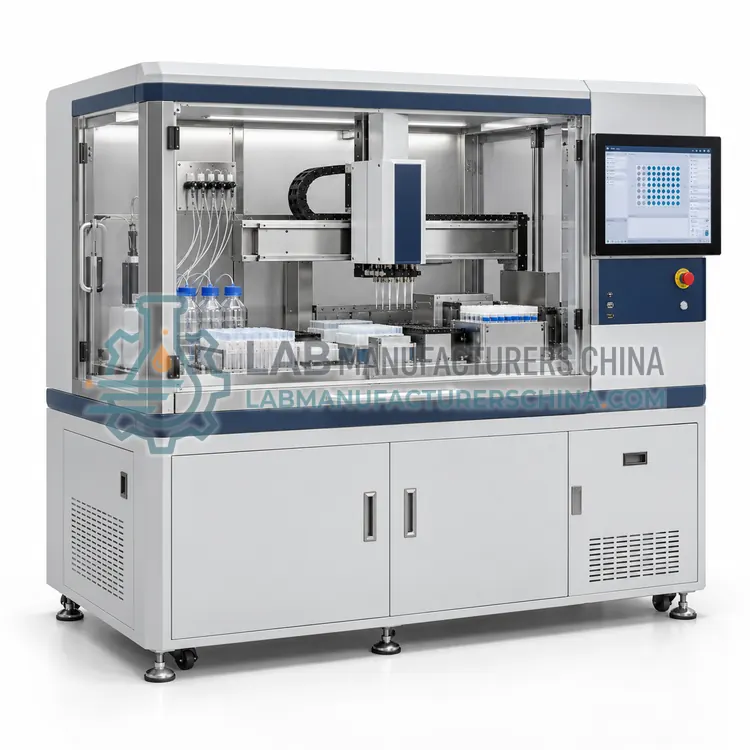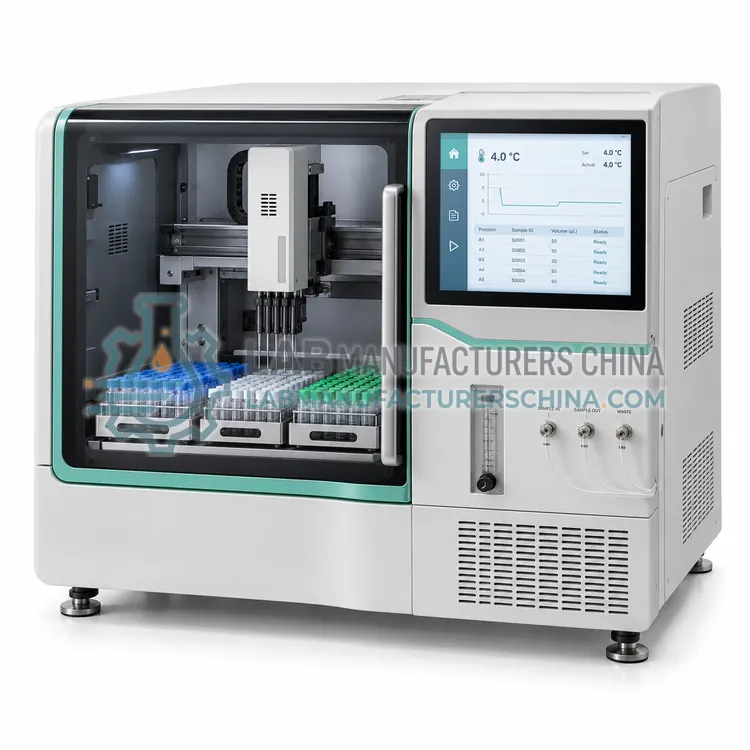
Microplate High-Throughput Sampler
微孔板高通量进样器
- SKU SAL-0002
- Sample Loaders
- CE (to be confirmed)
- IEC 61010-1 compliance (to be confirmed)
- ISO 9001 manufacturing (to be confirmed)
Price on request — FOB / CIF quoted per order
Prices depend on configuration, quantity and destination port.
Key specifications
| Plate formats | 96 and 384-well (ANSI/SLAS) |
|---|---|
| Well bottom types | U, V and flat |
| Sample volume range | Approx. 5–200 µL per well |
| Cycle time per well (excl. acquisition) | Approx. 10–30 s |
| Mixing method | Aspirate-dispense cycles / orbital shake |
| Carry-over | Below 0.1% |
Request a quote Download brochure · to be provided
By Lab Manufacturers China Technical TeamLast reviewed Standards: ISO 20391-1, CLSI H62, IEC 61010-1
What is the Microplate High-Throughput Sampler?
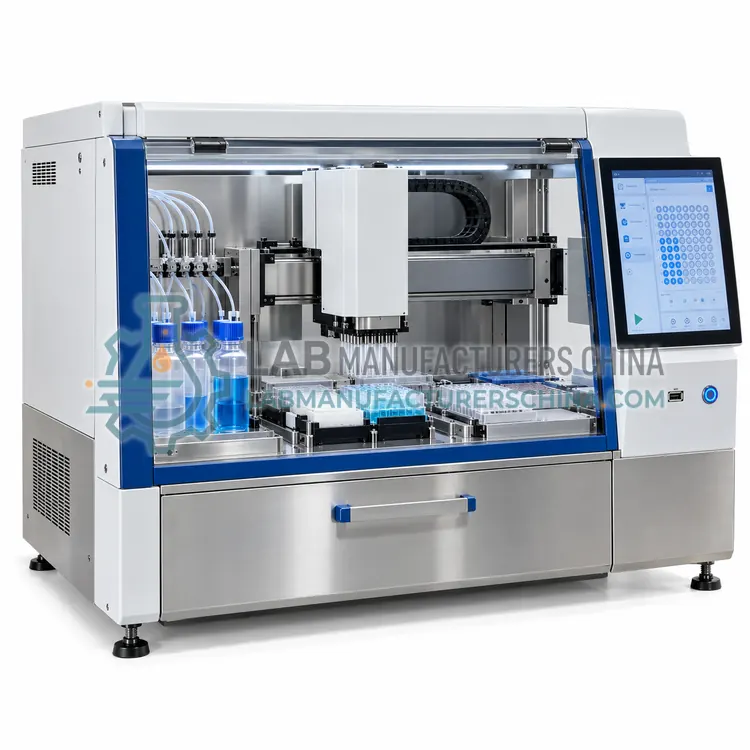
A microplate high-throughput sampler presents 96 or 384-well plates to a cytometer and samples each well in sequence with rapid mixing and wash cycles. It is used for compound screening, antibody discovery and dose-response assays where hundreds to thousands of wells must be read per day.
What is the Microplate High-Throughput Sampler?
A microplate high-throughput sampler presents 96 or 384-well plates to a cytometer and samples each well in sequence with rapid mixing and wash cycles. It is used for compound screening, antibody discovery and dose-response assays where hundreds to thousands of wells must be read per day.
Overview
Microplate samplers aspirate from each well of a plate using a probe on an X-Y-Z stage, with liquid-level detection to handle variable fill volumes. Mixing is performed by repeated aspiration and dispensing or by an orbital shake step, and modes such as sample-saving or high-speed acquisition reduce dead volume and run time. Typical cycle time is 10 to 30 seconds per well, so a 96-well plate can be completed in about 30 to 60 minutes, and a 384-well plate in a few hours. Wash cycles with sheath or dedicated wash buffer limit carry-over, often to below 0.1 percent. The system reads plates in user-defined order and exports one FCS file per well with row and column metadata. Plates must meet ANSI/SLAS footprint dimensions, and U or V-bottom plates are preferred for small volumes of cells.
How does it work?
A sample loader positions a container under or beside the cytometer's sample injection probe using a motorized carousel, rack or X-Y-Z robotic arm. The probe descends into the tube or well, often after a programmed mixing step by vortexing, pipette aspiration or orbital shaking, and aspirates a defined volume with a syringe pump or pneumatic metering system. The sample is delivered to the flow cell, and the probe exterior and interior are rinsed with sheath or wash solution in a wash station to limit carry-over. Liquid-level sensors and pressure monitoring detect empty wells or clogs. Software sequences the run order, synchronizes acquisition with the cytometer, and writes one FCS file per well with its plate position and metadata.
What are the key features?
- Supports 96 and 384-well plates in ANSI/SLAS footprint formats
- Liquid-level sensing handles variable fill volumes across wells
- Rapid mixing by repeated aspiration or orbital shaking before each draw
- Sample-saving mode reduces dead volume for precious samples
- Carry-over typically below 0.1 percent with dedicated wash cycles
- Exports one FCS file per well with plate row and column metadata
What are the technical specifications?
A typical microplate high-throughput sampler configuration offers plate formats of 96 and 384-well (ANSI/SLAS), well bottom types of U, V and flat, sample volume range of Approx. 5–200 µL per well, cycle time per well (excl. acquisition) of Approx. 10–30 s, mixing method of Aspirate-dispense cycles / orbital shake and carry-over of Below 0.1%. Values are indicative of the product class; the exact figures for each configuration are confirmed on the quotation and the calibration documents supplied with the instrument.
Which applications is it used for?
The Microplate High-Throughput Sampler is used in compound and drug screening, antibody and hybridoma screening, dose-response and cytotoxicity assays, multiplex bead immunoassays and CRISPR pooled screen QC. Across the wider Sample Loaders class, laboratories also deploy it for high-throughput drug screening, unattended clinical immunophenotyping runs and CAR-T and cell therapy in-process testing.
Which standards and certifications apply?
Relevant standards and methods include ISO 20391-1, CLSI H62, IEC 61010-1, IEC 61010-2-101, ISAC FCS 3.1 and ANSI SLAS microplate footprint (ANSI/SLAS 1-2004). Certification candidates for this model are CE, IEC 61010-1 compliance and ISO 9001 manufacturing; each is to be confirmed for the specific configuration before shipment, and certificates are supplied only where they have been issued.
Verify the loader is aligned with the cytometer probe and that the probe height and stroke are calibrated for each container type. Validate carry-over by running a high-concentration bead or cell sample followed by blanks, and confirm volume accuracy gravimetrically. Clean the wash station and replace probe tubing according to the manufacturer's schedule, using bleach or dedicated decontamination solution when biohazardous samples are run. Enable audit trail and user access control if data are used in regulated work. Plates should be sealed or covered during long runs to limit evaporation, and samples fixed or kept cold to maintain stability. Periodically check mechanical movement, and keep software and firmware versions under change control.
How do I select the right Microplate High-Throughput Sampler?
Choose a microplate sampler for screening laboratories running tens to hundreds of plates per week, and verify cycle time against your acquisition duration. Tube-based routine work does not need it. In an RFQ specify plate formats, well-bottom types, carry-over target, stacker option, sample volume range and cytometer model.
How does it compare with other Sample Loaders variants?
Select a loader by the container formats, throughput and sample type you handle. Tube carousels suit routine clinical panels with 12 to 40 tubes, while microplate samplers support 96 and 384-well screening. Check carry-over specification, typically below 0.5 percent, and the minimum sample volume and dead volume, which matter for precious samples. Confirm mixing capability, because sedimenting cells need resuspension before each draw. Consider temperature control when samples are labile, and barcode reading for chain-of-custody. Verify mechanical and software compatibility with your cytometer model and whether the loader supports walk-away operation, automatic cleaning and error recovery. Finally review the footprint and whether a biosafety cabinet placement is needed.
Full specifications
| Plate formats | 96 and 384-well (ANSI/SLAS) |
|---|---|
| Well bottom types | U, V and flat |
| Sample volume range | Approx. 5–200 µL per well |
| Cycle time per well (excl. acquisition) | Approx. 10–30 s |
| Mixing method | Aspirate-dispense cycles / orbital shake |
| Carry-over | Below 0.1% |
| Liquid-level sensing | Capacitive or pressure based |
| Positioning repeatability | Within ±0.2 mm |
| Plate capacity | 1 plate (stage) to 20+ plates (stacker) |
| Data output | FCS 3.1, one file per well |
Indicative values for this product class. Final specifications are confirmed on the quotation and in the calibration documents supplied with the instrument.
Applications
- Compound and drug screening
- Antibody and hybridoma screening
- Dose-response and cytotoxicity assays
- Multiplex bead immunoassays
- CRISPR pooled screen QC
Key features
- Supports 96 and 384-well plates in ANSI/SLAS footprint formats
- Liquid-level sensing handles variable fill volumes across wells
- Rapid mixing by repeated aspiration or orbital shaking before each draw
- Sample-saving mode reduces dead volume for precious samples
- Carry-over typically below 0.1 percent with dedicated wash cycles
- Exports one FCS file per well with plate row and column metadata
Frequently asked questions about Microplate High-Throughput Sampler
With 10 to 30 seconds of handling and about 10 to 60 seconds of acquisition per well, a 96-well plate usually takes roughly 30 to 90 minutes. Shorter acquisition and sample-saving modes can bring time down for high-throughput screening.
U-bottom or V-bottom 96-well plates are preferred because cells settle in a small area and can be fully aspirated with low dead volume. Flat-bottom plates work for bead assays but leave larger residual volumes, reducing recovery.
Yes, if plates are sealed or covered, samples are fixed or kept cool, and the system has sufficient sheath and waste capacity. Stackers extend capacity to many plates, and software can pause and report errors such as clogs.
It is an automated device that positions tubes or plates under the cytometer's sample probe, mixes and injects each sample, and washes the probe between samples. It lets a cytometer run many samples unattended and with consistent timing and volumes.
Carry-over is limited by rinsing the probe inside and out with sheath or wash solution between samples, using dedicated wash stations and optional bleach cycles. Manufacturers typically specify below 0.5 percent, which users should verify with a high-concentration sample followed by blanks.
Some models accept both through interchangeable racks or adapters, but many are designed for a single format. Tube carousels suit 12 to 40 tubes, while plate samplers handle 96 or 384-well plates, so choose based on your dominant workflow.