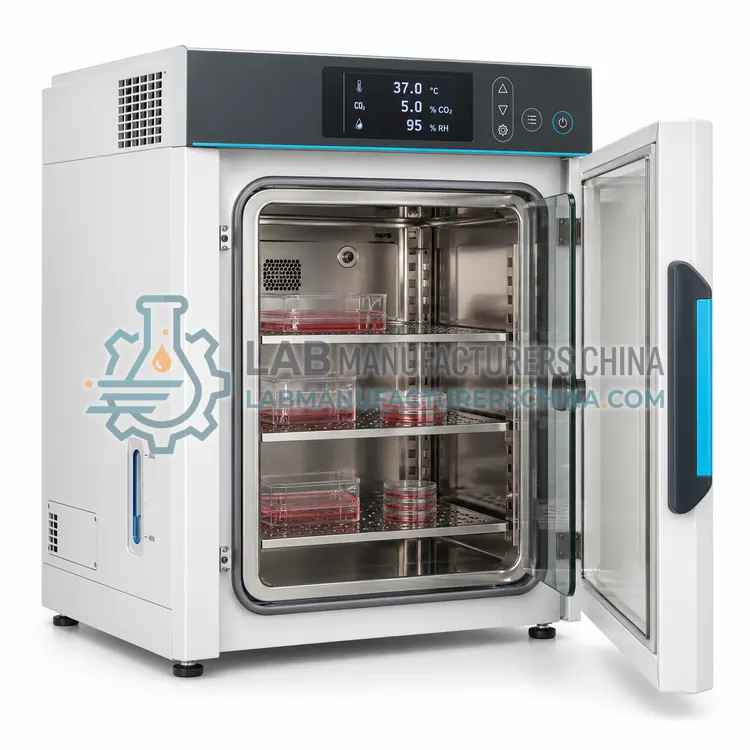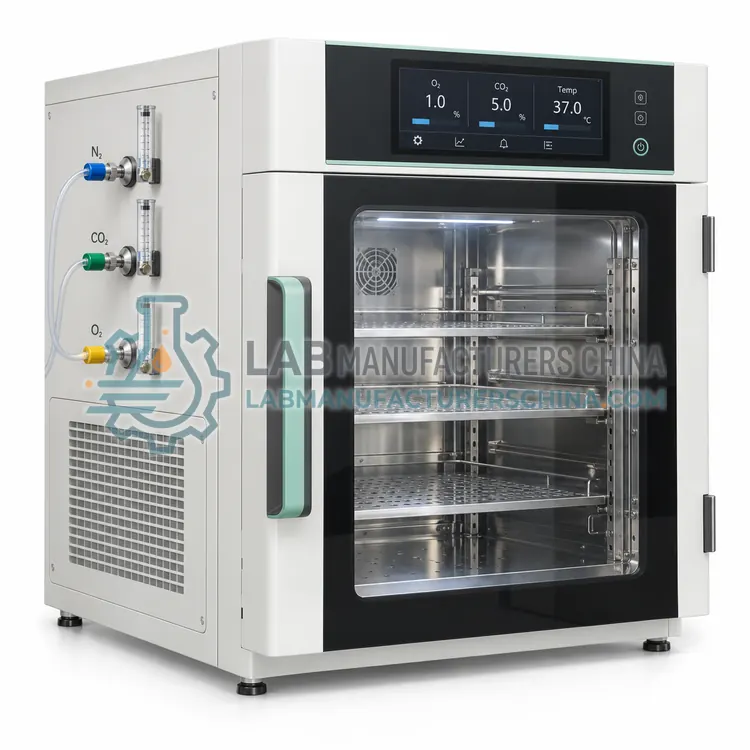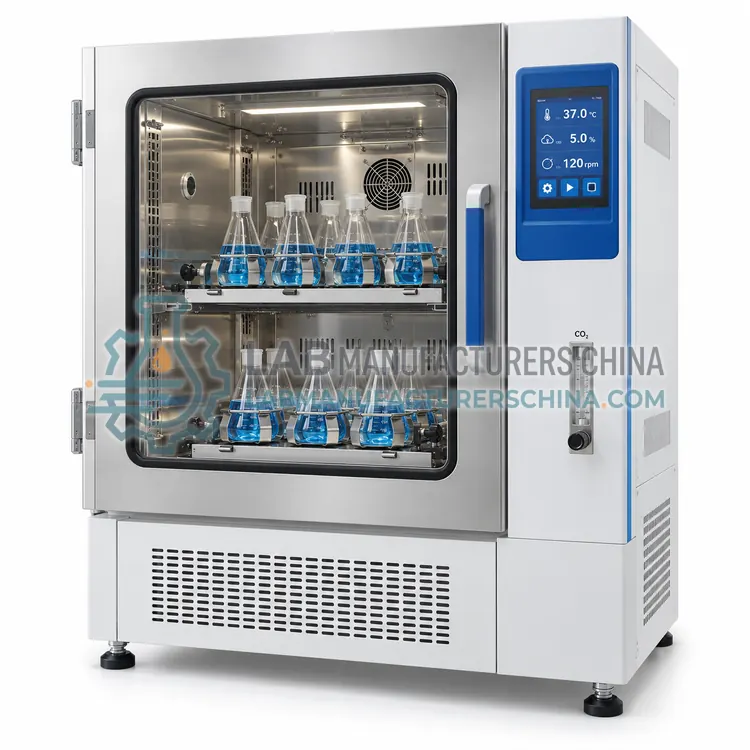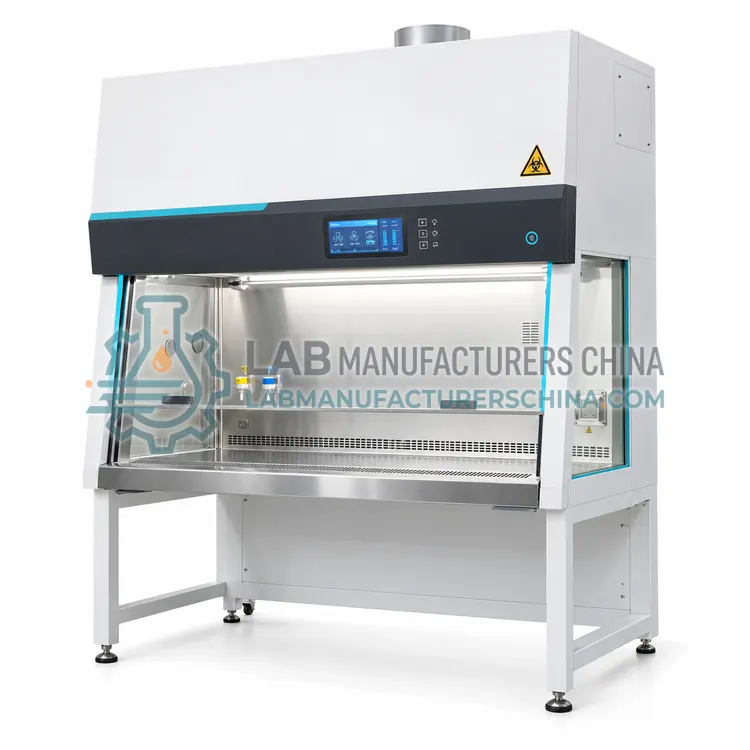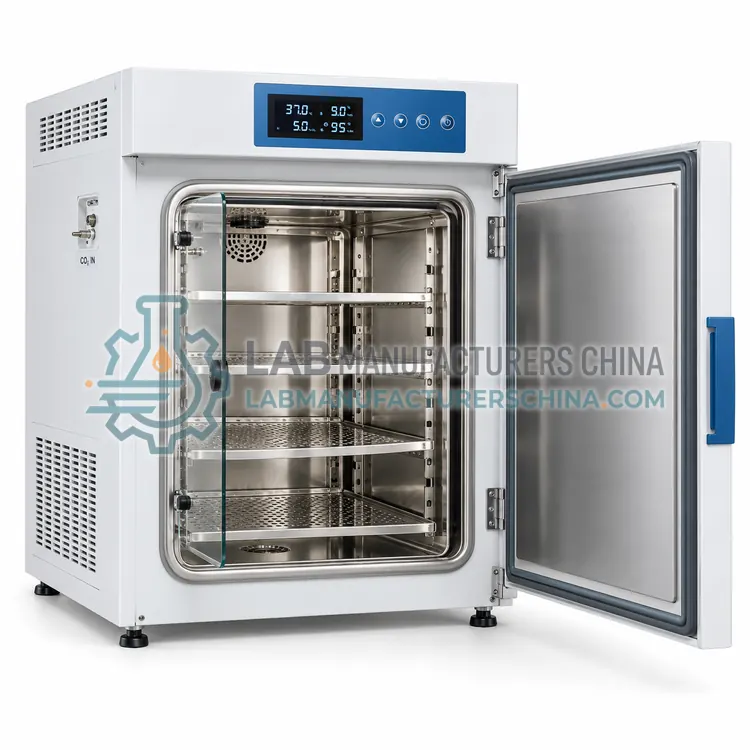
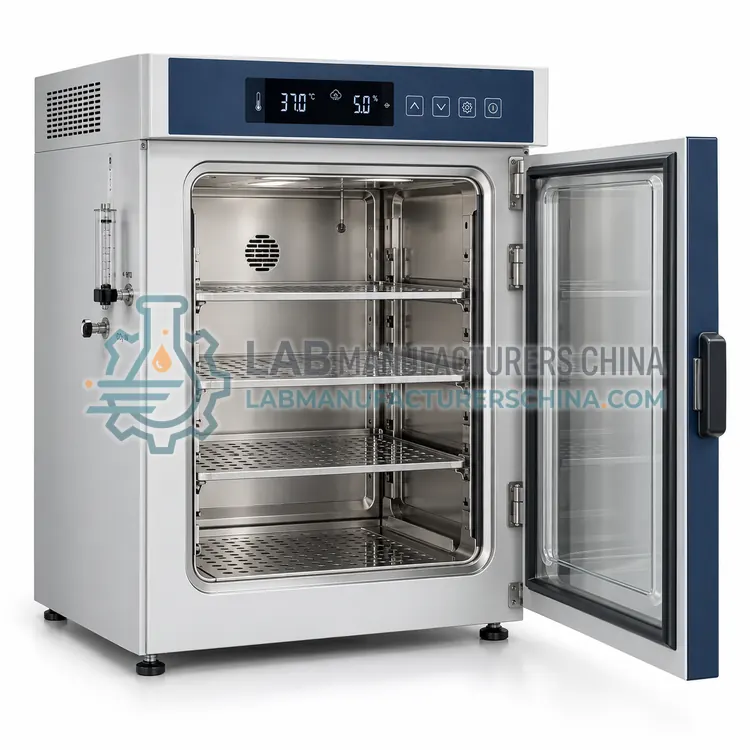
CO2 Shaking Incubator
振荡式 CO2 培养箱
- SKU CON-0005
- CO2 Incubators
- CE (to be confirmed)
- ISO 9001 manufacturing (to be confirmed)
- IEC 61010-1 safety (to be confirmed)
Price on request — FOB / CIF quoted per order
Prices depend on configuration, quantity and destination port.
Key specifications
| Shaking speed | 50–300 rpm, within ±1 rpm |
|---|---|
| Orbit diameter | 10–50 mm (model dependent) |
| Temperature range | ambient +5 to 60 °C, set at 37 °C |
| CO2 range | 0–20%, controlled at 5% |
| Vessel capacity | up to 4 x 2 L flasks or 8 microplate positions |
| Working volume | 10 mL–2 L per vessel |
Request a quote Download brochure · to be provided
By Lab Manufacturers China Technical TeamLast reviewed Standards: IEC 61010-1, IEC 61010-2-010, IEC 61326-1
What is the CO2 Shaking Incubator?
A CO2 shaking incubator combines orbital agitation with temperature and carbon dioxide control, so suspension cells and microcarrier cultures are mixed continuously for uniform nutrient and oxygen exposure at 37 °C and pH 7.4.
What is the CO2 Shaking Incubator?
A CO2 shaking incubator combines orbital agitation with temperature and carbon dioxide control, so suspension cells and microcarrier cultures are mixed continuously for uniform nutrient and oxygen exposure at 37 °C and pH 7.4.
Overview
The chamber holds flasks, spinner vessels or deep-well plates on an orbital platform running at 50–300 rpm with an amplitude of 10–50 mm, while temperature is held at 37 °C and CO2 at 5%. Continuous motion keeps cells suspended, prevents local depletion of nutrients and oxygen, and reduces attachment of cells to vessel walls. Applications include suspension cell lines, hybridoma and insect cell culture, microcarrier-based expansion of adherent cells and bacterial or yeast culture at controlled pH through CO2 or bicarbonate buffering. Clamps or trays secure vessels so that they cannot shift at higher speeds, and the drive system is designed to minimise vibration and heat. Because agitation creates shear, speed must be matched to cell sensitivity, and microcarrier cultures need slower ramping during attachment.
How does it work?
Cells in culture cannot regulate their own environment, so the incubator supplies what the medium cannot. Temperature is held at 37 °C by a water jacket, an air jacket or direct heating elements around the chamber, with a PID controller and an over-temperature cut-out. Carbon dioxide is measured by an infrared or thermal conductivity sensor and injected from a supply cylinder to maintain 5% CO2, which keeps bicarbonate-buffered medium at physiological pH. A water pan or humidity injection keeps relative humidity above 90%, preventing evaporation that would concentrate salts and osmolytes and change the pH set point. Copper-lined or antimicrobial interior panels and HEPA filters reduce contamination risk, and an inner glass door limits gas exchange when the outer door is opened. Some models add nitrogen to control oxygen for hypoxic culture.
What are the key features?
- Orbital shaking at 50–300 rpm with 10–50 mm amplitude
- Temperature control at 37 °C and CO2 control at 5%
- Clamps and trays for flasks, spinner vessels and deep-well plates
- Low-vibration direct drive to limit cell shear damage
- Programmable speed ramps for microcarrier attachment
- Inner glass door and HEPA filtration options
What are the technical specifications?
A typical co2 shaking incubator configuration offers shaking speed of 50–300 rpm, within ±1 rpm, orbit diameter of 10–50 mm (model dependent), temperature range of ambient +5 to 60 °C, set at 37 °C, CO2 range of 0–20%, controlled at 5%, vessel capacity of up to 4 x 2 L flasks or 8 microplate positions and working volume of 10 mL–2 L per vessel. Values are indicative of the product class; the exact figures for each configuration are confirmed on the quotation and the calibration documents supplied with the instrument.
Which applications is it used for?
The CO2 Shaking Incubator is used in suspension cell line expansion, hybridoma and insect cell culture, microcarrier-based adherent cell culture and bacterial and yeast culture with CO2 buffering. Across the wider CO2 Incubators class, laboratories also deploy it for routine mammalian cell line culture, stem cell and primary cell maintenance and vaccine and recombinant protein production.
Which standards and certifications apply?
Relevant standards and methods include IEC 61010-1, IEC 61010-2-010, IEC 61326-1, EN 12469, ISO 14644-1 and USP <1046>. Certification candidates for this model are CE, ISO 9001 manufacturing and IEC 61010-1 safety; each is to be confirmed for the specific configuration before shipment, and certificates are supplied only where they have been issued.
Install the incubator on a level surface away from direct sunlight, heat sources and draughts, leaving clearance for the gas connection and ventilation. Fill the humidity pan with sterile distilled water and change it weekly, since stagnant water is a common contamination source; some models use humidity injection that avoids standing water. Verify temperature and CO2 accuracy at installation and at least every six months with a calibrated external instrument, and record recovery time after door opening. Do not overload shelves, because air circulation is needed for uniformity. Handle spills immediately, use only compatible disinfectants, and follow the manufacturer's decontamination procedure before servicing. Keep a log of cleaning, calibration and decontamination events so that culture problems can be traced.
How do I select the right CO2 Shaking Incubator?
Select a CO2 shaking incubator for suspension culture, microcarrier expansion or any process needing continuous gentle mixing at controlled pH. Specify speed and amplitude range, vessel capacity, ramp programming, CO2 control and the containment features available.
How does it compare with other CO2 Incubators variants?
Choose the chamber type first. Water-jacketed incubators hold temperature most stably through power interruptions and suit laboratories with frequent door openings, while air-jacketed and direct-heat models warm up faster, are lighter and need less maintenance. Then consider contamination control: copper interior surfaces, HEPA filtration of the air circuit and high-temperature or vaporised hydrogen peroxide decontamination cycles reduce losses in busy laboratories. Check CO2 and temperature accuracy and uniformity, recovery time after door opening, humidity control, and whether oxygen control is needed for stem cell or hypoxia work. Review alarm functions, data logging, access control and remote monitoring if the incubator holds irreplaceable cultures or is part of a regulated process. Confirm stackability, shelf adjustability and available chamber volumes before ordering.
Full specifications
| Shaking speed | 50–300 rpm, within ±1 rpm |
|---|---|
| Orbit diameter | 10–50 mm (model dependent) |
| Temperature range | ambient +5 to 60 °C, set at 37 °C |
| CO2 range | 0–20%, controlled at 5% |
| Vessel capacity | up to 4 x 2 L flasks or 8 microplate positions |
| Working volume | 10 mL–2 L per vessel |
| Humidity | above 80% relative humidity with humidity tray |
| Drive | Direct drive, low vibration |
| Programmable ramps | Speed and time profiles for attachment |
| Dimensions (W x D x H) | approx. 700 x 700 x 800 mm |
Indicative values for this product class. Final specifications are confirmed on the quotation and in the calibration documents supplied with the instrument.
Applications
- Suspension cell line expansion
- Hybridoma and insect cell culture
- Microcarrier-based adherent cell culture
- Bacterial and yeast culture with CO2 buffering
Key features
- Orbital shaking at 50–300 rpm with 10–50 mm amplitude
- Temperature control at 37 °C and CO2 control at 5%
- Clamps and trays for flasks, spinner vessels and deep-well plates
- Low-vibration direct drive to limit cell shear damage
- Programmable speed ramps for microcarrier attachment
- Inner glass door and HEPA filtration options
Frequently asked questions about CO2 Shaking Incubator
Suspension lines usually tolerate 100–150 rpm, while shear-sensitive cells need 50–80 rpm and microcarrier cultures are started slower and ramped up. Speed should be the lowest that keeps cells suspended and prevents wall attachment.
Yes. Microcarriers provide a large surface area in a small volume, and the shaking keeps them suspended. Attachment needs a slow intermittent agitation phase, then speed is increased to maintain uniform suspension without excessive shear.
Yes, and that matters if the cultures contain infectious or genetically modified material. Use vented caps or sealed vessels, and where containment is required add an exhaust filter or choose a model with an integrated aerosol management feature.
Water-jacketed chambers hold temperature more stably during power cuts and heavy door use, but are heavier and need more maintenance. Air-jacketed and direct-heat units warm up faster, recover quickly and are easier to move, which suits most routine laboratories.
Without high humidity, medium evaporates and concentrates salts and proteins, raising osmolarity and shifting pH. This changes growth rates and can make results from long experiments inconsistent, especially in small-volume or multi-well formats.
Infrared sensors typically hold CO2 within ±0.1–0.3% of the set point and are unaffected by humidity, while thermal conductivity sensors are cheaper but sensitive to moisture. Accuracy should be verified with a calibrated analyser at least twice a year.
Related models