Automatic Fusion Machine for XRF Beads
XRF 熔片自动熔样机
- SKU CHE-0003
- Chemical Sample Preparation
- CE (to be confirmed)
- ISO 9001 manufacturing (to be confirmed)
Price on request — FOB / CIF quoted per order
Prices depend on configuration, quantity and destination port.
Key specifications
| Maximum temperature | 1100–1200 °C |
|---|---|
| Temperature control | ±5 °C |
| Number of positions | 1, 2, 4 or 6 |
| Sample mass | 0.3–1.5 g |
| Flux mass | 4–10 g (Li2B4O7 / LiBO2) |
| Bead diameter | 32 or 40 mm |
Request a quote Download brochure · to be provided
By Lab Manufacturers China Technical TeamLast reviewed Standards: ISO 18283, ISO 12743, ASTM D2013
What is the Automatic Fusion Machine for XRF Beads?
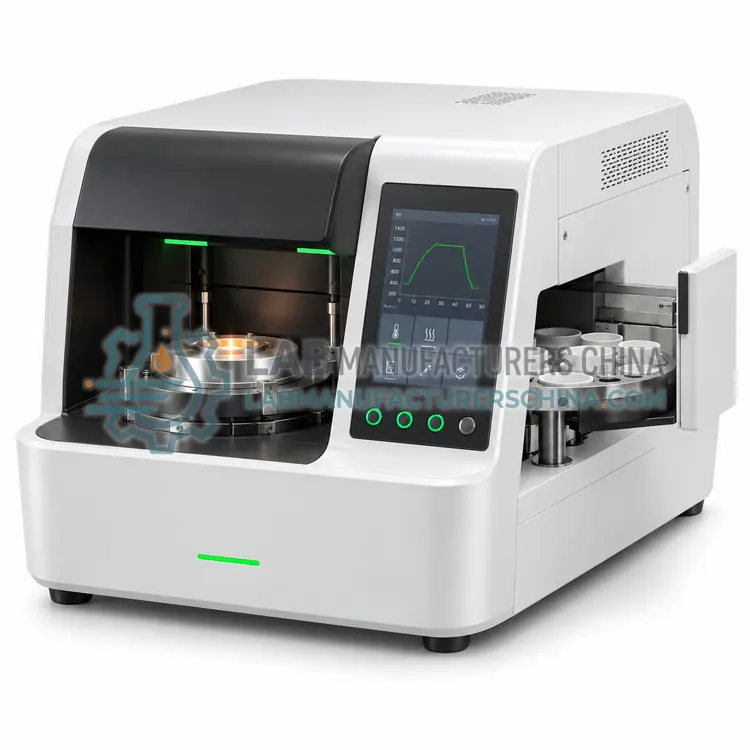
An automatic fusion machine melts an oxidized sample with lithium borate flux in a platinum crucible at 1000–1100 °C and casts a homogeneous glass bead. It is used for accurate XRF analysis of ores, cement, slag, ceramics and refractories.
What is the Automatic Fusion Machine for XRF Beads?
An automatic fusion machine melts an oxidized sample with lithium borate flux in a platinum crucible at 1000–1100 °C and casts a homogeneous glass bead. It is used for accurate XRF analysis of ores, cement, slag, ceramics and refractories.
Overview
The instrument combines a gas or electric induction heating unit, a crucible-and-mold rocking or rotating mechanism, and a cooling station with compressed air. A typical run weighs 0.5–1 g of sample and 5–10 g of flux, with an oxidizer such as lithium nitrate for sulfide or metal content and a non-wetting agent such as lithium bromide. The melt is agitated for 5–10 minutes to ensure complete dissolution and bubble release, then cast into a platinum-gold mold to produce a flat 32 or 40 mm bead. Electric fusion machines offer temperature control to ±5 °C, and several positions allow 1 to 6 samples at once, for output around 6–20 beads per hour. Crucibles of 95% Pt/5% Au resist wetting, and need regular weighing and polishing.
How does it work?
Preparation reduces a bulk sample to a small, homogeneous portion without changing composition. Size reduction proceeds in stages: jaw or roll crushers break lumps to a few millimeters by compressive force, and pulverizers such as ring-and-puck vibratory mills grind to below 75 µm by impact, shear and attrition in hardened steel, tungsten carbide or agate vessels. Pressing compacts powder with or without binder at 20–40 tons to create flat pellets for XRF. Fusion dissolves oxide samples in molten lithium borate flux at 1000–1100 °C to produce glass beads free of particle effects. Microwave digestion heats samples in acid inside sealed vessels at elevated pressure to convert solids to solutions, using dielectric heating from 2.45 GHz microwaves.
What are the key features?
- Electric or gas heating to 1100 °C with temperature control to ±5 °C
- Crucible rocking or rotating mechanism for bubble-free homogeneous melts
- Platinum-gold crucibles and molds giving flat bead surfaces without polishing
- Programmable stages for pre-oxidation, fusion, casting and cooling
- One to six fusion positions for production throughput
- Compressed-air cooling station with bead release verification
What are the technical specifications?
A typical automatic fusion machine for xrf beads configuration offers maximum temperature of 1100–1200 °C, temperature control of ±5 °C, number of positions of 1, 2, 4 or 6, sample mass of 0.3–1.5 g, flux mass of 4–10 g (Li2B4O7 / LiBO2) and bead diameter of 32 or 40 mm. Values are indicative of the product class; the exact figures for each configuration are confirmed on the quotation and the calibration documents supplied with the instrument.
Which applications is it used for?
The Automatic Fusion Machine for XRF Beads is used in cement raw meal and clinker beads, iron ore, bauxite and mineral assay, slag and refractory analysis, ceramic and glass raw materials and calibration-standard preparation for XRF. Across the wider Chemical Sample Preparation class, laboratories also deploy it for ore and mineral sample preparation for XRF and ICP, coal and coke sample reduction and cement and slag pellet and bead preparation.
Which standards and certifications apply?
Relevant standards and methods include ISO 18283, ISO 12743, ASTM D2013, ASTM E1842, ISO 14869-2, EPA 3051A, GB/T 474 and IEC 61010-1. Certification candidates for this model are CE and ISO 9001 manufacturing; each is to be confirmed for the specific configuration before shipment, and certificates are supplied only where they have been issued.
Sample preparation often dominates total uncertainty, so control it like any analytical step. Clean crushers, mills and dies between samples with a cleaning sand or compressed air, and run a pre-contamination blank when trace elements matter. Choose grinding vessel material by the elements to be analyzed, since steel adds Fe, Cr and Mn while tungsten carbide adds W and Co. Install dust extraction and hearing protection around crushers and mills. Platinum-gold crucibles for fusion must be weighed, polished and protected from reducing samples containing sulfides or metals. Microwave vessels require torque-controlled closure, venting checks and acid-handling procedures. Record weights, times and temperatures for traceability under ISO/IEC 17025.
How do I select the right Automatic Fusion Machine for XRF Beads?
Select this variant when XRF accuracy for major oxides outweighs trace sensitivity, such as cement and ore analysis. Pressed pellets are faster for trace elements. In an RFQ, specify electric or gas heating, number of positions, bead size, crucible alloy, sample types including sulfides, and the flux and oxidizer supply arrangement.
How does it compare with other Chemical Sample Preparation variants?
Match the preparation route to the analytical technique and sample type. XRF of ores and cement needs pulverizing to below 75 µm followed by pressing, or fusion for best accuracy. ICP and AAS need digestion or fusion to solutions, with microwave digestion suited to organic, geological and metallurgical samples in small batches. Hard or abrasive samples require tungsten carbide or zirconia grinding components, while trace-metal work needs agate or zirconia to avoid contamination. Check sample volume per batch, throughput, cross-contamination control, noise and dust extraction. Consider whether automated pressing or fusion with robotic handling is justified by sample count. Confirm that the prepared sample meets the method's particle size, homogeneity and mass requirements.
Full specifications
| Maximum temperature | 1100–1200 °C |
|---|---|
| Temperature control | ±5 °C |
| Number of positions | 1, 2, 4 or 6 |
| Sample mass | 0.3–1.5 g |
| Flux mass | 4–10 g (Li2B4O7 / LiBO2) |
| Bead diameter | 32 or 40 mm |
| Fusion time | 5–15 min per cycle |
| Crucible material | Pt 95% / Au 5% |
| Heating method | Electric resistance or gas burner |
| Power supply | 220 V, single-phase, 50 Hz (3–6 kW) |
Indicative values for this product class. Final specifications are confirmed on the quotation and in the calibration documents supplied with the instrument.
Applications
- Cement raw meal and clinker beads
- Iron ore, bauxite and mineral assay
- Slag and refractory analysis
- Ceramic and glass raw materials
- Calibration-standard preparation for XRF
Key features
- Electric or gas heating to 1100 °C with temperature control to ±5 °C
- Crucible rocking or rotating mechanism for bubble-free homogeneous melts
- Platinum-gold crucibles and molds giving flat bead surfaces without polishing
- Programmable stages for pre-oxidation, fusion, casting and cooling
- One to six fusion positions for production throughput
- Compressed-air cooling station with bead release verification
Frequently asked questions about Automatic Fusion Machine for XRF Beads
Fusion results are calculated from the dilution ratio, so sample and flux weights must be exact, typically to ±0.1 mg. Loss on ignition is determined separately and used to correct the sample mass on an ignited basis.
Only after pre-oxidation. Sulfides and metals alloy with platinum and ruin crucibles, so samples are first roasted or treated with oxidizers such as lithium nitrate or sodium nitrate before fusion. Consult the method for specific ratios.
Crucibles and molds should be inspected before use, polished periodically for flat beads, and weighed to detect mass loss. With careful practice they last thousands of fusions. Avoid reducing conditions and contact with carbon or metals.
Pressed powder pellets are commonly prepared from material ground to below 75 µm, and finer if mineralogical effects are significant. Fusion removes particle-size dependence, but samples still need grinding to about 100 µm or finer for complete dissolution in the flux.
Fusion beads give better accuracy for major oxides because they eliminate particle size and mineralogical effects, at the cost of dilution and reduced trace sensitivity. Pressed pellets are faster and cheaper, and better for trace elements.
Clean equipment between samples with pre-grinding a small portion of the next sample or cleaning sand, brush and compressed air. Use dedicated vessels for high- and low-concentration samples, and check cleanliness by running a blank.