Laboratory Jaw Crusher
实验室颚式破碎机
- SKU CHE-0001
- Chemical Sample Preparation
- CE (to be confirmed)
- ISO 9001 manufacturing (to be confirmed)
Price on request — FOB / CIF quoted per order
Prices depend on configuration, quantity and destination port.
Key specifications
| Feed opening | 100 × 60 mm to 250 × 150 mm |
|---|---|
| Maximum feed size | ≤ 100 mm |
| Discharge size | 1–10 mm adjustable |
| Throughput | 30–500 kg/h |
| Jaw plate material | Manganese steel or tungsten carbide |
| Motor power | 1.5–5.5 kW |
Request a quote Download brochure · to be provided
By Lab Manufacturers China Technical TeamLast reviewed Standards: ISO 18283, ISO 12743, ASTM D2013
What is the Laboratory Jaw Crusher?
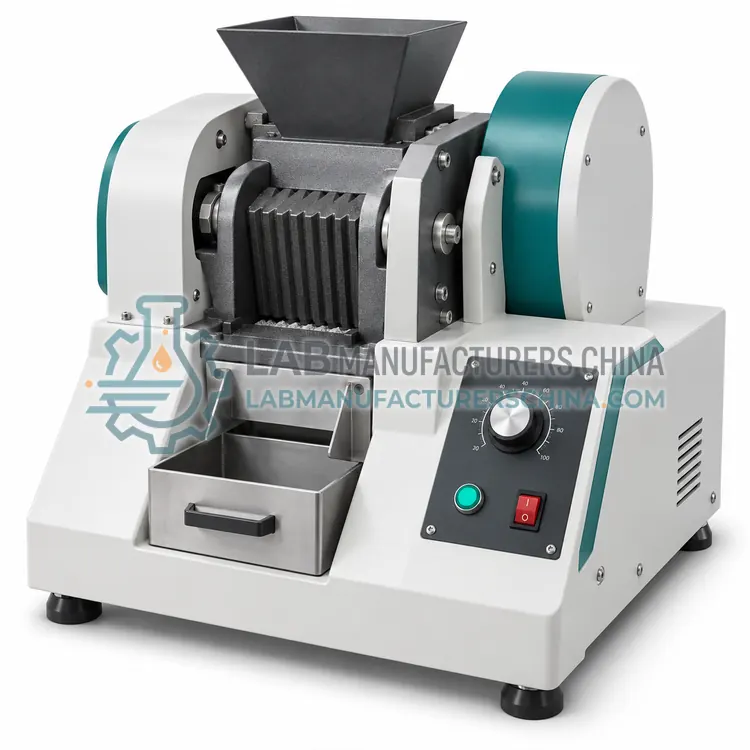
A laboratory jaw crusher reduces hard rock, ore, slag and coke lumps to a few millimeters by compressive force between a fixed and a swinging jaw plate. It is the first stage of sample preparation before splitting and pulverizing.
What is the Laboratory Jaw Crusher?
A laboratory jaw crusher reduces hard rock, ore, slag and coke lumps to a few millimeters by compressive force between a fixed and a swinging jaw plate. It is the first stage of sample preparation before splitting and pulverizing.
Overview
A motor-driven eccentric shaft moves the swing jaw toward the fixed jaw, crushing feed material in a V-shaped chamber until it is small enough to fall through the adjustable discharge gap. Jaw plates are made of manganese steel or tungsten carbide for abrasive samples, and models with throats from 100 × 60 mm to 250 × 150 mm accept feed up to about 100 mm. Output size is set by the discharge gap, commonly 1–10 mm, and throughput ranges from 30 to 500 kg/h. Sealed dust hoods and extraction connections limit exposure to silica dust. Plate replacement and gap setting are the main maintenance tasks. Because jaw plates wear and contaminate samples with Fe, Mn or Cr, material choice should reflect the elements being analyzed.
How does it work?
Preparation reduces a bulk sample to a small, homogeneous portion without changing composition. Size reduction proceeds in stages: jaw or roll crushers break lumps to a few millimeters by compressive force, and pulverizers such as ring-and-puck vibratory mills grind to below 75 µm by impact, shear and attrition in hardened steel, tungsten carbide or agate vessels. Pressing compacts powder with or without binder at 20–40 tons to create flat pellets for XRF. Fusion dissolves oxide samples in molten lithium borate flux at 1000–1100 °C to produce glass beads free of particle effects. Microwave digestion heats samples in acid inside sealed vessels at elevated pressure to convert solids to solutions, using dielectric heating from 2.45 GHz microwaves.
What are the key features?
- Manganese steel or tungsten carbide jaw plates for abrasive and hard samples
- Adjustable discharge gap from about 1 to 10 mm with lockable setting
- Dust hood with extraction port to limit silica exposure
- Safety interlocks on hopper and feed cover
- Feed throat sizes from 100 × 60 mm up to 250 × 150 mm
- Easily removable plates and wear parts for quick cleaning and replacement
What are the technical specifications?
A typical laboratory jaw crusher configuration offers feed opening of 100 × 60 mm to 250 × 150 mm, maximum feed size of ≤ 100 mm, discharge size of 1–10 mm adjustable, throughput of 30–500 kg/h, jaw plate material of Manganese steel or tungsten carbide and motor power of 1.5–5.5 kW. Values are indicative of the product class; the exact figures for each configuration are confirmed on the quotation and the calibration documents supplied with the instrument.
Which applications is it used for?
The Laboratory Jaw Crusher is used in primary crushing of ore and rock samples, slag and ferroalloy sample reduction, coke and coal lump reduction, cement clinker and refractory prep and geological exploration samples. Across the wider Chemical Sample Preparation class, laboratories also deploy it for ore and mineral sample preparation for XRF and ICP, coal and coke sample reduction and cement and slag pellet and bead preparation.
Which standards and certifications apply?
Relevant standards and methods include ISO 18283, ISO 12743, ASTM D2013, ASTM E1842, ISO 14869-2, EPA 3051A, GB/T 474 and IEC 61010-1. Certification candidates for this model are CE and ISO 9001 manufacturing; each is to be confirmed for the specific configuration before shipment, and certificates are supplied only where they have been issued.
Sample preparation often dominates total uncertainty, so control it like any analytical step. Clean crushers, mills and dies between samples with a cleaning sand or compressed air, and run a pre-contamination blank when trace elements matter. Choose grinding vessel material by the elements to be analyzed, since steel adds Fe, Cr and Mn while tungsten carbide adds W and Co. Install dust extraction and hearing protection around crushers and mills. Platinum-gold crucibles for fusion must be weighed, polished and protected from reducing samples containing sulfides or metals. Microwave vessels require torque-controlled closure, venting checks and acid-handling procedures. Record weights, times and temperatures for traceability under ISO/IEC 17025.
How do I select the right Laboratory Jaw Crusher?
Select this variant as the first stage when lumps exceed 10 mm or samples are hard, such as ore, slag and clinker. Use a roll crusher for brittle or fragile materials to limit fines. In an RFQ, specify maximum feed size, target output size, throughput, jaw plate material and dust extraction needs.
How does it compare with other Chemical Sample Preparation variants?
Match the preparation route to the analytical technique and sample type. XRF of ores and cement needs pulverizing to below 75 µm followed by pressing, or fusion for best accuracy. ICP and AAS need digestion or fusion to solutions, with microwave digestion suited to organic, geological and metallurgical samples in small batches. Hard or abrasive samples require tungsten carbide or zirconia grinding components, while trace-metal work needs agate or zirconia to avoid contamination. Check sample volume per batch, throughput, cross-contamination control, noise and dust extraction. Consider whether automated pressing or fusion with robotic handling is justified by sample count. Confirm that the prepared sample meets the method's particle size, homogeneity and mass requirements.
Full specifications
| Feed opening | 100 × 60 mm to 250 × 150 mm |
|---|---|
| Maximum feed size | ≤ 100 mm |
| Discharge size | 1–10 mm adjustable |
| Throughput | 30–500 kg/h |
| Jaw plate material | Manganese steel or tungsten carbide |
| Motor power | 1.5–5.5 kW |
| Sample hardness limit | Up to 320 MPa compressive strength |
| Noise level | ≤ 85 dB(A) |
| Dimensions (typical) | 600 × 450 × 700 mm |
| Power supply | 380 V, 3-phase, 50 Hz |
Indicative values for this product class. Final specifications are confirmed on the quotation and in the calibration documents supplied with the instrument.
Applications
- Primary crushing of ore and rock samples
- Slag and ferroalloy sample reduction
- Coke and coal lump reduction
- Cement clinker and refractory prep
- Geological exploration samples
Key features
- Manganese steel or tungsten carbide jaw plates for abrasive and hard samples
- Adjustable discharge gap from about 1 to 10 mm with lockable setting
- Dust hood with extraction port to limit silica exposure
- Safety interlocks on hopper and feed cover
- Feed throat sizes from 100 × 60 mm up to 250 × 150 mm
- Easily removable plates and wear parts for quick cleaning and replacement
Frequently asked questions about Laboratory Jaw Crusher
Most laboratory jaw crushers reduce feed to 1–10 mm depending on the discharge gap, and some reach below 1 mm in a single pass for brittle samples. A secondary mill or pulverizer is still needed for analytical fineness.
Manganese steel is durable and economical but adds iron, manganese and chromium. Tungsten carbide resists abrasion and is used for very hard samples but adds tungsten and cobalt. Choose a material whose elements are not analytes.
Use an enclosed hood, a connection to a laboratory extraction or dust collector with HEPA filtration, and wet cleaning of the work area. Crushing silica-bearing rock creates respirable crystalline silica, so exposure limits apply.
Pressed powder pellets are commonly prepared from material ground to below 75 µm, and finer if mineralogical effects are significant. Fusion removes particle-size dependence, but samples still need grinding to about 100 µm or finer for complete dissolution in the flux.
Fusion beads give better accuracy for major oxides because they eliminate particle size and mineralogical effects, at the cost of dilution and reduced trace sensitivity. Pressed pellets are faster and cheaper, and better for trace elements.
Clean equipment between samples with pre-grinding a small portion of the next sample or cleaning sand, brush and compressed air. Use dedicated vessels for high- and low-concentration samples, and check cleanliness by running a blank.