Fluorescence-Activated Cell Sorter
荧光激活细胞分选仪
- SKU CES-0002
- Cell Separation
- CE (to be confirmed)
- ISO 9001 manufacturing (to be confirmed)
- IEC 61010-1 safety (to be confirmed)
- IEC 60825-1 laser safety (to be confirmed)
Price on request — FOB / CIF quoted per order
Prices depend on configuration, quantity and destination port.
Key specifications
| Lasers | 2–5 lines, typically 405, 488, 561 and 640 nm |
|---|---|
| Fluorescence detectors | up to 20 |
| Sort rate | 5,000–30,000 events per second |
| Purity | 98–99.9% (population dependent) |
| Recovery | 70–90% (typical) |
| Collection formats | Tubes, plates and single-cell deposition |
Request a quote Download brochure · to be provided
By Lab Manufacturers China Technical TeamLast reviewed Standards: ISO 20387, USP <1046>, IEC 61010-1
What is the Fluorescence-Activated Cell Sorter?
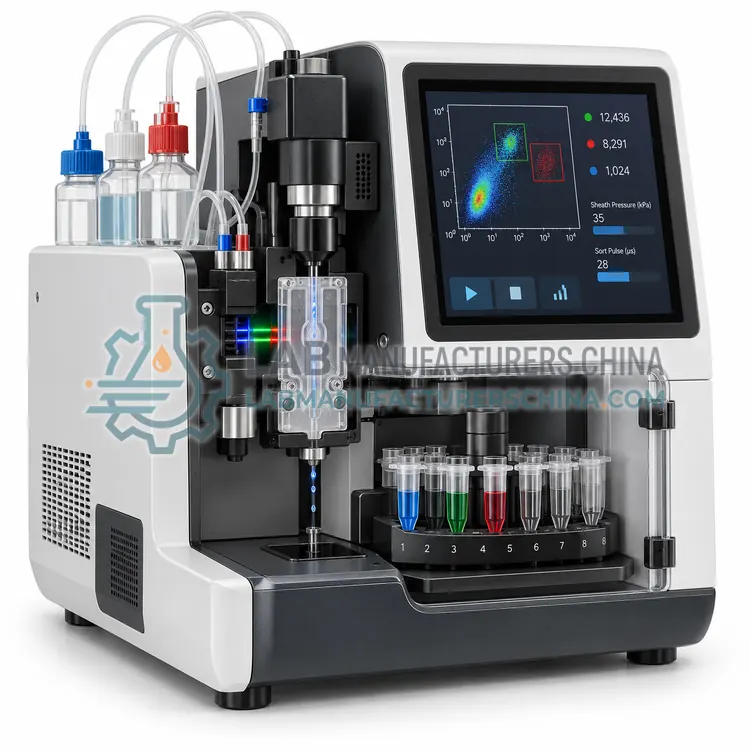
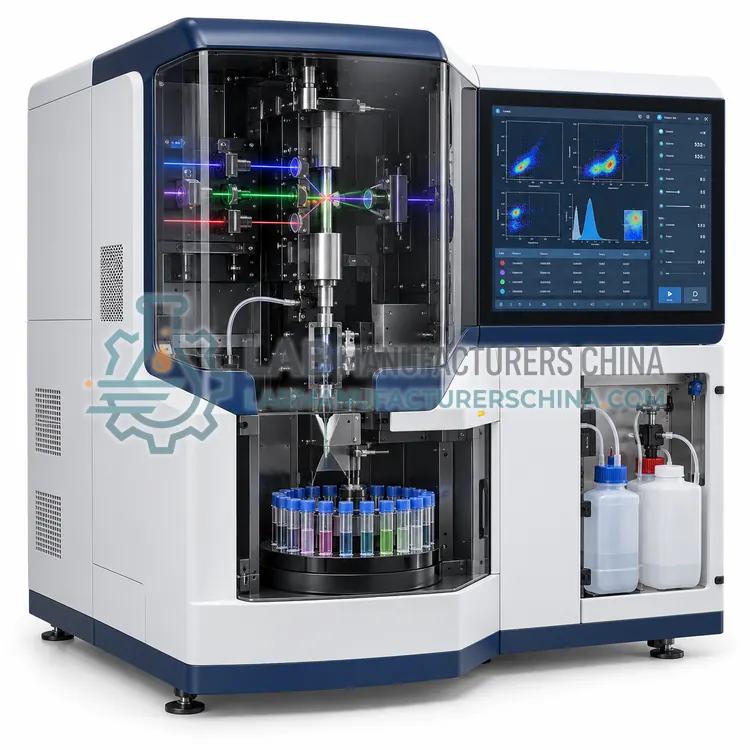
A fluorescence-activated cell sorter interrogates each cell in a fluid stream, applies a charge to droplets containing selected cells and deflects them into collection tubes, achieving 98–99.9% purity and depositing single cells into plates with index information.
What is the Fluorescence-Activated Cell Sorter?
A fluorescence-activated cell sorter interrogates each cell in a fluid stream, applies a charge to droplets containing selected cells and deflects them into collection tubes, achieving 98–99.9% purity and depositing single cells into plates with index information.
Overview
Cells stained with fluorescent antibodies pass one by one through laser interrogation points, and the instrument decides within microseconds whether a cell meets the sort criteria. A piezoelectric element vibrates the nozzle to break the stream into droplets, and selected droplets are charged before passing between deflection plates, which steer them into the chosen collection vessel. Multiple populations can be collected simultaneously, and single-cell mode deposits one cell per well for cloning or sequencing with recorded index information. Practical sorting rates are 5,000–30,000 events per second, with purity of 98–99.9% and recovery of 70–90%. Lasers fall under IEC 60825-1, aerosol containment is needed for potentially infectious samples, and the instrument requires trained operators and regular optical quality control.
How does it work?
Separation exploits a physical or biochemical difference between the target and the rest of the sample. Immunomagnetic methods coat cells with antibody-conjugated magnetic particles and either retain labelled cells in a column placed in a magnetic field, or label everything except the target and let the desired cells flow through untouched. Fluorescence-activated sorting stains cells with fluorescent antibodies, interrogates each cell in a fluid stream and applies a charge to the droplet containing a selected cell, which is then deflected into a collection tube. Microfluidic sorters use narrow channels, acoustic waves or optical forces to deflect cells without droplets. Density-based separation layers the sample over a medium of defined density so that cells of different density band at different interfaces during centrifugation. Each method trades purity, yield, speed and gentleness differently, and downstream assays determine which balance is acceptable.
What are the key features?
- Jet-in-air or cuvette sorting with piezoelectric droplet formation
- Two to five lasers and up to 20 fluorescence detectors
- Sort rates of 5,000–30,000 events per second
- Purity of 98–99.9% with recovery of 70–90%
- Single-cell deposition into plates with index sorting
- Aerosol containment option for infectious samples
What are the technical specifications?
A typical fluorescence-activated cell sorter configuration offers lasers of 2–5 lines, typically 405, 488, 561 and 640 nm, fluorescence detectors of up to 20, sort rate of 5,000–30,000 events per second, purity of 98–99.9% (population dependent), recovery of 70–90% (typical) and collection formats of Tubes, plates and single-cell deposition. Values are indicative of the product class; the exact figures for each configuration are confirmed on the quotation and the calibration documents supplied with the instrument.
Which applications is it used for?
The Fluorescence-Activated Cell Sorter is used in rare cell isolation for downstream sequencing, single-cell cloning and plate deposition, immune subset purification for functional assays and cell line development with reporter selection. Across the wider Cell Separation class, laboratories also deploy it for T cell and immune subset isolation, stem cell and progenitor enrichment and cell therapy starting material preparation.
Which standards and certifications apply?
Relevant standards and methods include ISO 20387, USP <1046>, IEC 61010-1, IEC 61010-2-020, IEC 60825-1 and ISO 15189. Certification candidates for this model are CE, ISO 9001 manufacturing, IEC 61010-1 safety and IEC 60825-1 laser safety; each is to be confirmed for the specific configuration before shipment, and certificates are supplied only where they have been issued.
Work in a biosafety cabinet with appropriate containment, and keep separation buffers cold unless the protocol states otherwise, since cells are more sensitive to handling than to the method itself. Use fresh antibodies and beads, avoid vigorous pipetting, and filter samples through a 30–40 µm mesh to prevent column or nozzle blockage. Include a dead-cell removal step, because dead cells bind non-specifically and reduce purity. After separation, verify purity and viability by flow cytometry and record recovery and purity values for each preparation. Aseptic technique and closed systems are required for cell therapy workflows, where separation is part of a validated process under ISO 20387 and USP <1046> expectations, including documented operator training and traceability of reagents and lots.
How do I select the right Fluorescence-Activated Cell Sorter?
Select a cell sorter when purity above 98% is required, when multiple populations must be separated in one pass, or when single cells must be deposited with index data. Specify laser and detector configuration, sort rate, nozzle options, aerosol containment and index sorting capability.
How does it compare with other Cell Separation variants?
Choose by the required purity, yield, cell number and downstream application. Magnetic separation is fast, gentle and scalable, works with 10⁷ to 10⁹ cells and needs no sorter, but purity is typically 90–98%, so it may not be sufficient for single-cell sequencing. Fluorescence-activated sorting reaches 98–99.9% purity, can deposit single cells into plates with index information and supports multi-parameter gating, at the cost of lower throughput, higher shear stress and specialised operation. Microfluidic and acoustic methods suit low-volume samples and cell types sensitive to shear. Density gradient separation remains the standard first step for blood and bone marrow, followed by magnetic or flow-based purification. Confirm compatibility of labels, buffers and consumables with downstream culture, functional assays and regulatory requirements.
Full specifications
| Lasers | 2–5 lines, typically 405, 488, 561 and 640 nm |
|---|---|
| Fluorescence detectors | up to 20 |
| Sort rate | 5,000–30,000 events per second |
| Purity | 98–99.9% (population dependent) |
| Recovery | 70–90% (typical) |
| Collection formats | Tubes, plates and single-cell deposition |
| Nozzle sizes | 70, 100 and 130 µm |
| Aerosol containment | Optional class II containment |
| Data output | FCS files with sort reports and index information |
| Dimensions (W x D x H) | approx. 1,000 x 800 x 900 mm |
Indicative values for this product class. Final specifications are confirmed on the quotation and in the calibration documents supplied with the instrument.
Applications
- Rare cell isolation for downstream sequencing
- Single-cell cloning and plate deposition
- Immune subset purification for functional assays
- Cell line development with reporter selection
Key features
- Jet-in-air or cuvette sorting with piezoelectric droplet formation
- Two to five lasers and up to 20 fluorescence detectors
- Sort rates of 5,000–30,000 events per second
- Purity of 98–99.9% with recovery of 70–90%
- Single-cell deposition into plates with index sorting
- Aerosol containment option for infectious samples
Frequently asked questions about Fluorescence-Activated Cell Sorter
Typically 98–99.9%, depending on how well separated the populations are, the sort mode used and the event rate. Purity can be checked by re-analysing an aliquot, and recovery typically falls as purity settings become stricter.
Index sorting records the full fluorescence and scatter data for each cell deposited into a plate, so single-cell sequencing results can be linked back to phenotype. This is valuable for correlating transcriptomes with marker expression.
For samples that may contain infectious agents, yes. Sorting generates aerosols, so a class II biological safety cabinet or an integrated containment hood is required, along with documented decontamination procedures after each session.
Positive selection labels the target cells so they are retained or collected. Negative selection labels everything except the target, so the desired cells remain untouched and unlabelled, which is preferred when the downstream assay is sensitive to bound antibody.
Typically 90–98% for positive selection and similar for well-optimised negative selection, depending on the marker and sample. Flow sorting raises purity to 98–99.9%, but yields fewer cells and takes longer.
Clumps and fibrin block magnetic columns and clog sorter nozzles, causing loss of sample and poor reproducibility. Passing the suspension through a 30–40 µm mesh removes aggregates while keeping single cells intact.
Related models