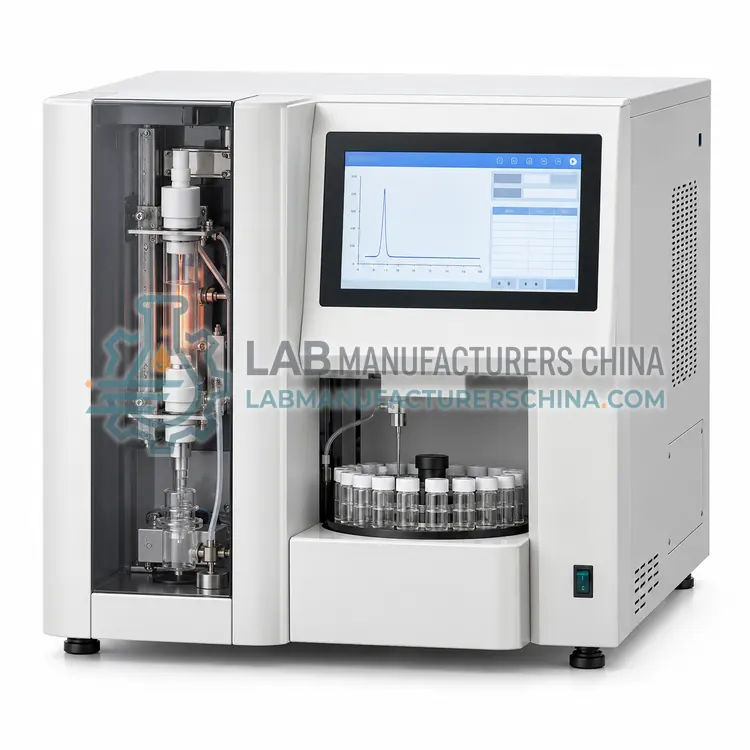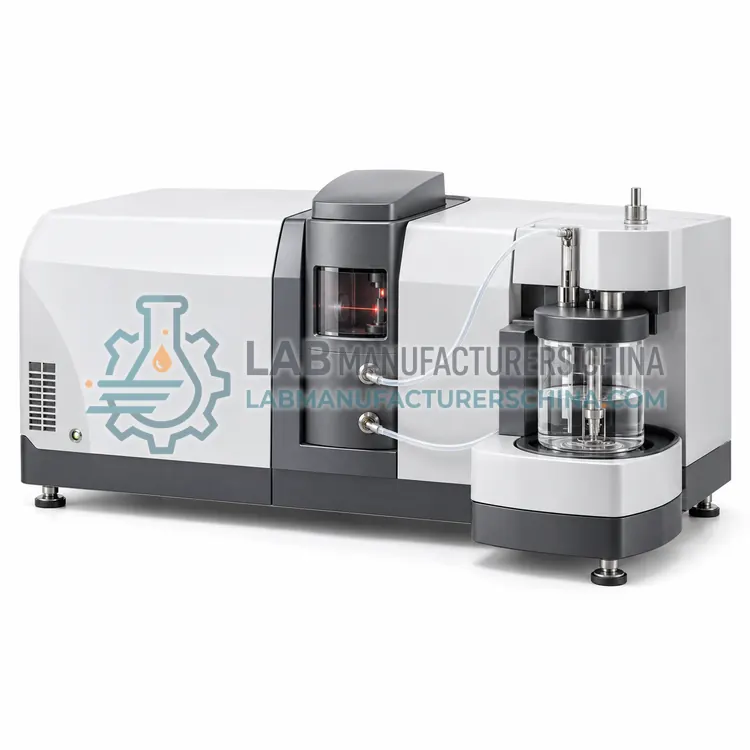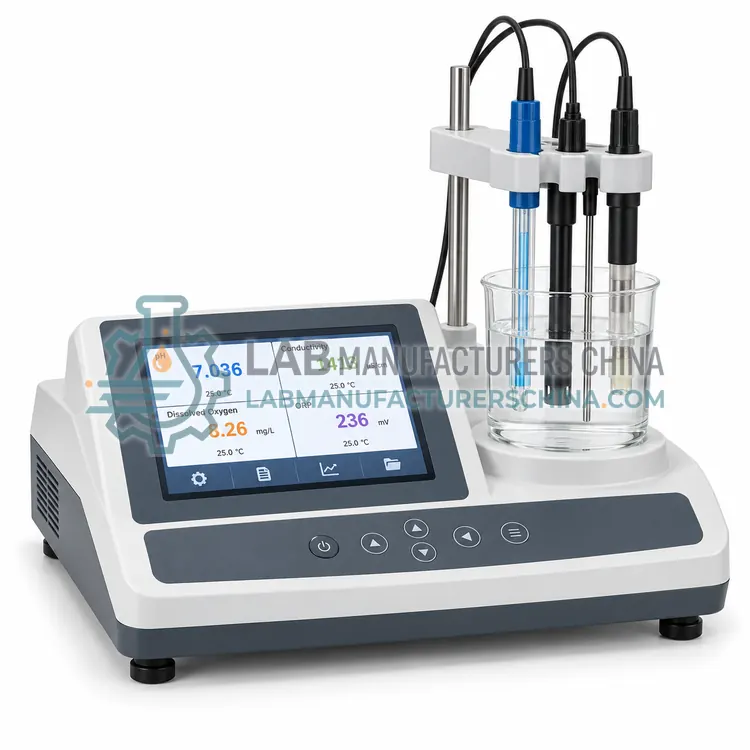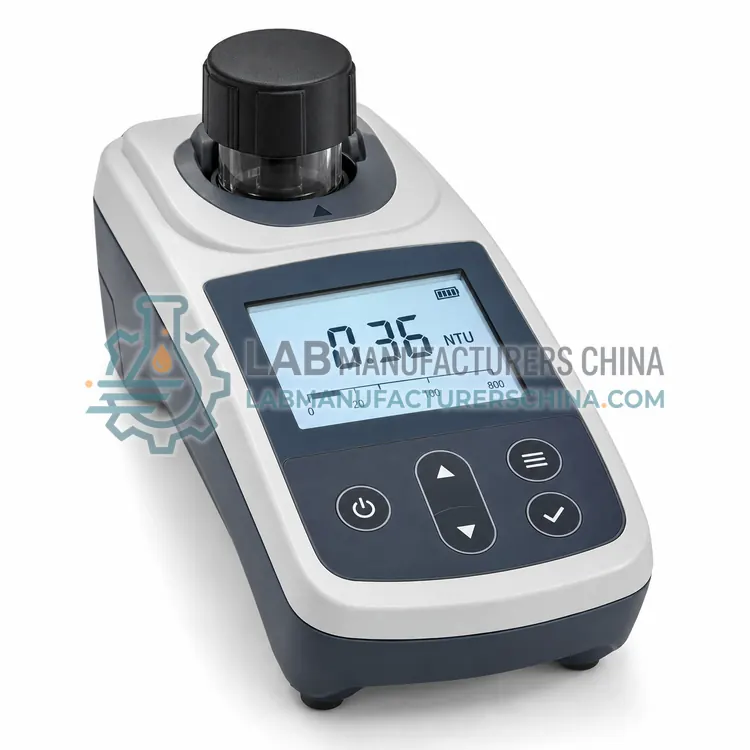
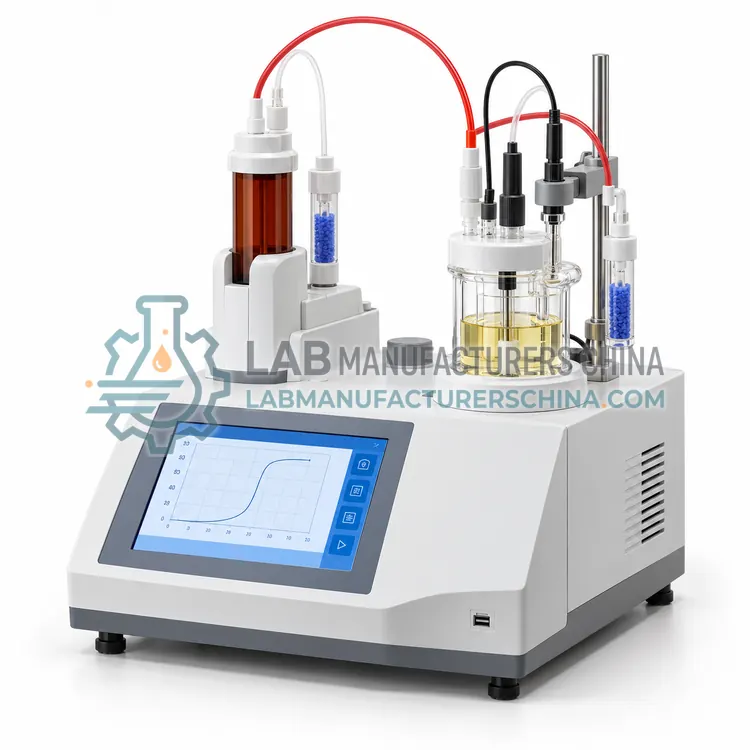
Automatic Karl Fischer Titrator
自动卡尔费休水分滴定仪
- SKU ANA-0002
- Analytical Analyzers
- CE (to be confirmed)
- ISO 9001 manufacturing (to be confirmed)
- IEC 61010-1 safety (to be confirmed)
Price on request — FOB / CIF quoted per order
Prices depend on configuration, quantity and destination port.
Key specifications
| Measuring principle | Volumetric or coulometric KF |
|---|---|
| Water content range (coulometric) | 1 µg–100 mg |
| Water content range (volumetric) | 0.01–100% |
| Burette resolution | 1/20000 (10 mL burette) |
| Repeatability | RSD ≤1% (>10 mg water), ≤3% (<1 mg) |
| Drift rate | ≤10 µg/min stable |
Request a quote Download brochure · to be provided
By Lab Manufacturers China Technical TeamLast reviewed Standards: USP <921>, USP <643>, Ph. Eur. 2.5.12
What is the Automatic Karl Fischer Titrator?
An automatic Karl Fischer titrator determines water content specifically by reaction with iodine and sulfur dioxide, using volumetric or coulometric titration. It measures from a few micrograms to hundreds of milligrams of water and is the reference method for pharmaceuticals, oils, solvents and chemicals.
What is the Automatic Karl Fischer Titrator?
An automatic Karl Fischer titrator determines water content specifically by reaction with iodine and sulfur dioxide, using volumetric or coulometric titration. It measures from a few micrograms to hundreds of milligrams of water and is the reference method for pharmaceuticals, oils, solvents and chemicals.
Overview
The Karl Fischer titrator relies on the stoichiometric reaction of water with iodine in the presence of sulfur dioxide, a base and an alcohol. Volumetric models deliver iodine-containing titrant from a burette and suit water contents from 0.01% to 100%, while coulometric models generate iodine electrochemically in the cell and detect water from 1 µg to about 100 mg. Bipolar platinum electrodes detect the end point at constant current, and a drift compensation routine corrects for ambient moisture ingress. Oven attachments at 100–250 °C release water from solids that do not dissolve in the cell, avoiding side reactions. Samples are added by syringe, weighing boat or autosampler. Automatic titrators store titer determination, record drift and manage audit trails, which supports USP <921> and Ph. Eur. 2.5.12 water determination methods. Reagent handling and solvent disposal require trained staff.
How does it work?
Analytical analyzers combine a sample handling stage, a selective sensor or measurement principle and a data system that converts the raw signal to a reported value. Examples include thermogravimetric drying with a balance for moisture, coulometric or volumetric titration for water, catalytic oxidation with infrared detection for organic carbon, light scattering for particle size and ion-selective electrodes for electrochemical parameters. Each design is optimized for one analyte class and sample matrix, which improves speed, repeatability and ease of use over general-purpose instruments. Calibration against certified reference materials links the output to SI units. Automation such as autosamplers, dosing units and validated software methods reduces operator variation. Results are stored with audit trails so that measurements can be traced to instrument, method and operator during regulatory inspection.
What are the key features?
- Volumetric and coulometric modes cover water from 1 µg to 100%.
- Drift compensation corrects for moisture entering the titration cell.
- Bipolar platinum electrode provides a stable, sharp end point.
- Oven sample changer releases water from insoluble or reactive solids.
- Titer determination is stored with traceable standards and reminders.
- Audit trail and e-signature options support regulated laboratories.
What are the technical specifications?
A typical automatic karl fischer titrator configuration offers measuring principle of Volumetric or coulometric KF, water content range (coulometric) of 1 µg–100 mg, water content range (volumetric) of 0.01–100%, burette resolution of 1/20000 (10 mL burette), repeatability of RSD ≤1% (>10 mg water), ≤3% (<1 mg) and drift rate of ≤10 µg/min stable. Values are indicative of the product class; the exact figures for each configuration are confirmed on the quotation and the calibration documents supplied with the instrument.
Which applications is it used for?
The Automatic Karl Fischer Titrator is used in pharmaceutical API and excipient water content, edible oil and transformer oil moisture, solvent and chemical water specification, lithium-ion battery materials and plastics and polymers. Across the wider Analytical Analyzers class, laboratories also deploy it for pharmaceutical and API quality control, food and beverage composition testing and chemical and polymer characterization.
Which standards and certifications apply?
Relevant standards and methods include USP <921>, USP <643>, Ph. Eur. 2.5.12, ISO 760, ISO 13320, ASTM E203, ASTM D7573 and GB/T 6283. Certification candidates for this model are CE, ISO 9001 manufacturing and IEC 61010-1 safety; each is to be confirmed for the specific configuration before shipment, and certificates are supplied only where they have been issued.
Install analyzers on stable benches with controlled temperature and humidity, away from drafts and vibration. Follow manufacturer requirements for gases, reagents, waste handling and ventilation. Calibrate and verify routinely using certified reference materials relevant to the matrix, and schedule preventive maintenance for consumables such as electrodes, lamps, catalysts and dispersion units. Validate methods for accuracy, repeatability and linearity before release testing, and record them under a quality system such as ISO 17025 or GMP. Use software with user levels, audit trail and electronic signatures where regulated. Provide training for sample preparation, because sampling error is usually the largest contributor to measurement uncertainty.
How do I select the right Automatic Karl Fischer Titrator?
Select a Karl Fischer titrator for specific water determination and when results must match pharmacopoeial methods. Use coulometric mode below about 1% water and volumetric mode above it. In an RFQ, specify expected water range, sample type, oven requirement, autosampler need and reagent supply arrangements.
How does it compare with other Analytical Analyzers variants?
Start from the measurand and the sample matrix. Determine the required concentration range, accuracy, sample throughput and regulatory method, then select the analyzer type that natively meets them. For water in solids and liquids at ppm levels, a Karl Fischer titrator is the reference, while a halogen moisture analyzer suits fast loss-on-drying checks above 0.1%. TOC analyzers should be matched to the expected range and the presence of particulates or salts. Laser diffraction covers 0.01 to 3500 µm for dry or wet dispersions. Benchtop multiparameter analyzers suit labs measuring pH, conductivity and dissolved oxygen together. Also consider sample preparation needs, consumables, software compliance, automation level and local service support.
Full specifications
| Measuring principle | Volumetric or coulometric KF |
|---|---|
| Water content range (coulometric) | 1 µg–100 mg |
| Water content range (volumetric) | 0.01–100% |
| Burette resolution | 1/20000 (10 mL burette) |
| Repeatability | RSD ≤1% (>10 mg water), ≤3% (<1 mg) |
| Drift rate | ≤10 µg/min stable |
| Indication | Bipolar Pt electrode, dual Pt |
| Oven temperature (option) | 50–250 °C |
| Stored methods | ≥100 |
| Interfaces | USB, RS-232, Ethernet |
Indicative values for this product class. Final specifications are confirmed on the quotation and in the calibration documents supplied with the instrument.
Applications
- Pharmaceutical API and excipient water content
- Edible oil and transformer oil moisture
- Solvent and chemical water specification
- Lithium-ion battery materials
- Plastics and polymers
Key features
- Volumetric and coulometric modes cover water from 1 µg to 100%.
- Drift compensation corrects for moisture entering the titration cell.
- Bipolar platinum electrode provides a stable, sharp end point.
- Oven sample changer releases water from insoluble or reactive solids.
- Titer determination is stored with traceable standards and reminders.
- Audit trail and e-signature options support regulated laboratories.
Frequently asked questions about Automatic Karl Fischer Titrator
Choose coulometric titration for trace water, usually below 1% and down to micrograms, such as in oils, solvents and APIs. Volumetric titration is better for higher water contents up to 100% because it can deliver larger amounts of titrant quickly.
An oven heats the sample in a sealed vial and carries released water by dry gas into the titration cell. It is used for solids that do not dissolve, react with the reagent or contain interfering substances, avoiding side reactions and cell contamination.
For volumetric titration, determine titer daily or before each series using a water standard or sodium tartrate dihydrate, and repeat if reagent or conditions change. Coulometric instruments need periodic verification with a water standard rather than titer determination.
An analytical analyzer is a dedicated laboratory instrument that measures a specific property or group of properties, such as moisture, carbon content or particle size. It combines sample handling, a selective sensor and software to deliver quantified results quickly and repeatably.
Use Karl Fischer titration for specific water determination, including trace levels down to ppm, and when volatile solvents would bias weight loss. Use a halogen moisture analyzer for rapid loss-on-drying checks of robust materials where total volatiles, typically above 0.1%, are acceptable.
Most analyzers are verified daily or per batch with reference standards and formally calibrated at least annually. Frequency depends on the instrument, method criticality and quality system, and additional checks follow maintenance, consumable changes or out-of-trend results.
Related models