Lab Manufacturers China

Distillation Units

蒸馏水器

DIU · Laboratory Water Purification · 6 models

By Lab Manufacturers China Technical TeamLast reviewed Standards: ISO 3696, CLSI GP40, USP <645>

Standards referenced

  • ISO 3696
  • CLSI GP40
  • USP <645>
  • IEC 61010-1
  • ISO 9001

What are Distillation Units?

Distillation units boil water and condense the vapor to leave non-volatile contaminants behind, producing pyrogen-free distilled water. They are used for reagent preparation, autoclave feed and common standard methods and analyses that specify distilled water.

6 models of Distillation Units

The 6 models below are current configurations; specifications are confirmed on quotation.

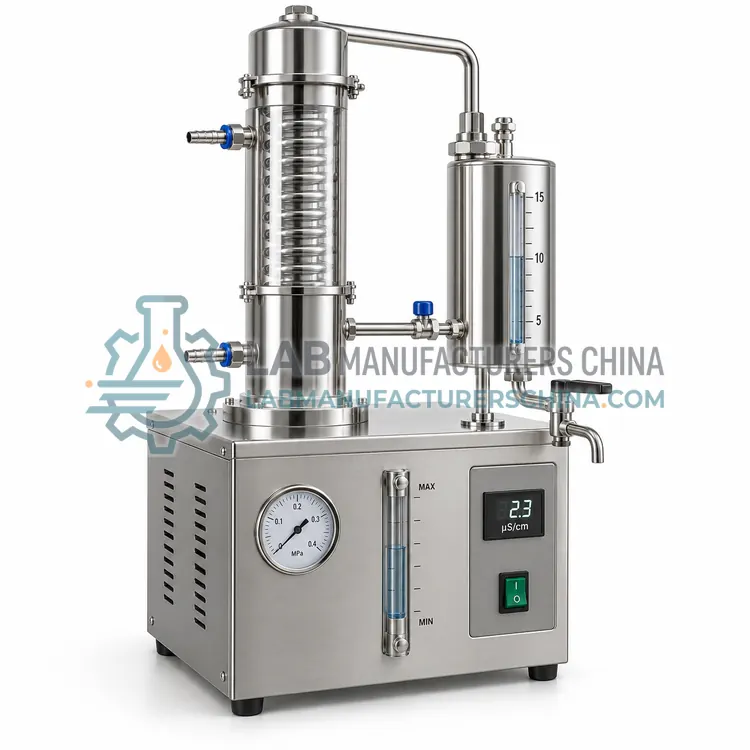
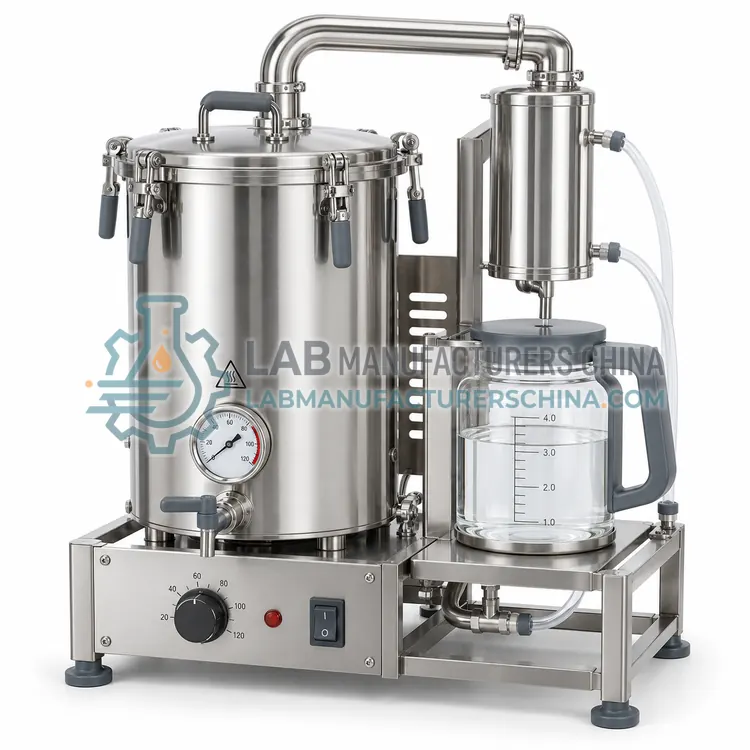
Single-Stage Water Still

单级蒸馏水器

  • DIU-0001
  • Distillation Units
  • CE (to be confirmed)
  • ISO 9001 manufacturing (to be confirmed)
  • RoHS (to be confirmed)
Output:
2–20 L/h
Conductivity:
1–5 µS/cm
Heater power:
2–12 kW
Cooling:
Water or air cooled
Boiler material:
Borosilicate glass or stainless steel
Condenser material:
Glass, stainless steel or copper

A single-stage water still boils and condenses feed water once to remove non-volatile ions and pyrogens. It is the standard unit for routine reagent water and autoclave feed in many general laboratories.

Request a quote
View details

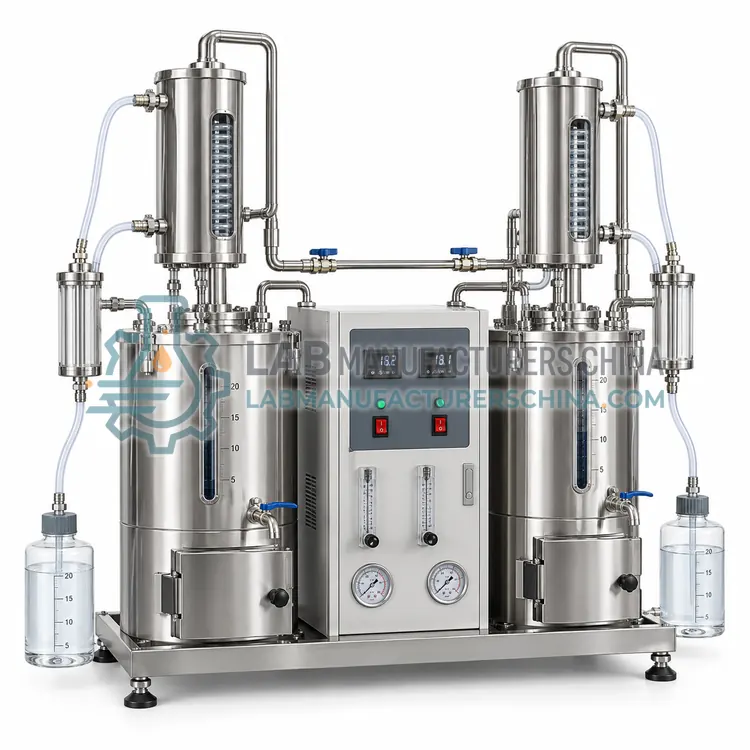
Double-Stage Water Still

双级蒸馏水器

  • DIU-0002
  • Distillation Units
  • CE (to be confirmed)
  • ISO 9001 manufacturing (to be confirmed)
  • RoHS (to be confirmed)
Output:
1–10 L/h
Conductivity:
0.5–1 µS/cm
Stages:
2
Heater power:
3–15 kW
Cooling water:
2–6 L/min
Boiler material:
Borosilicate glass or stainless steel

A double-stage water still distills the distillate a second time, giving lower conductivity and lower pyrogen content. It is used where high-purity distilled water is required for demanding analytical and biological work.

Request a quote
View details

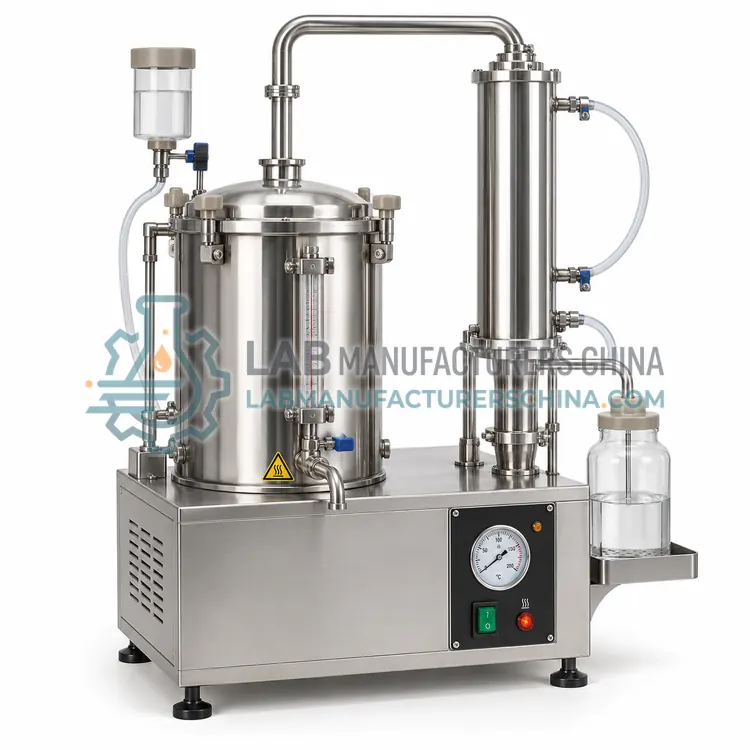
Automatic Water Still

自动蒸馏水器

  • DIU-0003
  • Distillation Units
  • CE (to be confirmed)
  • ISO 9001 manufacturing (to be confirmed)
  • RoHS (to be confirmed)
Output:
4–30 L/h
Conductivity:
1–5 µS/cm
Level control:
Float or conductivity sensor
Automatic drain:
Timed or conductivity triggered
Storage tank:
10–100 L optional
Safety:
Low-level and over-temperature cutout

An automatic water still fills, boils, monitors and drains itself, so it can run unattended for long periods. It is used where a reliable, continuous supply of distilled water is needed every day.

Request a quote
View details

Quartz Water Still

石英蒸馏水器

  • DIU-0004
  • Distillation Units
  • CE (to be confirmed)
  • ISO 9001 manufacturing (to be confirmed)
  • RoHS (to be confirmed)
Output:
0.5–4 L/h
Conductivity:
0.1–0.5 µS/cm
Boiler material:
Fused quartz
Condenser material:
Quartz or borosilicate glass
Heating:
External infrared or resistance
Trace metals:
Very low, no metal contact

A quartz water still uses a quartz boiler and condenser to avoid releasing ions and trace metals from the vessel. It is used for the highest-purity distilled water in sensitive trace analysis.

Request a quote
View details

Continuous Water Distiller

连续式蒸馏水器

  • DIU-0005
  • Distillation Units
  • CE (to be confirmed)
  • ISO 9001 manufacturing (to be confirmed)
  • RoHS (to be confirmed)
Output:
10–100 L/h
Conductivity:
1–5 µS/cm
Stages:
1 or 2
Boiler bleed:
Continuous or cyclic
Cooling:
Water cooled or air cooled
Heater power:
9–45 kW

A continuous water distiller produces distilled water as long as feed is supplied, without batch filling. It is used where a steady stream is needed for washers, autoclaves and process production support.

Request a quote
View details

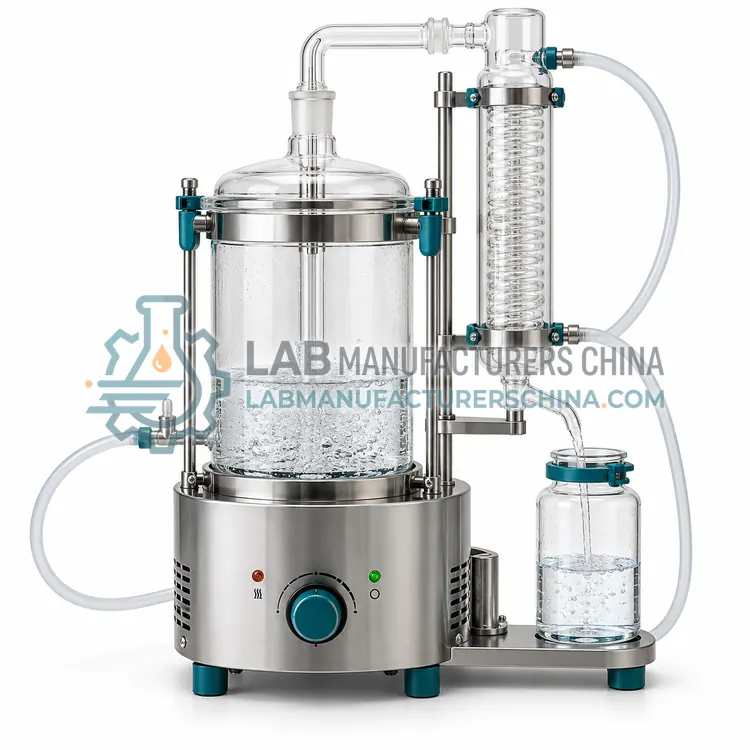
Tabletop Water Distiller

台式蒸馏水器

  • DIU-0006
  • Distillation Units
  • CE (to be confirmed)
  • RoHS (to be confirmed)
  • ISO 9001 manufacturing (to be confirmed)
Output:
1–4 L/h
Batch volume:
1–8 L
Conductivity:
1–5 µS/cm
Boiler material:
Borosilicate glass and stainless steel
Cooling:
Air cooled
Automatic shutoff:
On selected models

A tabletop water distiller is a small self-contained unit that produces a few liters per batch for individual laboratories. It is used where a compact, low-volume distilled water source is practical for one laboratory at a time.

Request a quote
View details

Compare Distillation Units models

ModelOutputConductivityHeater powerCoolingBoiler material
Single-Stage Water StillDIU-00012–20 L/h1–5 µS/cm2–12 kWWater or air cooledBorosilicate glass or stainless steel
Double-Stage Water StillDIU-00021–10 L/h0.5–1 µS/cm3–15 kW—Borosilicate glass or stainless steel
Automatic Water StillDIU-00034–30 L/h1–5 µS/cm3–15 kW——
Quartz Water StillDIU-00040.5–4 L/h0.1–0.5 µS/cm1–4 kWWater cooledFused quartz
Continuous Water DistillerDIU-000510–100 L/h1–5 µS/cm9–45 kWWater cooled or air cooled—
Tabletop Water DistillerDIU-00061–4 L/h1–5 µS/cm0.5–3 kWAir cooledBorosilicate glass and stainless steel

Indicative values for this product class. Final specifications are confirmed on the quotation and in the calibration documents supplied with the instrument.

How do Distillation Units work?

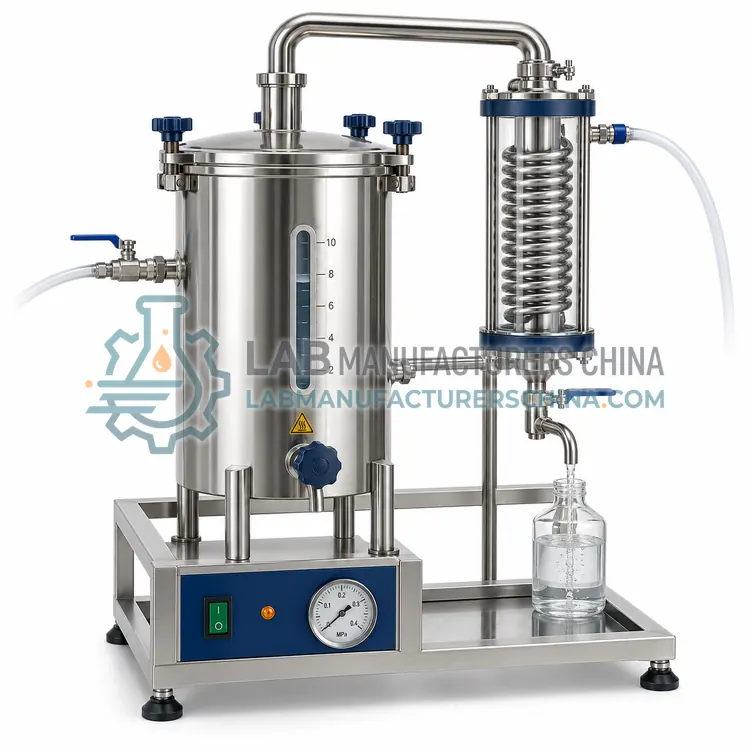
A distillation unit heats feed water to boiling in a boiler, and the steam rises through a column or baffle that separates entrained droplets carrying dissolved salts. The vapor then condenses on a cooled surface and is collected as distillate. Non-volatile ions, particles and pyrogens remain in the boiler, which is drained periodically, while volatile substances such as ammonia, carbon dioxide and some organics may carry over unless a baffle or a second stage traps them. Single-stage stills give conductivity of about 1 to 5 microsiemens per centimeter, and double-stage units reach lower values by distilling the distillate again. Typical components are the boiler with heating elements and level control, the condenser with cooling water or air, the baffle, and conductivity monitoring. Scale from hard water forms on the elements, so descaling is routine maintenance.

Which Distillation Units variants are available?

  • Single-Stage Water Still — A single-stage water still boils and condenses feed water once to remove non-volatile ions and pyrogens.
  • Double-Stage Water Still — A double-stage water still distills the distillate a second time, giving lower conductivity and lower pyrogen content.
  • Automatic Water Still — An automatic water still fills, boils, monitors and drains itself, so it can run unattended for long periods.
  • Quartz Water Still — A quartz water still uses a quartz boiler and condenser to avoid releasing ions and trace metals from the vessel.
  • Continuous Water Distiller — A continuous water distiller produces distilled water as long as feed is supplied, without batch filling.
  • Tabletop Water Distiller — A tabletop water distiller is a small self-contained unit that produces a few liters per batch for individual laboratories.

How do I choose the right variant?

Begin with the required water quality and volume. Single-stage stills suit general reagent preparation and autoclave feed, while double-stage or quartz stills are chosen when very low conductivity and low pyrogen content are needed. Match output to daily demand, considering that a still runs continuously and needs cooling water unless it is air-cooled. Check the material of the boiler and condenser, since borosilicate glass, quartz and stainless steel differ in contamination and durability. Hard feed water increases scaling and maintenance, so consider softening or reverse osmosis pretreatment. Look for automatic level control, over-temperature protection and conductivity monitoring, and confirm whether the design allows easy descaling. Finally, compare energy and cooling water consumption, because distillation has the highest operating cost of the common purification methods.

Where are Distillation Units used?

Distillation Units are specified in reagent and buffer preparation, autoclave and sterilizer feed, microbiology media preparation, standard methods requiring distilled water, glassware rinsing and final wash and pyrogen-free water for some applications.

Which standards and certifications apply?

Work with Distillation Units is commonly governed by ISO 3696, CLSI GP40, USP <645>, IEC 61010-1 and ISO 9001. Instrument certifications such as CE marking are confirmed per configuration and never assumed.

What are the key considerations before purchase?

Feed the still with softened or pretreated water to slow scale formation, and descale on a regular schedule with a suitable acid. Do not let the boiler run dry; keep level controls and low-level cutouts in working order. Ensure adequate cooling water flow and temperature, because poor cooling reduces output and may allow vapor to escape. Drain the boiler concentrate regularly to prevent salt buildup, and never let it concentrate beyond the design limit. Clean the condenser and collection vessel to avoid re-contamination, and cover stored distillate. Follow IEC 61010-1 for electrical safety and local rules for hot water and steam. Record conductivity, output and descaling dates so quality and maintenance stay under control.

Frequently asked questions about Distillation Units

A single-stage still reaches about 1 to 5 microsiemens per centimeter, and a double-stage still lower values, with very low pyrogen content. Volatile contaminants are not removed unless a baffle or second stage is used.

Need help specifying Distillation Units?

Request a quote