How do High-Pressure Homogenizers work?
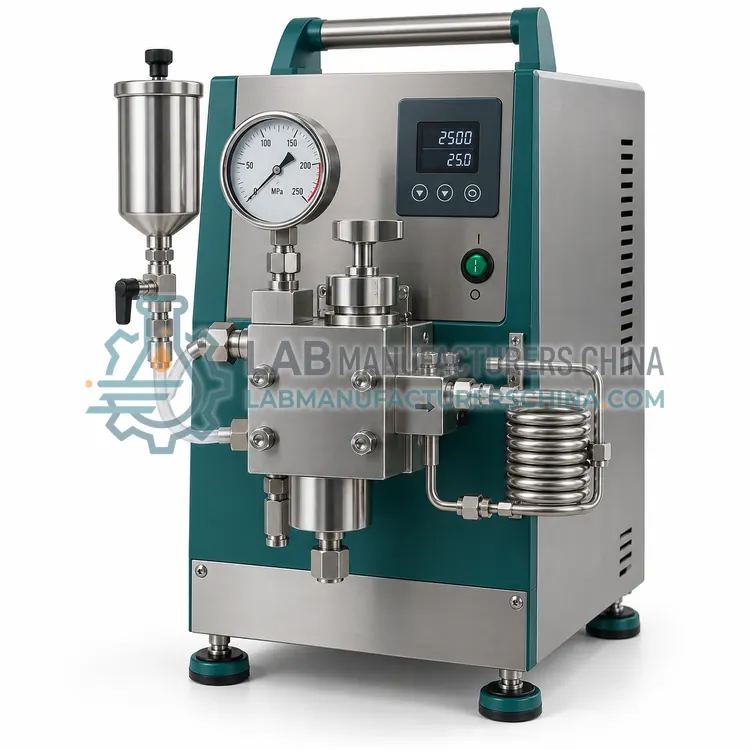
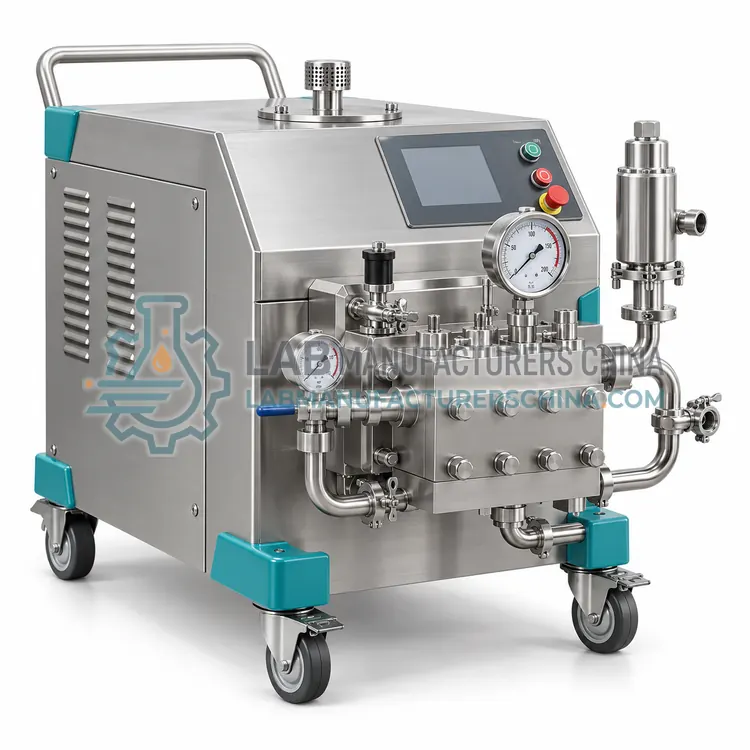
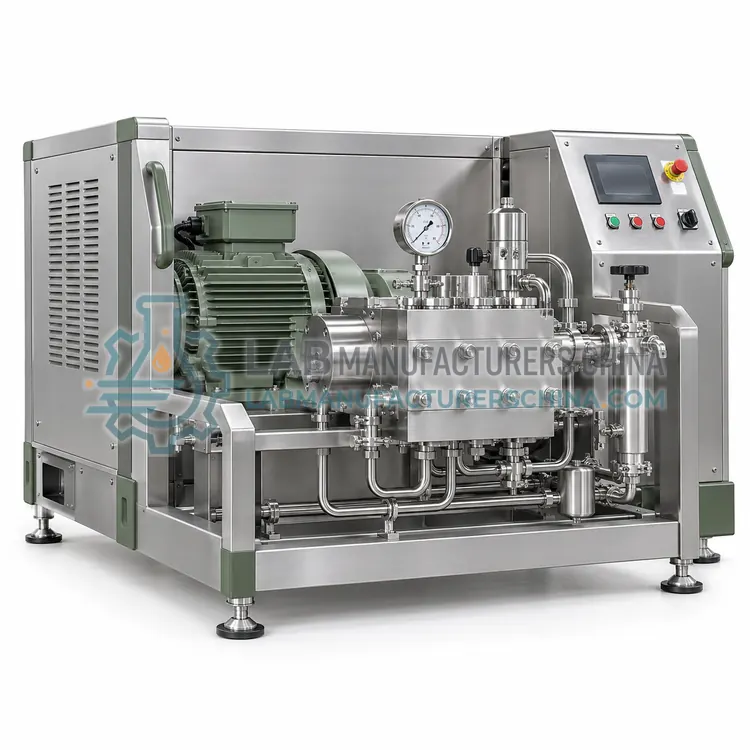
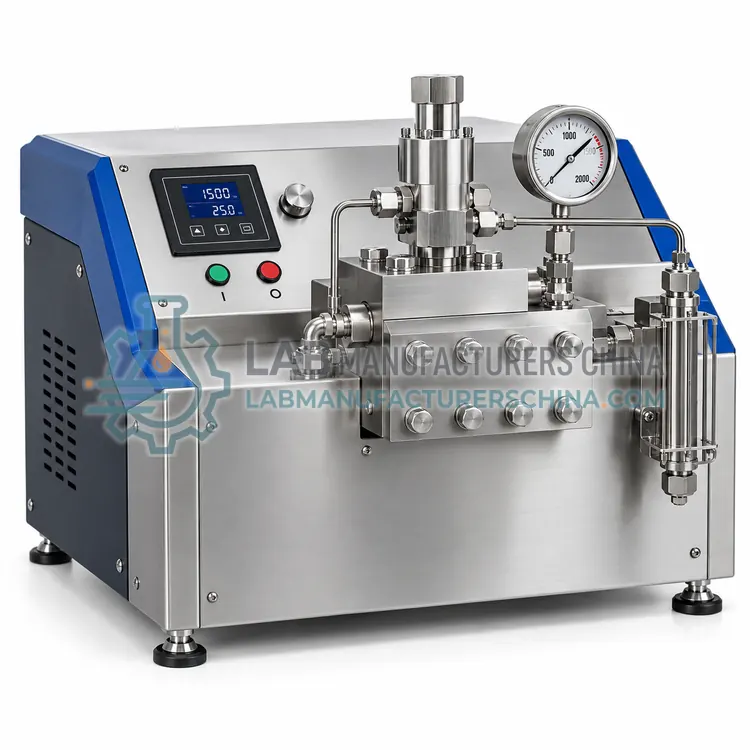
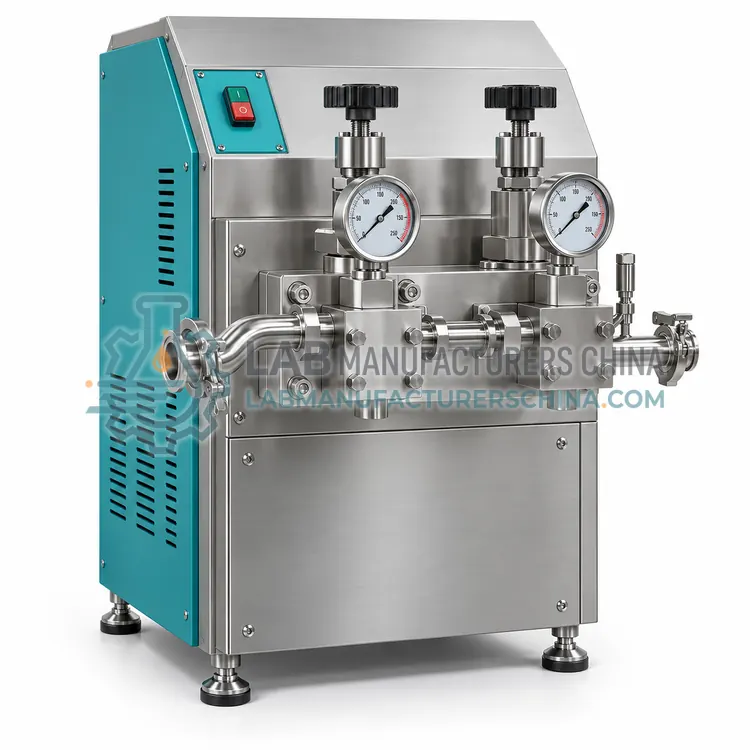
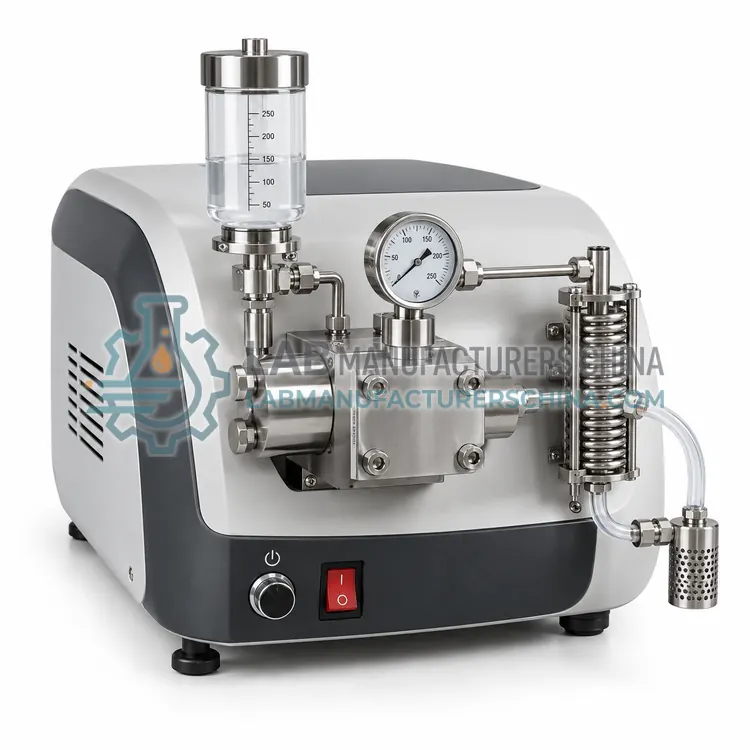
A high-pressure homogenizer uses a positive-displacement piston pump to pressurize the sample, then forces it through a narrow valve or interaction chamber. As the fluid passes the valve seat, velocity rises sharply and pressure drops, creating intense shear, turbulence and cavitation that break droplets and cells. In a two-stage design a second valve at lower pressure further refines the particle size distribution and reduces recoalescence. Product temperature rises by roughly 2 to 3 °C per 100 bar, so jacketed heat exchangers or ice cooling control the outlet temperature. Main components are the feed hopper or reservoir, pistons and seals, the valve assembly with wear-resistant seats, a pressure gauge, and the cooling circuit. Operating pressure, number of passes, valve geometry and temperature determine the achievable droplet size, often in the 50 to 500 nm range.
Which High-Pressure Homogenizers variants are available?
- Benchtop High-Pressure Homogenizer — A benchtop high-pressure homogenizer is a compact unit that processes 10 to 500 mL at pressures up to about 1,500 bar.
- Pilot-Scale High-Pressure Homogenizer — A pilot-scale high-pressure homogenizer processes 1 to 50 L per batch at pressures up to about 1,500 bar, bridging benchtop screening and production.
- Production-Scale High-Pressure Homogenizer — A production-scale high-pressure homogenizer runs continuous flows of 500 to 20,000 L/h at pressures up to about 1,000 bar.
- Ultra-High-Pressure Homogenizer — An ultra-high-pressure homogenizer reaches 2,000 bar and above to produce very fine nanoemulsions, nanosuspensions and submicron dispersions that conventional machines cannot achieve.
- Two-Stage High-Pressure Homogenizer — A two-stage high-pressure homogenizer adds a second valve at lower pressure after the main stage to narrow the particle size distribution and prevent recoalescence.
- High-Pressure Cell Disruptor — A high-pressure cell disruptor uses 500 to 1,200 bar to rupture bacteria, yeast and mammalian cells for intracellular protein, nucleic acid or organelle recovery.
How do I choose the right variant?
Select first by working pressure and throughput, because these set the achievable particle size and the batch time. Nanoemulsions and liposomes usually need 1,000 to 1,500 bar, while cell disruption often works at 500 to 1,000 bar. Match the machine size to batch volume: benchtop units for 10 to 500 mL, pilot units for 1 to 50 L, and production units above that. Choose the valve or interaction chamber geometry for your application, and whether one or two stages are needed. Confirm wetted materials such as 316L stainless steel, ceramic or diamond for abrasive samples, and the ability to autoclave or steam-in-place where sterility matters. Specify cooling, number of passes, pressure control and data logging in the request.
Where are High-Pressure Homogenizers used?
High-Pressure Homogenizers are specified in nanoemulsion and liposome preparation, cell disruption for protein and nucleic acid recovery, pharmaceutical suspension particle size reduction, beverage and dairy emulsion stabilization, cosmetic nanoemulsion development and food ingredient microencapsulation.
Which standards and certifications apply?
Work with High-Pressure Homogenizers is commonly governed by IEC 61010-1, IEC 61010-2-051, ISO 13320, EN ISO 12100 and GB 4793.1. Instrument certifications such as CE marking are confirmed per configuration and never assumed.
What are the key considerations before purchase?
Install the unit on a level, rigid surface and allow access to the valve, seals and cooling lines. Prime the system before pressurizing to avoid dry running, which damages pistons and seals. Inspect and replace valve seats, O-rings and piston seals on a schedule, because wear shifts particle size. Clean and flush immediately after use; for biological work, validate a cleaning protocol that removes residues between products. Follow IEC 61010-1 for electrical safety and the local pressure equipment rules. Never open the valve assembly while the system is pressurized. Record pressure, passes, temperature and results so that batches can be reproduced, and verify performance with particle size analysis before release.