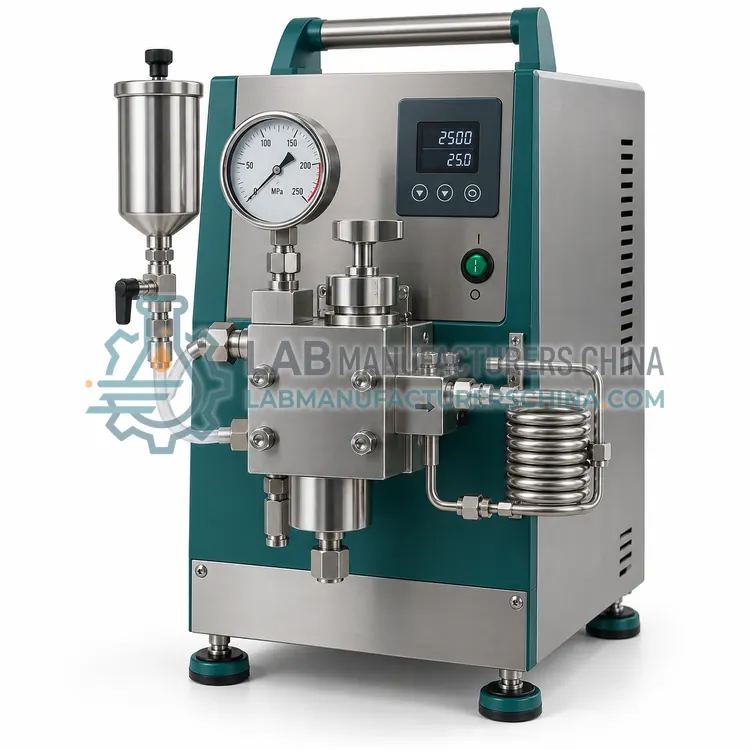
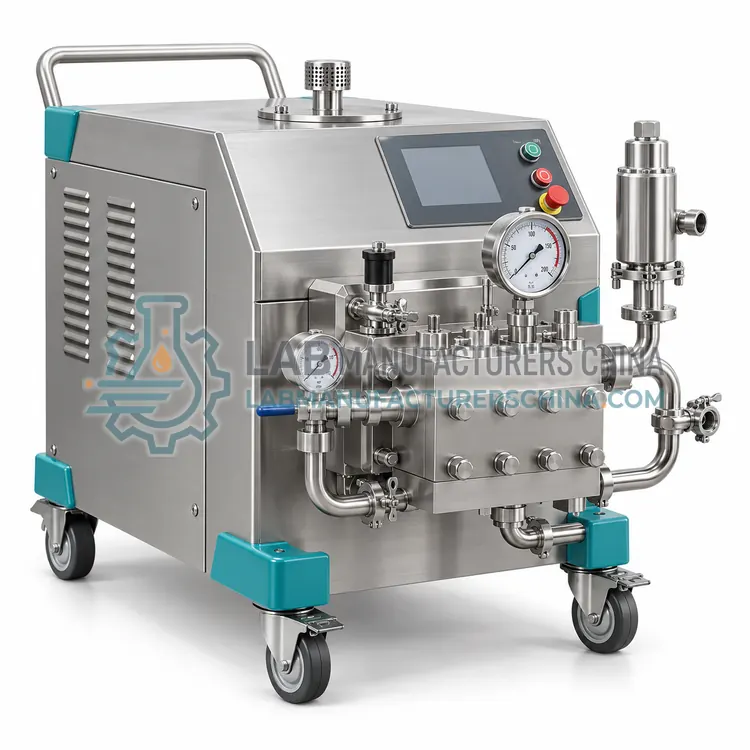
Pilot-Scale High-Pressure Homogenizer
中试规模高压均质机
- SKU HPH-0002
- High-Pressure Homogenizers
- CE (to be confirmed)
- ISO 9001 manufacturing (to be confirmed)
- 3-A sanitary design (to be confirmed)
Price on request — FOB / CIF quoted per order
Prices depend on configuration, quantity and destination port.
Key specifications
| Working pressure | Up to 1,500 bar |
|---|---|
| Batch volume | 1–50 L |
| Flow rate | 50–500 L/h |
| Number of plungers | 2 or 3 |
| Stages | 1 or 2 |
| Feed vessel | Jacketed, agitated |
Request a quote Download brochure · to be provided
By Lab Manufacturers China Technical TeamLast reviewed Standards: IEC 61010-1, IEC 61010-2-051, ISO 13320
What is the Pilot-Scale High-Pressure Homogenizer?
A pilot-scale high-pressure homogenizer processes 1 to 50 L per batch at pressures up to about 1,500 bar, bridging benchtop screening and production. It is used for scale-up studies, clinical trial material and small production runs.
What is the Pilot-Scale High-Pressure Homogenizer?
A pilot-scale high-pressure homogenizer processes 1 to 50 L per batch at pressures up to about 1,500 bar, bridging benchtop screening and production. It is used for scale-up studies, clinical trial material and small production runs.
Overview
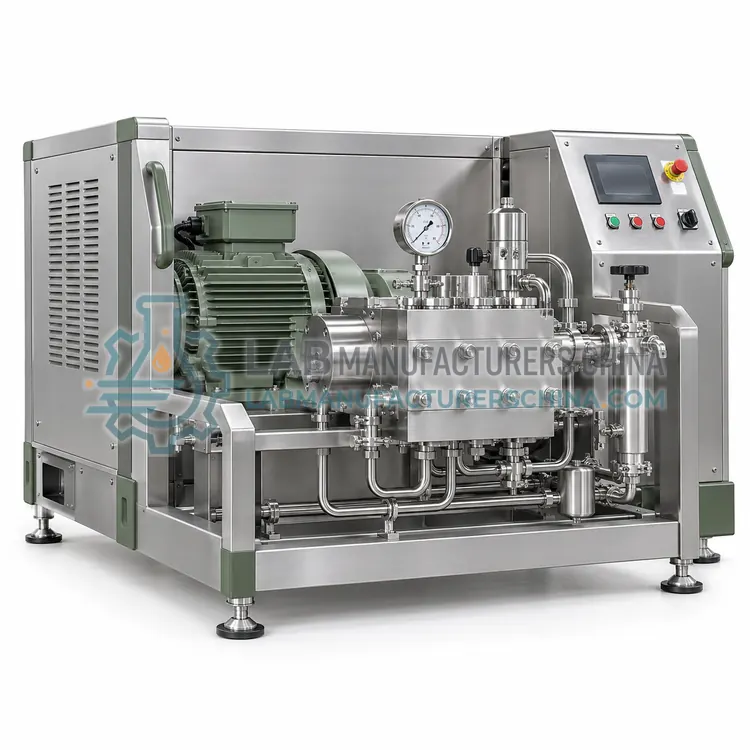
The pilot-scale homogenizer uses a larger piston pump with two or three plungers, driven by a geared motor and often mounted on a mobile stainless steel frame. Batch volumes range from 1 to 50 L, with flow rates of 50 to 500 L/h and pressures up to about 1,500 bar. A jacketed feed vessel with agitation allows recirculation for multiple passes and can be heated or cooled. Pressure is set by an adjustable valve and read on a calibrated gauge or transducer. Sanitary fittings, tri-clamp connections and drainable lines simplify cleaning between products. The unit usually supports product-contact documentation and may offer steam-in-place or clean-in-place options. Because it can reproduce the pressures used in production, it provides the link for scale-up, and it is often used to generate clinical and stability batches.
How does it work?
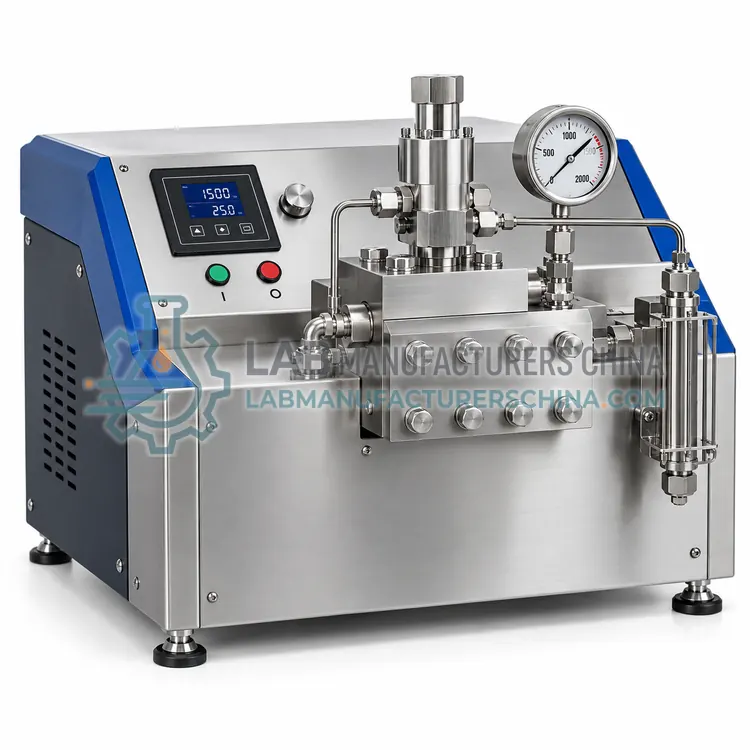
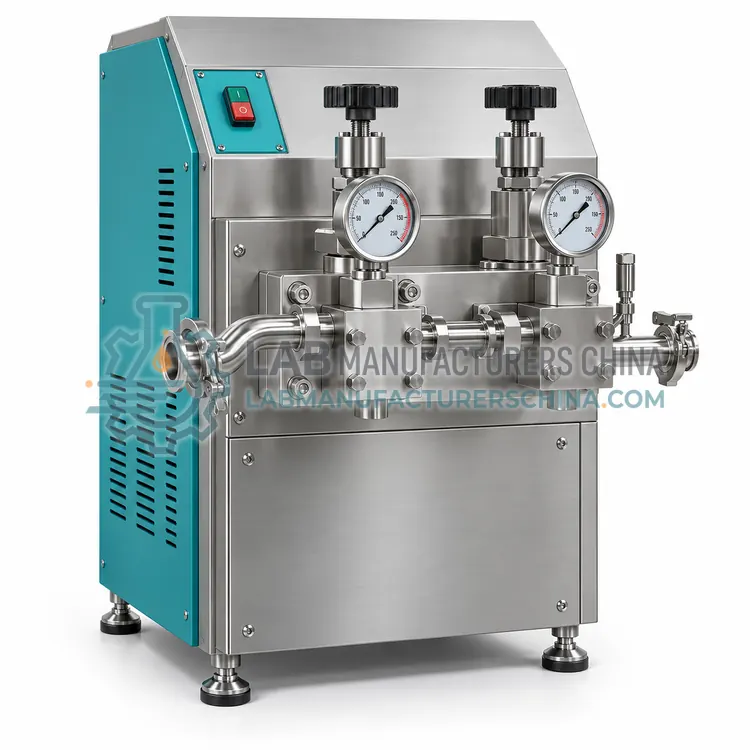
A high-pressure homogenizer uses a positive-displacement piston pump to pressurize the sample, then forces it through a narrow valve or interaction chamber. As the fluid passes the valve seat, velocity rises sharply and pressure drops, creating intense shear, turbulence and cavitation that break droplets and cells. In a two-stage design a second valve at lower pressure further refines the particle size distribution and reduces recoalescence. Product temperature rises by roughly 2 to 3 °C per 100 bar, so jacketed heat exchangers or ice cooling control the outlet temperature. Main components are the feed hopper or reservoir, pistons and seals, the valve assembly with wear-resistant seats, a pressure gauge, and the cooling circuit. Operating pressure, number of passes, valve geometry and temperature determine the achievable droplet size, often in the 50 to 500 nm range.
What are the key features?
- Batch volumes of 1–50 L with flow rates 50–500 L/h
- Two or three plungers for stable pressure and low pulsation
- Jacketed, agitated feed vessel for recirculation
- Sanitary tri-clamp connections for cleaning
- Steam-in-place or clean-in-place options on selected models
- Mobile stainless steel frame with digital pressure display
What are the technical specifications?
A typical pilot-scale high-pressure homogenizer configuration offers working pressure of Up to 1,500 bar, batch volume of 1–50 L, flow rate of 50–500 L/h, number of plungers of 2 or 3, stages of 1 or 2 and feed vessel of Jacketed, agitated. Values are indicative of the product class; the exact figures for each configuration are confirmed on the quotation and the calibration documents supplied with the instrument.
Which applications is it used for?
The Pilot-Scale High-Pressure Homogenizer is used in scale-up and process development, clinical trial batch preparation, pilot nanoemulsion production, dairy and beverage homogenization trials and cell disruption at liter scale. Across the wider High-Pressure Homogenizers class, laboratories also deploy it for nanoemulsion and liposome preparation, cell disruption for protein and nucleic acid recovery and pharmaceutical suspension particle size reduction.
Which standards and certifications apply?
Relevant standards and methods include IEC 61010-1, IEC 61010-2-051, ISO 13320, EN ISO 12100 and GB 4793.1. Certification candidates for this model are CE, ISO 9001 manufacturing and 3-A sanitary design; each is to be confirmed for the specific configuration before shipment, and certificates are supplied only where they have been issued.
Install the unit on a level, rigid surface and allow access to the valve, seals and cooling lines. Prime the system before pressurizing to avoid dry running, which damages pistons and seals. Inspect and replace valve seats, O-rings and piston seals on a schedule, because wear shifts particle size. Clean and flush immediately after use; for biological work, validate a cleaning protocol that removes residues between products. Follow IEC 61010-1 for electrical safety and the local pressure equipment rules. Never open the valve assembly while the system is pressurized. Record pressure, passes, temperature and results so that batches can be reproduced, and verify performance with particle size analysis before release.
How do I select the right Pilot-Scale High-Pressure Homogenizer?
Choose the pilot-scale unit when batch size reaches liters and when data must support production scale-up. Confirm pressure, flow, feed-vessel size, cleaning method and the possibility to reuse valve geometry from the production machine. Specify sanitary and documentation requirements in the RFQ.
How does it compare with other High-Pressure Homogenizers variants?
Select first by working pressure and throughput, because these set the achievable particle size and the batch time. Nanoemulsions and liposomes usually need 1,000 to 1,500 bar, while cell disruption often works at 500 to 1,000 bar. Match the machine size to batch volume: benchtop units for 10 to 500 mL, pilot units for 1 to 50 L, and production units above that. Choose the valve or interaction chamber geometry for your application, and whether one or two stages are needed. Confirm wetted materials such as 316L stainless steel, ceramic or diamond for abrasive samples, and the ability to autoclave or steam-in-place where sterility matters. Specify cooling, number of passes, pressure control and data logging in the request.
Full specifications
| Working pressure | Up to 1,500 bar |
|---|---|
| Batch volume | 1–50 L |
| Flow rate | 50–500 L/h |
| Number of plungers | 2 or 3 |
| Stages | 1 or 2 |
| Feed vessel | Jacketed, agitated |
| Temperature range | 4–90 °C |
| Wetted material | 316L stainless steel |
| Cleaning | CIP/SIP optional |
| Power supply | 380 V three-phase |
| Mobility | Mobile frame with castors |
Indicative values for this product class. Final specifications are confirmed on the quotation and in the calibration documents supplied with the instrument.
Applications
- Scale-up and process development
- Clinical trial batch preparation
- Pilot nanoemulsion production
- Dairy and beverage homogenization trials
- Cell disruption at liter scale
Key features
- Batch volumes of 1–50 L with flow rates 50–500 L/h
- Two or three plungers for stable pressure and low pulsation
- Jacketed, agitated feed vessel for recirculation
- Sanitary tri-clamp connections for cleaning
- Steam-in-place or clean-in-place options on selected models
- Mobile stainless steel frame with digital pressure display
Frequently asked questions about Pilot-Scale High-Pressure Homogenizer
It uses the same valve geometry and pressure range as production machines, so particle size and process times transfer more reliably. Data from pilot runs support the design of larger batches.
Many models offer clean-in-place and steam-in-place options with sanitary connections. Confirm compatibility with your cleaning agents and validate residue removal for regulated products.
Typical pilot batches are 1 to 50 L, which is enough for clinical material and process studies without the cost of a production run. Accurate minimum volume depends on vessel and dead volume.
Most nanoemulsions form at 1,000 to 1,500 bar with several passes to reach droplets below 200 nm. Start at a lower pressure and increase, checking particle size after each pass to avoid unnecessary wear.
Mechanical work and valve shear convert into heat, raising the sample by roughly 2 to 3 °C per 100 bar. Use a jacketed reservoir, ice cooling and a pre-chilled sample for heat-sensitive actives.
Typically three to eight passes, depending on formulation. Additional passes reduce droplet size further but also add heat and wear, so verify with particle size data where the curve stops improving.