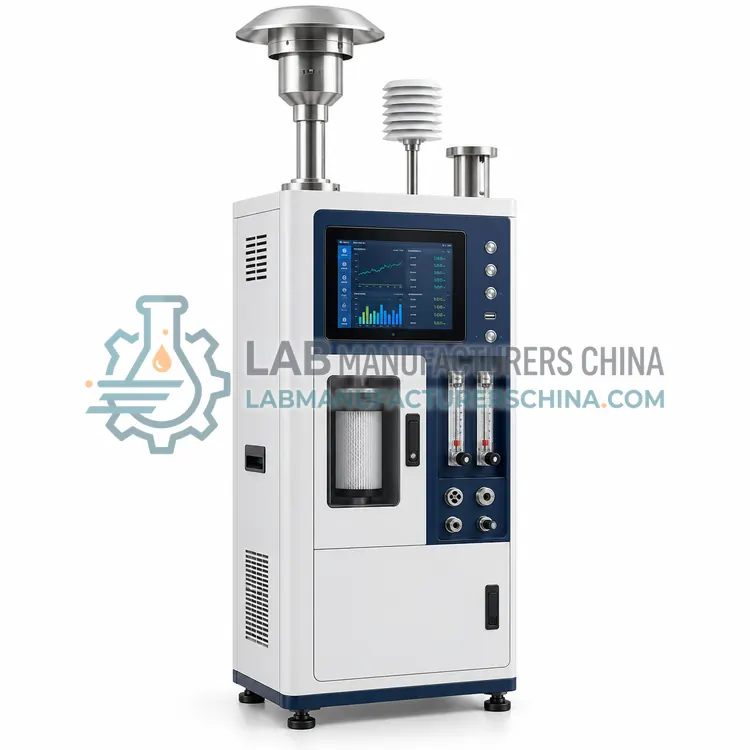
How do Soil Nutrient Analyzers work?
Soil nutrient analysis usually begins with extraction, because plant-available nutrients are a small fraction of the total. Available phosphorus is extracted in a bicarbonate or acid solution and measured by the molybdenum blue colorimetric method. Available nitrogen as ammonium and nitrate is extracted in salt solution and measured by indophenol blue or ultraviolet absorption, while total nitrogen uses Kjeldahl digestion or combustion. Potassium is extracted and measured by flame emission or atomic absorption. Automated analyzers perform these steps in continuous flow, mixing sample with reagents in tubing and reading the coloured product in a flow cell, which gives high throughput with low reagent use. Near-infrared instruments predict organic matter and nutrient content from reflectance spectra. Compact field analyzers combine extraction with a simple colorimeter or ion-selective electrode for immediate results.
Which Soil Nutrient Analyzers variants are available?
- Soil NPK Nutrient Analyzer — A laboratory instrument that measures available nitrogen, phosphorus and potassium in prepared soil extracts.
- Continuous-Flow Soil Nutrient Analyzer — An automated analyzer that mixes sample with reagents in flowing tubing and measures several nutrients in sequence.
- Soil Nitrogen Analyzer — A laboratory system that determines total nitrogen in soil by Kjeldahl digestion or combustion.
- Near-Infrared Soil Nutrient Analyzer — An instrument that predicts soil organic matter and nutrient indicators from reflectance spectra.
- Portable Soil Multi-Parameter Nutrient Analyzer — A field instrument that measures several soil nutrients and related parameters from extracts on site.
How do I choose the right variant?
Decide first whether the requirement is available nutrients for fertilizer recommendations, total content for nutrient budgeting, or rapid field estimates. For official recommendations, use the extraction and measurement methods prescribed by the local soil testing service, because calibrations between soil test values and crop response are tied to a specific method. Continuous flow and discrete analyzers give high throughput and good precision for routine laboratory work, while a manual spectrophotometer suits low volumes. Kjeldahl or combustion nitrogen analyzers are chosen when total nitrogen is required. Near-infrared is attractive for large sample numbers once calibrated locally, but it needs reference data. Compact field analyzers are useful for immediate guidance but have wider uncertainty. Consider digestion and extraction safety, reagent and waste handling, the sample preparation needed, and compatibility with laboratory information systems.
Where are Soil Nutrient Analyzers used?
Soil Nutrient Analyzers are specified in fertilizer recommendation testing, soil fertility monitoring, precision agriculture management and environmental and research studies.
Which standards and certifications apply?
Work with Soil Nutrient Analyzers is commonly governed by ISO 11261 (total nitrogen), ISO 11263 (phosphorus), ISO 11260 (CEC), ISO 10694 (organic carbon), HJ 634 (ammonium, nitrite and nitrate) and ISO 10390 (pH). Instrument certifications such as CE marking are confirmed per configuration and never assumed.
What are the key considerations before purchase?
Use representative, air-dried and sieved samples and record the preparation, because soil test values depend on sampling depth, drying and particle size. Follow the extraction conditions exactly: extractant concentration, soil to solution ratio, shaking time and temperature all change the result. Run blanks and certified reference soil with each batch, and check calibration curves daily for colorimetric methods. For continuous flow systems, maintain tubing, lamps and flow rates, and check for carry-over between samples. Keep reagents fresh and store them as the method requires, and neutralise or dispose of acid and heavy-metal waste properly. Calibrate balances and check the spectrometer wavelength accuracy. Document method, units and reporting basis so results can be compared over time and between laboratories.