Summary
Biosafety cabinets protect the operator, the sample and the environment through inward airflow, HEPA-filtered downflow and HEPA-filtered exhaust. Class I protects operator and environment, Class II also protects the sample, and Class III is a gas-tight glove box. Choose by the risk group of the agents and any chemical use.
What does a biosafety cabinet do?
A biosafety cabinet (BSC) is a ventilated enclosure that contains aerosols generated when handling biological material. It provides three kinds of protection: personnel protection, from an inward airflow through the front opening; product protection, from HEPA-filtered air flowing over the work surface; and environmental protection, from HEPA filtration of the exhaust. A HEPA filter removes at least 99.97 % of particles at 0.3 micrometers in the US definition, and EN 1822 classifies H13 and H14 filters at 99.95 % and 99.995 % efficiency at the most penetrating particle size.
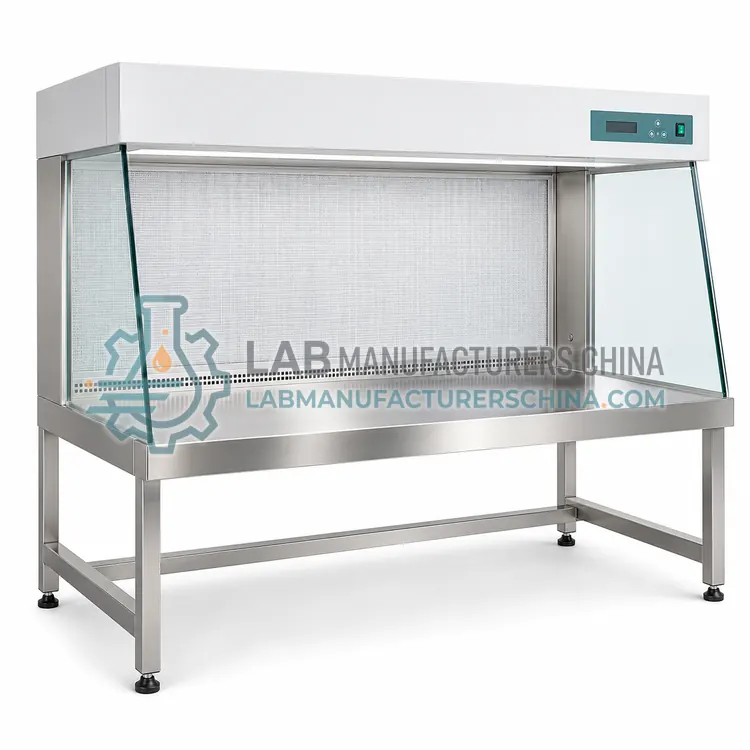
A BSC is not the same as a clean bench. A horizontal or vertical laminar flow clean bench protects the product only, and in a horizontal model the air blows toward the operator. It must not be used for infectious or hazardous material.
A BSC also does not protect against everything. It is not a fume hood. Most classes recirculate part of the air, so volatile toxic chemicals and radionuclides need either a cabinet designed for them or a separate chemical enclosure. Good technique, including placement of materials, slow arm movement and avoiding blocking the grilles, is as important as the equipment.
How do Class I, II and III cabinets differ?
Class I cabinets draw room air in through the front opening and exhaust it through a HEPA filter. They protect the operator and the environment but not the sample, since unfiltered room air flows over the work surface. They are used for enclosing equipment such as centrifuges or for work where sample sterility is not important.
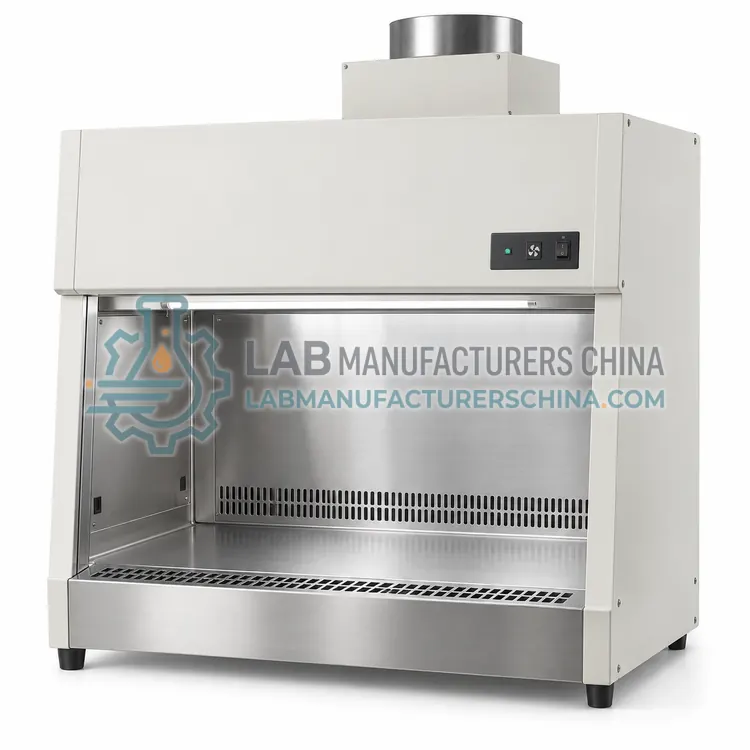
Class II cabinets are the most common in laboratories. They draw air through the front grille to protect the operator, pass HEPA-filtered downflow over the work surface to protect the sample, and exhaust through a HEPA filter to protect the environment. They are divided into types A1, A2, B1 and B2.
Class III cabinets are fully enclosed, gas-tight units. Work is done through attached arm-length gloves, material enters and leaves through a dunk tank or double-door autoclave or pass box, and the cabinet operates under negative pressure. Both the supply and exhaust air are HEPA filtered, and the exhaust is often double filtered or incinerated. They are used for the highest containment, typically associated with biosafety level 4 work.
The classification of the agent into risk groups under national or WHO guidance, together with a site risk assessment, determines which class is required.
What distinguishes Class II Types A1, A2, B1 and B2?
The four Class II types differ in inflow velocity, the share of air recirculated, and how the exhaust is handled.
- Type A1 has a minimum inflow velocity of about 0.38 m/s (75 fpm) in NSF/ANSI 49. About 70 % of air is recirculated and 30 % exhausted into the room or through a canopy connection. It suits work with microbiological agents and no volatile toxic chemicals.
- Type A2 has a minimum inflow of 0.5 m/s (100 fpm), with about 70 % recirculation. Connected to an exhaust by a thimble or canopy connection, it can handle minute quantities of volatile chemicals and radionuclides as adjuncts to microbiological work. It is the most commonly purchased type.
- Type B1 has a 0.5 m/s inflow, about 40 % recirculated and 60 % exhausted through a dedicated hard duct. It can handle small amounts of volatile chemicals.
- Type B2 is a total-exhaust cabinet with no recirculation. Air is drawn in at 0.5 m/s, and all supply and inflow air is exhausted through a dedicated duct, making it suitable for work with significant volatile toxic chemicals or radionuclides.
EN 12469 sets the European approach and requires an inflow velocity that keeps personnel protection at or above a defined level, so values differ slightly in method but are equivalent in intent. Exhaust ducting and building airflow design have cost and planning consequences, particularly for B2.
Which standards and tests apply?
Two standards dominate. EN 12469 (Biotechnology — Performance criteria for microbiological safety cabinets) sets performance criteria and test methods for cabinets used in Europe. NSF/ANSI 49 (Biosafety Cabinetry: Design, Construction, Performance, and Field Certification) is widely used in North America and referenced worldwide. In China, YY 0569 covers Class II biological safety cabinets. The HEPA filter performance is referenced to EN 1822 and IEST-RP-CC001 or ISO 29463 in other documents.
Type tests performed on the design include the following.
- Personnel protection, often with a microbial aerosol challenge such as Bacillus subtilis spores, or a potassium iodide method in EN 12469.
- Product protection and cross-contamination tests.
- Inflow and downflow velocity measurement and airflow smoke pattern visualization.
- HEPA filter leak scan, using an aerosol such as PAO or DOP.
- Noise, illumination, vibration and electrical safety tests; electrical safety refers to IEC 61010-1.
Field certification is needed at installation, after relocation, after filter change or repair, and at least annually. A certifier tests inflow, downflow, filter integrity, alarms and lighting. A certification sticker and report should be retained. Buyers should confirm any test certificate or type approval from documents rather than catalogue statements.
How should a buyer choose the right cabinet?
Start with the risk assessment. Identify the agents, their risk group, the volume and concentration handled, the procedures that create aerosols, and any chemicals or radioisotopes used alongside them. Then follow this sequence.
1. Decide the class. Class II covers most cell culture, microbiology and clinical work. Class I suits operator-only protection. Class III is for the highest-risk agents. 2. Decide the type. Choose A2 for general biological work and minimal chemical use, B2 when volatile toxic chemicals are significant, and B1 if a partial exhaust is acceptable. 3. Select the width from 0.9 m (3 ft), 1.2 m (4 ft), 1.5 m (5 ft) or 1.8 m (6 ft) according to the number of operators and the equipment inside. 4. Plan exhaust. Check whether the cabinet can be thimble connected, how the duct is routed, and whether the building supply can make up the air removed. 5. Consider location. Avoid doors, walkways and air diffusers that disturb the inflow, and leave clearance around the unit for service.
Check features such as UV lamp (optional and not a substitute for disinfection), sash alarm, filter life indicator, stand height, drain and service connections, and noise below about 60 dB(A). Put the required standard, class and type, width, exhaust method and documentation in the RFQ.
What maintenance and operating practices keep a cabinet safe?
A cabinet is only as protective as its condition and its use. Good practice includes the following.
- Turn the blower on for at least 4 to 5 minutes before work and after work so the workspace is purged.
- Wipe surfaces before and after use with a disinfectant suitable for the agents and compatible with stainless steel, and follow with water or alcohol if a corrosive disinfectant is used.
- Place materials in zones: clean items on one side, contaminated waste on the other, and avoid blocking the front and rear grilles.
- Work at least 10 to 15 cm inside the front grille, move arms slowly, and minimize traffic behind the operator.
- Avoid open flames. A Bunsen burner disturbs airflow and can damage the HEPA filter; use a micro-incinerator or disposable loops instead.
- Record the certification date, pressure gauge readings and filter life alarms in a log.
- Decontaminate the cabinet, typically with formaldehyde or vaporized hydrogen peroxide, before filter change or relocation, according to a written procedure.
Train all users and review the procedures annually. Confirm with your supplier the expected HEPA filter life, the availability of replacement filters and certified service support in your country.