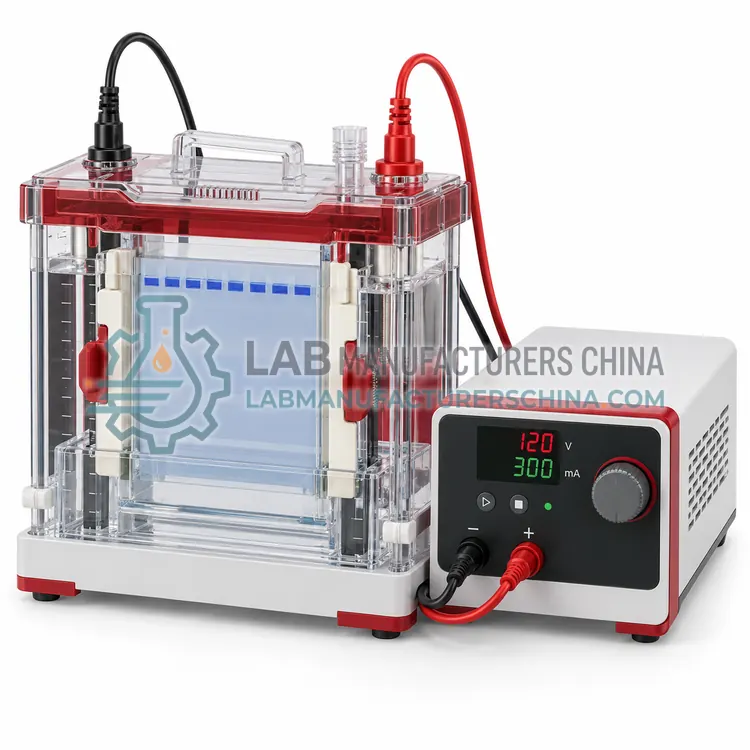
How do Vertical Electrophoresis work?
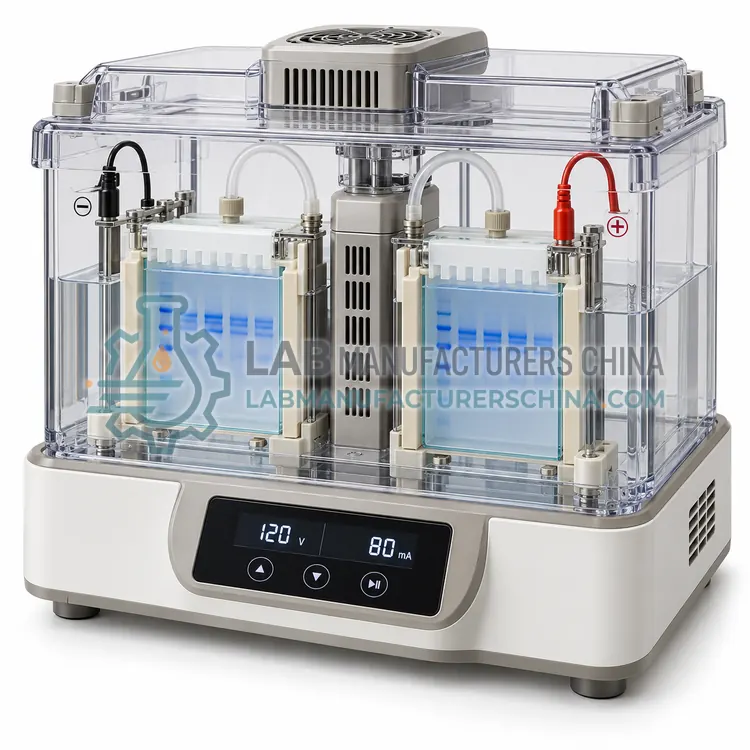
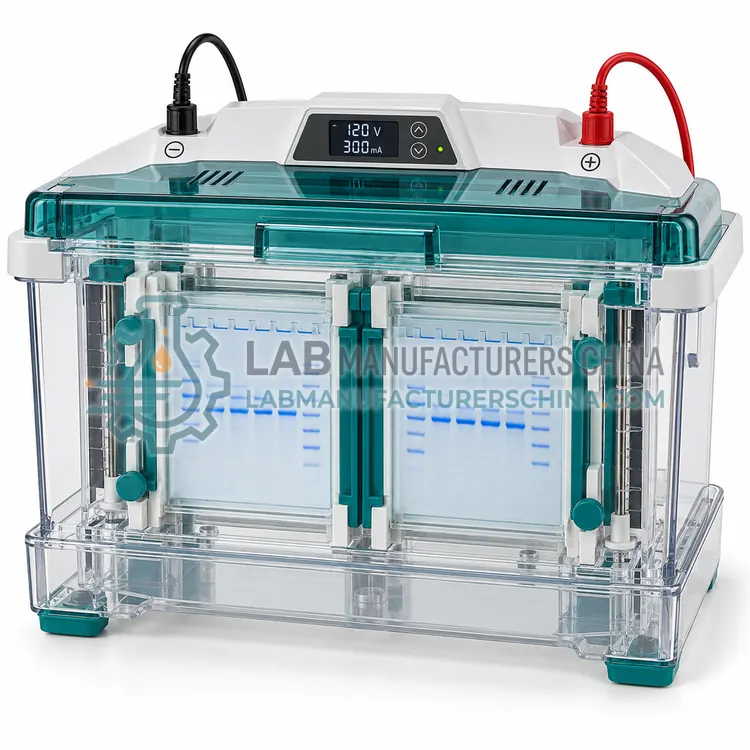
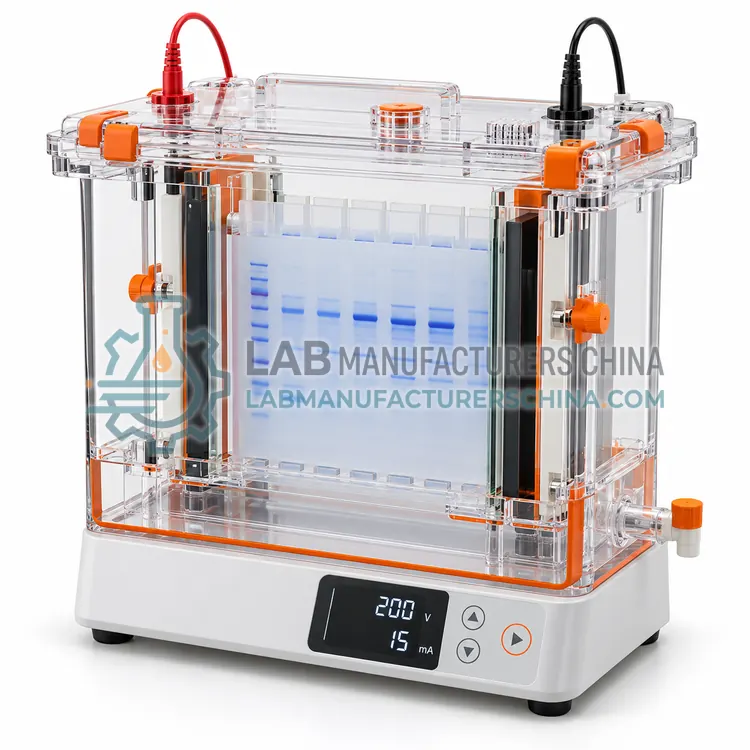
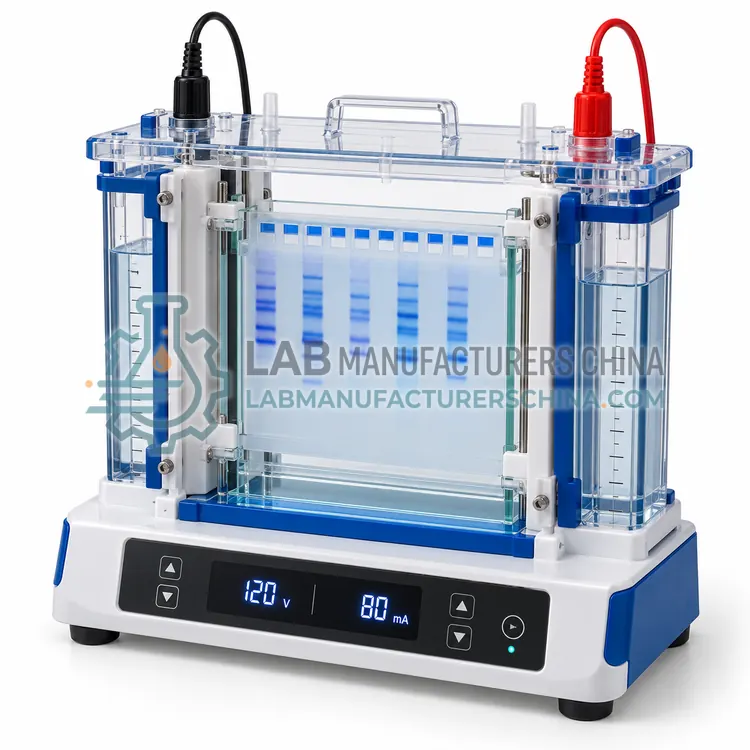
In a vertical system a polyacrylamide gel is cast between two glass plates separated by spacers and mounted so that its top edge dips into an upper buffer chamber and its bottom edge into a lower one. Voltage across the two chambers drives charged molecules down through the gel. Polyacrylamide forms a tighter and more uniform mesh than agarose, and its pore size is set by total acrylamide percentage and crosslinker ratio, so proteins or fragments differing by a few kilodaltons or a single nucleotide can be resolved. In discontinuous SDS-PAGE, a stacking gel concentrates samples into a sharp band before they enter the resolving gel. Key parts include the plates, spacers, combs, clamps, gaskets, buffer chambers and a cooling core or plate that removes Joule heat.
Which Vertical Electrophoresis variants are available?
- Mini Vertical Gel Electrophoresis System for Proteins — A compact vertical unit for 8 x 7 cm polyacrylamide gels that runs one to four gels in 40–90 minutes.
- Midi Vertical Gel Electrophoresis System — A vertical unit for 16 x 16 cm gels that gives a separation path about twice as long as a mini gel.
- Large-Format Vertical Electrophoresis System for 2D-PAGE — A large vertical unit for 20 x 20 cm gels, often with a cooling circuit, designed for the second dimension of two-dimensional electrophoresis and high-resolution separation of complex proteomes.
- DNA Sequencing Gel Electrophoresis Apparatus — A vertical apparatus with long, thin plates, typically 33 x 42 cm or longer, that resolves nucleic acid fragments differing by one nucleotide on denaturing polyacrylamide gels.
- Multi-Gel Vertical Electrophoresis Chamber with Gel Caster — A vertical tank that runs up to six or twelve gels in a single chamber, supplied with a multi-gel caster for batch preparation.
How do I choose the right variant?
Decide the gel format from the application. Mini gels of about 8 x 7 cm are quick and economical for routine protein checks and western blot preparation. Midi and large-format gels give longer separation paths for complex samples, and 20 x 20 cm plates are standard for two-dimensional electrophoresis. Sequencing apparatus with long thin plates suits nucleic acid work at single-base resolution. Consider throughput, whether multiple gels must be run and cast together, and whether cooling is needed for long high-voltage runs. Check gel thickness options from 0.75 to 1.5 mm, comb well counts, compatibility with pre-cast gels, and plate and spacer quality, because chipped glass causes leaks. Match the power supply to voltage and current needs, especially for multi-gel runs.
Where are Vertical Electrophoresis used?
Vertical Electrophoresis are specified in SDS-PAGE protein separation, native PAGE and activity gels, two-dimensional electrophoresis, DNA sequencing gels and western blot sample preparation.
Which standards and certifications apply?
Work with Vertical Electrophoresis is commonly governed by IEC 61010-1, IEC 61326-1, Ph. Eur. 2.2.31, USP <1053> and ISO 17025. Instrument certifications such as CE marking are confirmed per configuration and never assumed.
What are the key considerations before purchase?
Assemble plates on a clean, flat surface and check gaskets and spacers for damage before each cast, since leaks ruin gels and contaminate the lower chamber. Acrylamide monomer is neurotoxic, so use gloves and cured gels or pre-cast products where possible. Use fresh APS and TEMED for reproducible polymerisation. Keep buffer chambers filled to the marked level and fit the cooling core for long runs. Clean glass plates with non-abrasive detergent and never use razor blades for separation. Electrical safety follows IEC 61010-1, with interlocked lids and insulated leads. Keep records of gel percentage, buffer batch and run conditions, and verify performance with molecular weight markers.