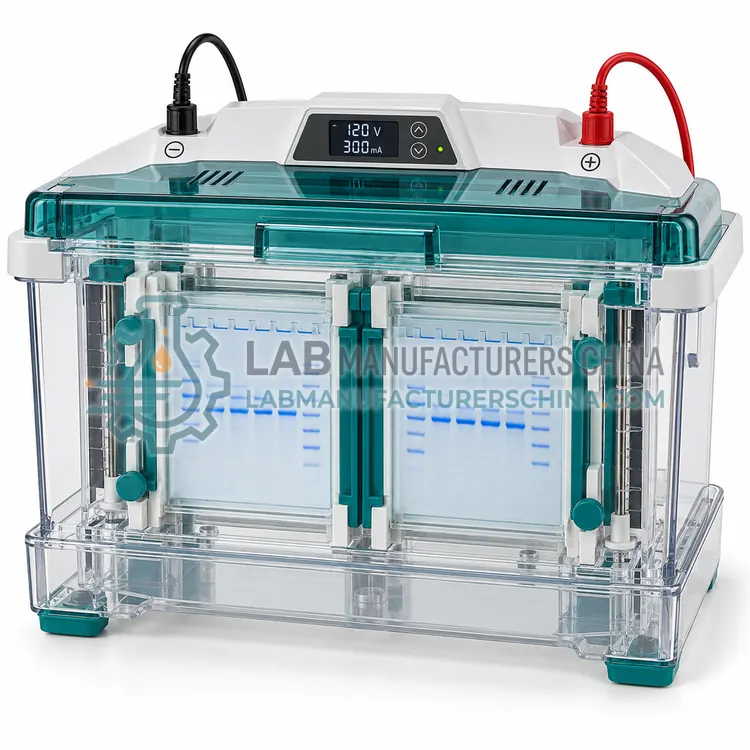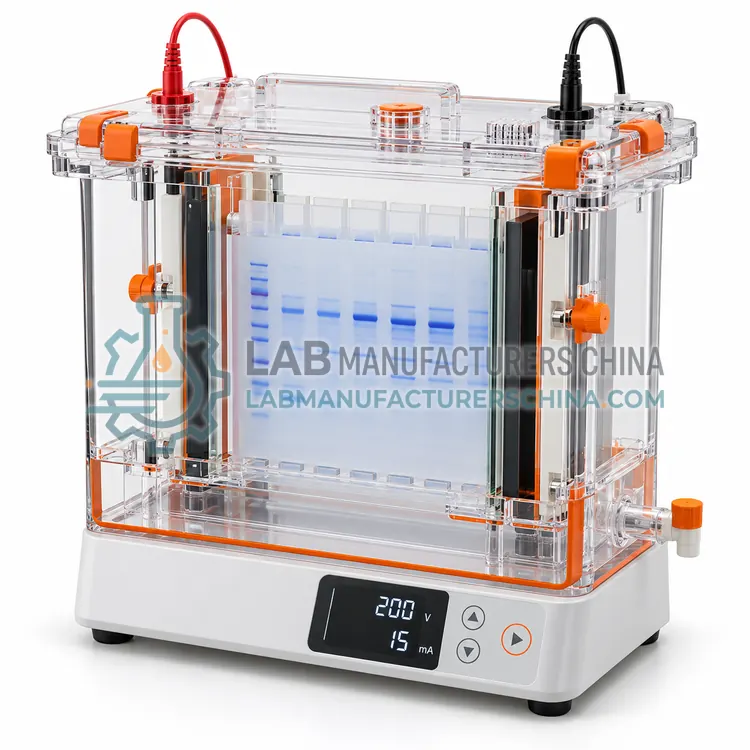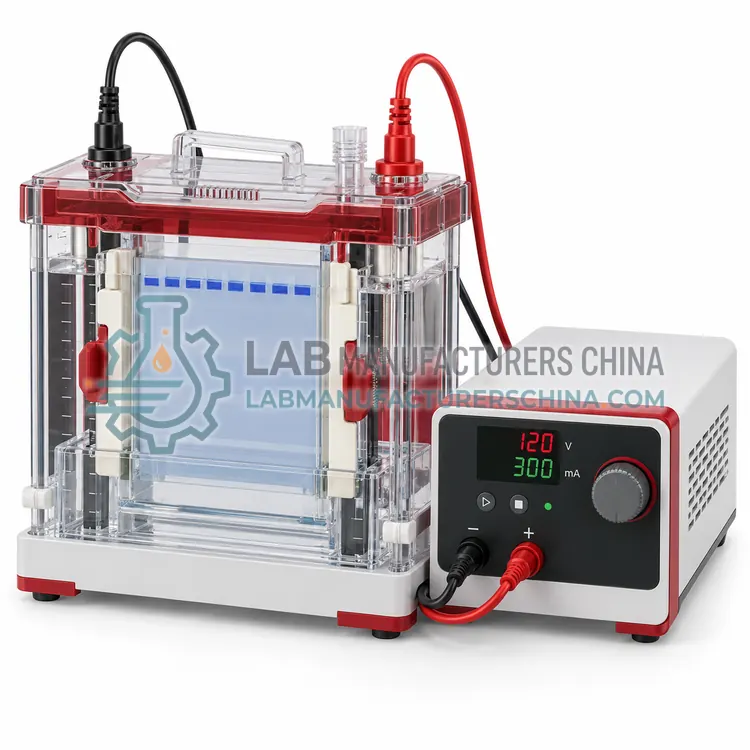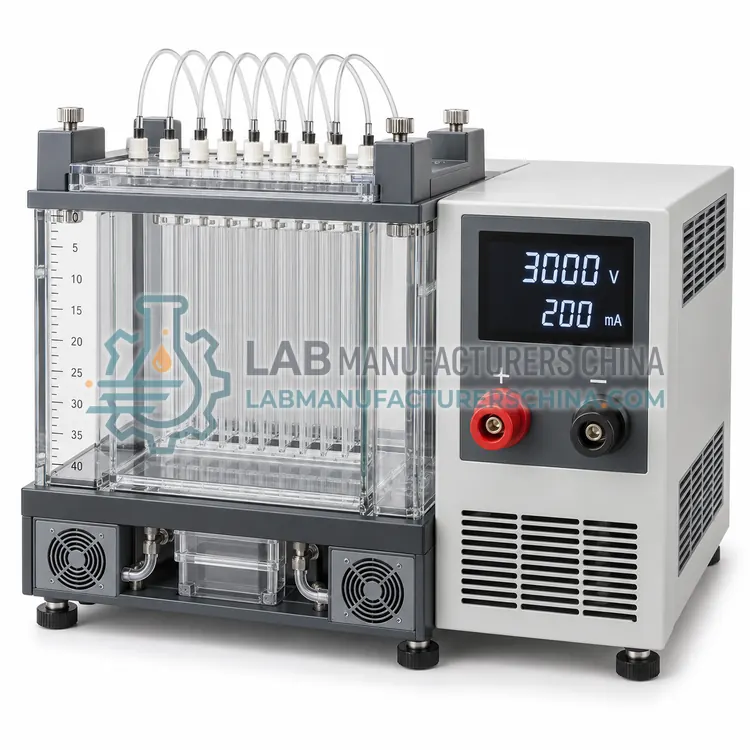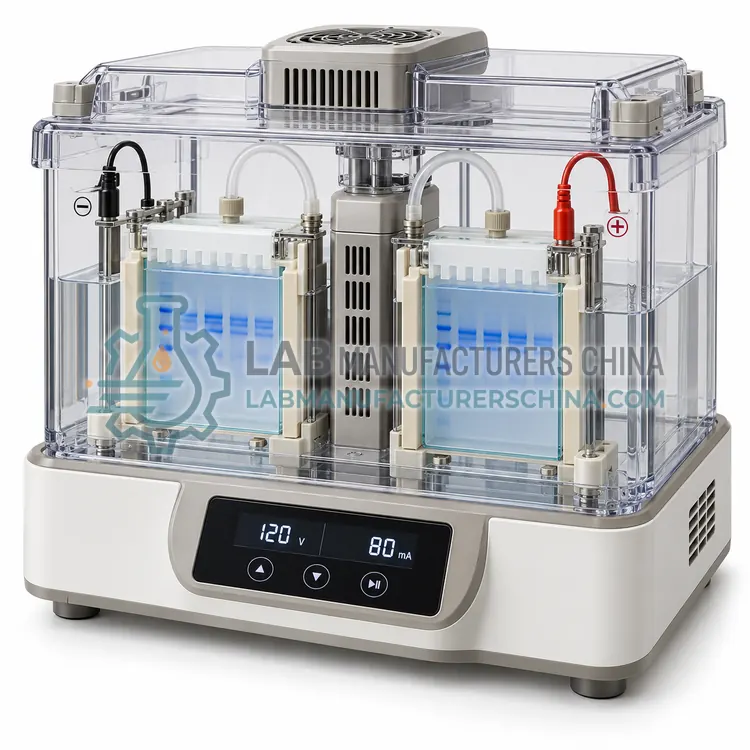

DNA Sequencing Gel Electrophoresis Apparatus
DNA 测序胶电泳装置
- SKU VEE-0004
- Vertical Electrophoresis
- CE (to be confirmed)
- ISO 9001 manufacturing (to be confirmed)
- RoHS (to be confirmed)
Price on request — FOB / CIF quoted per order
Prices depend on configuration, quantity and destination port.
Key specifications
| Gel size (W x L) | 33 x 42 cm (38 x 50 cm option) |
|---|---|
| Gel thickness | 0.2–0.4 mm |
| Gel type | 6–8% denaturing polyacrylamide, 7–8 M urea |
| Maximum voltage | 3000 V DC |
| Maximum power | 100 W |
| Gel temperature | approx. 45–55 °C |
Request a quote Download brochure · to be provided
By Lab Manufacturers China Technical TeamLast reviewed Standards: IEC 61010-1, IEC 61326-1, Ph. Eur. 2.2.31
What is the DNA Sequencing Gel Electrophoresis Apparatus?
A vertical apparatus with long, thin plates, typically 33 x 42 cm or longer, that resolves nucleic acid fragments differing by one nucleotide on denaturing polyacrylamide gels. It is used for manual sequencing, primer extension and footprinting work.
What is the DNA Sequencing Gel Electrophoresis Apparatus?
A vertical apparatus with long, thin plates, typically 33 x 42 cm or longer, that resolves nucleic acid fragments differing by one nucleotide on denaturing polyacrylamide gels. It is used for manual sequencing, primer extension and footprinting work.
Overview
A sequencing gel apparatus is built for single-nucleotide resolution. Plates of about 33 x 42 cm or 38 x 50 cm, and gels only 0.2–0.4 mm thick, are run in 6–8% denaturing polyacrylamide containing 7–8 M urea at temperatures of around 50 °C. High voltage of 1500–3000 V is applied, so the apparatus uses a thermostatic aluminium plate and a safety lid with interlock to handle heat and electrical hazards. Shark-tooth combs give sharp lanes of 0.4 mm wells. Samples can be radiolabelled, fluorescently labelled or silver-stained after separation, and the gel is often dried. Although automated capillary sequencers have replaced most manual sequencing, these systems remain used for primer extension, RNase protection, DNase footprinting, AFLP and microsatellite analysis on slab gels.
How does it work?
In a vertical system a polyacrylamide gel is cast between two glass plates separated by spacers and mounted so that its top edge dips into an upper buffer chamber and its bottom edge into a lower one. Voltage across the two chambers drives charged molecules down through the gel. Polyacrylamide forms a tighter and more uniform mesh than agarose, and its pore size is set by total acrylamide percentage and crosslinker ratio, so proteins or fragments differing by a few kilodaltons or a single nucleotide can be resolved. In discontinuous SDS-PAGE, a stacking gel concentrates samples into a sharp band before they enter the resolving gel. Key parts include the plates, spacers, combs, clamps, gaskets, buffer chambers and a cooling core or plate that removes Joule heat.
What are the key features?
- Plates of 33 x 42 cm or longer give the migration distance needed for single-base resolution
- Thermostatic aluminium plate keeps the gel near 50 °C to maintain full DNA denaturation
- Thin spacers of 0.2–0.4 mm and shark-tooth combs produce sharp lanes
- Safety lid with interlock and high-voltage shrouded connectors suits 3000 V operation
- Upper and lower buffer tanks with level marks allow ion gradient (wedge) loading techniques
- Gel caster and leveling accessories help pour bubble-free thin gels reproducibly
What are the technical specifications?
A typical dna sequencing gel electrophoresis apparatus configuration offers gel size (W x L) of 33 x 42 cm (38 x 50 cm option), gel thickness of 0.2–0.4 mm, gel type of 6–8% denaturing polyacrylamide, 7–8 M urea, maximum voltage of 3000 V DC, maximum power of 100 W and gel temperature of approx. 45–55 °C. Values are indicative of the product class; the exact figures for each configuration are confirmed on the quotation and the calibration documents supplied with the instrument.
Which applications is it used for?
The DNA Sequencing Gel Electrophoresis Apparatus is used in manual Sanger sequencing, primer extension assays, DNase footprinting and AFLP and microsatellite analysis. Across the wider Vertical Electrophoresis class, laboratories also deploy it for SDS-PAGE protein separation, native PAGE and activity gels and two-dimensional electrophoresis.
Which standards and certifications apply?
Relevant standards and methods include IEC 61010-1, IEC 61326-1, Ph. Eur. 2.2.31, USP <1053> and ISO 17025. Certification candidates for this model are CE, ISO 9001 manufacturing and RoHS; each is to be confirmed for the specific configuration before shipment, and certificates are supplied only where they have been issued.
Assemble plates on a clean, flat surface and check gaskets and spacers for damage before each cast, since leaks ruin gels and contaminate the lower chamber. Acrylamide monomer is neurotoxic, so use gloves and cured gels or pre-cast products where possible. Use fresh APS and TEMED for reproducible polymerisation. Keep buffer chambers filled to the marked level and fit the cooling core for long runs. Clean glass plates with non-abrasive detergent and never use razor blades for separation. Electrical safety follows IEC 61010-1, with interlocked lids and insulated leads. Keep records of gel percentage, buffer batch and run conditions, and verify performance with molecular weight markers.
How do I select the right DNA Sequencing Gel Electrophoresis Apparatus?
Select a sequencing gel apparatus when single-base resolution on a slab gel is needed and capillary instruments are not available or suitable. It needs a high-voltage power supply of 3000 V and careful gel casting. Specify plate size, spacer thickness, comb type, maximum voltage and power, and temperature control.
How does it compare with other Vertical Electrophoresis variants?
Decide the gel format from the application. Mini gels of about 8 x 7 cm are quick and economical for routine protein checks and western blot preparation. Midi and large-format gels give longer separation paths for complex samples, and 20 x 20 cm plates are standard for two-dimensional electrophoresis. Sequencing apparatus with long thin plates suits nucleic acid work at single-base resolution. Consider throughput, whether multiple gels must be run and cast together, and whether cooling is needed for long high-voltage runs. Check gel thickness options from 0.75 to 1.5 mm, comb well counts, compatibility with pre-cast gels, and plate and spacer quality, because chipped glass causes leaks. Match the power supply to voltage and current needs, especially for multi-gel runs.
Full specifications
| Gel size (W x L) | 33 x 42 cm (38 x 50 cm option) |
|---|---|
| Gel thickness | 0.2–0.4 mm |
| Gel type | 6–8% denaturing polyacrylamide, 7–8 M urea |
| Maximum voltage | 3000 V DC |
| Maximum power | 100 W |
| Gel temperature | approx. 45–55 °C |
| Comb type | Shark-tooth, 48–96 wells |
| Typical run time | 2–4 h at 50–60 W |
| Resolution | 1 nucleotide up to approx. 400 nt |
| Buffer volume | approx. 1.5–2 L (1x TBE) |
Indicative values for this product class. Final specifications are confirmed on the quotation and in the calibration documents supplied with the instrument.
Applications
- Manual Sanger sequencing
- Primer extension assays
- DNase footprinting
- AFLP and microsatellite analysis
Key features
- Plates of 33 x 42 cm or longer give the migration distance needed for single-base resolution
- Thermostatic aluminium plate keeps the gel near 50 °C to maintain full DNA denaturation
- Thin spacers of 0.2–0.4 mm and shark-tooth combs produce sharp lanes
- Safety lid with interlock and high-voltage shrouded connectors suits 3000 V operation
- Upper and lower buffer tanks with level marks allow ion gradient (wedge) loading techniques
- Gel caster and leveling accessories help pour bubble-free thin gels reproducibly
Frequently asked questions about DNA Sequencing Gel Electrophoresis Apparatus
Heat of about 50 °C keeps DNA fully denatured by preventing secondary structures that cause band compressions. The urea in the gel adds denaturing strength, and the thermostatic plate distributes heat evenly to avoid smiling.
A sequencing gel needs a supply delivering up to 3000 V with constant-power mode, typically 50–100 W. Constant power keeps the gel temperature stable as resistance changes. The supply should have a safety interlock and overload protection.
Routine sequencing has moved to automated capillary instruments, but slab gels remain useful for primer extension, footprinting, RNase protection, AFLP and microsatellite work, particularly where radioactive detection or low per-gel cost is preferred.
A vertical system runs polyacrylamide gels between glass plates to separate proteins and short nucleic acids with high resolution. It is used for SDS-PAGE, native PAGE, two-dimensional electrophoresis, sequencing gels and preparing samples for western blotting.
Polyacrylamide forms a finer and more uniform mesh whose pore size is tuned by acrylamide percentage and crosslinker. This resolves proteins and small nucleic acids that differ by a few kilodaltons or a single base, which agarose cannot separate.
Leaks usually come from chipped glass plates, worn gaskets, misaligned spacers or over-tightened clamps. Inspect the plate edges, replace damaged gaskets, assemble on a flat surface and test with water before pouring the gel.
Related models