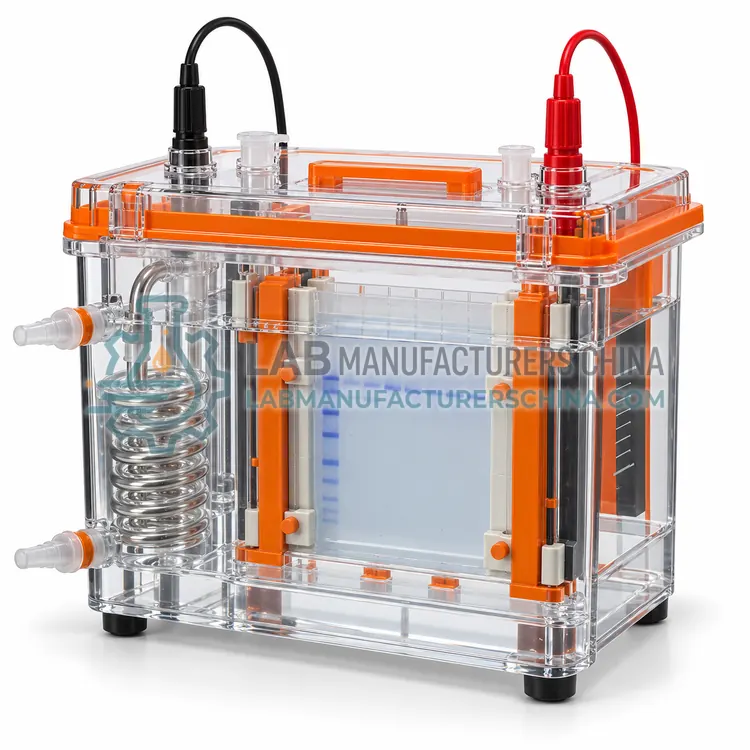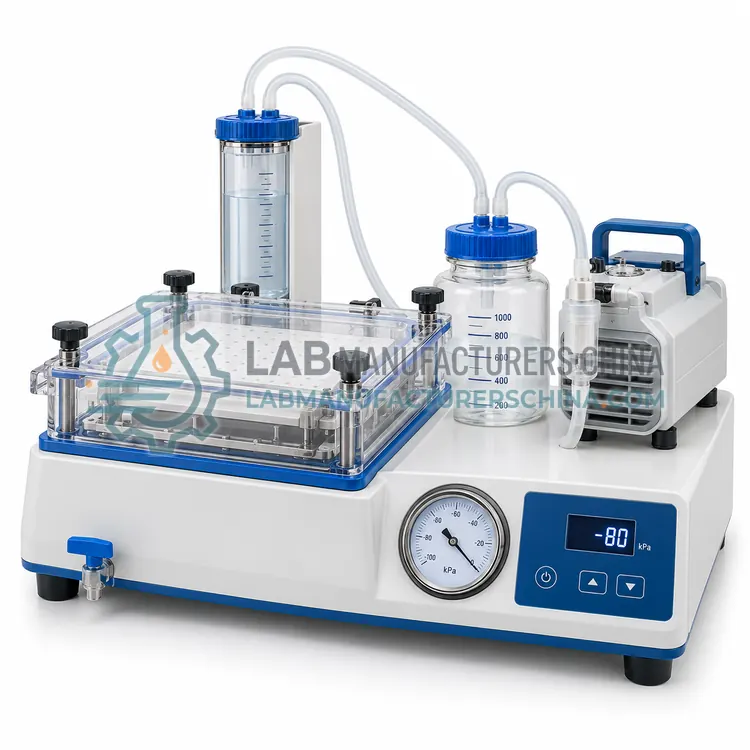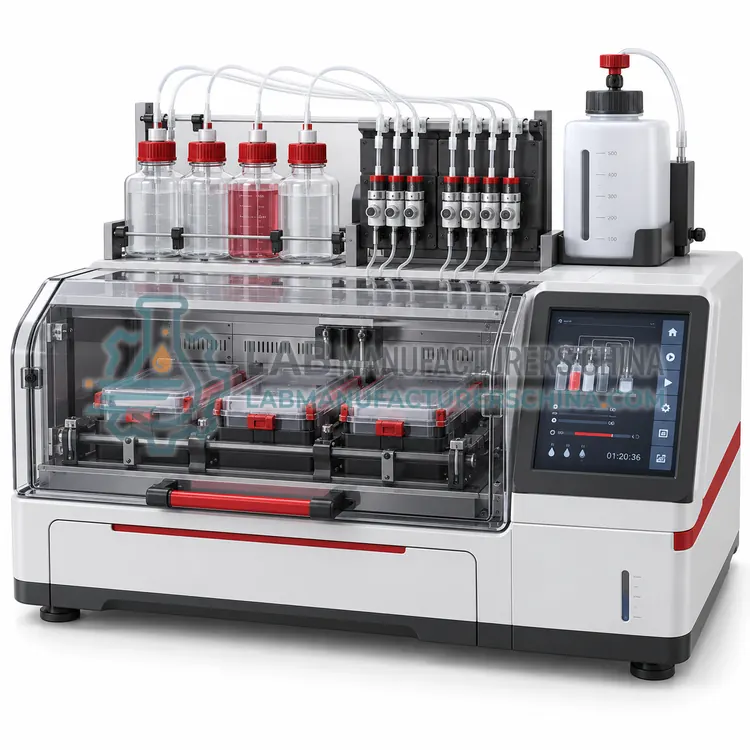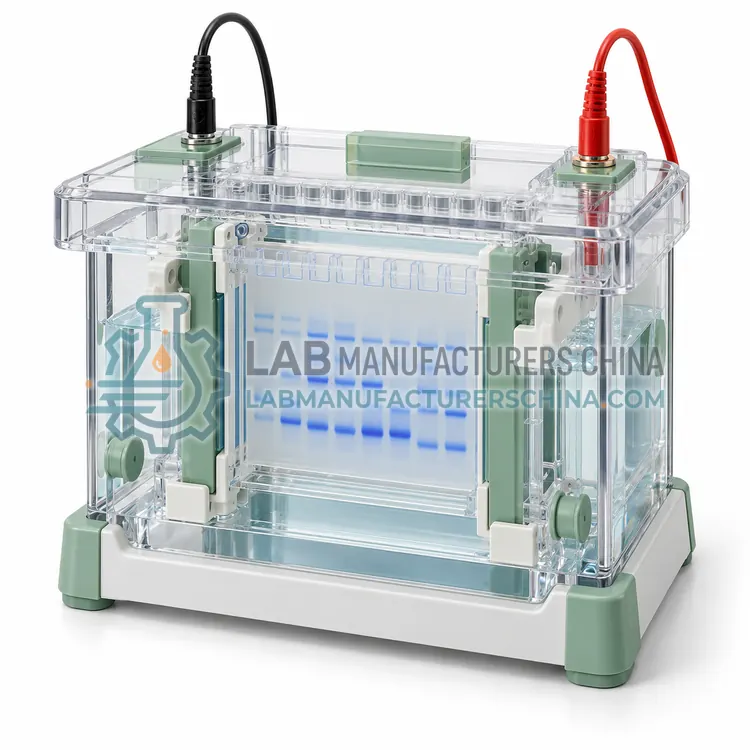
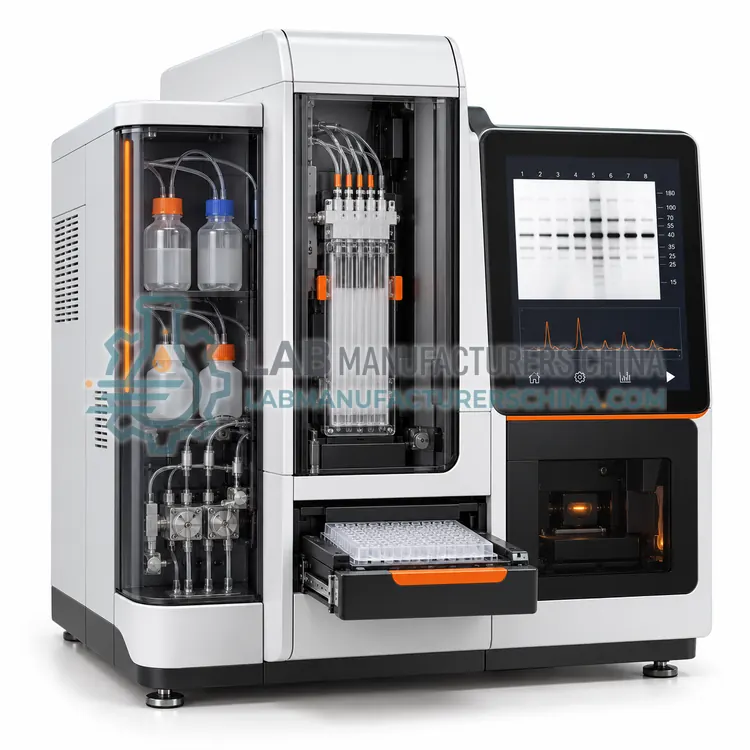
Automated Capillary Western Blot System
自动化毛细管 Western 印迹系统
- SKU WBS-0001
- Western Blot Systems
- CE (to be confirmed)
- ISO 9001 manufacturing (to be confirmed)
- IEC 61010-1 safety (to be confirmed)
- 21 CFR Part 11 software compliance (to be confirmed)
Price on request — FOB / CIF quoted per order
Prices depend on configuration, quantity and destination port.
Key specifications
| Capillaries per cartridge | 12, 24, 48 or 96 |
|---|---|
| Run time | approx. 3–5 h |
| Sample volume | 0.5–5 µL per capillary |
| Protein concentration | 0.2–2 mg/mL total protein (typical) |
| Molecular weight range | approx. 12–440 kDa |
| Separation | Capillary electrophoresis in photoactivated matrix |
Request a quote Download brochure · to be provided
By Lab Manufacturers China Technical TeamLast reviewed Standards: USP <1057>, Ph. Eur. 2.2.31, IEC 61010-1
What is the Automated Capillary Western Blot System?
An automated capillary western blot system separates proteins in a capillary and performs blocking, antibody incubation and detection inside the same capillary, quantifying results as peak areas. It replaces manual gels and membranes with a few hours of hands-off operation.
What is the Automated Capillary Western Blot System?
An automated capillary western blot system separates proteins in a capillary and performs blocking, antibody incubation and detection inside the same capillary, quantifying results as peak areas. It replaces manual gels and membranes with a few hours of hands-off operation.
Overview
The system loads samples, a biotinylated ladder and reagents into a capillary cartridge with a photoactivated separation matrix. After electrophoretic separation, proteins are immobilised on the capillary wall by ultraviolet light, then exposed in sequence to blocking reagent, primary antibody, secondary antibody carrying a chemiluminescent enzyme and substrate. Chemiluminescent signal is captured by a CCD camera and displayed as a lane profile with peak area and mass values calculated against the ladder. Typical runs use 0.5–5 µL of lysate at 0.2–2 mg/mL total protein and complete 12 to 96 capillaries in three to five hours. Because volumes and incubations are instrument controlled, results are highly reproducible and exported as digital records with full traceability.
How does it work?
Western blotting starts with separation of proteins by SDS-PAGE or a capillary system. In conventional blotting, the gel is placed against a nitrocellulose or PVDF membrane in a transfer stack and an electric field drives the negatively charged proteins out of the gel onto the membrane, where they bind by hydrophobic and electrostatic interaction. The membrane is then blocked with protein or detergent to saturate remaining binding sites, incubated with a primary antibody against the target, washed, incubated with an enzyme- or fluorophore-labelled secondary antibody that recognises the primary antibody, and washed again. Bound enzyme is detected by adding a chemiluminescent or colorimetric substrate, and the signal is imaged and quantified against a standard or a loading control. Automated capillary systems perform the equivalent steps in a capillary with a separation matrix and immobilised reagents.
What are the key features?
- Capillary separation with in-capillary blocking and antibody steps
- Quantitative peak area and mass values against a biotinylated ladder
- Sample consumption of 0.5–5 µL per capillary
- 12 to 96 capillary cartridges for flexible throughput
- Automated chemiluminescent detection with digital records
- Validated instrument and software for regulated laboratories
What are the technical specifications?
A typical automated capillary western blot system configuration offers capillaries per cartridge of 12, 24, 48 or 96, run time of approx. 3–5 h, sample volume of 0.5–5 µL per capillary, protein concentration of 0.2–2 mg/mL total protein (typical), molecular weight range of approx. 12–440 kDa and separation of Capillary electrophoresis in photoactivated matrix. Values are indicative of the product class; the exact figures for each configuration are confirmed on the quotation and the calibration documents supplied with the instrument.
Which applications is it used for?
The Automated Capillary Western Blot System is used in quantitative protein expression analysis, biopharmaceutical purity and identity testing, signalling pathway and phosphorylation studies and antibody characterisation and validation. Across the wider Western Blot Systems class, laboratories also deploy it for specific protein detection in cell lysates, recombinant protein expression monitoring and biopharmaceutical purity and identity testing.
Which standards and certifications apply?
Relevant standards and methods include USP <1057>, Ph. Eur. 2.2.31, IEC 61010-1, ISO 17025, 21 CFR Part 11 and ISO 9001. Certification candidates for this model are CE, ISO 9001 manufacturing, IEC 61010-1 safety and 21 CFR Part 11 software compliance; each is to be confirmed for the specific configuration before shipment, and certificates are supplied only where they have been issued.
Transfer efficiency depends on current, time, buffer composition and the amount of methanol or SDS, so conditions should be established for each target protein and recorded in the method. Air bubbles trapped in the stack cause localised transfer gaps, and membranes must be handled with gloves and kept wet once activated. Blocking agent choice affects background and antibody binding, and milk-based blockers can interfere with phospho-specific antibodies. Wash volumes and times must be consistent to keep background low. Chemiluminescent substrates fade quickly, so images should be captured within the recommended window, and quantitative comparisons should include a loading control on the same membrane. Store antibodies in aliquots at the recommended temperature and record lot numbers, because antibody performance varies between lots.
How do I select the right Automated Capillary Western Blot System?
Select an automated capillary system when quantitative, reproducible western blot data with digital records are required and sample volume is limited. Specify capillary count, molecular weight range, sample volume, detection chemistry and the validation documentation provided for regulated use.
How does it compare with other Western Blot Systems variants?
Choose first between conventional and automated blotting. Conventional tank or semi-dry transfer with manual antibody incubation costs less per sample and allows flexible antibody choices, but requires more hands-on time and gives semi-quantitative results. Automated capillary systems reduce run time to a few hours, use nanolitre sample volumes and produce quantitative peak areas, which suits regulated laboratories generating many comparable data sets. For conventional workflows, decide transfer format by gel size and protein molecular weight: tank transfer suits large gels and high molecular weight proteins, semi-dry transfer is faster and uses less buffer, and vacuum transfer is useful for thick gels. Check membrane and gel dimensions, electrode type, current and voltage range, cooling options and whether the system handles multiple gels at once.
Full specifications
| Capillaries per cartridge | 12, 24, 48 or 96 |
|---|---|
| Run time | approx. 3–5 h |
| Sample volume | 0.5–5 µL per capillary |
| Protein concentration | 0.2–2 mg/mL total protein (typical) |
| Molecular weight range | approx. 12–440 kDa |
| Separation | Capillary electrophoresis in photoactivated matrix |
| Detection | Chemiluminescence with CCD imaging |
| Quantification | Peak area and mass against biotinylated ladder |
| Data output | Digital lane profiles with audit trail |
| Dimensions (W x D x H) | approx. 500 x 500 x 450 mm |
Indicative values for this product class. Final specifications are confirmed on the quotation and in the calibration documents supplied with the instrument.
Applications
- Quantitative protein expression analysis
- Biopharmaceutical purity and identity testing
- Signalling pathway and phosphorylation studies
- Antibody characterisation and validation
Key features
- Capillary separation with in-capillary blocking and antibody steps
- Quantitative peak area and mass values against a biotinylated ladder
- Sample consumption of 0.5–5 µL per capillary
- 12 to 96 capillary cartridges for flexible throughput
- Automated chemiluminescent detection with digital records
- Validated instrument and software for regulated laboratories
Frequently asked questions about Automated Capillary Western Blot System
Separation, immobilisation, blocking, antibody incubation and detection all occur inside a capillary, so no gel casting, membrane transfer or manual washing is needed. The result is a quantitative lane profile rather than a photographic band image.
About 0.5–5 µL per capillary at 0.2–2 mg/mL total protein, so a typical experiment uses less than 20 µL of lysate. Low-abundance targets may need a higher protein concentration or an enrichment step.
Usually yes, provided the antibody works in denaturing conditions and is validated for the target species. Concentrations are often higher than for manual blots because diffusion is limited, and each antibody should be titrated on the system before routine use.
An electric field drives negatively charged SDS-coated proteins out of the gel and onto a nitrocellulose or PVDF membrane placed against it. Proteins bind the membrane by hydrophobic and electrostatic interactions, after which antibodies detect the target.
Nitrocellulose binds proteins well and gives low background for most chemiluminescent detection. PVDF has higher binding capacity and better mechanical strength, which helps with repeated stripping and reprobing and with low-abundance or small proteins.
Use a pre-stained molecular weight ladder on the gel, and stain the membrane with Ponceau S or a reversible protein stain to confirm that proteins have moved. Staining the gel after transfer shows how much protein remains behind.
Related models