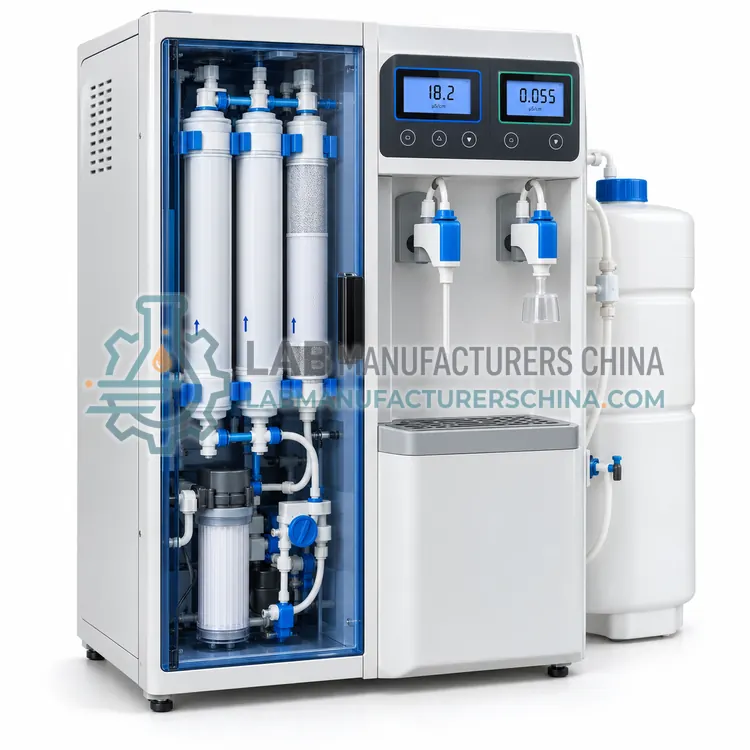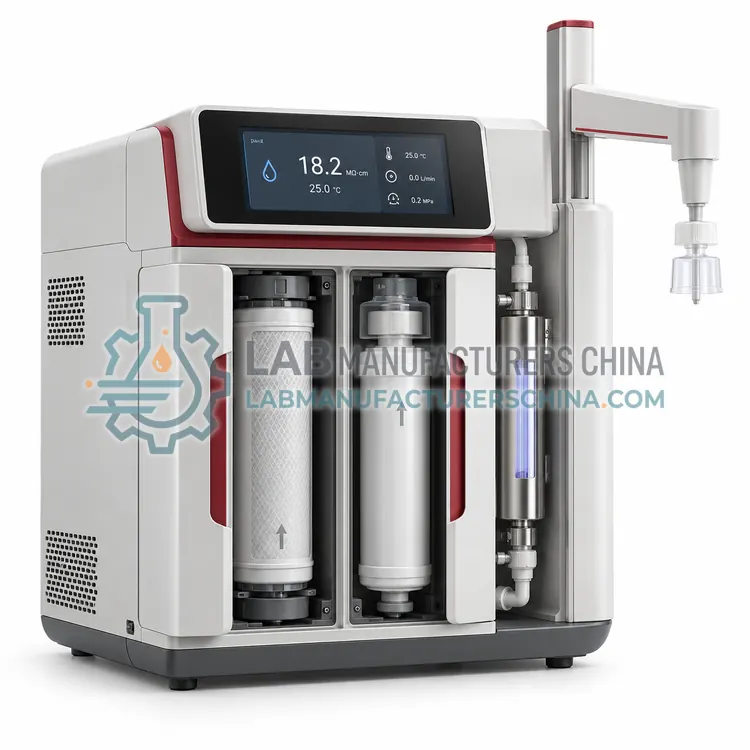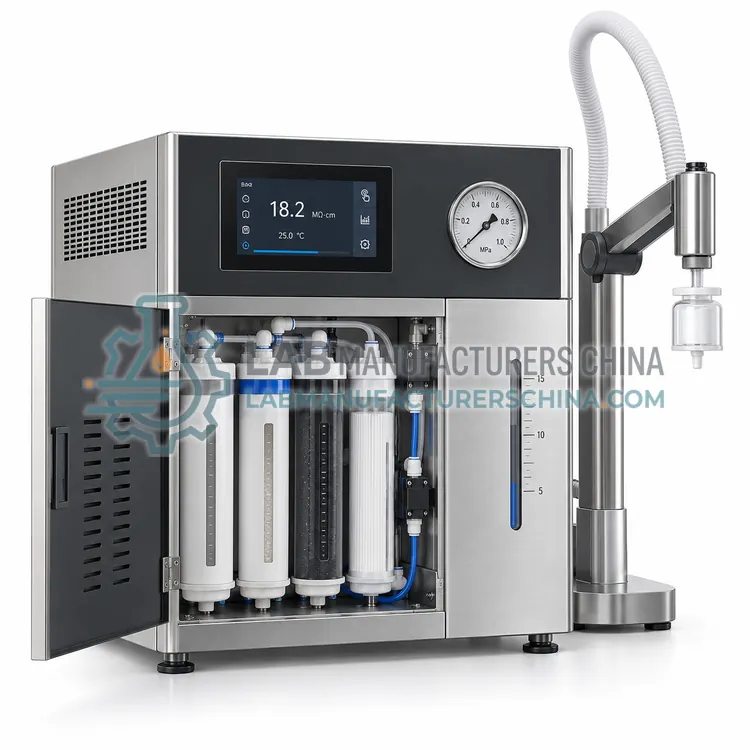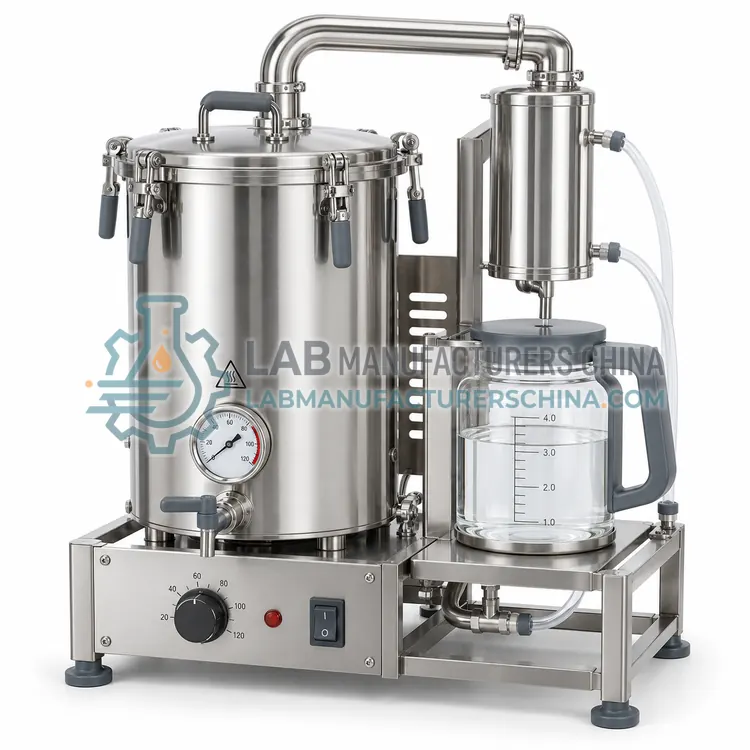
Ultrapure Water Polishing Unit
超纯水精处理单元
- SKU UWS-0005
- Ultrapure Water Systems
- CE (to be confirmed)
- RoHS (to be confirmed)
- ISO 9001 manufacturing (to be confirmed)
Price on request — FOB / CIF quoted per order
Prices depend on configuration, quantity and destination port.
Key specifications
| Resistivity | 18.2 MΩ·cm at 25 °C |
|---|---|
| Flow rate | 0.5–2 L/min |
| Feed requirement | Type II, < 5 µS/cm |
| Ion exchange | Mixed bed cartridge |
| Organic stage | Carbon or 185 nm UV |
| Final filter | 0.22 µm or ultrafiltration |
Request a quote Download brochure · to be provided
By Lab Manufacturers China Technical TeamLast reviewed Standards: ISO 3696, CLSI GP40, USP <643>
What is the Ultrapure Water Polishing Unit?
An ultrapure water polishing unit is added after an existing purification system to raise quality to Type I. It removes residual ions, dissolved organics and fine particles at the point of use.
What is the Ultrapure Water Polishing Unit?
An ultrapure water polishing unit is added after an existing purification system to raise quality to Type I. It removes residual ions, dissolved organics and fine particles at the point of use.
Overview
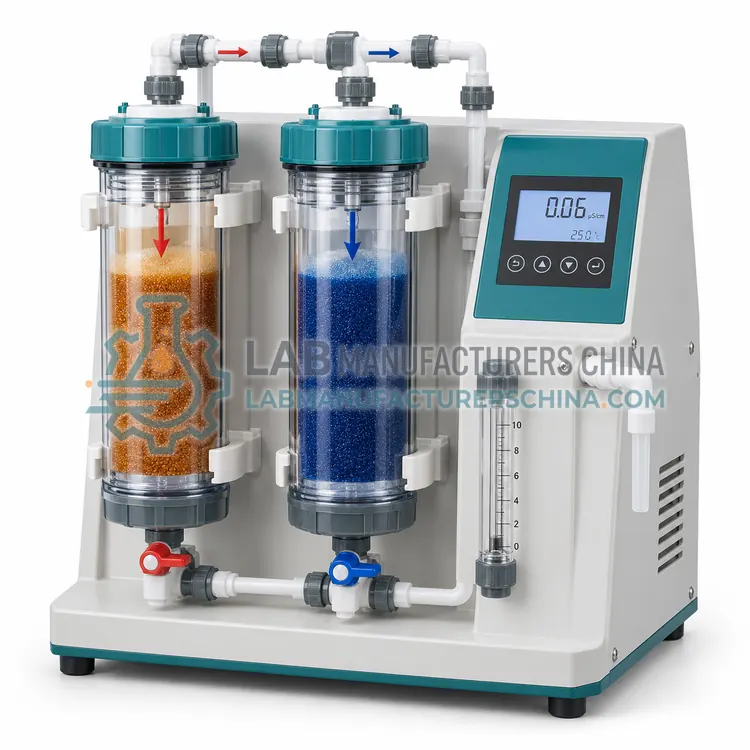
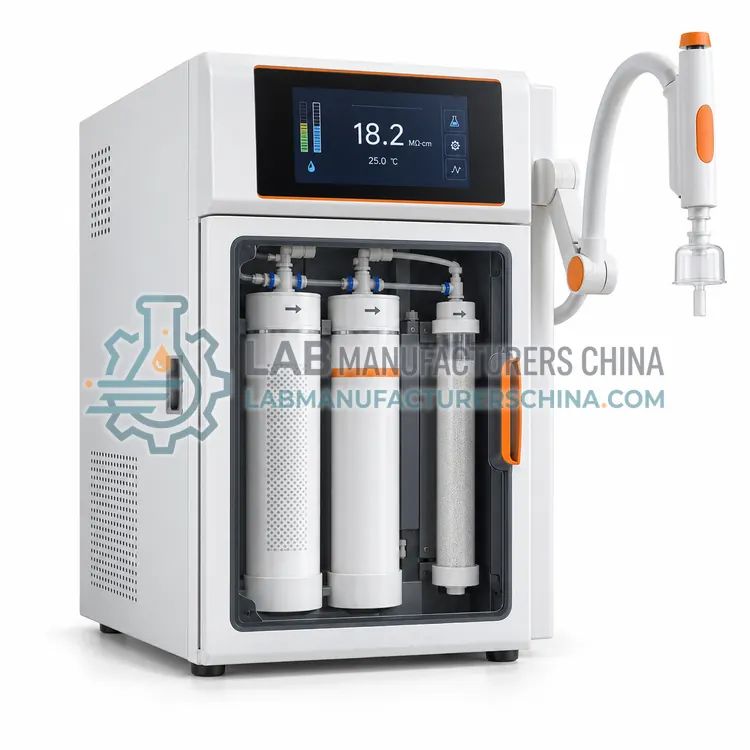
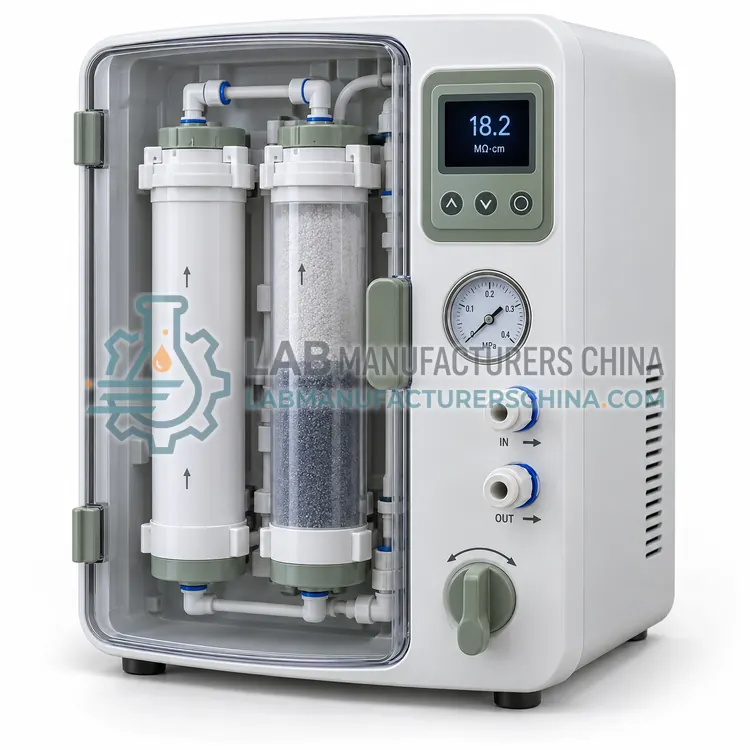
The polishing unit is a modular add-on for laboratories that already have reverse osmosis, distillation or Type II water. It typically contains a mixed-bed ion exchange cartridge, a carbon or UV oxidation stage, and a 0.22 micron or ultrafiltration final filter, arranged in a recirculating loop. Feed enters from the existing system and exits at Type I quality, with resistivity raised to 18.2 megohm-centimeters and organic carbon reduced to low parts per billion. Because it treats already-purified water, cartridge life is long and running cost is low. The unit can be bench-top or wall-mounted and is often fitted with a dispensing point. It is a cost-effective way to add ultrapure capability to an existing installation, and it can be serviced independently of the upstream system.
How does it work?
An ultrapure water system chains several purification steps to reach Type I quality. Feed, usually reverse osmosis or distilled water, passes through activated carbon to remove organics and chlorine, ion exchange resin to remove ions, a 185 nanometer ultraviolet lamp to oxidize residual organics, a 254 nanometer lamp to inactivate microorganisms, and ultrafiltration or microfiltration to remove particles, bacteria and endotoxins. A final 0.22 micron filter or ultrafiltration membrane polishes the water at the point of use. Resistivity and total organic carbon are monitored continuously, and recirculation keeps the loop fresh. The combination of steps is essential because no single technique removes all contaminant classes, and care in materials, dead volume and loop design prevents the purified water from being re-contaminated before it is dispensed.
What are the key features?
- Modular add-on for existing purification systems
- Mixed-bed ion exchange and carbon or UV stage
- Final 0.22 µm or ultrafiltration filter
- Resistivity raised to 18.2 MΩ·cm
- Long cartridge life because feed is already pure
- Independent service from the upstream system
What are the technical specifications?
A typical ultrapure water polishing unit configuration offers resistivity of 18.2 MΩ·cm at 25 °C, flow rate of 0.5–2 L/min, feed requirement of Type II, < 5 µS/cm, ion exchange of Mixed bed cartridge, organic stage of Carbon or 185 nm UV and final filter of 0.22 µm or ultrafiltration. Values are indicative of the product class; the exact figures for each configuration are confirmed on the quotation and the calibration documents supplied with the instrument.
Which applications is it used for?
The Ultrapure Water Polishing Unit is used in upgrading an existing Type II supply, adding a Type I point of use, trace analysis reagent water, adding ultrapure water to older systems and supplementing a shared purification plant. Across the wider Ultrapure Water Systems class, laboratories also deploy it for trace metal and ion analysis, HPLC, LC-MS and UHPLC mobile phases and molecular biology and PCR.
Which standards and certifications apply?
Relevant standards and methods include ISO 3696, CLSI GP40, USP <643>, USP <645>, IEC 61010-1 and ISO 9001. Certification candidates for this model are CE, RoHS and ISO 9001 manufacturing; each is to be confirmed for the specific configuration before shipment, and certificates are supplied only where they have been issued.
Maintain the system on the manufacturer's schedule: replace pretreatment and polishing cartridges, and the UV lamps, before performance declines. Keep the recirculation loop short and flowing, because stagnant water allows biofilm to form on wetted surfaces and raises total organic carbon. Sanitize on a defined interval and after any contamination event, and verify with resistivity and microbial testing. Handle the point-of-use filter carefully to avoid contamination, and touch only the connector. Draw water just before use and do not store Type I water for long, since its purity degrades in containers. Follow IEC 61010-1 for electrical safety, and document resistivity, total organic carbon and service dates for traceability.
How do I select the right Ultrapure Water Polishing Unit?
Choose a polishing unit when an existing system already provides good Type II water and only a point-of-use upgrade is needed. If the feed is tap water, add reverse osmosis instead. In the RFQ, state feed quality, flow and purity targets.
How does it compare with other Ultrapure Water Systems variants?
Start from the analytical method, because it determines the required resistivity, total organic carbon, bacterial and endotoxin limits. Trace metals and ion chromatography need low ionic content, LC-MS needs low organic carbon, and cell culture needs low endotoxin and bacteria. Choose a system with the purification steps that meet those requirements, and confirm that resistivity and total organic carbon are monitored, ideally with a calibration option. Size the unit by daily volume and instantaneous flow, and decide whether it should produce Type I only or both Type I and Type II. Consider the feed source, since reverse osmosis feed extends cartridge life compared with tap water. Check the point-of-use dispenser, dead volume, recirculation, sanitization procedure and consumable cost per liter before selecting.
Full specifications
| Resistivity | 18.2 MΩ·cm at 25 °C |
|---|---|
| Flow rate | 0.5–2 L/min |
| Feed requirement | Type II, < 5 µS/cm |
| Ion exchange | Mixed bed cartridge |
| Organic stage | Carbon or 185 nm UV |
| Final filter | 0.22 µm or ultrafiltration |
| Recirculation | Continuous loop |
| Monitoring | Resistivity |
| Mounting | Bench or wall |
| Power supply | 100–240 V, 50/60 Hz |
Indicative values for this product class. Final specifications are confirmed on the quotation and in the calibration documents supplied with the instrument.
Applications
- Upgrading an existing Type II supply
- Adding a Type I point of use
- Trace analysis reagent water
- Adding ultrapure water to older systems
- Supplementing a shared purification plant
Key features
- Modular add-on for existing purification systems
- Mixed-bed ion exchange and carbon or UV stage
- Final 0.22 µm or ultrafiltration filter
- Resistivity raised to 18.2 MΩ·cm
- Long cartridge life because feed is already pure
- Independent service from the upstream system
Frequently asked questions about Ultrapure Water Polishing Unit
It performs best with Type II water of low ionic content, ideally below a few microsiemens per centimeter. With poorer feed, cartridges exhaust faster and quality may not reach 18.2 megohm-centimeters.
To most purification systems, provided the feed pressure and flow match its requirements and there is space for the unit and its loop. Confirm compatibility with the upstream supplier.
Because the feed is already pure, the resin and carbon have far less to remove, so they last longer. This lowers the cost per liter of ultrapure water compared with treating tap water.
Type I water has resistivity near 18.2 megohm-centimeters at 25 degrees Celsius, total organic carbon below about 10 parts per billion, very low bacteria and, where specified, low endotoxin. These limits follow CLSI GP40 and ISO 3696.
The 185 nanometer lamp oxidizes organic molecules, lowering total organic carbon, while the 254 nanometer lamp inactivates microorganisms by damaging their nucleic acids. Together they control organics and microbial growth.
Only briefly, because containers leach ions and organics and allow microbial growth. Draw water fresh at the point of use and keep the system recirculating when idle to maintain quality.
Related models