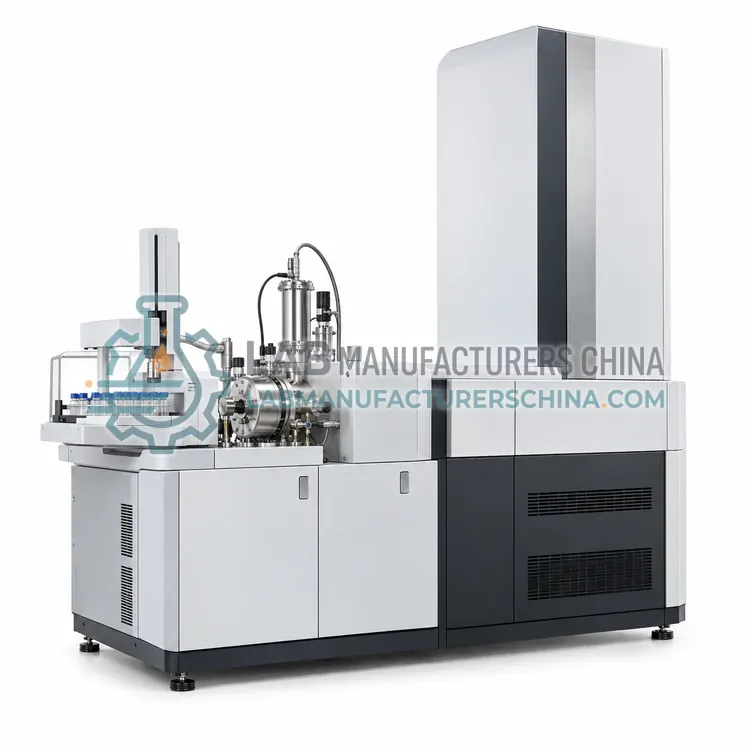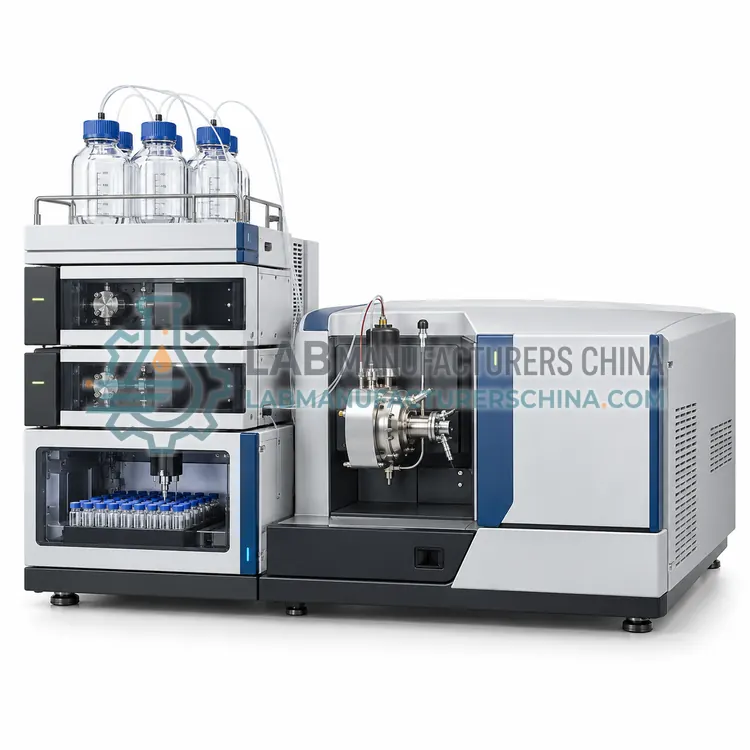
Benchtop Triple Quadrupole LC-MS/MS System for Clinical Quantitation
用于临床定量的台式三重四极杆液相色谱串联质谱系统
- CE (to be confirmed)
- +2
Welcome to Lab Manufacturers China — laboratory instruments direct from a Chinese manufacturer
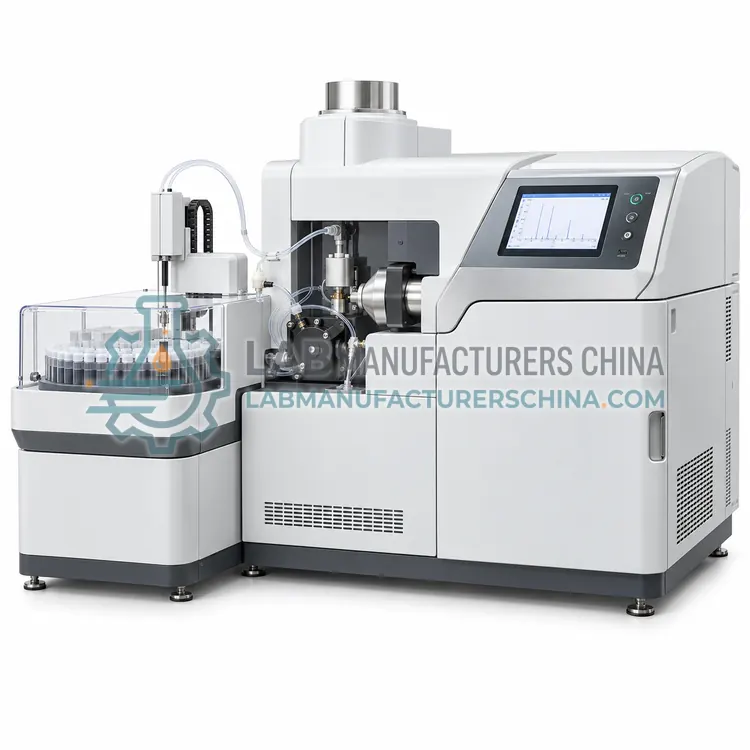
三重四极杆电感耦合等离子体质谱(ICP-MS/MS)系统
Price on request — FOB / CIF quoted per order
Prices depend on configuration, quantity and destination port.
| Mass range | m/z 2–260 |
|---|---|
| Detection limit (As, O2 mode) | < 1 ng/L |
| Background equivalent concentration (S, O2 mode) | < 100 ng/L |
| Abundance sensitivity | < 1 × 10⁻¹⁰ at m/z ±1 |
| Sensitivity (Y-89) | > 500 Mcps/ppm |
| Oxide ratio (CeO/Ce) | < 1.5% |
By Lab Manufacturers China Technical TeamLast reviewed Standards: ICH M10, FDA Bioanalytical Method Validation Guidance, EU Commission Decision 2002/657/EC
A triple quadrupole ICP-MS, or ICP-MS/MS, places a mass-selecting quadrupole before the reaction cell so that only the target mass enters it. This gives controlled reaction chemistry and removes polyatomic and isobaric interferences for trace elements such as sulfur, phosphorus, arsenic and selenium.
A triple quadrupole ICP-MS, or ICP-MS/MS, places a mass-selecting quadrupole before the reaction cell so that only the target mass enters it. This gives controlled reaction chemistry and removes polyatomic and isobaric interferences for trace elements such as sulfur, phosphorus, arsenic and selenium.
ICP-MS/MS combines an argon plasma ion source with two quadrupoles and a collision/reaction cell in between. The first quadrupole acts as a mass filter at the analyte mass, which keeps plasma-derived ions from entering the cell and makes reactions with gases such as oxygen, ammonia or hydrogen predictable. Analytes can be measured on-mass or as reaction-product ions, for example arsenic as AsO+ at m/z 91 or sulfur as SO+ at m/z 48. This approach reduces interferences that helium collision mode alone cannot remove, for instance in phosphorus, titanium in complex matrices or rare earth elements with oxide overlaps. The system handles typical ICP-MS sample introduction, including nebulizer, spray chamber and autosampler, and can be coupled to LC or laser ablation. Background equivalent concentrations often reach sub-ng/L levels for many elements, though results depend on cleanliness of reagents and sample preparation.
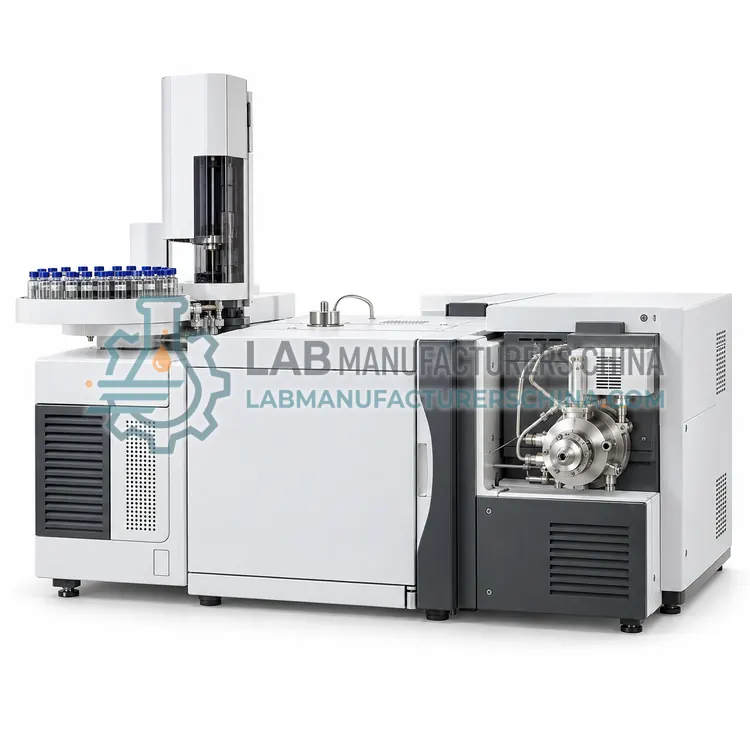
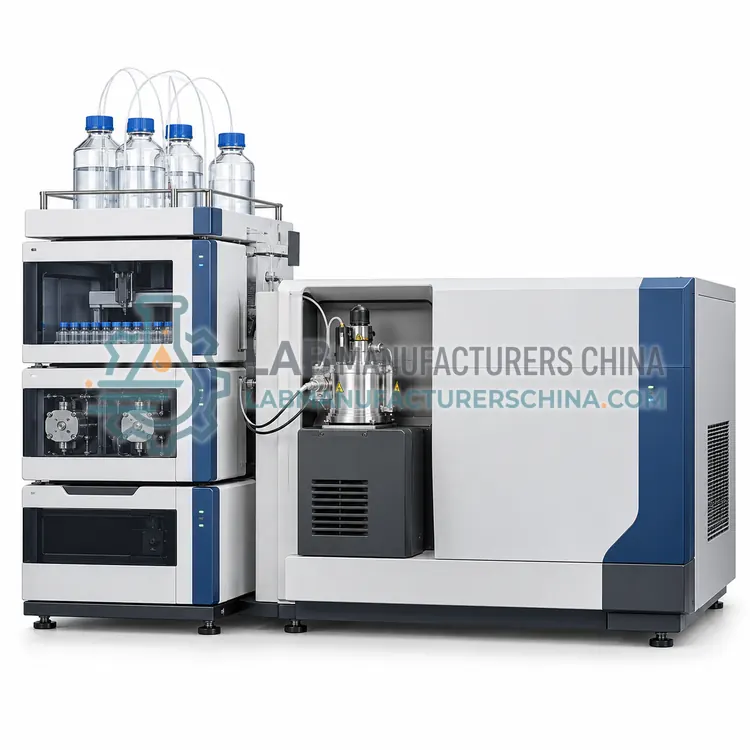
A triple quadrupole has three sections in series. The first quadrupole (Q1) transmits only ions of a chosen mass-to-charge ratio. The second section (q2) is a collision cell filled with nitrogen or argon at low pressure, where the selected precursor ions are accelerated and fragmented by collision-induced dissociation. The third quadrupole (Q3) then transmits only chosen product ions to the detector, usually an electron multiplier. Operating Q1 and Q3 at fixed masses gives multiple reaction monitoring (MRM), which filters out most chemical noise and gives very selective quantitation. Other scan modes include product-ion scan, precursor-ion scan and neutral-loss scan. The instrument is normally coupled to a liquid chromatograph through an electrospray or APCI source, or to a gas chromatograph through an electron-ionization source. Ion guides, a vacuum system with turbomolecular pumps and a data system for scheduled MRM complete the design.
A typical triple quadrupole icp-ms (icp-ms/ms) system configuration offers mass range of m/z 2–260, detection limit (As, O2 mode) of < 1 ng/L, background equivalent concentration (S, O2 mode) of < 100 ng/L, abundance sensitivity of < 1 × 10⁻¹⁰ at m/z ±1, sensitivity (Y-89) of > 500 Mcps/ppm and oxide ratio (CeO/Ce) of < 1.5%. Values are indicative of the product class; the exact figures for each configuration are confirmed on the quotation and the calibration documents supplied with the instrument.
The Triple Quadrupole ICP-MS (ICP-MS/MS) System is used in ultratrace impurities in semiconductor chemicals, sulfur and phosphorus in biological samples, arsenic and selenium speciation with LC, rare earth element analysis in geological samples and nanoparticle analysis by single-particle mode. Across the wider Triple Quadrupole MS class, laboratories also deploy it for clinical and therapeutic drug monitoring, pharmacokinetic and bioanalytical studies and pesticide and veterinary drug residue testing.
Relevant standards and methods include ICH M10, FDA Bioanalytical Method Validation Guidance, EU Commission Decision 2002/657/EC, SANTE/11312/2021, ISO 17025 and CLSI C62. Certification candidates for this model are CE, IEC 61010-1 safety and ISO 9001 manufacturing; each is to be confirmed for the specific configuration before shipment, and certificates are supplied only where they have been issued.
Install the system in a temperature-stable room with clean, stable power and adequate floor loading for the instrument and its rotary or dry backing pumps. Supply nitrogen of sufficient purity and flow for the source and collision gas, and high-purity argon where required. Exhaust from the source and pumps must be vented safely. Perform mass calibration and tuning on a routine schedule, and run system suitability injections before each batch. Source cleaning, ion-guide maintenance and pump-oil or seal changes are the main preventive tasks. Laboratories working under regulated frameworks should plan installation, operational and performance qualification, audit-trail review and method validation according to ICH M10 or equivalent guidance.
Choose ICP-MS/MS when interferences limit a single-quadrupole ICP-MS, particularly for S, P, Si, As, Se, Ti and rare earths, or when mass-shift reaction chemistry is needed. A single-quadrupole system with helium collision mode is often enough for routine water and food metals. In an RFQ specify element list, detection limits, matrix types, cell gases required, speciation coupling and argon consumption.
Start with the sample introduction technique, because it decides the source and the chromatograph: LC-MS/MS for polar, non-volatile or thermally labile analytes, GC-MS/MS for volatile and semi-volatile compounds, and ICP-MS/MS for elemental analysis. Next define the required limit of quantitation in the final matrix, not the instrument sensitivity on a neat standard, and the number of MRM transitions per run, since a fast scheduled method needs dwell times of a few milliseconds and rapid polarity switching. Consider the dynamic range needed, typically four to six orders of magnitude, and the robustness of the source and ion optics under dirty matrices. Check the vendor's regulated-data software features if the laboratory works under GLP, GMP or 21 CFR Part 11 expectations. Finally compare the total cost of ownership, including vacuum pumps, nitrogen generator demand, service and column consumption.
| Mass range | m/z 2–260 |
|---|---|
| Detection limit (As, O2 mode) | < 1 ng/L |
| Background equivalent concentration (S, O2 mode) | < 100 ng/L |
| Abundance sensitivity | < 1 × 10⁻¹⁰ at m/z ±1 |
| Sensitivity (Y-89) | > 500 Mcps/ppm |
| Oxide ratio (CeO/Ce) | < 1.5% |
| Doubly charged ratio (Ce++/Ce+) | < 2% |
| Cell gases | He, H2, O2, NH3 (mixture) |
| Linear dynamic range | Up to 10 orders of magnitude |
| RF generator frequency | 27.12 or 40 MHz |
Indicative values for this product class. Final specifications are confirmed on the quotation and in the calibration documents supplied with the instrument.
ICP-MS/MS adds a quadrupole before the reaction cell, so only the selected mass enters it. This makes reaction chemistry with gases like oxygen or ammonia predictable and removes interferences that collision mode cannot, especially for sulfur, phosphorus, arsenic, selenium and some rare earths.
In mass-shift mode the analyte reacts in the cell to form a product ion at a different mass, such as arsenic forming AsO+ at m/z 91. Because the first quadrupole controls what enters, the product is measured free from the original interference at the parent mass.
A typical system consumes roughly 15 to 20 L/min of argon for the plasma, plus small flows of helium and reaction gases such as oxygen, hydrogen or ammonia mixtures. Gas purity of at least 99.999% is commonly recommended, and gas lines should be fitted with appropriate safety controls.
It measures selected precursor-to-product ion transitions, typically in multiple reaction monitoring mode. Because both the parent ion and a characteristic fragment must match, the instrument can quantify target compounds at trace levels in complex samples such as plasma, food extracts or soil with low interference.
A single quadrupole measures intact ions in one mass filter and is used for simple screening and confirmation. A triple quadrupole adds fragmentation and a second filter, giving much higher selectivity and lower detection limits for quantitation in complex matrices, at higher cost and method development effort.
Modern instruments with dwell times of 1 to 5 ms and scheduled acquisition can monitor several hundred transitions in one run, sometimes above 500 with fast polarity switching. The practical limit depends on chromatographic peak width, required points per peak and the desired sensitivity for each analyte.
用于临床定量的台式三重四极杆液相色谱串联质谱系统
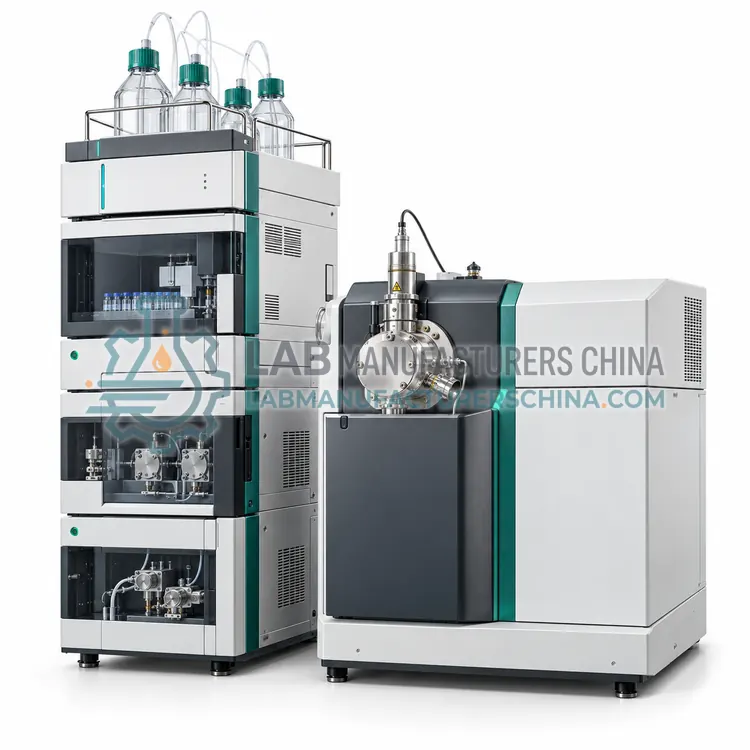
用于生物分析的高灵敏度三重四极杆液相色谱串联质谱仪
用于食品安全和残留分析的三重四极杆液相色谱串联质谱系统