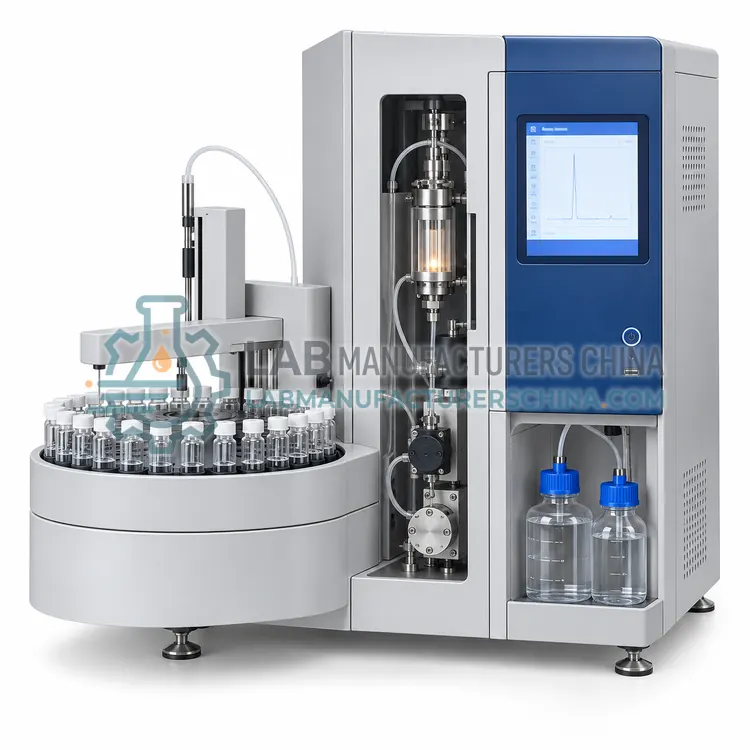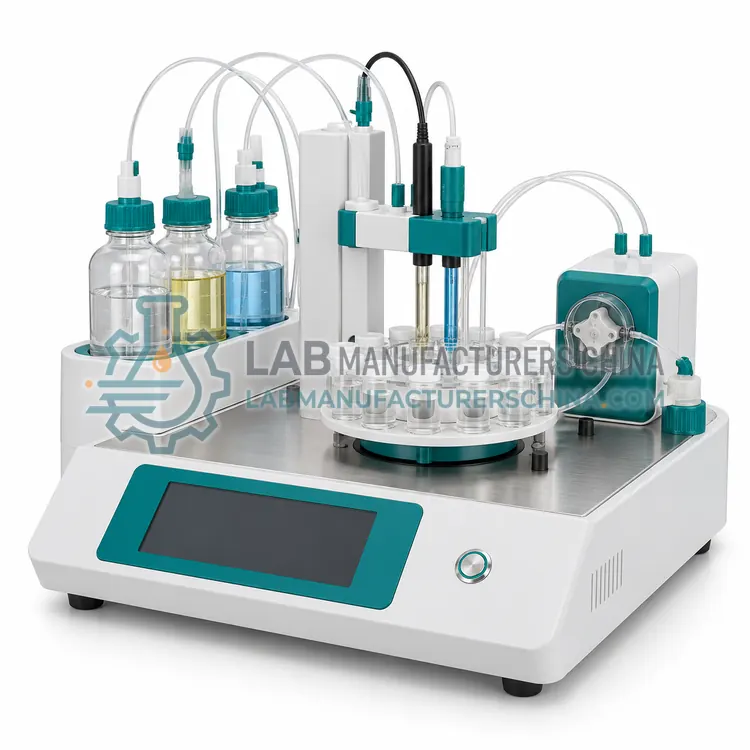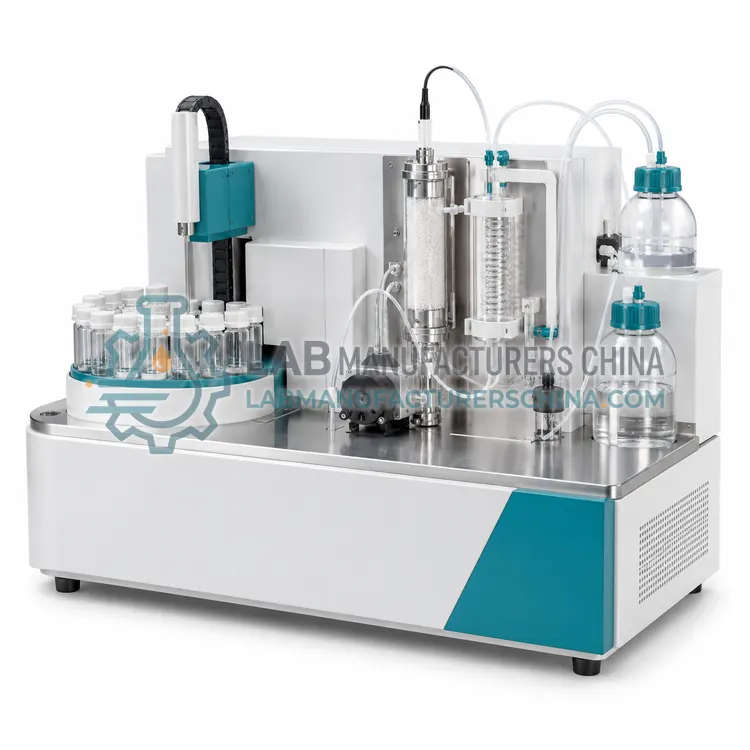
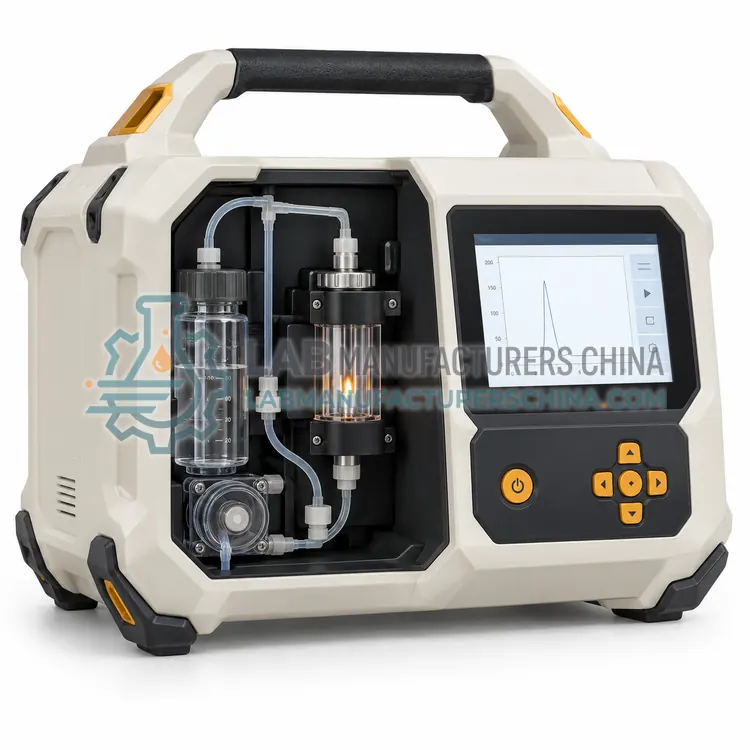
Ultrapure Water TOC Analyzer
超纯水 TOC 分析仪
- SKU TOC-0005
- TOC Analyzers
- CE (to be confirmed)
- ISO 9001 manufacturing (to be confirmed)
Price on request — FOB / CIF quoted per order
Prices depend on configuration, quantity and destination port.
Key specifications
| Oxidation method | 185 nm UV, reagent-free |
|---|---|
| Measuring range | 0.5–1,000 µg/L TOC |
| Detection principle | Differential conductivity, temperature compensated |
| Sample conductivity | < 1 µS/cm |
| Accuracy | ± 0.5 µg/L or ± 5% of reading |
| Measurement cycle | 1–5 min |
Request a quote Download brochure · to be provided
By Lab Manufacturers China Technical TeamLast reviewed Standards: ISO 8245, ASTM D4839, ASTM D5173
What is the Ultrapure Water TOC Analyzer?
An online sensor-type TOC analyzer that measures organics in high-purity water down to 0.5 µg/L using UV oxidation and conductivity detection. It is intended for semiconductor, power generation and pharmaceutical purified water loops with very low conductivity, rather than for wastewater or raw water.
What is the Ultrapure Water TOC Analyzer?
An online sensor-type TOC analyzer that measures organics in high-purity water down to 0.5 µg/L using UV oxidation and conductivity detection. It is intended for semiconductor, power generation and pharmaceutical purified water loops with very low conductivity, rather than for wastewater or raw water.
Overview
This variant is designed for water with conductivity below 1 µS/cm, where organic carbon is measured in the low parts-per-billion. The sample flows through a UV reactor at 185 nm, where organics are oxidized to CO2 and organic acids, and the resulting rise in conductivity, compensated for temperature, is converted to TOC. A differential conductivity approach or membrane-based CO2 detection removes the contribution of ionic species already in the water. The analyzer is mounted directly on the loop, offers 0.5–1,000 µg/L range and updates every 1 to 5 minutes. It can include a system suitability routine with sucrose and benzoquinone to verify oxidation efficiency, meeting the practice expected under USP <643> and Ph. Eur. 2.2.44. Because ionic or high-salt samples bias the measurement, this type is unsuitable for raw water or wastewater, and the sample line must use low-TOC materials.
How does it work?
A TOC analyzer converts all organic carbon in a water sample to CO2 and quantifies the gas. Two oxidation routes dominate. High-temperature catalytic combustion injects the sample into a furnace at 680–900 °C containing a platinum or similar catalyst, which also handles particulates and difficult compounds. UV-persulfate oxidation adds sodium persulfate and irradiates the sample with UV at 185 and 254 nm to generate hydroxyl radicals. Inorganic carbon is removed first by acidification and sparging, or measured separately to give TOC by difference. The CO2 is carried by purified air or oxygen to a non-dispersive infrared detector, or measured by membrane conductometry in low-level systems. Peak area is integrated and converted to concentration using a multi-point calibration against potassium hydrogen phthalate standards.
What are the key features?
- 185 nm UV oxidation with temperature-compensated conductivity detection
- Range 0.5–1,000 µg/L with updates every 1 to 5 minutes
- Built-in system suitability test with sucrose and benzoquinone standards
- Electropolished stainless-steel or PFA wetted parts to minimize organic leaching
- Analog, relay and digital outputs for loop monitoring and alarms
- Reagent-free operation with no carrier gas or chemicals required
What are the technical specifications?
A typical ultrapure water toc analyzer configuration offers oxidation method of 185 nm UV, reagent-free, measuring range of 0.5–1,000 µg/L TOC, detection principle of Differential conductivity, temperature compensated, sample conductivity of < 1 µS/cm, accuracy of ± 0.5 µg/L or ± 5% of reading and measurement cycle of 1–5 min. Values are indicative of the product class; the exact figures for each configuration are confirmed on the quotation and the calibration documents supplied with the instrument.
Which applications is it used for?
The Ultrapure Water TOC Analyzer is used in semiconductor ultrapure water loops, power plant makeup and boiler feedwater, pharmaceutical purified water and WFI systems and reverse osmosis and deionization performance monitoring. Across the wider TOC Analyzers class, laboratories also deploy it for drinking water treatment monitoring, wastewater discharge compliance and surface water and groundwater surveys.
Which standards and certifications apply?
Relevant standards and methods include ISO 8245, ASTM D4839, ASTM D5173, ASTM D5904, USP <643>, Ph. Eur. 2.2.44, HJ 501 and IEC 61010-1. Certification candidates for this model are CE and ISO 9001 manufacturing; each is to be confirmed for the specific configuration before shipment, and certificates are supplied only where they have been issued.
Install the analyzer on a stable bench with clean, dry carrier gas at 99.99% purity or a zero-air generator, and provide ventilation for exhaust. Calibrate at least monthly with potassium hydrogen phthalate and verify with sodium carbonate and a blank each run. Keep glassware organic-free and use ultrapure water blanks, since ambient organics cause high blanks. Replace combustion catalyst, halogen scrubbers and persulfate reagent on the schedule stated by the manufacturer. For regulated laboratories, confirm software audit trails and user access levels, and run system suitability with sucrose and benzoquinone to check oxidation efficiency where USP <643> applies.
How do I select the right Ultrapure Water TOC Analyzer?
Select this variant for loop monitoring of high-purity water below 1 µS/cm where sub-µg/L sensitivity and no consumables are priorities. It is not a substitute for a combustion or UV-persulfate laboratory analyzer with water containing salts or particulates. In an RFQ, state the required TOC range, sample pressure and temperature, conductivity, and whether USP <643> system suitability is required.
How does it compare with other TOC Analyzers variants?
The decisive parameters are sample matrix, measuring range and operating mode. Wastewater and effluents with particulates, high salt or high carbon load call for high-temperature combustion with a robust injection system and dilution capability. Drinking water and cleaner surface water, typically below 20 mg/L, are well served by UV-persulfate or low-temperature oxidation with sub-0.1 mg/L resolution. Semiconductor and pharmaceutical purified water need online ppb-level sensors with conductivity-based detection. Decide whether you need laboratory batch analysis with an autosampler or continuous online data. If nitrogen loading matters for discharge permits, a combined TOC-TN configuration saves a second instrument. Also check the method you must follow, such as ISO 8245 or USP <643>, and the consumables cost of gases, catalyst and reagents.
Full specifications
| Oxidation method | 185 nm UV, reagent-free |
|---|---|
| Measuring range | 0.5–1,000 µg/L TOC |
| Detection principle | Differential conductivity, temperature compensated |
| Sample conductivity | < 1 µS/cm |
| Accuracy | ± 0.5 µg/L or ± 5% of reading |
| Measurement cycle | 1–5 min |
| Sample flow | 20–100 mL/min |
| Sample temperature | 1–95 °C |
| Wetted materials | 316L electropolished stainless steel, PFA, quartz |
| Outputs | 4–20 mA, RS-485, relays |
Indicative values for this product class. Final specifications are confirmed on the quotation and in the calibration documents supplied with the instrument.
Applications
- Semiconductor ultrapure water loops
- Power plant makeup and boiler feedwater
- Pharmaceutical purified water and WFI systems
- Reverse osmosis and deionization performance monitoring
Key features
- 185 nm UV oxidation with temperature-compensated conductivity detection
- Range 0.5–1,000 µg/L with updates every 1 to 5 minutes
- Built-in system suitability test with sucrose and benzoquinone standards
- Electropolished stainless-steel or PFA wetted parts to minimize organic leaching
- Analog, relay and digital outputs for loop monitoring and alarms
- Reagent-free operation with no carrier gas or chemicals required
Frequently asked questions about Ultrapure Water TOC Analyzer
USP <643> sets a TOC limit of 500 µg/L (0.50 mg/L) for purified water and water for injection, and Ph. Eur. uses the same limit. Many users set an internal action level well below it, which is why ppb-level resolution is useful.
Conductivity-based detection assumes water with very low ionic content. Dissolved salts, carbonate and particulates change the conductivity independently of organic carbon and can foul the UV reactor, producing biased results and requiring different oxidation and detection methods.
Run a system suitability test with sucrose as an easily oxidized standard and 1,4-benzoquinone as a harder one, each prepared at 500 µg/L carbon. Recovery of the benzoquinone relative to sucrose should meet the acceptance criterion in USP <643>, typically 85–115%.
It measures the total mass concentration of carbon bound in organic compounds, reported in mg/L or µg/L. Organic carbon is oxidized to CO2 and detected, so the result covers dissolved and, with suitable sample handling, particulate organic matter regardless of its chemical identity.
NPOC acidifies and sparges the sample to remove inorganic carbon, then measures the remaining non-purgeable organic carbon. TOC by difference measures total carbon and inorganic carbon separately and subtracts them. NPOC is more accurate when inorganic carbon is high, but loses volatile organics.
High-temperature catalytic combustion is usually preferred for wastewater because it oxidizes particulates, surfactants and refractory organics that UV-persulfate may only partially oxidize. It tolerates high salt and carbon loads when fitted with a suitable injector, dilution and salt-handling components.
Related models
Online TOC Analyzer for Surface Water and Effluent Monitoring
地表水与排放水在线 TOC 分析仪
- CE (to be confirmed)
- +2