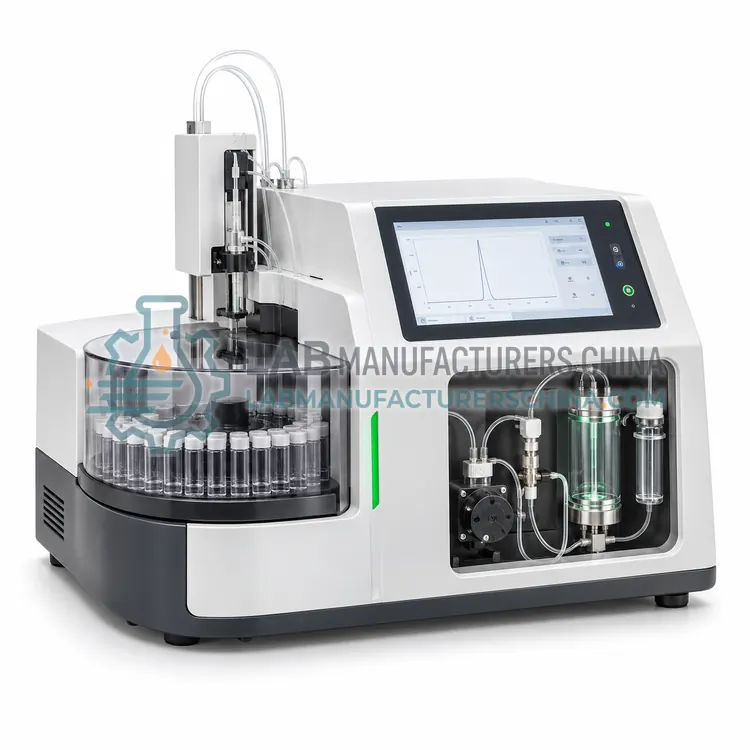
UV-Persulfate TOC Analyzer for Drinking Water
饮用水用紫外过硫酸盐 TOC 分析仪
- SKU TOC-0002
- TOC Analyzers
- CE (to be confirmed)
- ISO 9001 manufacturing (to be confirmed)
Price on request — FOB / CIF quoted per order
Prices depend on configuration, quantity and destination port.
Key specifications
| Oxidation method | UV (185/254 nm) with sodium persulfate |
|---|---|
| Measuring range (TOC) | 0.05–50 mg/L |
| Detector | NDIR CO2 detector |
| Detection limit | ≤ 50 µg/L |
| Repeatability | CV ≤ 2% |
| Analysis time | 4–6 min per sample |
Request a quote Download brochure · to be provided
By Lab Manufacturers China Technical TeamLast reviewed Standards: ISO 8245, ASTM D4839, ASTM D5173
What is the UV-Persulfate TOC Analyzer for Drinking Water?
A laboratory TOC analyzer that oxidizes organic carbon with UV light and sodium persulfate, offering sub-0.1 mg/L resolution. It suits drinking water treatment laboratories that track disinfection by-product precursors in low-carbon, low-particulate samples and want low running cost and short warm-up.
What is the UV-Persulfate TOC Analyzer for Drinking Water?
A laboratory TOC analyzer that oxidizes organic carbon with UV light and sodium persulfate, offering sub-0.1 mg/L resolution. It suits drinking water treatment laboratories that track disinfection by-product precursors in low-carbon, low-particulate samples and want low running cost and short warm-up.
Overview
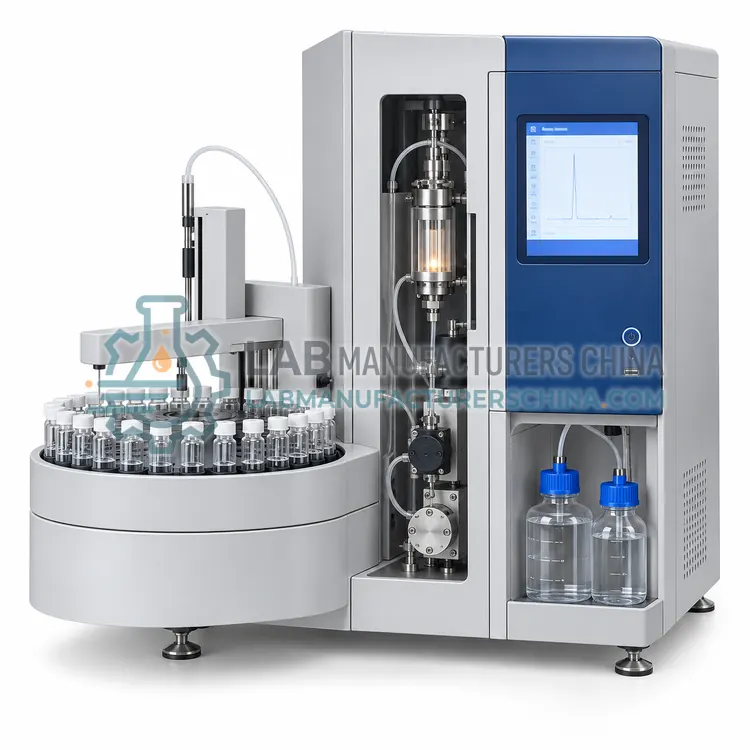
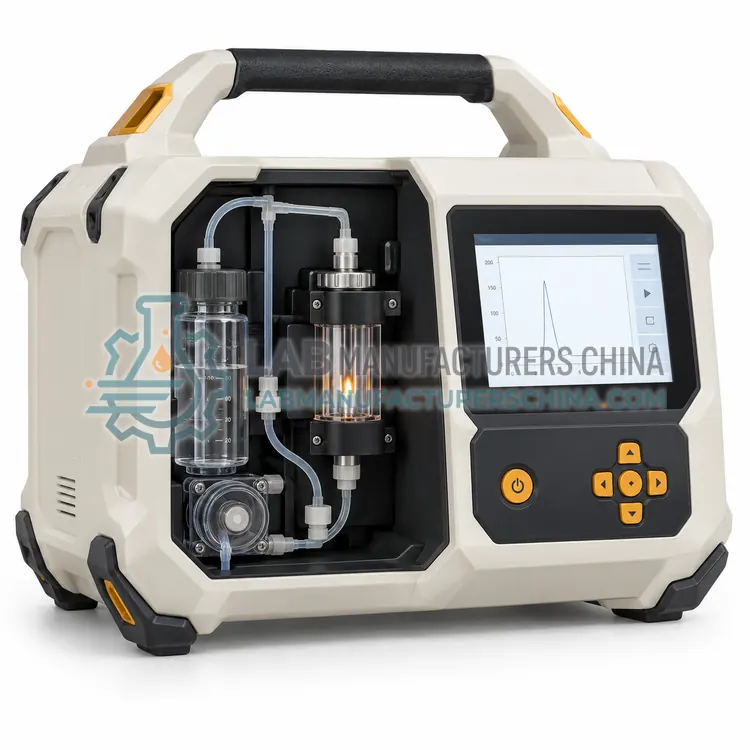
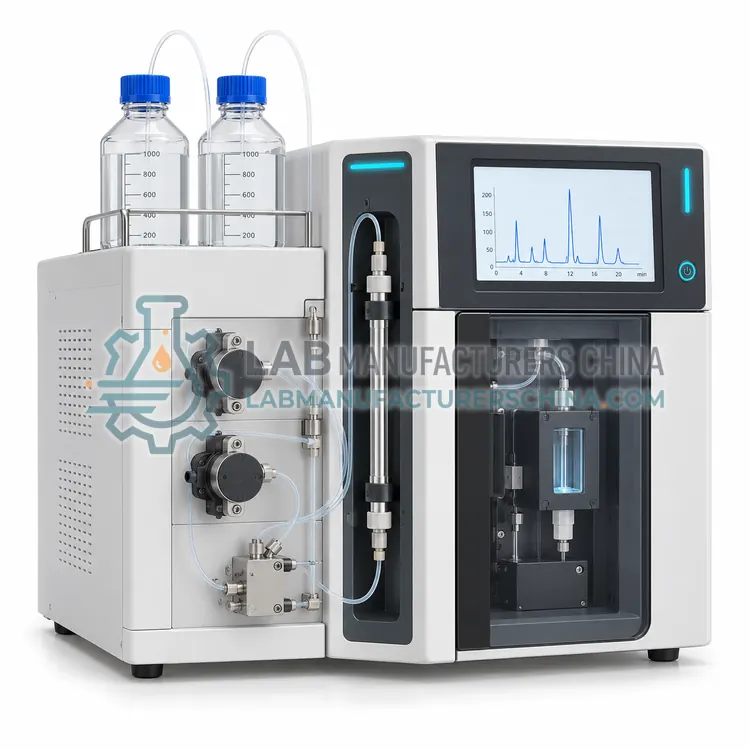
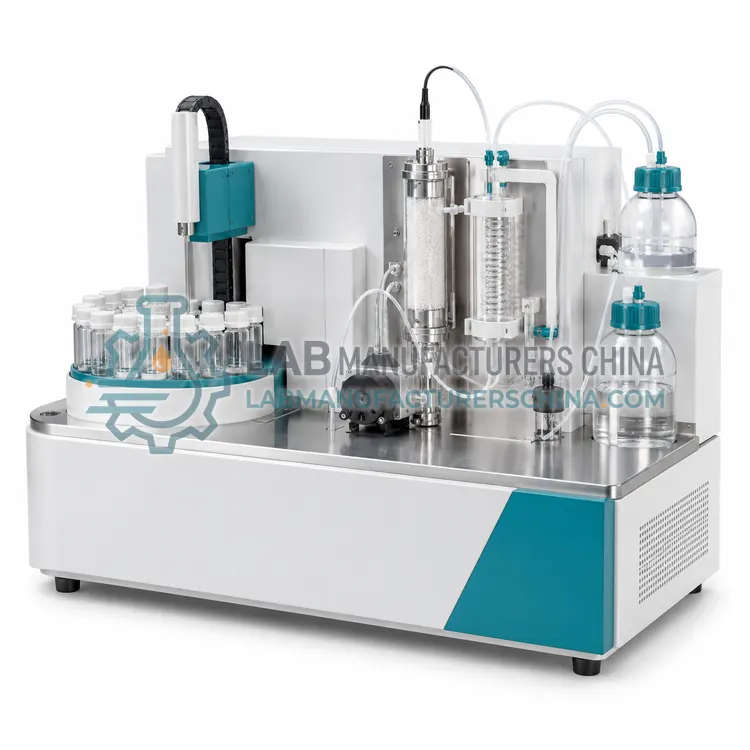
This variant pairs a low-pressure mercury UV reactor emitting at 185 and 254 nm with a persulfate and acid dosing system. After inorganic carbon is sparged, the oxidized sample is swept to an NDIR detector, typically yielding a range of 0.05 to 50 mg/L with a detection limit near 50 µg/L. Because there is no furnace, warm-up is short, power use is low and there is no combustion catalyst to replace. The design targets raw and finished drinking water, where TOC is monitored to optimize coagulation and to limit trihalomethane formation. It is less suited to heavy particulates or refractory polymers, which can be incompletely oxidized. Sample vials with stir-bar mixing and a sparge step give good NPOC precision, and typical runs take 4–6 minutes. The reagent bottles and UV lamp are the main consumables and are easy to swap.
How does it work?
A TOC analyzer converts all organic carbon in a water sample to CO2 and quantifies the gas. Two oxidation routes dominate. High-temperature catalytic combustion injects the sample into a furnace at 680–900 °C containing a platinum or similar catalyst, which also handles particulates and difficult compounds. UV-persulfate oxidation adds sodium persulfate and irradiates the sample with UV at 185 and 254 nm to generate hydroxyl radicals. Inorganic carbon is removed first by acidification and sparging, or measured separately to give TOC by difference. The CO2 is carried by purified air or oxygen to a non-dispersive infrared detector, or measured by membrane conductometry in low-level systems. Peak area is integrated and converted to concentration using a multi-point calibration against potassium hydrogen phthalate standards.
What are the key features?
- Low-pressure UV reactor at 185 and 254 nm generates hydroxyl radicals for oxidation
- Detection limit near 50 µg/L suited to treated drinking water
- No furnace, so short warm-up and lower power consumption
- Automatic acid and persulfate dosing with programmable sparge time
- Autosampler with 40 positions and optional sample stirring
- Software calculates NPOC, TC and IC with stored multi-point calibration
What are the technical specifications?
A typical uv-persulfate toc analyzer for drinking water configuration offers oxidation method of UV (185/254 nm) with sodium persulfate, measuring range (TOC) of 0.05–50 mg/L, detector of NDIR CO2 detector, detection limit of ≤ 50 µg/L, repeatability of CV ≤ 2% and analysis time of 4–6 min per sample. Values are indicative of the product class; the exact figures for each configuration are confirmed on the quotation and the calibration documents supplied with the instrument.
Which applications is it used for?
The UV-Persulfate TOC Analyzer for Drinking Water is used in raw and finished drinking water TOC monitoring, coagulant dose optimization studies, disinfection by-product precursor screening and reservoir and groundwater surveys. Across the wider TOC Analyzers class, laboratories also deploy it for drinking water treatment monitoring, wastewater discharge compliance and surface water and groundwater surveys.
Which standards and certifications apply?
Relevant standards and methods include ISO 8245, ASTM D4839, ASTM D5173, ASTM D5904, USP <643>, Ph. Eur. 2.2.44, HJ 501 and IEC 61010-1. Certification candidates for this model are CE and ISO 9001 manufacturing; each is to be confirmed for the specific configuration before shipment, and certificates are supplied only where they have been issued.
Install the analyzer on a stable bench with clean, dry carrier gas at 99.99% purity or a zero-air generator, and provide ventilation for exhaust. Calibrate at least monthly with potassium hydrogen phthalate and verify with sodium carbonate and a blank each run. Keep glassware organic-free and use ultrapure water blanks, since ambient organics cause high blanks. Replace combustion catalyst, halogen scrubbers and persulfate reagent on the schedule stated by the manufacturer. For regulated laboratories, confirm software audit trails and user access levels, and run system suitability with sucrose and benzoquinone to check oxidation efficiency where USP <643> applies.
How do I select the right UV-Persulfate TOC Analyzer for Drinking Water?
Choose this variant for low-carbon, low-solids water where sensitivity and low operating cost matter more than oxidizing power. If samples exceed about 50 mg/L, contain oils or polymers, or hold significant particulates, use the combustion variant. In an RFQ, state the TOC range, the reference method such as ISO 8245 or GB 5750, autosampler size, and the gas supply available.
How does it compare with other TOC Analyzers variants?
The decisive parameters are sample matrix, measuring range and operating mode. Wastewater and effluents with particulates, high salt or high carbon load call for high-temperature combustion with a robust injection system and dilution capability. Drinking water and cleaner surface water, typically below 20 mg/L, are well served by UV-persulfate or low-temperature oxidation with sub-0.1 mg/L resolution. Semiconductor and pharmaceutical purified water need online ppb-level sensors with conductivity-based detection. Decide whether you need laboratory batch analysis with an autosampler or continuous online data. If nitrogen loading matters for discharge permits, a combined TOC-TN configuration saves a second instrument. Also check the method you must follow, such as ISO 8245 or USP <643>, and the consumables cost of gases, catalyst and reagents.
Full specifications
| Oxidation method | UV (185/254 nm) with sodium persulfate |
|---|---|
| Measuring range (TOC) | 0.05–50 mg/L |
| Detector | NDIR CO2 detector |
| Detection limit | ≤ 50 µg/L |
| Repeatability | CV ≤ 2% |
| Analysis time | 4–6 min per sample |
| Sample volume | 10–25 mL per analysis |
| Autosampler capacity | 40 vials |
| Carrier gas | High-purity O2 or N2, 100 mL/min |
| Power supply | AC 220 V, 50/60 Hz, 300 VA |
Indicative values for this product class. Final specifications are confirmed on the quotation and in the calibration documents supplied with the instrument.
Applications
- Raw and finished drinking water TOC monitoring
- Coagulant dose optimization studies
- Disinfection by-product precursor screening
- Reservoir and groundwater surveys
Key features
- Low-pressure UV reactor at 185 and 254 nm generates hydroxyl radicals for oxidation
- Detection limit near 50 µg/L suited to treated drinking water
- No furnace, so short warm-up and lower power consumption
- Automatic acid and persulfate dosing with programmable sparge time
- Autosampler with 40 positions and optional sample stirring
- Software calculates NPOC, TC and IC with stored multi-point calibration
Frequently asked questions about UV-Persulfate TOC Analyzer for Drinking Water
Drinking water typically has TOC of 0.5–5 mg/L with few particulates. UV-persulfate oxidizes these organics efficiently, gives low blanks and high sensitivity, and avoids the furnace maintenance and warm-up of combustion systems, making it economical for frequent low-level measurements.
Low-pressure UV lamps commonly last 4,000 to 8,000 hours of operation. Falling recovery of a check standard such as sucrose, or a rising reading drift, signals that the lamp is ageing and should be replaced to maintain oxidation efficiency.
Moderate chloride is tolerated, but high chloride can consume oxidant radicals and form chlorine that interferes. Drinking water levels are normally acceptable, while brackish or saline samples need dilution or a halogen scrubber, or should be run on a combustion analyzer.
It measures the total mass concentration of carbon bound in organic compounds, reported in mg/L or µg/L. Organic carbon is oxidized to CO2 and detected, so the result covers dissolved and, with suitable sample handling, particulate organic matter regardless of its chemical identity.
NPOC acidifies and sparges the sample to remove inorganic carbon, then measures the remaining non-purgeable organic carbon. TOC by difference measures total carbon and inorganic carbon separately and subtracts them. NPOC is more accurate when inorganic carbon is high, but loses volatile organics.
High-temperature catalytic combustion is usually preferred for wastewater because it oxidizes particulates, surfactants and refractory organics that UV-persulfate may only partially oxidize. It tolerates high salt and carbon loads when fitted with a suitable injector, dilution and salt-handling components.
Related models
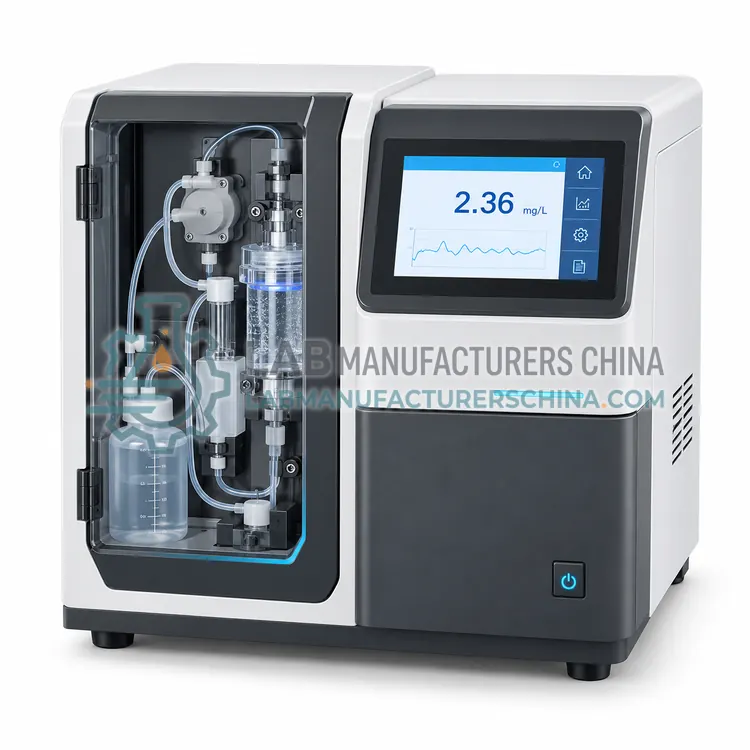
Online TOC Analyzer for Surface Water and Effluent Monitoring
地表水与排放水在线 TOC 分析仪
- CE (to be confirmed)
- +2