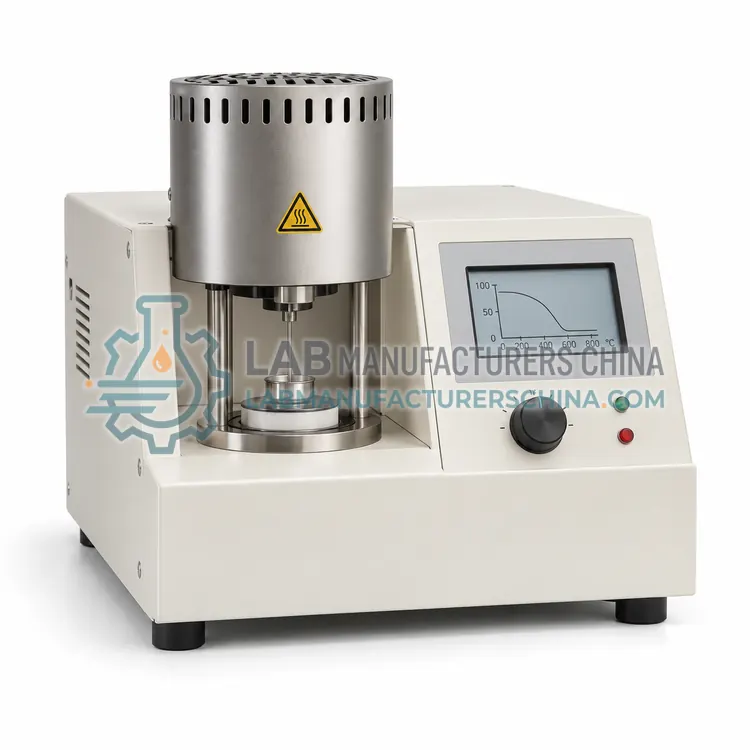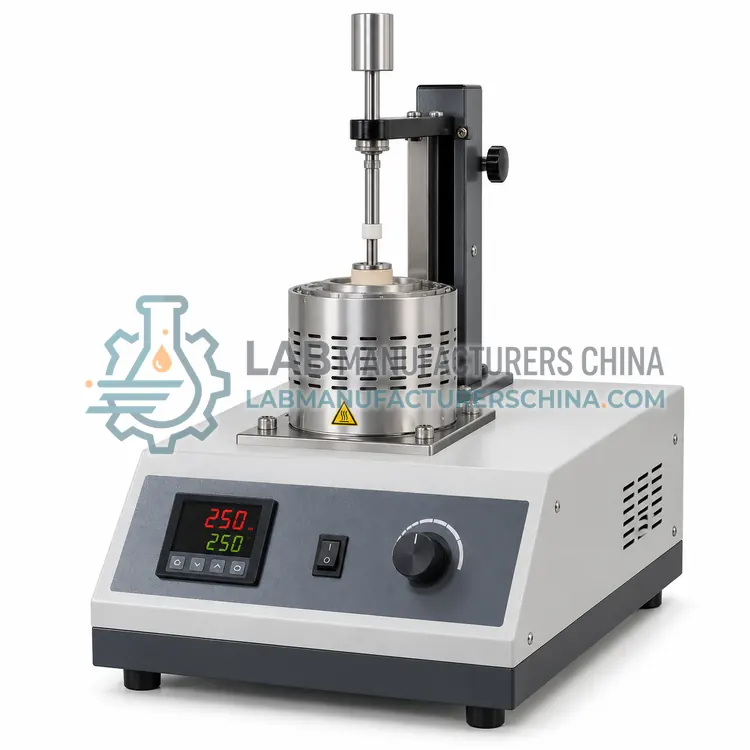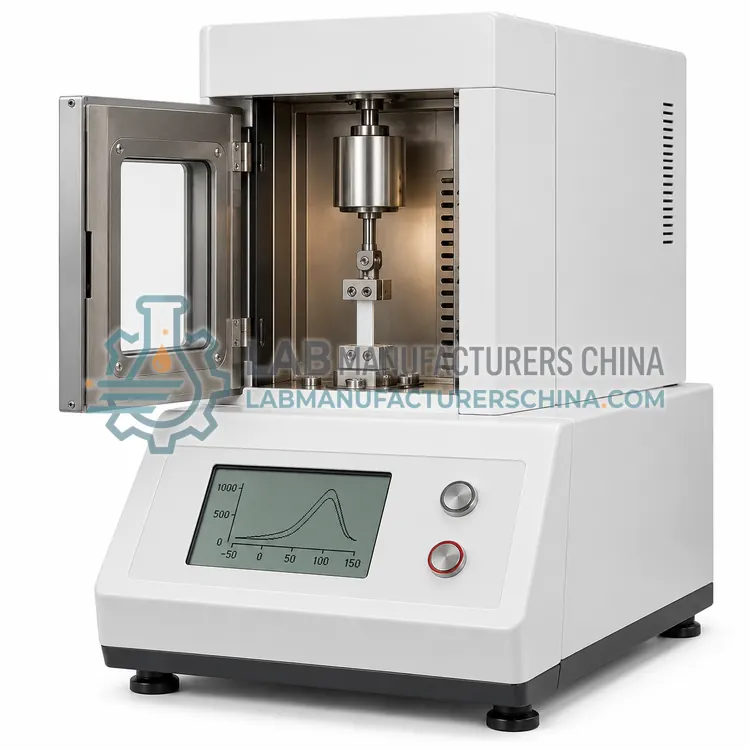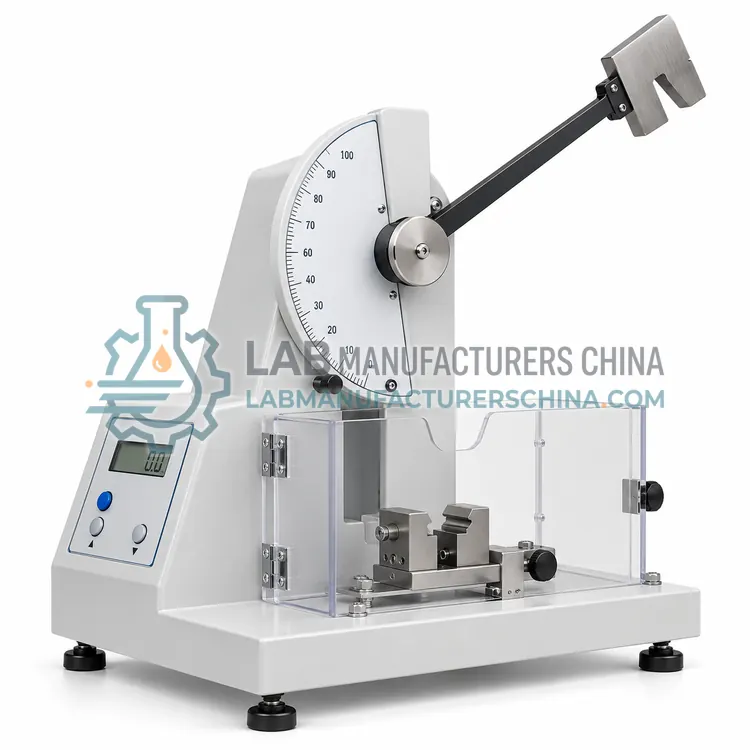
Heat Distortion and Vicat Softening Point Tester
热变形与维卡软化温度测定仪
- SKU THA-0005
- Thermal Analysis
- CE (to be confirmed)
- ISO 9001 manufacturing (to be confirmed)
Price on request — FOB / CIF quoted per order
Prices depend on configuration, quantity and destination port.
Key specifications
| Temperature range | Ambient to 300 °C |
|---|---|
| Heating rates | 50 ± 5 °C/h and 120 ± 10 °C/h |
| Heat deflection loads | 0.45 MPa and 1.80 MPa |
| Deflection limit | 0.32 mm (edgewise) per ISO 75 |
| Vicat needle area | 1 mm², flat ended |
| Vicat loads | 10 N and 50 N |
Request a quote Download brochure · to be provided
By Lab Manufacturers China Technical TeamLast reviewed Standards: ISO 11357-1, ISO 11358-1, ISO 11359-1
What is the Heat Distortion and Vicat Softening Point Tester?
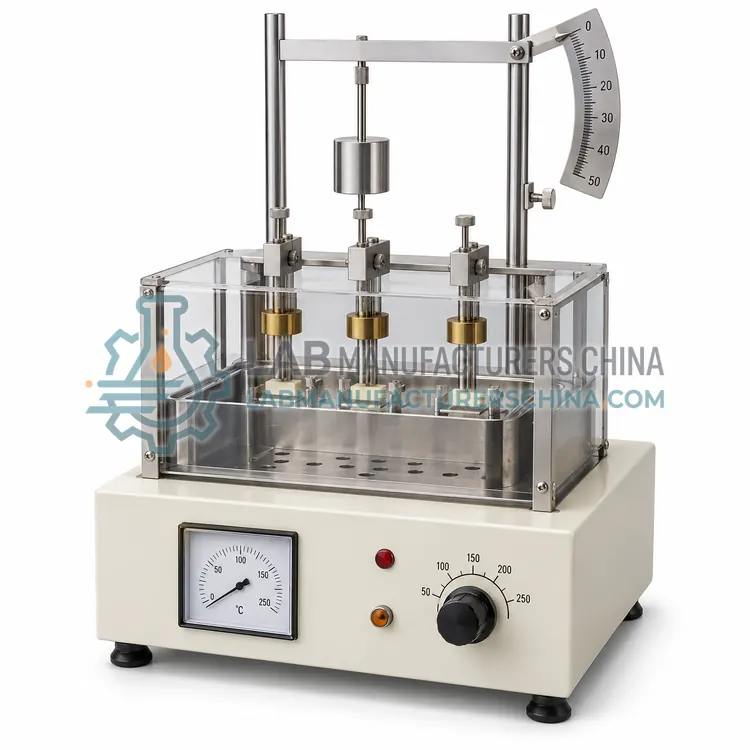
A combined HDT and Vicat tester heats specimens in a controlled oil bath under a defined load and records the temperature at which a specified deflection or penetration occurs. It provides the two softening temperatures most often quoted in plastic specifications.
What is the Heat Distortion and Vicat Softening Point Tester?
A combined HDT and Vicat tester heats specimens in a controlled oil bath under a defined load and records the temperature at which a specified deflection or penetration occurs. It provides the two softening temperatures most often quoted in plastic specifications.
Overview
The instrument holds several specimens in a silicone oil bath with motorised stirring and programmable heating rates, while dial gauges or displacement transducers monitor deflection or needle penetration. Heat deflection testing loads a bar supported at two points, with stresses of 0.45 MPa or 1.80 MPa and edgewise or flatwise orientation, and records the temperature at which the bar deflects by a defined distance. Vicat testing presses a flat-ended needle of 1 mm² under 10 N or 50 N into a specimen and records the temperature at penetration of 1 mm. Bath temperature uniformity, heating rate and specimen conditioning dominate the result, and the equipment usually handles three to six specimens in parallel with a reference thermometer for bath calibration.
How does it work?
Each thermal analysis technique monitors a different physical property as temperature changes. Differential scanning calorimetry records heat flow and reveals glass transition, melting, crystallisation and cure. Thermogravimetry records mass and reveals decomposition and filler content. Thermomechanical analysis records dimensional change under a defined probe and load, giving the coefficient of linear thermal expansion and softening behaviour. Dynamic mechanical analysis applies an oscillating deformation and records storage modulus, loss modulus and damping, which are the most sensitive indicators of glass transition in composites. Heat deflection and Vicat instruments apply a defined load with a standard indenter and record the temperature at which a specified deflection is reached. Thermal conductivity methods measure steady-state or transient heat flow through the specimen.
What are the key features?
- Silicone oil bath with motorised stirring
- Heating rates of 50 °C/h and 120 °C/h
- Loads of 0.45 MPa and 1.80 MPa for heat deflection
- Vicat needle with 10 N and 50 N weights
- Three to six specimens measured in parallel
- Reference thermometer for bath calibration
What are the technical specifications?
A typical heat distortion and vicat softening point tester configuration offers temperature range of Ambient to 300 °C, heating rates of 50 ± 5 °C/h and 120 ± 10 °C/h, heat deflection loads of 0.45 MPa and 1.80 MPa, deflection limit of 0.32 mm (edgewise) per ISO 75, vicat needle area of 1 mm², flat ended and vicat loads of 10 N and 50 N. Values are indicative of the product class; the exact figures for each configuration are confirmed on the quotation and the calibration documents supplied with the instrument.
Which applications is it used for?
The Heat Distortion and Vicat Softening Point Tester is used in material specification testing for moulding grades, incoming verification of engineering plastics, comparison of suppliers for the same grade and quality control of reinforced compounds. Across the wider Thermal Analysis class, laboratories also deploy it for glass transition and melting point determination, heat deflection and Vicat softening temperature testing and thermal expansion and coefficient of linear expansion.
Which standards and certifications apply?
Relevant standards and methods include ISO 11357-1, ISO 11358-1, ISO 11359-1, ISO 6721-1, ISO 306, ISO 75-1, ASTM D648, ASTM D1525, ASTM D4065 and IEC 61010-1. Certification candidates for this model are CE and ISO 9001 manufacturing; each is to be confirmed for the specific configuration before shipment, and certificates are supplied only where they have been issued.
Calibrate the temperature and the property scale with certified standards at the start of a series, and record heating and cooling rates because thermal history changes crystallinity and transitions for every technique. Condition specimens according to the product standard, usually 23 °C and 50% relative humidity, since absorbed moisture shifts results in polyamides and other hygroscopic plastics. Use specimens with parallel faces and uniform thickness, and avoid machining damage on the measuring surfaces. Purge gas protects against oxidation in calorimetry and thermogravimetry, while heat deflection and Vicat tests need a stable silicone oil bath and correct indenter geometry. Keep calibration certificates, raw curves and instrument logs for traceability.
How do I select the right Heat Distortion and Vicat Softening Point Tester?
Specify a combined tester when both heat deflection and Vicat temperatures are required by your material specifications, and confirm bath capacity in relation to the number of specimens you test per batch. Check that the load set, the deflection limit and the needle geometry match the standard edition you follow, and that the bath can be calibrated with a traceable thermometer.
How does it compare with other Thermal Analysis variants?
Start from the property the specification names. If the requirement is a glass transition or a melting point, differential scanning calorimetry is the usual method, while thermomechanical analysis is preferred when the transition must be expressed as a dimensional change or when the coefficient of thermal expansion is also needed. For composites, filled compounds and damping behaviour, dynamic mechanical analysis gives the clearest glass transition and is the standard reference for automotive and structural applications. Decomposition temperature, filler content and thermal stability require thermogravimetry. Heat deflection and Vicat temperatures are short-term, load-dependent indicators widely used in material specifications. Thermal conductivity is measured separately by transient or steady-state methods, and the technique chosen must match the conductivity range and specimen form.
Full specifications
| Temperature range | Ambient to 300 °C |
|---|---|
| Heating rates | 50 ± 5 °C/h and 120 ± 10 °C/h |
| Heat deflection loads | 0.45 MPa and 1.80 MPa |
| Deflection limit | 0.32 mm (edgewise) per ISO 75 |
| Vicat needle area | 1 mm², flat ended |
| Vicat loads | 10 N and 50 N |
| Penetration limit | 1 mm |
| Simultaneous positions | 3–6 |
| Bath medium | Silicone oil |
| Power supply | 220 V, 50/60 Hz |
Indicative values for this product class. Final specifications are confirmed on the quotation and in the calibration documents supplied with the instrument.
Applications
- Material specification testing for moulding grades
- Incoming verification of engineering plastics
- Comparison of suppliers for the same grade
- Quality control of reinforced compounds
Key features
- Silicone oil bath with motorised stirring
- Heating rates of 50 °C/h and 120 °C/h
- Loads of 0.45 MPa and 1.80 MPa for heat deflection
- Vicat needle with 10 N and 50 N weights
- Three to six specimens measured in parallel
- Reference thermometer for bath calibration
Frequently asked questions about Heat Distortion and Vicat Softening Point Tester
Results depend on load, orientation, specimen conditioning, heating rate and bath uniformity, and a change in any one of these changes the reported temperature. The specimen must be conditioned at 23 °C and 50% RH, carefully positioned edgewise or flatwise, and tested at exactly the specified heating rate.
No. It is a short-term, load-specific indicator measured with a rising temperature ramp and does not account for creep, fatigue or long-term ageing. Design limits should be based on long-term property data, with the heat deflection value used only as a comparative specification figure within a material family.
Check oil level and clarity before each series, since degraded or contaminated oil changes heat transfer and can deposit on specimens, and verify bath uniformity with a calibrated thermometer at working temperature. Oil should be replaced at the interval recommended by the manufacturer and whenever it discolours or develops odour.
Both use a defined load and a heated bath. The heat deflection test measures the temperature at which a loaded, supported bar deflects by a specified amount, so it reflects stiffness in bending. The Vicat test measures the temperature at which a needle penetrates a defined depth into a flat specimen, so it reflects softening rather than flexural stiffness.
Dynamic mechanical analysis is the most sensitive, because the damping peak and the drop in storage modulus respond strongly to even small amounts of the mobile amorphous phase. It detects transitions in highly filled or crosslinked materials that give only a weak signal in differential scanning calorimetry.
Water acts as a plasticiser in polyamides, polycarbonates and other hygroscopic plastics, lowering the glass transition and shifting melting and softening temperatures. Specimens must therefore be conditioned to a defined moisture state, or dried and tested promptly, and the conditioning must be reported so results can be compared.
Related models