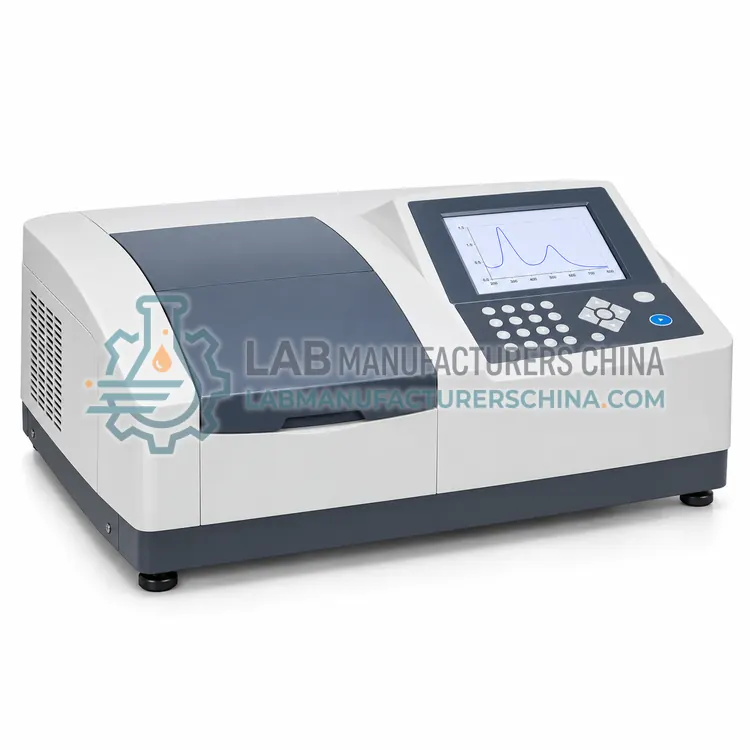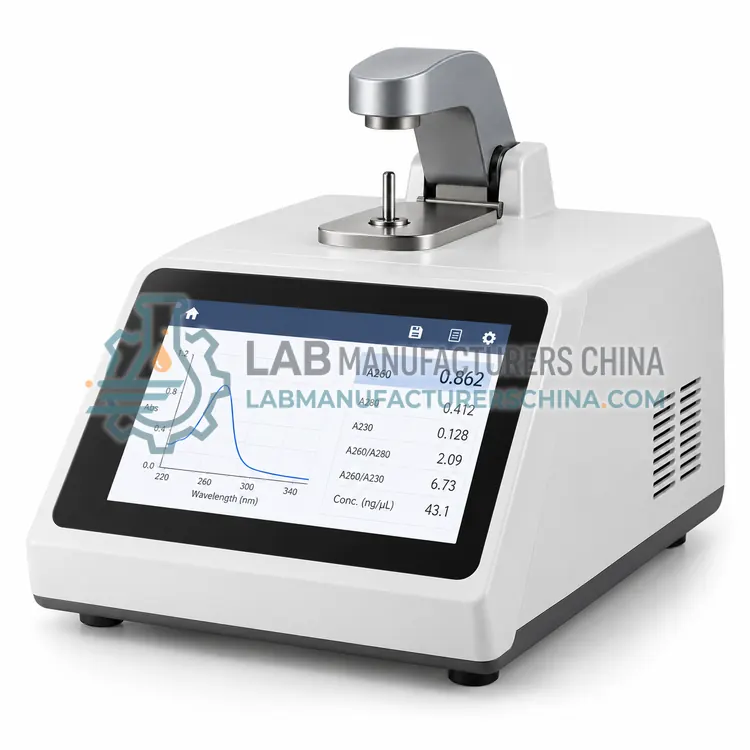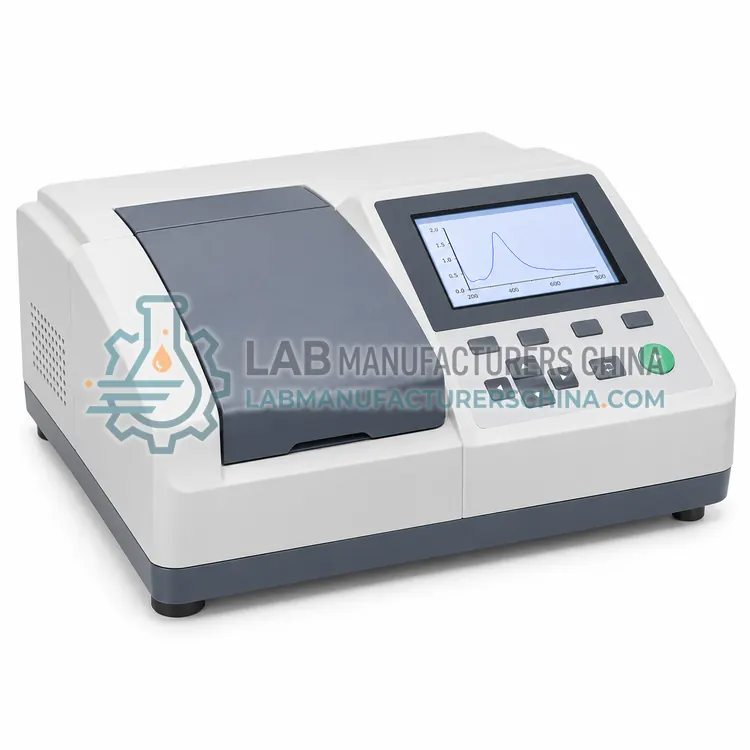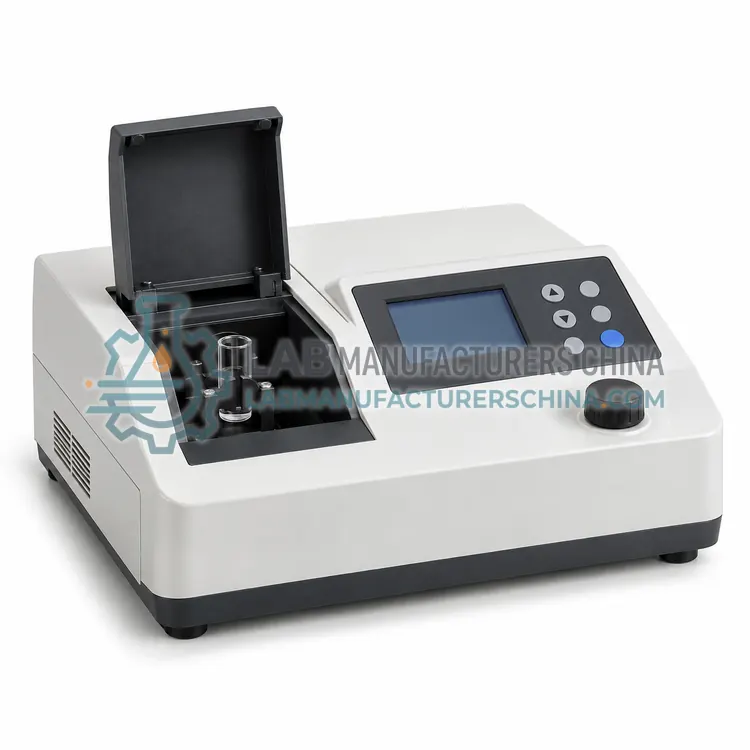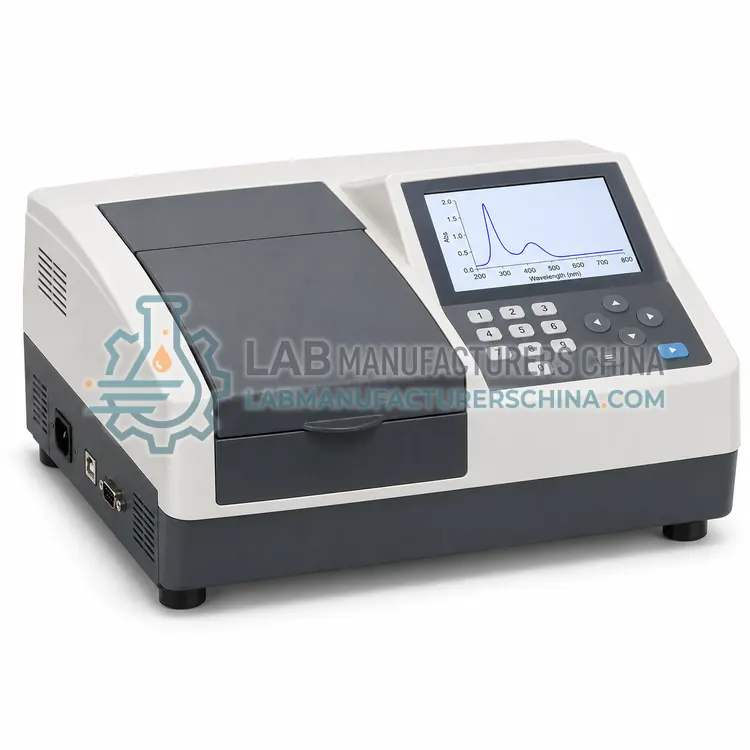
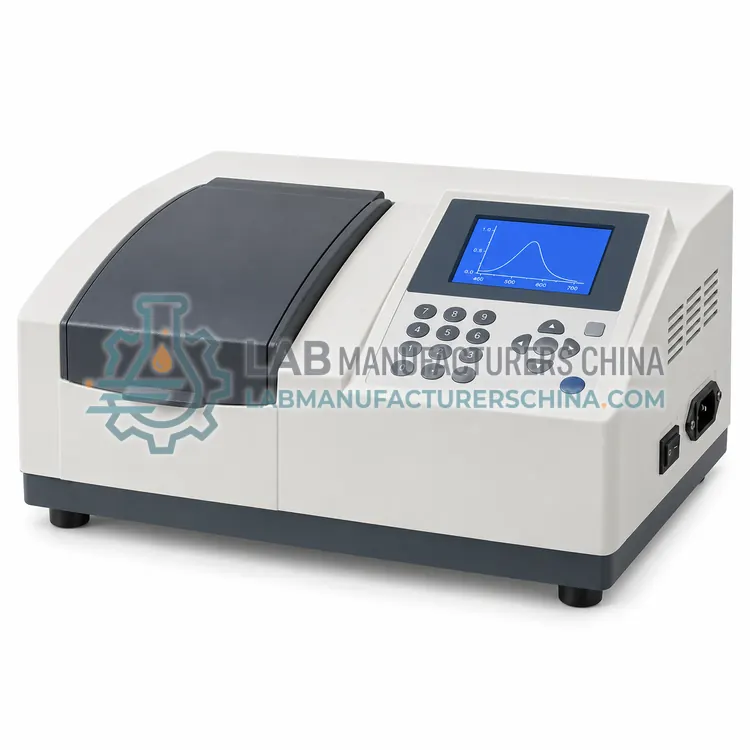
Visible Range Spectrophotometer
可见分光光度计
- SKU SPE-0001
- Spectrophotometers
- CE (to be confirmed)
- ISO 9001 manufacturing (to be confirmed)
Price on request — FOB / CIF quoted per order
Prices depend on configuration, quantity and destination port.
Key specifications
| Wavelength range | 320–1100 nm |
|---|---|
| Spectral bandwidth | 2–4 nm |
| Wavelength accuracy | ±2 nm |
| Wavelength repeatability | ≤1 nm |
| Photometric range | 0–2 A; 0–200 %T |
| Photometric accuracy | ±0.004 A at 1 A |
Request a quote Download brochure · to be provided
By Lab Manufacturers China Technical TeamLast reviewed Standards: USP <857>, Ph. Eur. 2.2.25, ASTM E275
What is the Visible Range Spectrophotometer?
A visible range spectrophotometer measures absorbance and transmittance between roughly 320 and 1100 nm using a tungsten-halogen lamp. It is the economical choice for colorimetric assays, water analysis kits and teaching laboratories, where ultraviolet measurement is not required.
What is the Visible Range Spectrophotometer?
A visible range spectrophotometer measures absorbance and transmittance between roughly 320 and 1100 nm using a tungsten-halogen lamp. It is the economical choice for colorimetric assays, water analysis kits and teaching laboratories, where ultraviolet measurement is not required.
Overview
The visible range spectrophotometer is the simplest grating-based instrument in the family. A single tungsten-halogen lamp illuminates a concave or plane grating monochromator, and a silicon photodiode records the signal. Because no deuterium source is fitted, the instrument is compact, warms up quickly and has low running cost. Typical spectral bandwidth is 2–4 nm, which is adequate for broad colorimetric absorption bands such as those produced by phosphate, nitrite, iron and chlorine test reagents. Models usually offer transmittance, absorbance and concentration modes, stored calibration curves and a choice of 10 mm cuvettes or round test tubes. Photometric range is commonly 0–2 A with a stated accuracy of about ±0.004 A at 1 A. The design is well suited to teaching laboratories, water treatment plants and clinical chemistry screening where sample throughput is moderate.
How does it work?
A spectrophotometer passes light from a lamp through a monochromator, which selects a narrow wavelength band using a diffraction grating or filter. The band then crosses a sample held in a cuvette, and a detector such as a silicon photodiode or photomultiplier tube records the transmitted intensity. Absorbance is calculated as the negative logarithm of transmittance, and the Beer–Lambert law relates it linearly to analyte concentration within a limited range. Light sources are typically a tungsten-halogen lamp for the visible range and a deuterium lamp for the ultraviolet. Single-beam designs measure reference and sample sequentially, while double-beam designs split the beam to compensate for lamp drift. Reflectance instruments replace the cuvette with an integrating sphere or a fixed 45/0 geometry to capture color data.
What are the key features?
- Tungsten-halogen lamp gives stable output across the visible and near-infrared range.
- Compact optical bench with fast warm-up reduces bench space and start-up time.
- Stored calibration curves allow direct concentration readout for routine assays.
- Accepts 10 mm cuvettes and round test tubes through an interchangeable holder.
- USB or RS-232 output supports data transfer to a PC or printer.
- Low-cost replaceable lamp keeps running expense modest.
What are the technical specifications?
A typical visible range spectrophotometer configuration offers wavelength range of 320–1100 nm, spectral bandwidth of 2–4 nm, wavelength accuracy of ±2 nm, wavelength repeatability of ≤1 nm, photometric range of 0–2 A; 0–200 %T and photometric accuracy of ±0.004 A at 1 A. Values are indicative of the product class; the exact figures for each configuration are confirmed on the quotation and the calibration documents supplied with the instrument.
Which applications is it used for?
The Visible Range Spectrophotometer is used in colorimetric water testing, teaching laboratories, clinical chemistry screening and food and beverage quality checks. Across the wider Spectrophotometers class, laboratories also deploy it for nucleic acid and protein quantification, water and environmental colorimetric analysis and pharmaceutical and chemical QC.
Which standards and certifications apply?
Relevant standards and methods include USP <857>, Ph. Eur. 2.2.25, ASTM E275, ASTM E308, JJG 178 and IEC 61010-1. Certification candidates for this model are CE and ISO 9001 manufacturing; each is to be confirmed for the specific configuration before shipment, and certificates are supplied only where they have been issued.
Place the instrument on a vibration-free bench away from direct sunlight and strong air currents, and allow 15–30 minutes of warm-up for lamp stabilization. Verify wavelength accuracy, photometric accuracy, stray light and baseline noise at defined intervals using certified reference filters or solutions. Keep cuvettes clean, matched and free of scratches, and use quartz cells below 340 nm. Deuterium and tungsten lamps have finite lifetimes, so record lamp hours and schedule replacement. Keep the sample compartment dry and protected from spills. In regulated environments, apply installation, operational and performance qualification and maintain calibration records.
How do I select the right Visible Range Spectrophotometer?
Choose the visible model when all assays use visible-absorbing reagents and no ultraviolet measurement is planned. It is less costly and simpler than UV-capable instruments but cannot measure nucleic acids or UV-absorbing organics. In an RFQ, specify wavelength range, bandwidth, required cuvette types, number of stored curves and any regulatory reporting needs.
How does it compare with other Spectrophotometers variants?
Start with the wavelength range: visible-only instruments cover roughly 320–1100 nm and suit colorimetric assays, while UV-capable models extend to 190 nm for nucleic acids, proteins and organic compounds. Next consider photometric stability and stray light, which determine the usable absorbance range; double-beam optics give lower drift for long kinetic runs and method validation. Spectral bandwidth matters for sharp absorption peaks, with 1–2 nm adequate for most quantitative work. Sample volume and format separate standard cuvette models from microvolume and portable designs. Regulated laboratories should check for software audit trails, electronic records support and verification routines. Finally, consider throughput, accessories such as Peltier cell holders or autosamplers, and whether the instrument must operate outside the laboratory.
Full specifications
| Wavelength range | 320–1100 nm |
|---|---|
| Spectral bandwidth | 2–4 nm |
| Wavelength accuracy | ±2 nm |
| Wavelength repeatability | ≤1 nm |
| Photometric range | 0–2 A; 0–200 %T |
| Photometric accuracy | ±0.004 A at 1 A |
| Stray light | ≤0.5 %T at 360 nm |
| Light source | Tungsten-halogen lamp |
| Detector | Silicon photodiode |
| Display | LCD, 128 × 64 pixels |
| Power supply | AC 100–240 V, 50/60 Hz |
Indicative values for this product class. Final specifications are confirmed on the quotation and in the calibration documents supplied with the instrument.
Applications
- Colorimetric water testing
- Teaching laboratories
- Clinical chemistry screening
- Food and beverage quality checks
Key features
- Tungsten-halogen lamp gives stable output across the visible and near-infrared range.
- Compact optical bench with fast warm-up reduces bench space and start-up time.
- Stored calibration curves allow direct concentration readout for routine assays.
- Accepts 10 mm cuvettes and round test tubes through an interchangeable holder.
- USB or RS-232 output supports data transfer to a PC or printer.
- Low-cost replaceable lamp keeps running expense modest.
Frequently asked questions about Visible Range Spectrophotometer
No. DNA and RNA absorb at 260 nm, which is below the range of a visible-only instrument. A UV-capable model with a deuterium lamp and quartz cuvettes or a microvolume accessory is required for A260 quantification.
A bandwidth of 2–4 nm is generally sufficient because colorimetric reagents produce broad absorption bands tens of nanometers wide. Narrower bandwidth is only needed for sharp peaks such as those of holmium oxide or rare-earth solutions.
Allow about 15 minutes after switching on so the tungsten-halogen lamp and detector reach thermal equilibrium. For the highest photometric accuracy, verify the zero and 100 %T readings again after warm-up before measuring samples.
A spectrophotometer measures the intensity of light after it passes through or reflects from a sample at specific wavelengths. From this it reports transmittance, absorbance or reflectance, which can be converted to concentration using a calibration curve or to color coordinates such as CIE L*a*b*.
A colorimeter uses fixed filters or LEDs at a few wavelengths, while a spectrophotometer uses a monochromator to scan a continuous range. Spectrophotometers therefore offer higher spectral resolution, full spectra and greater flexibility, whereas colorimeters are simpler and suited to dedicated assays.
Ordinary glass and most plastics absorb strongly below about 340 nm, which would mask the sample signal. Fused quartz transmits down to roughly 190 nm, so it is required for nucleic acid measurements at 260 nm and for UV absorption of organic compounds.
Related models