Portable Grain and Seed Moisture Tester
便携式谷物和种子水分测定仪
- SKU SMM-0005
- Seed Moisture Meters
- CE (to be confirmed)
- RoHS (to be confirmed)
- ISO 9001 manufacturing (to be confirmed)
Price on request — FOB / CIF quoted per order
Prices depend on configuration, quantity and destination port.
Key specifications
| Measurement principle | Capacitance or resistance |
|---|---|
| Moisture range | 5–40%, species dependent |
| Accuracy | ±0.5–1.0% vs oven, with calibration |
| Repeatability | ±0.2% |
| Measurement time | 3–10 s |
| Sample volume | 100–500 mL |
Request a quote Download brochure · to be provided
By Lab Manufacturers China Technical TeamLast reviewed Standards: ISTA Rules Chapter 9 (moisture), ISO 712 (cereals moisture), ISO 6540 (maize moisture)
What is the Portable Grain and Seed Moisture Tester?
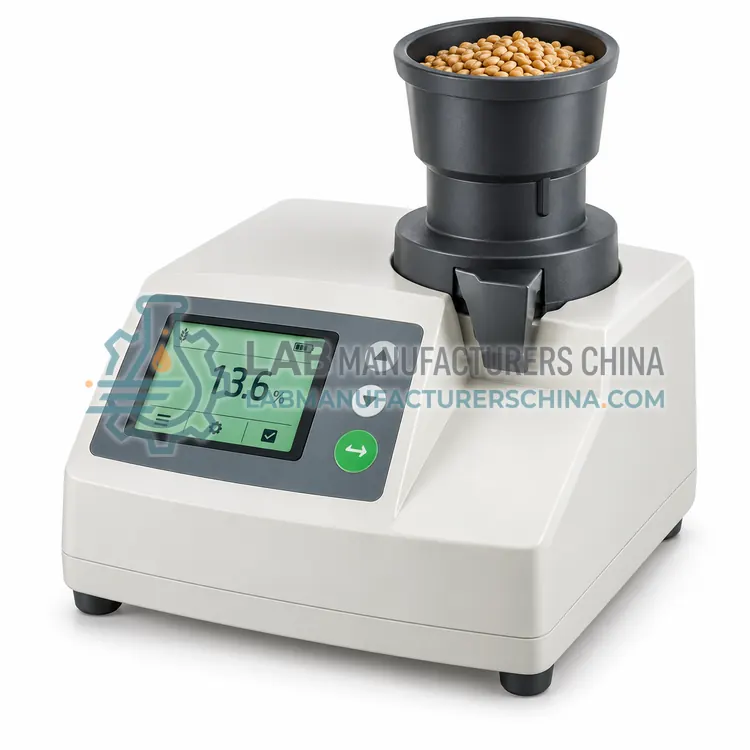
A battery-powered meter for on-the-spot moisture checks in the field, warehouse or drying facility. It is the right choice for growers and storekeepers who need immediate results to make drying and storage decisions.
What is the Portable Grain and Seed Moisture Tester?
A battery-powered meter for on-the-spot moisture checks in the field, warehouse or drying facility. It is the right choice for growers and storekeepers who need immediate results to make drying and storage decisions.
Overview
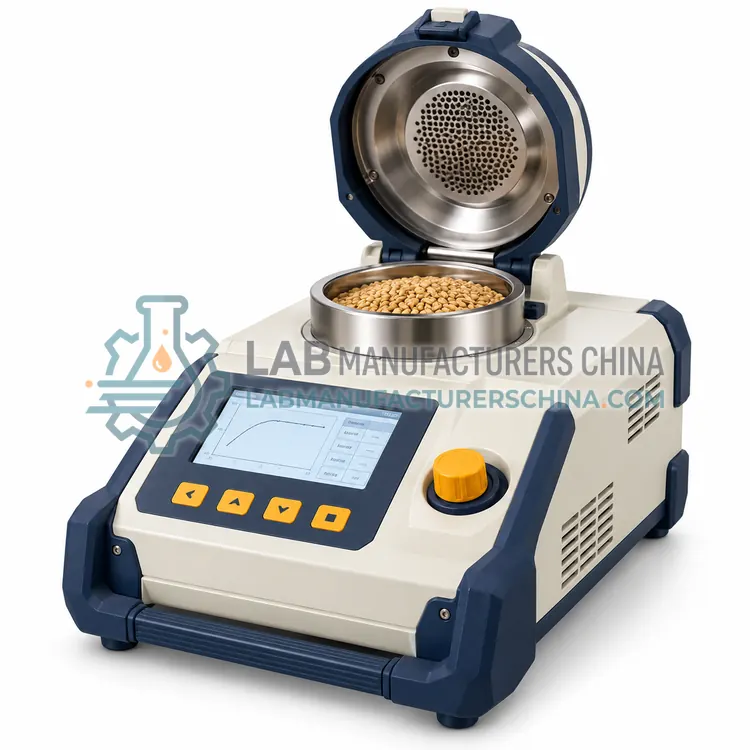
The portable grain and seed moisture tester uses capacitance or resistance sensing in a compact, battery-powered housing so that a measurement can be taken at the combine, in a truck or in a silo. A cup or a probe holds the sample, and species calibrations stored in the instrument convert the signal to moisture percentage with automatic temperature compensation. Some models include a weighing function for test weight and a memory to average several readings from one lot, which improves reliability because moisture varies within a load. Rugged construction, sealed keypad and a backlit display suit dusty and cold environments. The meter is calibrated at the factory and should be checked against a laboratory oven or a reference meter each season. Because readings are relative, the correct species setting and consistent sample filling are essential for useful results.
How does it work?
Moisture meters exploit the difference between water and dry matter. Capacitance meters place a fixed volume of seed in an electric field and measure the dielectric constant, which rises strongly with water content, converting the value to moisture percentage through a calibration specific to species, variety and temperature. Near-infrared meters measure reflectance or transmission and predict moisture from spectra, again using species-specific models. Loss-on-drying analyzers, using halogen, infrared or microwave heating, weigh the sample, dry it until the mass is stable and calculate the water driven off, which is the reference approach. Results may be expressed on a wet basis, the water fraction of the fresh sample, or a dry basis, which is needed for some standards. Equilibrium between the seed and the surrounding air means samples must be sealed and analysed quickly.
What are the key features?
- Battery-powered for use at the combine, truck or silo.
- Species calibrations with automatic temperature compensation.
- Memory averages several readings from one load.
- Rugged, sealed housing suits dusty and cold conditions.
- Optional weighing adds test weight measurement.
- Backlit display for use in low light and at night.
What are the technical specifications?
A typical portable grain and seed moisture tester configuration offers measurement principle of Capacitance or resistance, moisture range of 5–40%, species dependent, accuracy of ±0.5–1.0% vs oven, with calibration, repeatability of ±0.2%, measurement time of 3–10 s and sample volume of 100–500 mL. Values are indicative of the product class; the exact figures for each configuration are confirmed on the quotation and the calibration documents supplied with the instrument.
Which applications is it used for?
The Portable Grain and Seed Moisture Tester is used in on-farm harvest moisture checks, warehouse and silo monitoring, drying facility control and incoming load inspections. Across the wider Seed Moisture Meters class, laboratories also deploy it for seed lot storage safety assessment, trade contract moisture compliance and drying and conditioning control.
Which standards and certifications apply?
Relevant standards and methods include ISTA Rules Chapter 9 (moisture), ISO 712 (cereals moisture), ISO 6540 (maize moisture), AACC Method 44-15A and GB/T 3543.6 (seed moisture). Certification candidates for this model are CE, RoHS and ISO 9001 manufacturing; each is to be confirmed for the specific configuration before shipment, and certificates are supplied only where they have been issued.
Seal samples in moisture-tight containers immediately after sampling and analyse within the time the method allows, because seeds exchange water with ambient air. Fill capacitance meters to the correct volume, use the species calibration and record the sample temperature. For oven methods, control temperature, time and grinding exactly as specified, and cool samples in a desiccator before weighing to the required resolution. Verify meters against the oven method for each species and season, and keep a reference sample for checks. Avoid measuring seed that has been in a warm room for a long time without equilibration, since surface drying gives a low reading. Record species, variety, calibration used and result basis, and maintain the instrument's temperature sensor and balance on a calibration schedule.
How do I select the right Portable Grain and Seed Moisture Tester?
Select the portable tester for immediate field decisions where laboratory accuracy is not required and the species calibration is available. For trade or regulatory figures, confirm results with a laboratory oven method. In an RFQ, specify species, accuracy, portability and whether test weight is needed.
How does it compare with other Seed Moisture Meters variants?
Select the method according to the standard and the required accuracy. When a result must be reported under ISTA, national seed rules or a contract, use the oven procedure specified in the method, and use a meter only for screening or process control. For rapid checks on many lots, choose a capacitance or near-infrared instrument with a calibration for the exact species and variety group, and verify it against the oven method. Nominal capacitance readings are strongly affected by temperature and fill volume, so temperature compensation and consistent sample filling are essential. Near-infrared instruments need representative, clean samples and periodic bias adjustment. For oily seeds, small seeds and coated seed, confirm that a calibration exists. Consider portability, data export and sample throughput when many lots are checked daily.
Full specifications
| Measurement principle | Capacitance or resistance |
|---|---|
| Moisture range | 5–40%, species dependent |
| Accuracy | ±0.5–1.0% vs oven, with calibration |
| Repeatability | ±0.2% |
| Measurement time | 3–10 s |
| Sample volume | 100–500 mL |
| Temperature compensation | 0–40 °C |
| Species memory | 10–30 calibrations |
| Data memory | Up to 1000 records |
| Battery life | 20–50 h |
| Ingress protection | IP54 or better |
Indicative values for this product class. Final specifications are confirmed on the quotation and in the calibration documents supplied with the instrument.
Applications
- On-farm harvest moisture checks
- Warehouse and silo monitoring
- Drying facility control
- Incoming load inspections
Key features
- Battery-powered for use at the combine, truck or silo.
- Species calibrations with automatic temperature compensation.
- Memory averages several readings from one load.
- Rugged, sealed housing suits dusty and cold conditions.
- Optional weighing adds test weight measurement.
- Backlit display for use in low light and at night.
Frequently asked questions about Portable Grain and Seed Moisture Tester
With a correct species calibration and temperature compensation, results typically fall within about half to one percent of the oven method. Accuracy is poorer for varieties or seed conditions not represented in the calibration, so periodic verification is important.
Moisture varies within a truck or bin, so a single scoop may miss a wet or dry pocket. Taking several readings and averaging them gives a value more representative of the load, and the meter's memory function stores them for reporting.
Temperature compensation handles the main effect, but rain, condensation and very cold seed can still bias readings because surface water or ice changes the signal. Let samples equilibrate in a closed container before measuring in extreme conditions.
Wet basis expresses water as a percentage of the fresh sample mass, while dry basis expresses it as a percentage of the dry matter. Trade and most seed rules use wet basis, but some standards and research report dry basis, so the basis must always be stated.
Seeds continuously exchange water with the air and reach an equilibrium with ambient humidity. If a sample is left open, it gains or loses water, so the measured value no longer represents the lot at sampling. Sealed analysis within the allowed time avoids this error.
Compare it with the oven reference method for each species, using samples spanning the working moisture range, and calculate the average bias and scatter. Repeat the check each season and after repair or calibration changes, adjusting the meter if bias exceeds tolerance.
Related models