
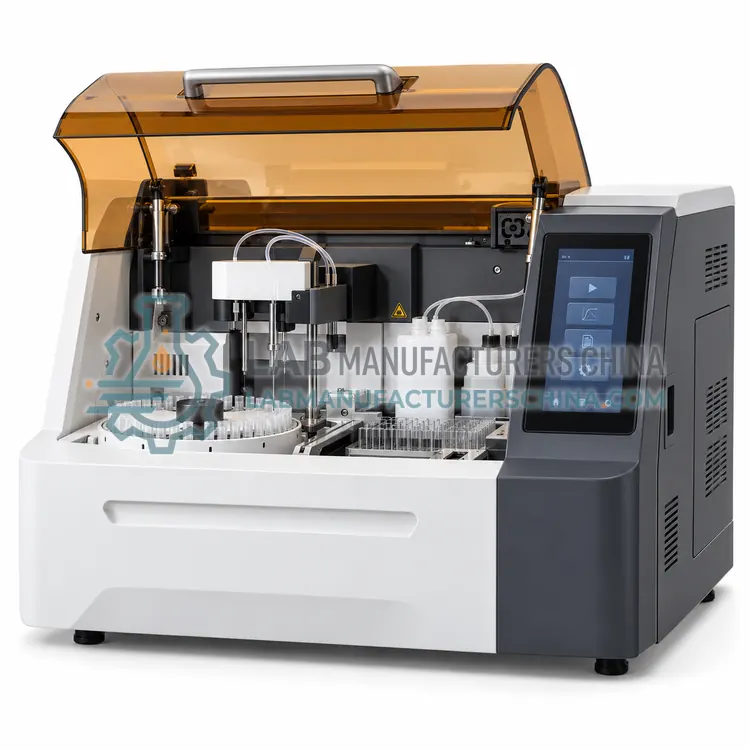
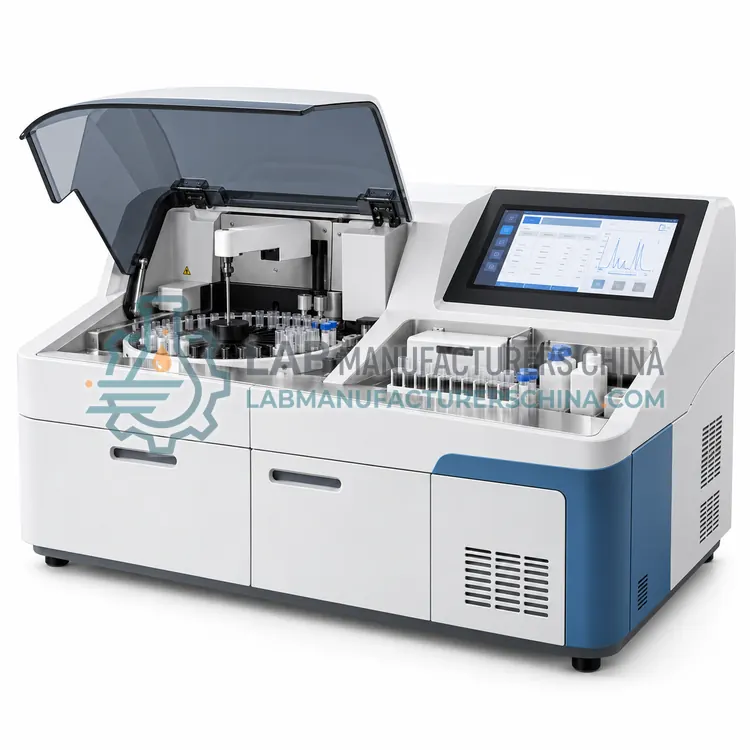
Portable Semi-Automatic Biochemistry Analyzer
便携式半自动生化分析仪
- SKU SEM-0004
- Semi-Automatic Analyzers
- CE (to be confirmed)
- ISO 13485 manufacturing (to be confirmed)
- NMPA registration for the analyzer (to be confirmed)
Price on request — FOB / CIF quoted per order
Prices depend on configuration, quantity and destination port.
Key specifications
| Wavelengths | 4–6 fixed wavelengths, 340–700 nm |
|---|---|
| Photometric range | 0–3.0 absorbance units |
| Battery life | 4–8 h continuous use |
| Throughput | 40–80 tests/h |
| Temperature control | Ambient to 37 °C block, ±0.3 °C |
| Weight | 3–6 kg with case |
Request a quote Download brochure · to be provided
By Lab Manufacturers China Technical TeamLast reviewed Standards: ISO 15189, CLSI EP05, CLSI EP06
What is the Portable Semi-Automatic Biochemistry Analyzer?
A portable semi-automatic analyzer packages the photometer, filters and battery power in a carrying case for field, mobile clinic and veterinary use. It handles a limited menu with the same calculation modes as a bench instrument and suits outreach testing where laboratory infrastructure is limited.
What is the Portable Semi-Automatic Biochemistry Analyzer?
A portable semi-automatic analyzer packages the photometer, filters and battery power in a carrying case for field, mobile clinic and veterinary use. It handles a limited menu with the same calculation modes as a bench instrument and suits outreach testing where laboratory infrastructure is limited.
Overview
The instrument works on the same photometric principle as a bench analyzer but is built for transport: a rugged housing, internal rechargeable battery, low-power LED source and a reduced filter set, often four to six wavelengths. It can run on mains or battery for several hours, and some models include an integrated incubator and a small printer. Typical applications are glucose, hemoglobin, creatinine, total protein, albumin and a few enzyme tests in rural clinics, veterinary practice and teaching in remote areas. Because the environment is uncontrolled, temperature compensation and stable LED sources matter, and the operator must be trained to keep the optical cell clean and to protect reagents from heat during transport.
How does it work?
A semi-automatic analyzer contains a light source, a wavelength selector such as interference filters or a grating, a temperature-controlled measuring position and a photodetector. The operator pipettes a measured volume of sample and working reagent into a cuvette or into a flow-through cell, mixes, and starts the reading. The instrument records absorbance at one or more wavelengths at fixed intervals, applies endpoint, kinetic or fixed-time calculation according to the selected program, and converts the signal into concentration using a stored calibration curve. Because the reaction temperature strongly affects enzyme kinetics, the measuring position is held at 37 degrees Celsius or at another programmed temperature, usually within 0.1 degrees Celsius. The operator's pipetting technique, cuvette cleanliness and correct reagent preparation determine the quality of the result, which is why training and written procedures matter more on this platform than on a fully automatic analyzer.
What are the key features?
- Rugged portable housing with carrying case
- Internal rechargeable battery for field operation
- Low-power LED source with four to six wavelengths
- Operation from mains or battery for several hours
- Optional integrated incubator and thermal printer
- Simple program set for common clinic analytes
What are the technical specifications?
A typical portable semi-automatic biochemistry analyzer configuration offers wavelengths of 4–6 fixed wavelengths, 340–700 nm, photometric range of 0–3.0 absorbance units, battery life of 4–8 h continuous use, throughput of 40–80 tests/h, temperature control of Ambient to 37 °C block, ±0.3 °C and weight of 3–6 kg with case. Values are indicative of the product class; the exact figures for each configuration are confirmed on the quotation and the calibration documents supplied with the instrument.
Which applications is it used for?
The Portable Semi-Automatic Biochemistry Analyzer is used in mobile and outreach clinics, veterinary field diagnostics, emergency and disaster response testing and teaching in areas without laboratory infrastructure. Across the wider Semi-Automatic Analyzers class, laboratories also deploy it for low-volume clinical chemistry testing, rural and outreach clinics and veterinary biochemistry.
Which standards and certifications apply?
Relevant standards and methods include ISO 15189, CLSI EP05, CLSI EP06, CLSI C24, IEC 61010-1 and IEC 61010-2-101. Certification candidates for this model are CE, ISO 13485 manufacturing and NMPA registration for the analyzer; each is to be confirmed for the specific configuration before shipment, and certificates are supplied only where they have been issued.
Install the analyzer on a level bench away from draughts, direct sunlight and vibration, with a stable power supply and a grounded outlet. Verify performance at installation with a reference material or an assigned sample, and check the temperature of the measuring position with an external thermometer. Daily work should include a distilled water blank, a control sample at normal and abnormal levels, and cleaning of the flow cell or cuvette holder. Replace lamps at the end of their rated life or when the blank absorbance rises, keep filters clean and dry, and store reagents according to the label. The laboratory must document operator competence, since results depend on pipetting accuracy, and should review calibration at each new reagent lot.
How do I select the right Portable Semi-Automatic Biochemistry Analyzer?
Choose this variant when the analyzer must travel and mains power is unreliable, and when the menu can be limited to a few robust assays. In the RFQ confirm the wavelengths provided, battery life, warm-up behaviour after transport, the stability of calibration between sites, and whether reagents are supplied in field-friendly packaging. Ask about operating temperature range for the intended climate.
How does it compare with other Semi-Automatic Analyzers variants?
Choose a semi-automatic analyzer when the budget is limited, when fewer than about one hundred tests are performed per day, or when the reagent menu changes often and single-channel flexibility is valuable. Compare models by the wavelength range and filter set, whether they use a flow-through cell or single cuvettes, the temperature control accuracy, and the calculation modes supported. A flow-through cell reduces cuvette cost but needs careful cleaning between samples to avoid carryover, while disposable cuvettes simplify workflow at higher consumable cost. Check the number of stored programs, the ability to run two-point and multi-point calibration, and whether the analyzer can print or export results. Confirm that reagents are open, since proprietary reagents on a semi-automatic platform usually negate the cost advantage.
Full specifications
| Wavelengths | 4–6 fixed wavelengths, 340–700 nm |
|---|---|
| Photometric range | 0–3.0 absorbance units |
| Battery life | 4–8 h continuous use |
| Throughput | 40–80 tests/h |
| Temperature control | Ambient to 37 °C block, ±0.3 °C |
| Weight | 3–6 kg with case |
| Data storage | 1,000 patient results |
| Interfaces | USB and optional Bluetooth printer |
| Power supply | AC 100–240 V or internal battery |
Indicative values for this product class. Final specifications are confirmed on the quotation and in the calibration documents supplied with the instrument.
Applications
- Mobile and outreach clinics
- Veterinary field diagnostics
- Emergency and disaster response testing
- Teaching in areas without laboratory infrastructure
Key features
- Rugged portable housing with carrying case
- Internal rechargeable battery for field operation
- Low-power LED source with four to six wavelengths
- Operation from mains or battery for several hours
- Optional integrated incubator and thermal printer
- Simple program set for common clinic analytes
Frequently asked questions about Portable Semi-Automatic Biochemistry Analyzer
Mechanical shock and temperature change can shift the optical zero, so the instrument should be allowed to reach ambient temperature and a blank should be run before use. Most portable analyzers hold calibration factors in memory, but the laboratory should verify with a control after each move.
Keep reagents cool and out of direct sunlight, use insulated boxes during transport, and record the time out of refrigeration. Once reconstituted, reagent stability shortens sharply at high ambient temperature, so the number of tests planned per session should be small.
With stable LED sources and a clean cell, performance is close to a bench instrument for endpoint assays, typically within a few percent on control material. Kinetic assays are more sensitive to temperature variation in the field, and results should be interpreted with the more permissive acceptance limits appropriate to the setting.
With manual pipetting and a flow-through cell, an experienced operator can complete roughly 60 to 120 tests per hour for simple endpoint assays, less for kinetic tests that need several readings. Daily capacity therefore depends on staffing, so these analyzers are usually chosen for workloads below about one hundred to two hundred tests per day.
A flow-through cell is a fixed optical cell that the sample is aspirated into and then rinsed out, which reduces consumable costs but requires thorough washing to avoid carryover. Disposable cuvettes are used once and discarded, which simplifies workflow and eliminates carryover risk at a higher cost per test.
Assays that need many timed readings, such as complex kinetic enzyme methods, and assays with aggressive reagents or short reaction windows, are poorly suited. High-volume panels, tests requiring automatic dilution and rerun, and assays with very low analyte concentrations needing high sensitivity are also better handled on a fully automatic platform.
Related models
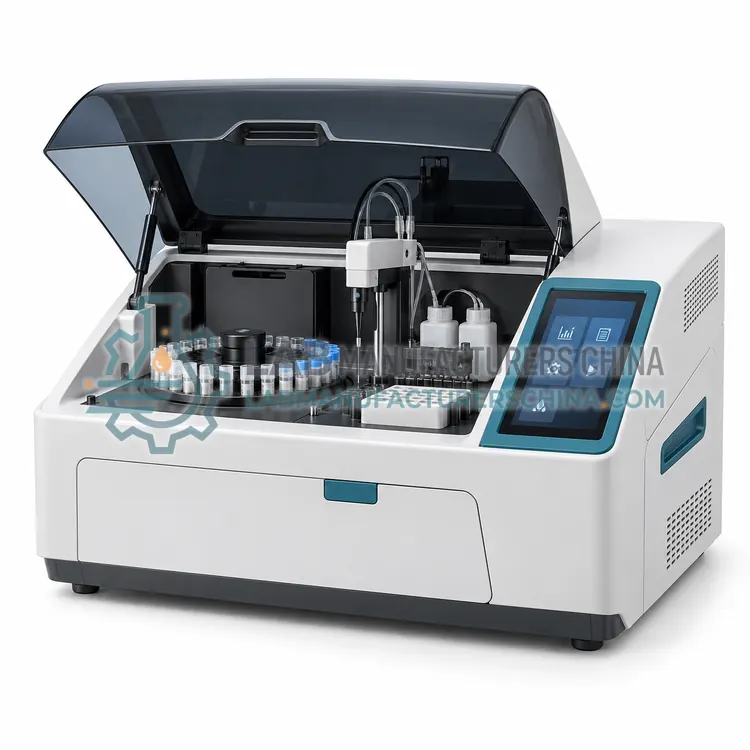
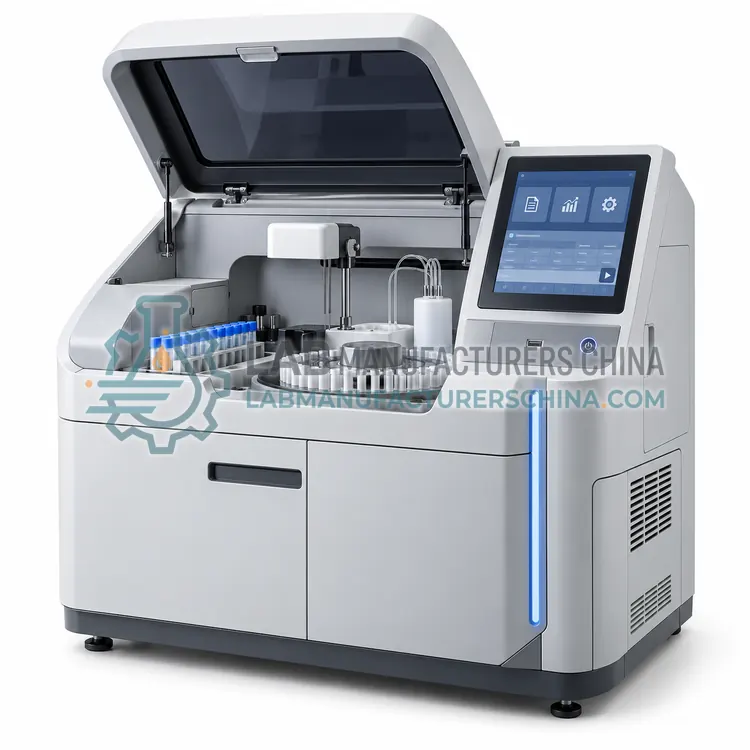
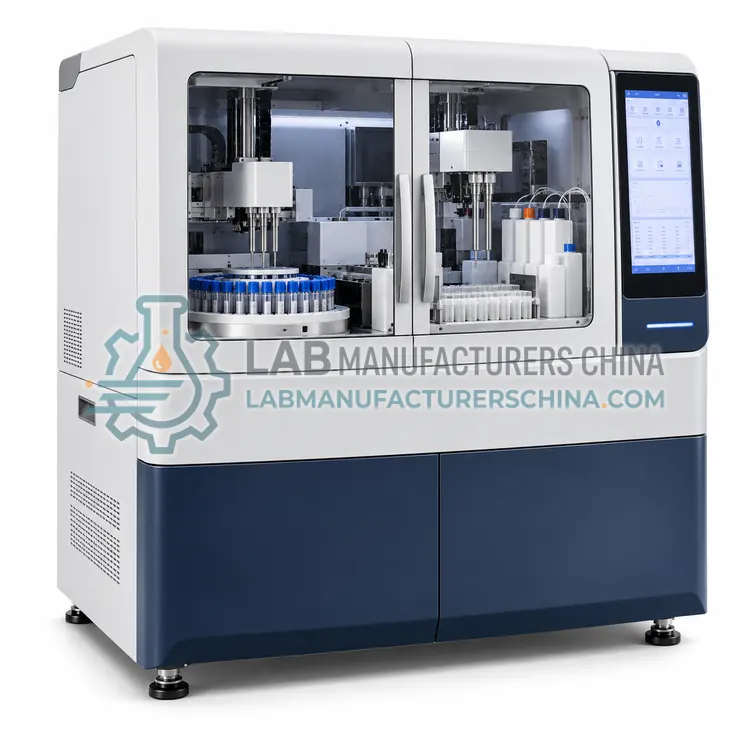
Fully Automatic Chemistry Analyzer with Immunoturbidimetry Module
带免疫比浊模块的全自动生化分析仪
- CE (to be confirmed)
- +2