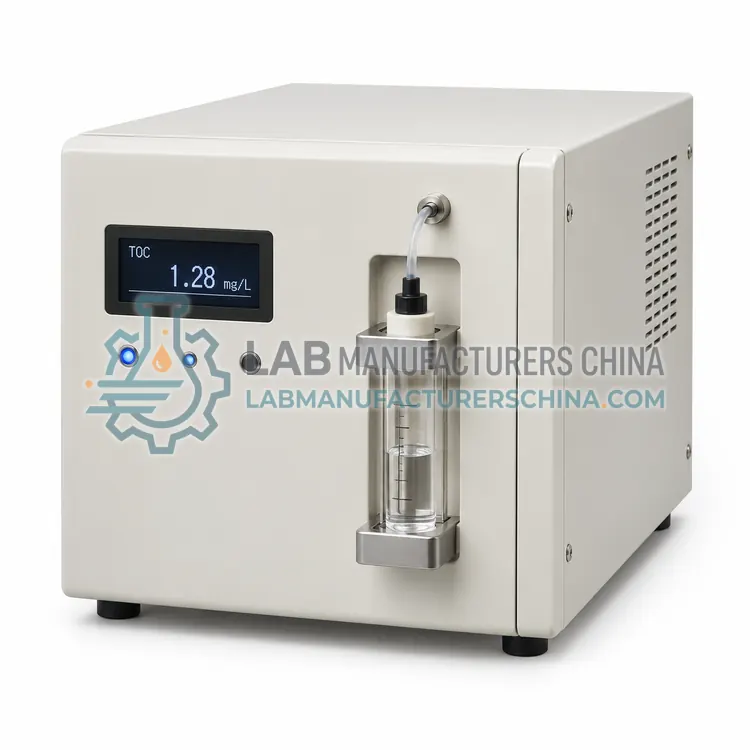
Online Total Organic Carbon (TOC) Analyzer
在线总有机碳(TOC)分析仪
- SKU PRC-0005
- Process Analyzers
- CE (to be confirmed)
- ISO 9001 manufacturing (to be confirmed)
- USP <643> suitability support (to be confirmed)
Price on request — FOB / CIF quoted per order
Prices depend on configuration, quantity and destination port.
Key specifications
| Measuring range (UV models) | 0.05–1000 μg/L |
|---|---|
| Measuring range (combustion models) | 0–20 000 mg/L |
| Oxidation method | UV/persulfate or 680–850 °C catalytic |
| Detector | NDIR |
| Accuracy | ±2 % or ±0.05 mg/L |
| Repeatability | ≤2 % RSD |
Request a quote Download brochure · to be provided
By Lab Manufacturers China Technical TeamLast reviewed Standards: ISO 9001, IEC 61010-1, IEC 60079-0
What is the Online Total Organic Carbon (TOC) Analyzer?
An automatic analyzer that oxidizes organic compounds in a water stream and measures the resulting carbon dioxide to report total organic carbon in mg/L or ug/L. It is the right choice for wastewater compliance and pharmaceutical water monitoring.
What is the Online Total Organic Carbon (TOC) Analyzer?
An automatic analyzer that oxidizes organic compounds in a water stream and measures the resulting carbon dioxide to report total organic carbon in mg/L or ug/L. It is the right choice for wastewater compliance and pharmaceutical water monitoring.
Overview
An online TOC analyzer automatically samples the stream, removes inorganic carbon by acidification and sparging, then oxidizes the remaining organic carbon to CO2 using high-temperature catalytic combustion at about 680 to 850 C, UV persulfate oxidation or UV oxidation alone. A non-dispersive infrared detector measures the CO2. High-temperature combustion handles particulates and difficult compounds for wastewater at ranges from 0 to 20000 mg/L. UV oxidation suits pure and ultrapure water at 0.05 to 1000 micrograms per liter, widely used in pharmaceutical water systems under USP <643>. Measurement cycles take 3 to 10 minutes. Reagent supply, catalyst condition and sample filtration are the main maintenance tasks, and system suitability tests with sucrose and benzoquinone standards verify performance.
How does it work?
Process analyzers replace manual sampling with automated measurement at or near the point of production. In-line sensors, such as pH or conductivity electrodes, sit in the pipe or tank. At-line and on-line systems draw a conditioned sample through a flow cell, filter and pressure regulator to a measuring module. Measurement techniques include potentiometry for pH, conductometry for ionic strength, optical luminescence or amperometry for dissolved oxygen, near-infrared spectroscopy with chemometric models for composition, and high-temperature oxidation with infrared detection for organic carbon. A transmitter digitizes the signal, applies temperature compensation and outputs 4 to 20 mA, Modbus, HART or Profibus to a PLC or DCS. Reliability depends on representative sampling, sensor cleaning, calibration and a validated relationship between analyzer and laboratory reference results.
What are the key features?
- High-temperature catalytic combustion oxidizes particulates and refractory organics in wastewater.
- UV persulfate and UV-only models measure ultrapure water down to 0.05 μg/L.
- Automatic inorganic carbon removal gives a true TOC result without manual steps.
- NDIR detection provides linear response over several orders of magnitude.
- System suitability routines support USP <643> and EP 2.2.44 compliance in pharmaceutical water.
- Automatic calibration and validation functions reduce operator intervention.
What are the technical specifications?
A typical online total organic carbon (toc) analyzer configuration offers measuring range (UV models) of 0.05–1000 μg/L, measuring range (combustion models) of 0–20 000 mg/L, oxidation method of UV/persulfate or 680–850 °C catalytic, detector of NDIR, accuracy of ±2 % or ±0.05 mg/L and repeatability of ≤2 % RSD. Values are indicative of the product class; the exact figures for each configuration are confirmed on the quotation and the calibration documents supplied with the instrument.
Which applications is it used for?
The Online Total Organic Carbon (TOC) Analyzer is used in pharmaceutical purified water and WFI, wastewater discharge compliance, cooling water leak detection and semiconductor ultrapure water. Across the wider Process Analyzers class, laboratories also deploy it for chemical reactor and neutralization control, boiler and cooling water monitoring and pharmaceutical and food fermentation control.
Which standards and certifications apply?
Relevant standards and methods include ISO 9001, IEC 61010-1, IEC 60079-0, ISO 10523, ISO 7888, ISO 8245, ASTM D1125 and ASTM E1655. Certification candidates for this model are CE, ISO 9001 manufacturing and USP <643> suitability support; each is to be confirmed for the specific configuration before shipment, and certificates are supplied only where they have been issued.
Install sensors where the sample is representative and flow is continuous, avoiding dead legs, air pockets and stagnant zones. Provide isolation valves or retractable assemblies so sensors can be removed without stopping the process. Calibrate against certified buffers or standards at defined intervals and compare periodically with laboratory results. Cleaning frequency depends on fouling; automatic jet or ultrasonic cleaning reduces manual work. In hazardous areas, select equipment certified to the local explosion protection scheme. Keep spare sensors, reagents and filters on site. Document alarm limits, maintenance tasks and the action to be taken when the analyzer fails, because automatic control loops depend on its signal.
How do I select the right Online Total Organic Carbon (TOC) Analyzer?
Choose UV models for pure and ultrapure water and combustion models for wastewater with particulates. In an RFQ specify TOC range, sample matrix and particulates, cycle time, regulatory standard such as USP <643> or ISO 8245, reagent consumption, output needs and reporting requirements.
How does it compare with other Process Analyzers variants?
Start with the variable that controls product quality or compliance and the response time needed. For ionic or acid-base control, pH and conductivity analyzers are the usual choice. For oxygen-sensitive processes, choose dissolved oxygen. For multi-component composition in real time, near-infrared with a calibrated model fits, while organic contamination in water is measured with TOC. Evaluate process conditions including temperature, pressure, fouling tendency, hazardous area classification and sample conditioning requirements. Compare accuracy, drift, calibration interval, maintenance effort, output protocols and alarm functions. Insertion or flow cell mounting, retractable housings and automatic cleaning matter in dirty streams. Plan a correlation study with laboratory methods before relying on analyzer values for control or release.
Full specifications
| Measuring range (UV models) | 0.05–1000 μg/L |
|---|---|
| Measuring range (combustion models) | 0–20 000 mg/L |
| Oxidation method | UV/persulfate or 680–850 °C catalytic |
| Detector | NDIR |
| Accuracy | ±2 % or ±0.05 mg/L |
| Repeatability | ≤2 % RSD |
| Cycle time | 3–10 min |
| Sample flow | 20–200 mL/min |
| Outputs | 4–20 mA, relay, Modbus |
| Power supply | 230 V AC, 50/60 Hz |
Indicative values for this product class. Final specifications are confirmed on the quotation and in the calibration documents supplied with the instrument.
Applications
- Pharmaceutical purified water and WFI
- Wastewater discharge compliance
- Cooling water leak detection
- Semiconductor ultrapure water
Key features
- High-temperature catalytic combustion oxidizes particulates and refractory organics in wastewater.
- UV persulfate and UV-only models measure ultrapure water down to 0.05 μg/L.
- Automatic inorganic carbon removal gives a true TOC result without manual steps.
- NDIR detection provides linear response over several orders of magnitude.
- System suitability routines support USP <643> and EP 2.2.44 compliance in pharmaceutical water.
- Automatic calibration and validation functions reduce operator intervention.
Frequently asked questions about Online Total Organic Carbon (TOC) Analyzer
It measures the carbon contained in organic compounds in a water sample. Inorganic carbon is removed or subtracted first, then organic carbon is oxidized to carbon dioxide and quantified, typically by infrared detection.
TOC is a fast, non-specific indicator of organic contamination and replaces older oxidizable substances tests. Pharmacopoeias set limits, such as 500 micrograms per liter for purified water, and require system suitability testing.
UV oxidation is gentle and sensitive for clean water but struggles with particles and refractory compounds. High-temperature combustion oxidizes nearly everything, including particulates, and suits wastewater but has a higher detection limit.
Process analyzers are instruments installed in or beside a production line that measure composition or properties automatically and continuously, sending values to a control system. They replace or supplement manual laboratory sampling.
In-line sensors measure directly in the process stream. On-line analyzers automatically divert a sample to an instrument and may return it. At-line analyzers are placed near the process but are operated manually with samples taken by an operator.
It depends on the technology and application. pH sensors are commonly checked weekly or monthly, while optical and NIR analyzers may be verified less often. The interval should be set by drift history and the risk of a wrong reading.
Related models