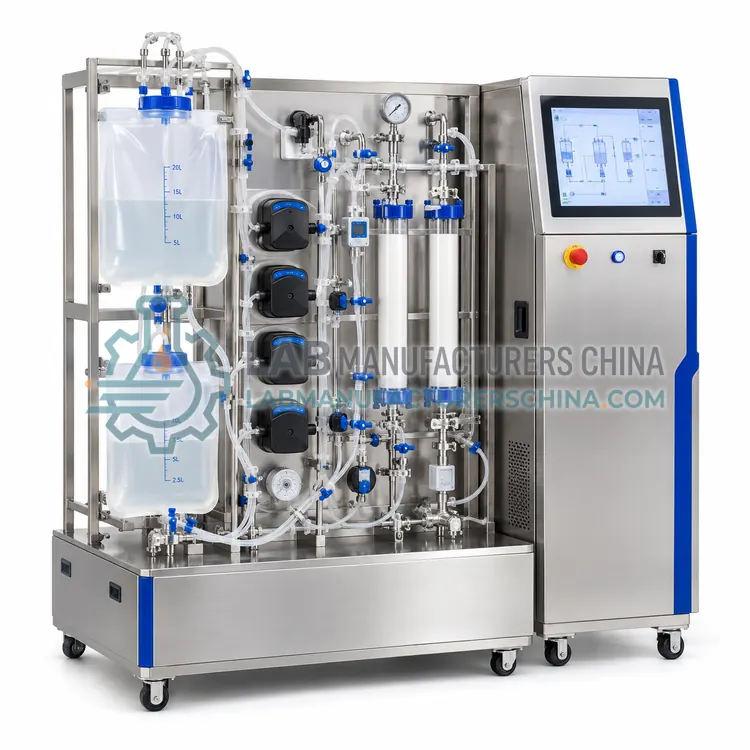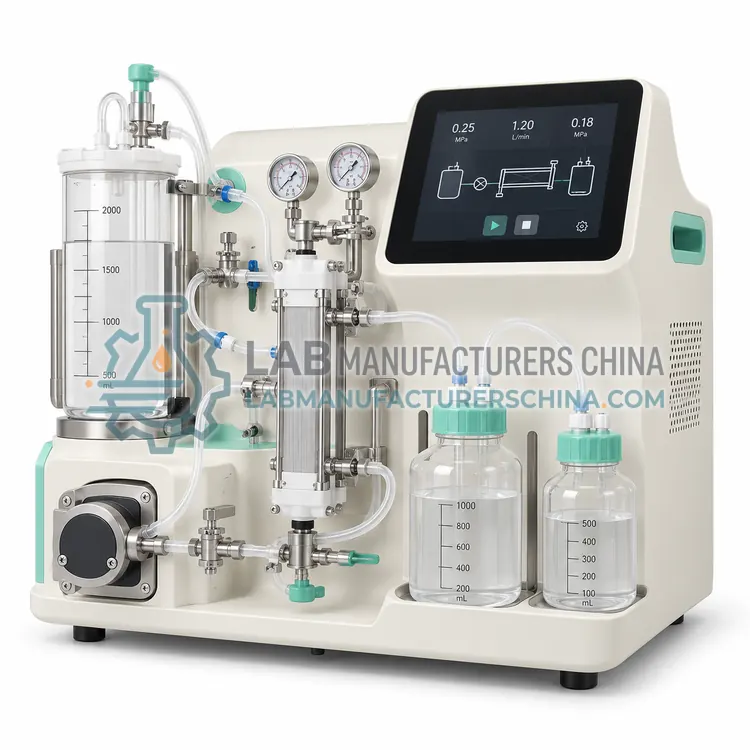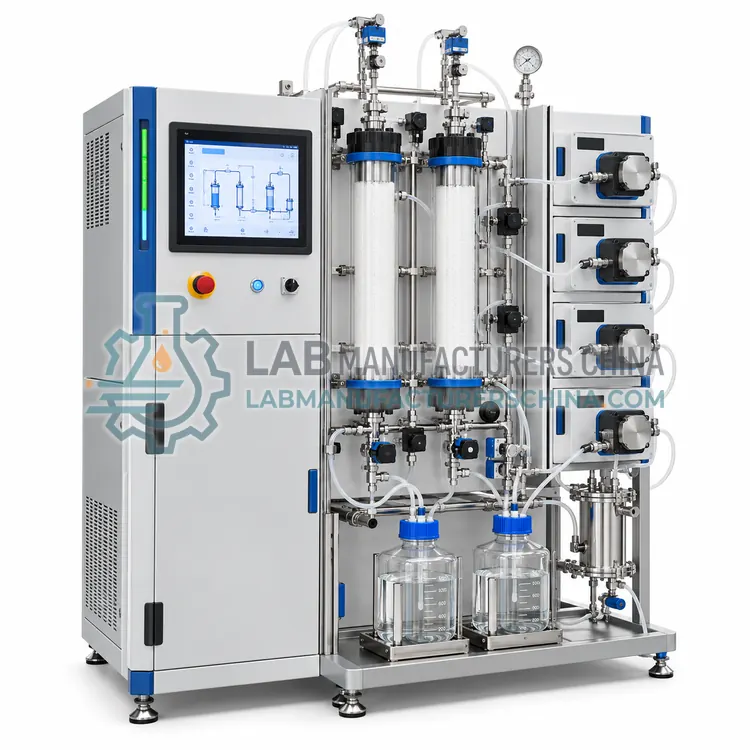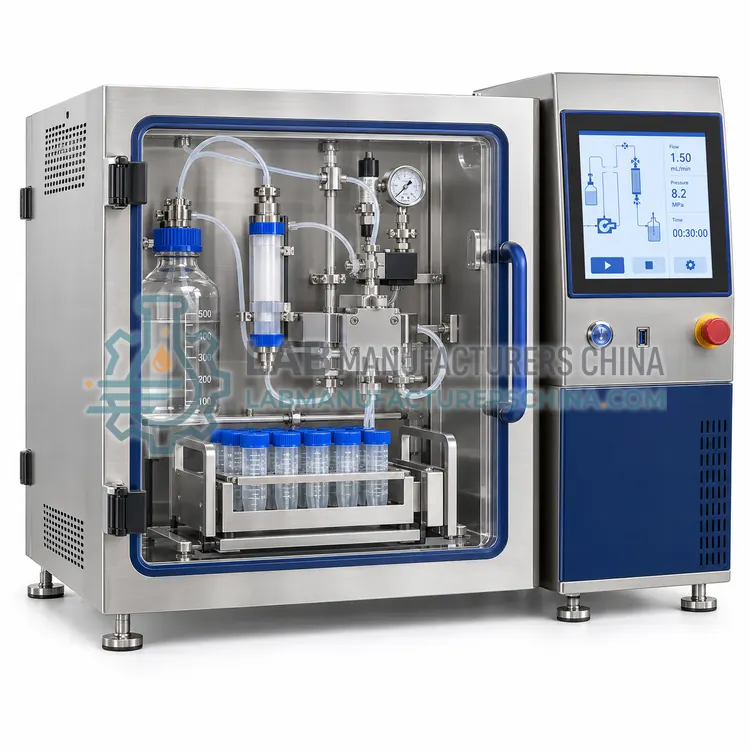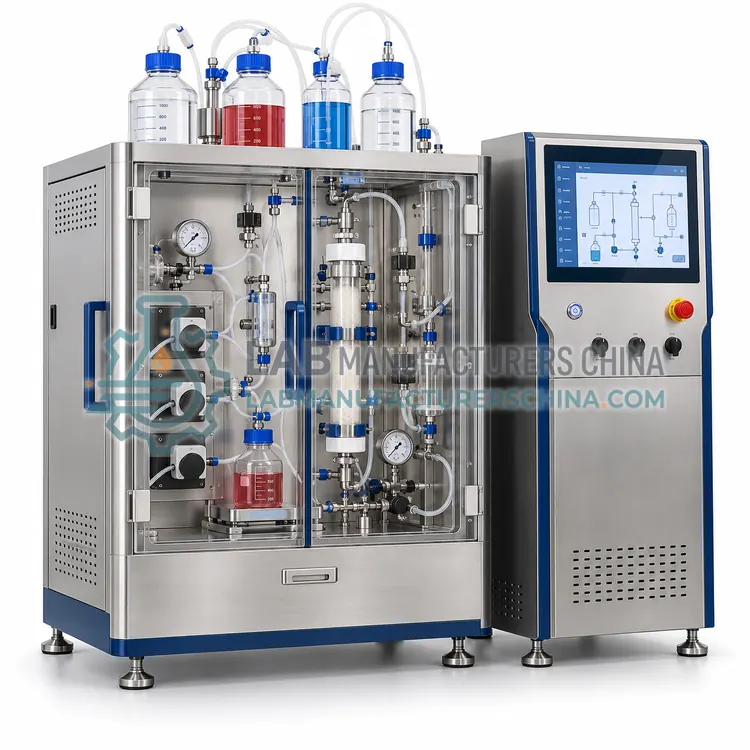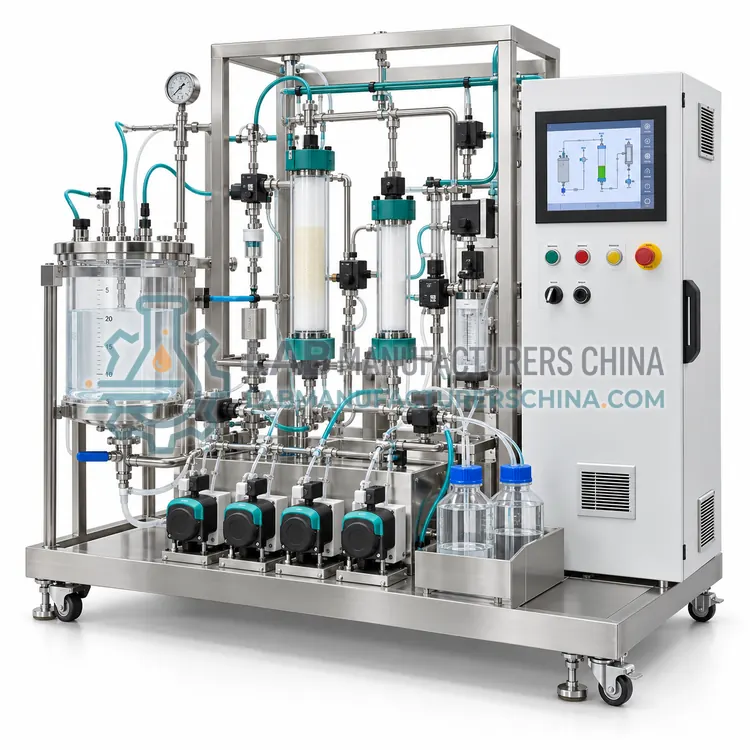
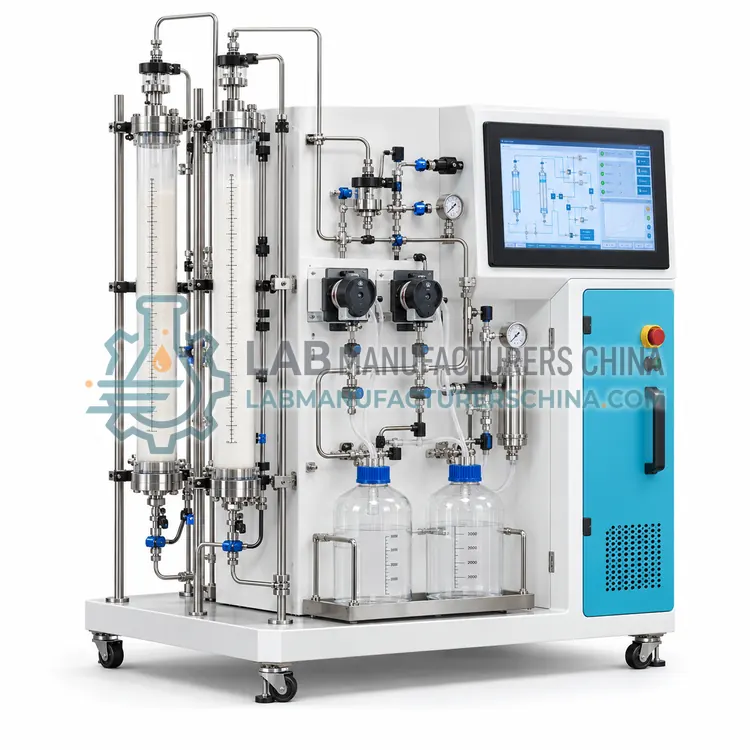
Process-Scale Chromatography System
工艺规模层析系统
- SKU PPU-0002
- Protein Purification
- CE (to be confirmed)
- ISO 9001 manufacturing (to be confirmed)
- Pressure equipment compliance (to be confirmed)
Price on request — FOB / CIF quoted per order
Prices depend on configuration, quantity and destination port.
Key specifications
| Flow rate range | Up to 1,000–3,000 L/h |
|---|---|
| Operating pressure | Up to 0.5–1.0 MPa |
| Column diameter | 200–2,000 mm |
| Detection | UV, conductivity, pH, pressure |
| Buffer handling | In-line dilution or premixed |
| Material contact | 316L stainless steel, sanitary elastomers |
Request a quote Download brochure · to be provided
By Lab Manufacturers China Technical TeamLast reviewed Standards: USP <1050>, USP <661>, ICH Q7
What is the Process-Scale Chromatography System?
A process-scale chromatography system is a sanitary, stainless-steel or hybrid skid that runs validated purification methods at manufacturing scale. It provides fully controlled flow, gradients, detection and cleaning-in-place for regulated, documented production.
What is the Process-Scale Chromatography System?
A process-scale chromatography system is a sanitary, stainless-steel or hybrid skid that runs validated purification methods at manufacturing scale. It provides fully controlled flow, gradients, detection and cleaning-in-place for regulated, documented production.
Overview
A process-scale chromatography system, sometimes called a skid, is built for the volumes and documentation requirements of manufacturing. It uses sanitary pumps, diaphragm or rotary-lobe valves, pressure-rated piping and large columns, and it typically includes in-line dilution or buffer preparation, ultraviolet and conductivity detection, and fraction valves. Sanitary design allows cleaning-in-place and, where needed, sterilize-in-place, with sloped lines, minimal dead legs and materials such as 316L stainless steel that resist corrosion and cleaning agents. Control is by a dedicated controller or plant automation running validated methods with audit trails, alarms and batch reporting. Methods transfer from laboratory development with scale-adjusted flow rates and identical linear velocities, and the system records the chromatogram, pooling and cleaning steps as part of the batch record.
How does it work?
Protein purification systems separate a target protein from host-cell proteins, nucleic acids, aggregates and process impurities by exploiting differences in binding, charge, hydrophobicity or size. A typical train begins with clarification by centrifugation or filtration, then capture chromatography, often affinity, which binds the target strongly and allows most impurities to flow through. Low-pH or other elution releases the product, which is then neutralized and further purified by ion exchange, hydrophobic interaction or multimodal chromatography, and polishing by size-exclusion or a second ion-exchange step removes aggregates and residual impurities. Tangential flow filtration concentrates the pool and exchanges it into the formulation buffer. Pumps, valves, detectors and software control flow rate, gradients, pooling and cleaning, and record the chromatogram and batch data.
What are the key features?
- Sanitary 316L stainless steel or hybrid flow path
- Clean-in-place and sterilize-in-place capability
- In-line buffer dilution and gradient formation
- Validated methods with audit trail and batch reporting
- Scalable from laboratory linear velocity
What are the technical specifications?
A typical process-scale chromatography system configuration offers flow rate range of Up to 1,000–3,000 L/h, operating pressure of Up to 0.5–1.0 MPa, column diameter of 200–2,000 mm, detection of UV, conductivity, pH, pressure, buffer handling of In-line dilution or premixed and material contact of 316L stainless steel, sanitary elastomers. Values are indicative of the product class; the exact figures for each configuration are confirmed on the quotation and the calibration documents supplied with the instrument.
Which applications is it used for?
The Process-Scale Chromatography System is used in manufacturing-scale antibody purification, recombinant protein production, vaccine purification and regulated batch production. Across the wider Protein Purification class, laboratories also deploy it for monoclonal antibody purification, recombinant protein purification and vaccine antigen purification.
Which standards and certifications apply?
Relevant standards and methods include USP <1050>, USP <661>, ICH Q7, ICH Q11, EU GMP Annex 1, 21 CFR Part 11 and IEC 61010-1. Certification candidates for this model are CE, ISO 9001 manufacturing and Pressure equipment compliance; each is to be confirmed for the specific configuration before shipment, and certificates are supplied only where they have been issued.
Maintain resins according to the manufacturer's cleaning-in-place and storage instructions, and track cycle numbers against the validated lifetime. Verify column packing with an asymmetry and plate-count test before use and record it. Calibrate pumps, detectors, pH and conductivity sensors on schedule, and check that gradient performance meets method requirements. Use sanitary fittings, validated cleaning agents and documented cleaning verification for multi-product equipment. Control buffer preparation and microbial quality, since contamination reduces resolution and can introduce impurities. For regulated manufacture, review chromatogram data, pooling criteria and deviations as part of batch review, and confirm that software supports audit trails. Electrical safety follows IEC 61010-1.
How do I select the right Process-Scale Chromatography System?
Choose a process-scale skid when methods move to manufacturing and documentation and cleaning must meet regulatory expectations. In an RFQ specify flow and pressure ranges, column sizes, sanitary and cleaning design, detection, automation and recording, and the validation and qualification package offered.
How does it compare with other Protein Purification variants?
Select from the target molecule, expression level and scale. For capture, affinity resins give high selectivity and yield when a suitable ligand exists, while ion exchange or hydrophobic interaction suit cost-sensitive or ligand-free processes. Match column dimensions to the mass of product per batch and to the linear velocity the resin tolerates at the required cycle time. Choose the system format by scale: an automated laboratory system with method development software for development, a process skid with sanitary design and cleaning-in-place for production, and single-use flow paths for multi-product facilities. Determine the filtration area and membrane format required for clarification and concentration from the volumetric throughput. Confirm detection wavelengths, gradient and flow ranges, automation, data recording and the validation documentation you need.
Full specifications
| Flow rate range | Up to 1,000–3,000 L/h |
|---|---|
| Operating pressure | Up to 0.5–1.0 MPa |
| Column diameter | 200–2,000 mm |
| Detection | UV, conductivity, pH, pressure |
| Buffer handling | In-line dilution or premixed |
| Material contact | 316L stainless steel, sanitary elastomers |
| Cleaning | Clean-in-place, wash and storage cycles |
| Control | PLC or DCS with data historian and audit trail |
Indicative values for this product class. Final specifications are confirmed on the quotation and in the calibration documents supplied with the instrument.
Applications
- Manufacturing-scale antibody purification
- Recombinant protein production
- Vaccine purification
- Regulated batch production
Key features
- Sanitary 316L stainless steel or hybrid flow path
- Clean-in-place and sterilize-in-place capability
- In-line buffer dilution and gradient formation
- Validated methods with audit trail and batch reporting
- Scalable from laboratory linear velocity
Frequently asked questions about Process-Scale Chromatography System
Keep the linear velocity and bed height similar and scale the column diameter to the increased mass of product, so that residence time and resolution stay comparable. Feed concentration, buffer composition and gradient in column volumes are also kept consistent during the transfer.
Sanitary design with sloped lines, minimal dead legs, cleanable joints and corrosion-resistant materials allows effective cleaning-in-place and prevents microbial growth and product carry-over between batches. This supports both product quality and cleaning validation.
Cleaning cycles should be validated and documented, with parameters such as flow, temperature, time and cleaning-agent concentration recorded, and acceptance criteria based on rinse water conductivity, total organic carbon or swab tests. The records form part of the batch documentation.
It captures and purifies recombinant proteins, antibodies and other biological products from harvested culture fluid. Chromatography steps bind the target and remove impurities, while filtration concentrates the product and places it in the formulation buffer for downstream use.
Capture is usually performed first, and affinity chromatography is preferred when a selective ligand exists because it removes most impurities in one step. Ion exchange or hydrophobic interaction capture is used when no affinity ligand is available or when cost and resin lifetime favor it.
Column diameter follows from the flow rate and the linear velocity the resin tolerates within the target cycle time, and bed height follows from the required resolution and dynamic binding capacity. Together they are set from the mass of product to process per batch.
Related models