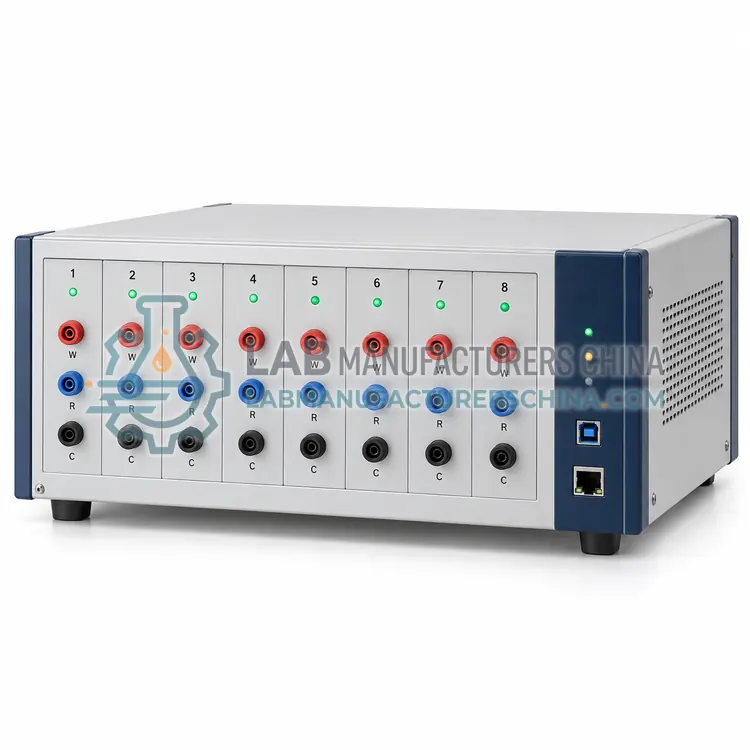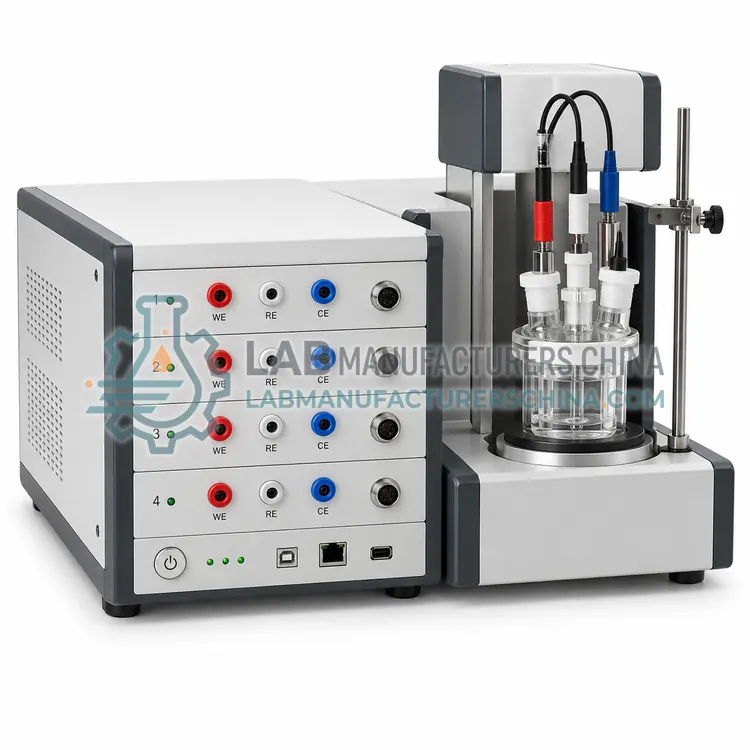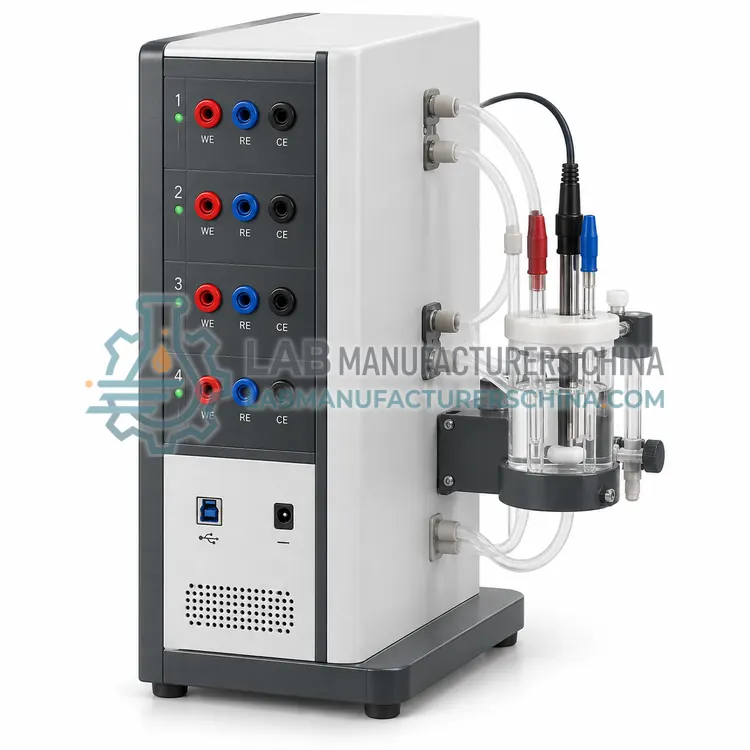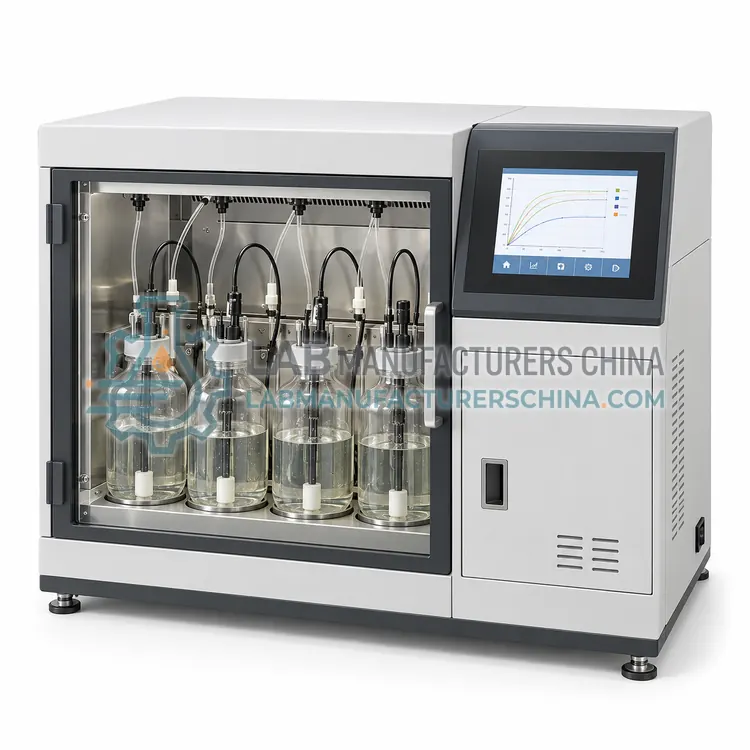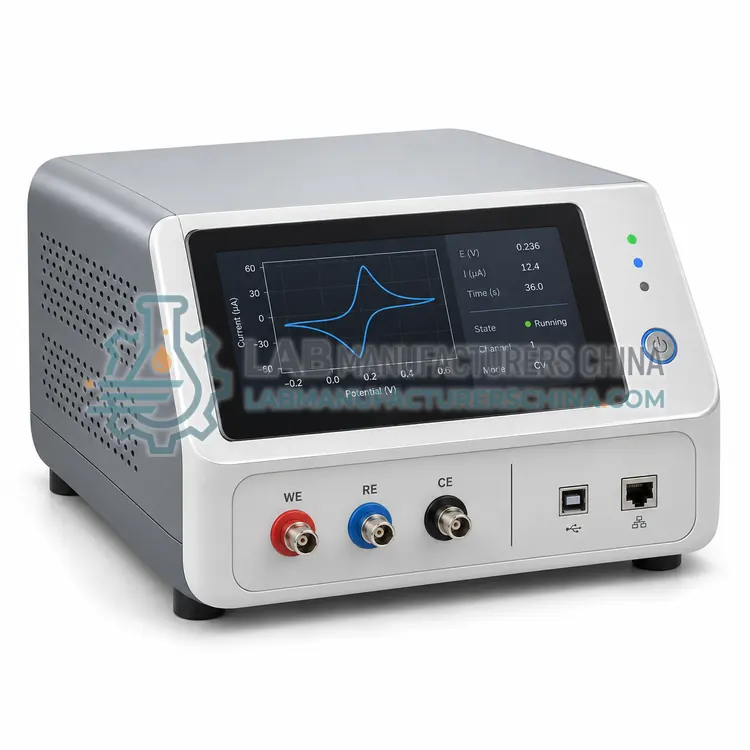
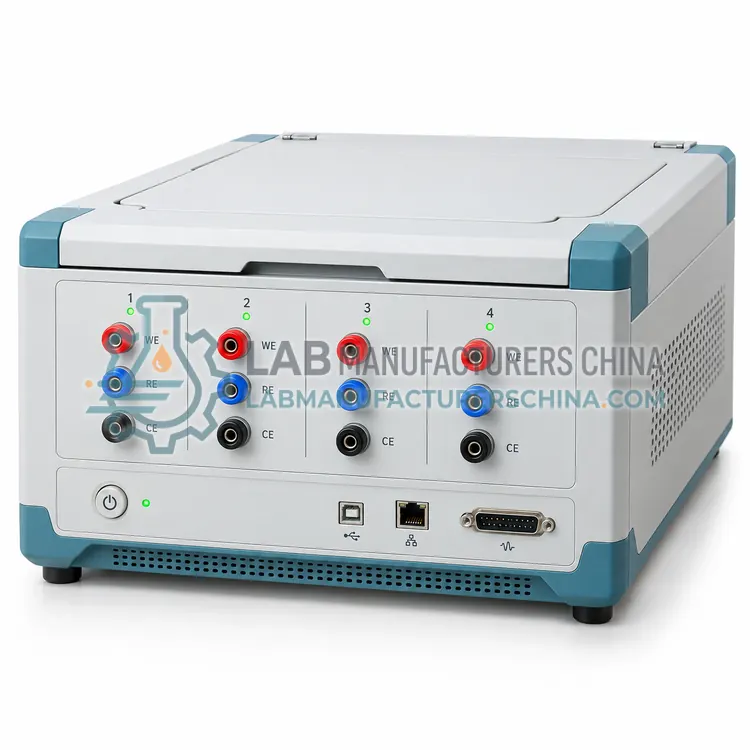
Bipotentiostat
双恒电位仪
- SKU POT-0004
- Potentiostats
- CE (to be confirmed)
- IEC 61010-1 safety (to be confirmed)
- ISO 9001 manufacturing (to be confirmed)
Price on request — FOB / CIF quoted per order
Prices depend on configuration, quantity and destination port.
Key specifications
| Number of working electrodes | 2, independently controlled |
|---|---|
| Applied potential range | ±10 V per channel |
| Current ranges | 100 pA–1 A per channel |
| Current resolution | 0.1% of range |
| Channel synchronisation | ≤10 µs |
| Compliance voltage | ±12–20 V |
Request a quote Download brochure · to be provided
By Lab Manufacturers China Technical TeamLast reviewed Standards: IEC 61010-1, ISO 17475, ISO 16773-1
What is the Bipotentiostat?
A bipotentiostat independently controls two working electrodes in one cell sharing a single reference and counter electrode. It is used with rotating ring-disc electrodes, dual-electrode sensors and generator-collector experiments in electroanalysis and corrosion research.
What is the Bipotentiostat?
A bipotentiostat independently controls two working electrodes in one cell sharing a single reference and counter electrode. It is used with rotating ring-disc electrodes, dual-electrode sensors and generator-collector experiments in electroanalysis and corrosion research.
Overview
The instrument contains two control loops that share one counter electrode and one reference electrode while holding each working electrode at its own potential. Typical measurements are the generator-collector experiment, in which species formed at a disc electrode are detected at a concentric ring electrode held at a different potential, and dual-electrode sensing, where two modified surfaces respond to different analytes. Collection efficiency depends on electrode geometry, rotation rate and the distance between the two working surfaces, so a rotator with defined geometry is normally part of the set-up. Frequency response analysis can be applied to either channel, sometimes simultaneously, for impedance measurements at both surfaces. Specifications mirror single-channel instruments: plus or minus 10 V potential range, current ranges from picoamperes or nanoamperes to amperes, and microsecond-scale synchronisation between channels for fast transient work.
How does it work?
Measurements use a three-electrode cell. The potentiostat applies a programmed potential between the working and counter electrodes, while a high-impedance input senses the reference electrode. A control amplifier continuously adjusts the cell current so the working electrode potential equals the set value, and a current-to-voltage converter measures that current across a selectable resistor, giving current ranges that can span twelve decades on one instrument. Compliance or output voltage, typically plus or minus 12 to 20 V, sets how much current can be delivered in high-resistance cells. In galvanostat mode the instrument controls current and monitors potential instead. A frequency response analyzer superimposes small-amplitude sine waves for impedance measurements over frequencies from microhertz to megahertz. Resolution is limited by the analog-to-digital converter and by noise from cables, stirring and the reference electrode, which is why shielded cells and a Faraday cage are common. Software controls the waveform, records data and fits the electrochemical model.
What are the key features?
- Two independent working electrode control loops in one cell
- Shared reference and counter electrode connections
- Microsecond channel synchronisation for transient experiments
- Compatible with rotating ring-disc electrodes and rotators
- Impedance measurement on one or both channels
- Software for collection efficiency and dual-electrode analysis
What are the technical specifications?
A typical bipotentiostat configuration offers number of working electrodes of 2, independently controlled, applied potential range of ±10 V per channel, current ranges of 100 pA–1 A per channel, current resolution of 0.1% of range, channel synchronisation of ≤10 µs and compliance voltage of ±12–20 V. Values are indicative of the product class; the exact figures for each configuration are confirmed on the quotation and the calibration documents supplied with the instrument.
Which applications is it used for?
The Bipotentiostat is used in rotating ring-disc electrode studies, dual-electrode electrochemical sensing, corrosion product detection, electrocatalyst screening and mediator and redox shuttle research. Across the wider Potentiostats class, laboratories also deploy it for corrosion and inhibitor evaluation, battery and supercapacitor testing and electrochemical sensor and biosensor development.
Which standards and certifications apply?
Relevant standards and methods include IEC 61010-1, ISO 17475, ISO 16773-1, ASTM G5, ASTM G61 and ASTM G71. Certification candidates for this model are CE, IEC 61010-1 safety and ISO 9001 manufacturing; each is to be confirmed for the specific configuration before shipment, and certificates are supplied only where they have been issued.
Install the instrument on a stable bench away from motors, pumps and switching power supplies, and connect the cell in a Faraday cage for low-current work. Use shielded cable and keep the reference electrode close to the working electrode to reduce uncompensated resistance; measure and compensate that resistance, especially in low-conductivity electrolytes. Verify performance with a dummy cell or a standard redox couple such as ferri-ferrocyanide before critical experiments. Grounding arrangements must avoid loops between the potentiostat, the cell and any peripheral equipment such as rotators, lamps or temperature baths. Calibrate the internal references annually, replace worn electrode leads and clips, and record the cell configuration, electrodes, reference type and scan parameters with each data set so results remain traceable.
How do I select the right Bipotentiostat?
Choose a bipotentiostat only when two working electrodes must be controlled independently in one cell, as with ring-disc or dual-sensor work. A single-channel instrument with a multiplexer cannot substitute because the electrodes must be polarised simultaneously. In an RFQ, specify electrode geometry, rotation system, synchronisation needs and impedance requirements.
How does it compare with other Potentiostats variants?
Choose the number of cells you must run at once, because multi-channel instruments cost less per channel than separate units and share one software licence. Then match current range and resolution to the application: corrosion and battery tests need amperes with moderate resolution, while microelectrode and sensor work needs picoampere resolution. Check the compliance voltage for high-resistance electrolytes, the impedance frequency range, the maximum data acquisition rate for fast kinetics, and whether the software includes the techniques you use, such as cyclic voltammetry, chronoamperometry, pulsed techniques, electrochemical impedance spectroscopy and galvanostatic cycling. Modular instruments allow later expansion. For field corrosion surveys, a portable USB unit connected to a laptop is often sufficient. Specify the cell, electrodes, cables and any booster or low-current module in an RFQ.
Full specifications
| Number of working electrodes | 2, independently controlled |
|---|---|
| Applied potential range | ±10 V per channel |
| Current ranges | 100 pA–1 A per channel |
| Current resolution | 0.1% of range |
| Channel synchronisation | ≤10 µs |
| Compliance voltage | ±12–20 V |
| EIS frequency range | 10 µHz–100 kHz |
| Potentiostat channels for EIS | Either channel, sequentially |
| Rotator interface | Analog control output |
| Interfaces | USB, LAN |
Indicative values for this product class. Final specifications are confirmed on the quotation and in the calibration documents supplied with the instrument.
Applications
- Rotating ring-disc electrode studies
- Dual-electrode electrochemical sensing
- Corrosion product detection
- Electrocatalyst screening
- Mediator and redox shuttle research
Key features
- Two independent working electrode control loops in one cell
- Shared reference and counter electrode connections
- Microsecond channel synchronisation for transient experiments
- Compatible with rotating ring-disc electrodes and rotators
- Impedance measurement on one or both channels
- Software for collection efficiency and dual-electrode analysis
Frequently asked questions about Bipotentiostat
It is the fraction of species generated at the disc electrode that reaches and reacts at the ring electrode. Values depend on the electrode geometry and rotation rate, and a well-aligned ring-disc electrode with a typical radius ratio gives collection efficiencies of about 0.2 to 0.4.
Usually not, because the channels share one reference and one counter electrode connection by design. Some instruments offer a mode to split the channels into independent single-channel units, which should be confirmed from the specification before purchase.
It matters for fast transient experiments such as potential-step collection measurements, where a delay of milliseconds distorts the response. A synchronisation specification of 10 microseconds or better is adequate for most ring-disc and dual-sensor applications.
A potentiostat controls the working electrode potential and measures current, which is used for voltammetry, corrosion and impedance work. A galvanostat controls current and measures potential, which is used for battery cycling and electrodeposition. Most laboratory instruments combine both modes in one unit.
Match the range to the largest and smallest currents in the experiment. Battery and corrosion studies may reach amperes, while microelectrodes and modified surfaces work in nanoamperes or picoamperes. Choose an instrument whose lowest range resolves the smallest current of interest without unacceptable noise.
At low currents, ambient electrical noise from mains wiring, lighting and computers can dominate the signal. A Faraday cage around the cell, together with shielded leads and a single defined ground point, reduces that noise so nanoampere and picoampere measurements become usable.
Related models