Blast Plasma Freezer
血浆速冻机
- SKU PLF-0003
- Plasma Freezers
- CE (to be confirmed)
- ISO 13485 (to be confirmed)
- ISO 9001 manufacturing (to be confirmed)
Price on request — FOB / CIF quoted per order
Prices depend on configuration, quantity and destination port.
Key specifications
| Air temperature | –40 °C to –60 °C |
|---|---|
| Core freezing time | ≤ 60–90 min to –30 °C (validated load) |
| Capacity per cycle | 12–60 bags (250–300 mL) |
| Cooling method | Forced air or contact plate |
| Core probes | 1–4 Pt100 |
| Net capacity | 150–500 L |
Request a quote Download brochure · to be provided
By Lab Manufacturers China Technical TeamLast reviewed Standards: Council of Europe Guide to the Preparation, Use and Quality Assurance of Blood Components, AABB Standards for Blood Banks and Transfusion Services, IEC 61010-2-011
What is the Blast Plasma Freezer?
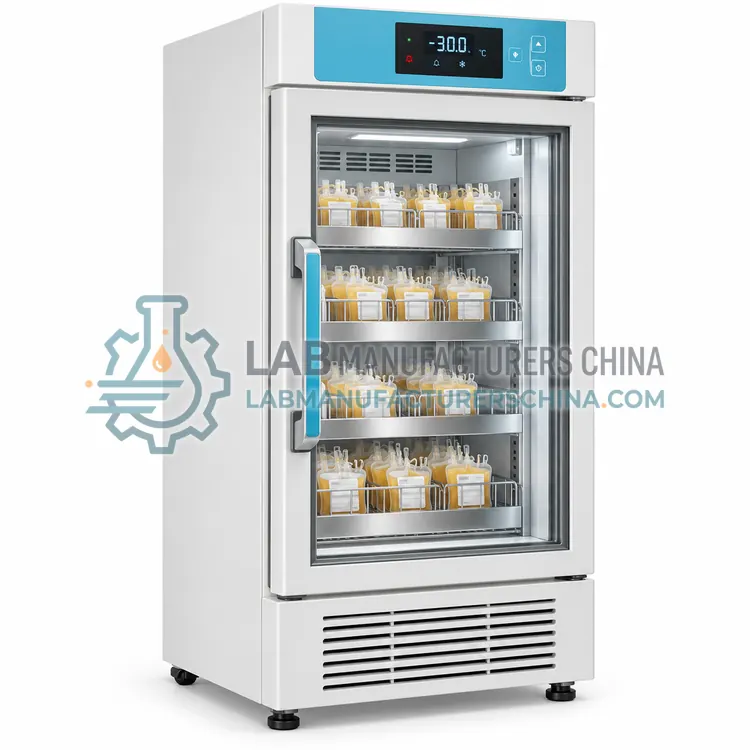
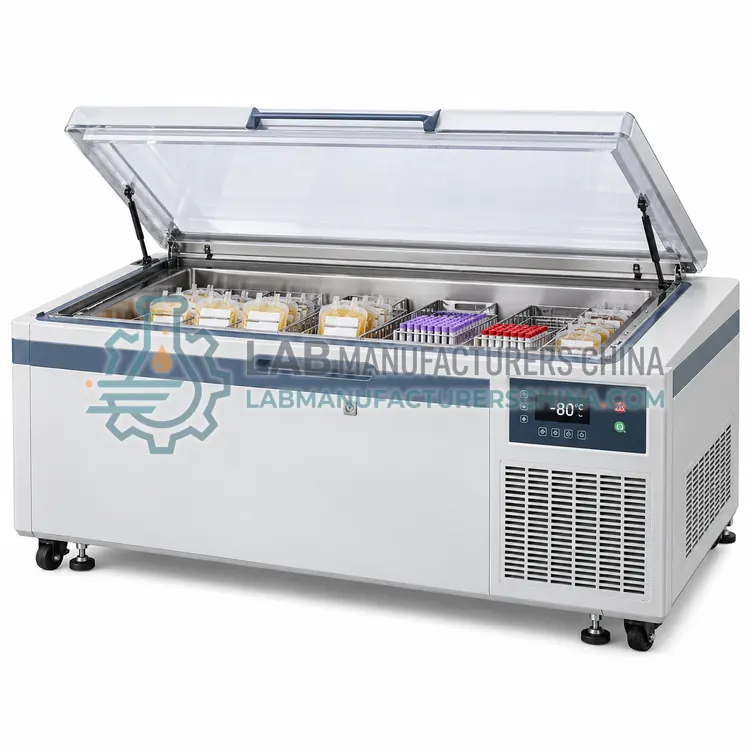
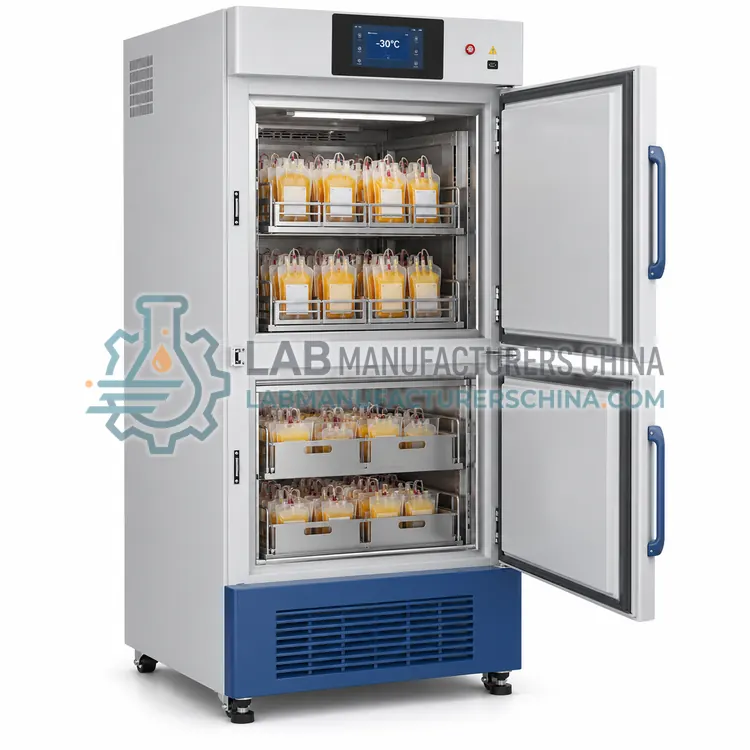
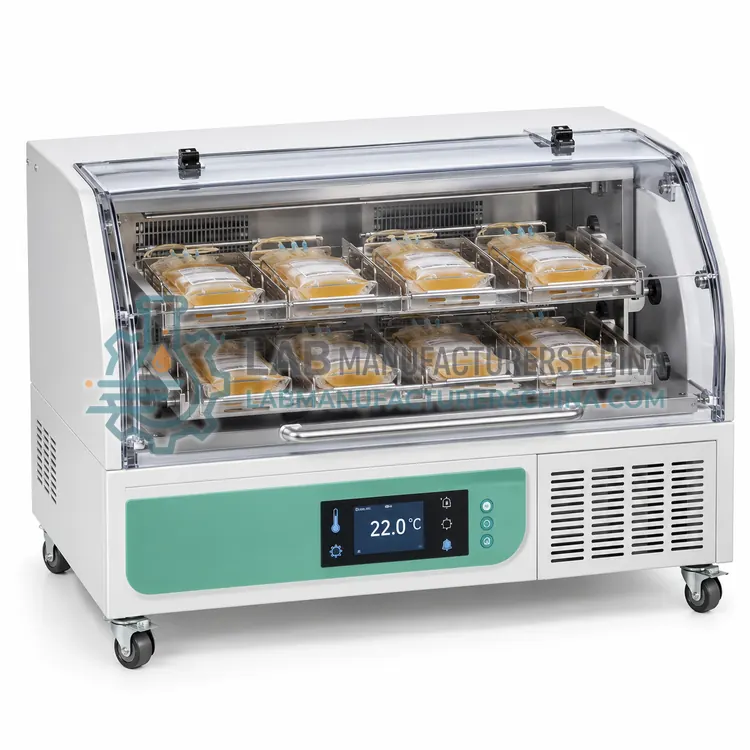
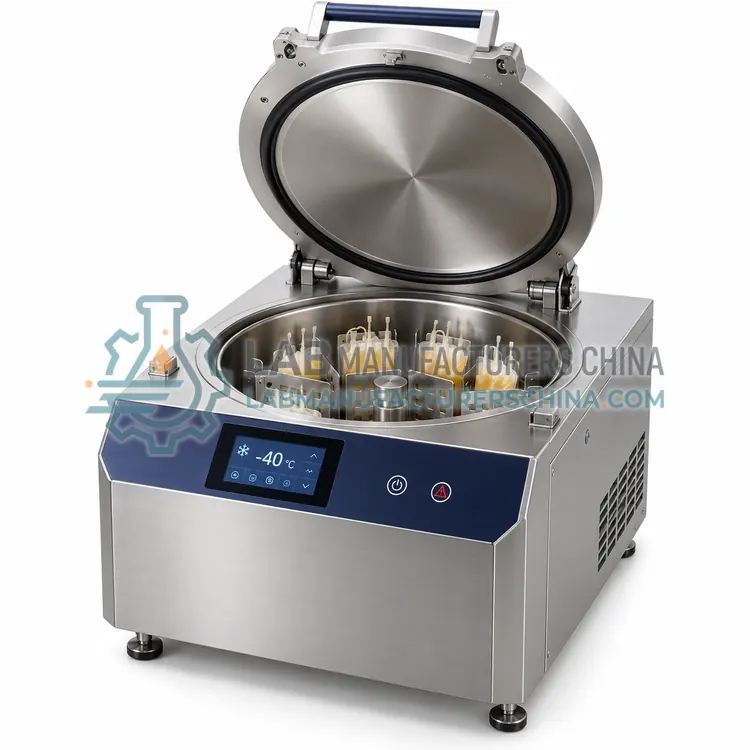
A blast plasma freezer rapidly freezes freshly separated plasma by forcing very cold air or contact plates around bags, typically bringing the core to –30 °C within about one hour. Blood centers use it to preserve Factor VIII and other labile proteins before storage.
What is the Blast Plasma Freezer?
A blast plasma freezer rapidly freezes freshly separated plasma by forcing very cold air or contact plates around bags, typically bringing the core to –30 °C within about one hour. Blood centers use it to preserve Factor VIII and other labile proteins before storage.
Overview
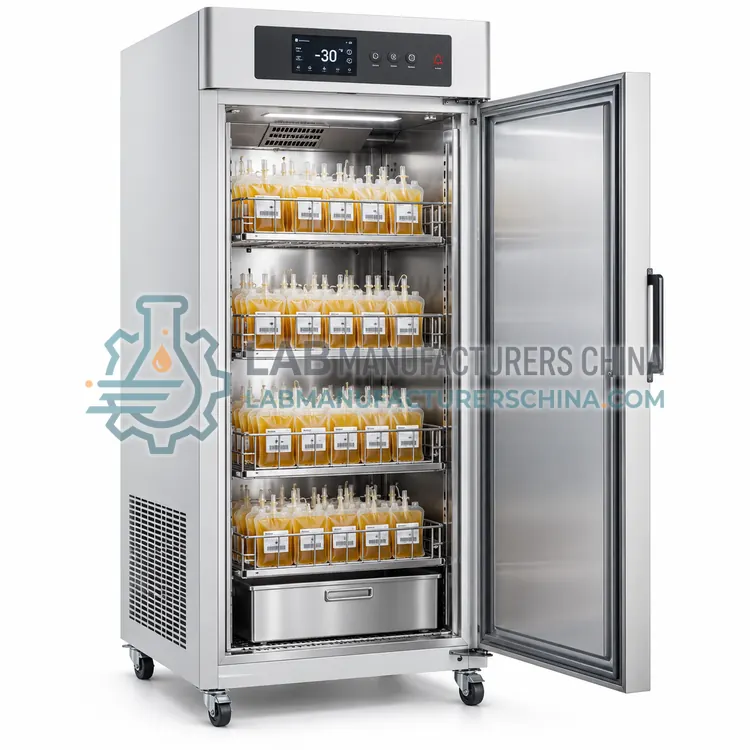
Rapid freezing matters because coagulation factors lose activity the longer plasma stays between 0 °C and –20 °C. A blast freezer uses a high-capacity refrigeration system and strong fans to circulate air at –40 °C to –60 °C across racks, or uses metal contact plates pressed to the bags. Core temperature probes, sometimes placed in a dummy bag, verify freezing time against a defined profile. Capacities range from 12 to 60 bags per cycle up to large batch units with carts. Controllers record cycle curves and alarm if freezing time exceeds limits. The frozen units are then moved to a storage freezer, so blast freezers are an upstream step rather than long-term storage.
How does it work?
Plasma freezers use a compressor refrigeration circuit, often a single-stage system with low-temperature refrigerant for –40 °C models and a cascade system for –80 °C models. Air circulates past plates or shelves to extract heat, and heavy polyurethane insulation limits gain. Quality depends on how fast plasma passes through its freezing range: coagulation factors such as Factor VIII are better preserved when the core reaches –30 °C within about one hour, so rapid freezers use high airflow or contact plates. A controller reads an RTD probe, often in a glycol buffer, and drives independent alarms and a recorder. Door gaskets with heaters prevent icing, and condenser fans and a backup CO2 or LN2 option can protect stock during power loss.
What are the key features?
- Air at –40 °C to –60 °C or contact plates for fast freezing
- Core temperature probe to verify freezing profile
- Cycle recording with alarms for time limit exceedance
- Racks or carts sized for plasma bags
- High-capacity compressor with fast recovery
- Stainless steel interior for routine disinfection
What are the technical specifications?
A typical blast plasma freezer configuration offers air temperature of –40 °C to –60 °C, core freezing time of ≤ 60–90 min to –30 °C (validated load), capacity per cycle of 12–60 bags (250–300 mL), cooling method of Forced air or contact plate, core probes of 1–4 Pt100 and net capacity of 150–500 L. Values are indicative of the product class; the exact figures for each configuration are confirmed on the quotation and the calibration documents supplied with the instrument.
Which applications is it used for?
The Blast Plasma Freezer is used in rapid freezing of fresh frozen plasma, plasma for fractionation, blood processing centers and cryoprecipitate preparation. Across the wider Plasma Freezers class, laboratories also deploy it for fresh frozen plasma storage, cryoprecipitate storage and plasma for fractionation.
Which standards and certifications apply?
Relevant standards and methods include Council of Europe Guide to the Preparation, Use and Quality Assurance of Blood Components, AABB Standards for Blood Banks and Transfusion Services, IEC 61010-2-011, IEC 61010-1, IEC 61326-1 and ISO 13485. Certification candidates for this model are CE, ISO 13485 and ISO 9001 manufacturing; each is to be confirmed for the specific configuration before shipment, and certificates are supplied only where they have been issued.
Install the freezer on a level floor with clear ventilation and a dedicated circuit. Run it empty until stable and map temperature before loading. Handle frozen plasma carefully to avoid bag cracks, and store in overwrap or cartons. Calibrate probes at least annually, test alarms regularly, and defrost or clean according to the maker's schedule to control frost. Keep records for the regulatory period and maintain a contingency plan that names a validated alternate freezer or dry-ice supply. Do not load large warm volumes at once, since this raises the chamber temperature and stresses the compressor.
How do I select the right Blast Plasma Freezer?
Choose a blast freezer if donations are processed in batches and freezing time from separation matters. Specify bags per cycle, bag size, plate or air design, cycle documentation and integration with a downstream storage freezer. Request validation data for freezing time at your load and confirm the electrical supply needed.
How does it compare with other Plasma Freezers variants?
Decide first whether you need freezing, storage or both. Blast models freeze plasma quickly and are usually followed by storage units. For storage, choose the temperature by the shelf life your regulator allows: storage at –25 °C or colder is commonly accepted for up to 36 months in European guidance, while –65 °C or colder extends shelf life under some standards. Then pick upright or chest format by floor space and access frequency, capacity in bags or liters, and monitoring needs. Check the recovery time after door opening, noise, ambient class and whether a CO2 or LN2 backup port is offered. Plan for electrical supply and heat load in the room.
Full specifications
| Air temperature | –40 °C to –60 °C |
|---|---|
| Core freezing time | ≤ 60–90 min to –30 °C (validated load) |
| Capacity per cycle | 12–60 bags (250–300 mL) |
| Cooling method | Forced air or contact plate |
| Core probes | 1–4 Pt100 |
| Net capacity | 150–500 L |
| Cycle logging | Electronic, USB download |
| Alarms | Cycle time, door, high temperature, power |
| Ambient range | 10–32 °C |
| Power supply | 380 V three-phase or 220 V, 50 Hz |
Indicative values for this product class. Final specifications are confirmed on the quotation and in the calibration documents supplied with the instrument.
Applications
- Rapid freezing of fresh frozen plasma
- Plasma for fractionation
- Blood processing centers
- Cryoprecipitate preparation
Key features
- Air at –40 °C to –60 °C or contact plates for fast freezing
- Core temperature probe to verify freezing profile
- Cycle recording with alarms for time limit exceedance
- Racks or carts sized for plasma bags
- High-capacity compressor with fast recovery
- Stainless steel interior for routine disinfection
Frequently asked questions about Blast Plasma Freezer
Many guidelines aim to reach a core temperature of –30 °C within about 60 minutes, and some accept up to 90 minutes, to preserve Factor VIII. Check your regulator, because time from collection to freezing and accepted freezing curves vary by jurisdiction.
Not normally. It is optimized for throughput and airflow rather than hold-over or uniform storage, so frozen units are moved to a storage freezer after the cycle. Some combined units exist, but check capacity and uniformity data before using one for both duties.
A dummy bag is a plasma bag filled with a simulant liquid that carries a temperature sensor at its center. It records the real core freezing curve during each cycle, which is more representative than air temperature and supports validation of freezing time.
Fresh frozen plasma is commonly stored at –25 °C or colder, with many sites using –30 °C to –40 °C. Some standards allow –18 °C to –25 °C for shorter periods, and –65 °C or colder for extended shelf life. Always follow your regulator and verify the product shelf life table.
Labile coagulation factors, notably Factor VIII, degrade more when plasma stays in the freezing range for long. Freezing the core to –30 °C within about one hour, often with blast air or contact plates, retains more activity, and guidelines define the time allowed from collection to freezing.
Plasma freezers carry independent alarm and recorder probes, tighter uniformity, battery-backed alarms and racking for blood bags, and are validated for transfusion-related storage. Laboratory freezers often lack these features and are not designed for storing components intended for patients.