Automated Titration Analyzer for Pharmaceutical Assay
药品含量自动滴定分析仪
- SKU PHA-0003
- Pharmaceutical Analyzers
- CE (to be confirmed)
- IEC 61010-1 compliance (to be confirmed)
- ISO 13485 manufacturing (to be confirmed)
Price on request — FOB / CIF quoted per order
Prices depend on configuration, quantity and destination port.
Key specifications
| Burette volume | 10–25 mL |
|---|---|
| Volume resolution | 0.001 mL or better |
| Potentiometric accuracy | about ±0.1 mV |
| Electrode types | pH, redox, ion-selective, non-aqueous |
| Sample positions | up to 16–36 |
| End point detection | Automatic with first or second derivative |
Request a quote Download brochure · to be provided
By Lab Manufacturers China Technical TeamLast reviewed Standards: USP <856>, USP <858>, USP <541>
What is the Automated Titration Analyzer for Pharmaceutical Assay?
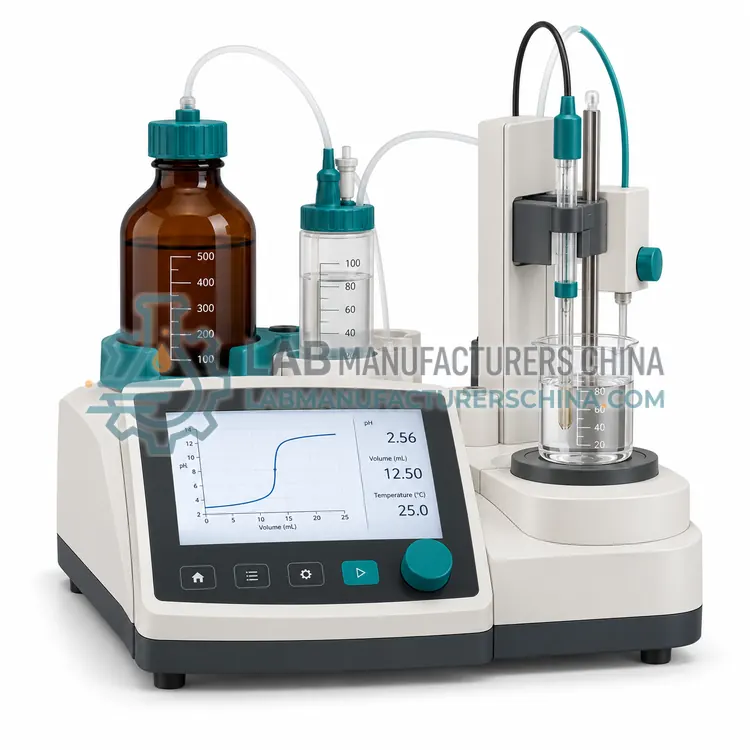
An automated titration analyzer determines drug content by adding reagent to an equivalence point detected electrochemically. It is chosen for assay of acids, bases and salts in quality control and is a standard pharmacopoeial method.
What is the Automated Titration Analyzer for Pharmaceutical Assay?
An automated titration analyzer determines drug content by adding reagent to an equivalence point detected electrochemically. It is chosen for assay of acids, bases and salts in quality control and is a standard pharmacopoeial method.
Overview
An automated titration analyzer controls the addition of titrant while monitoring a sensor response. In potentiometric titration a glass, combination or ion-selective electrode tracks the potential as reagent is added, and the instrument detects the inflection point and calculates content from the consumed volume and the sample weight. Common pharmaceutical applications include acid-base assay of salts, non-aqueous titration of weak bases in glacial acetic acid, and redox or precipitation titrations. Modern instruments use motorised burettes with high resolution, automatic endpoint detection, multiple electrode inputs and sample changers that let a batch run unattended. Methods, results and audit trails can be stored in software, which supports GMP data integrity requirements. Regular electrode maintenance and standardisation with certified reagents are essential.
How does it work?
Pharmaceutical analyzers apply spectroscopic, electrochemical or physical measurement principles to drug samples. Near-infrared instruments measure the absorption of light from about 780 to 2500 nm by overtone and combination vibrations of molecular bonds, which gives a fingerprint suitable for identification through packaging. Raman analyzers measure inelastic light scattering and are sensitive to molecular symmetry and crystal form. Potentiometric titrators add reagent until a sensor detects the equivalence point, so the consumed volume gives content. Laser diffraction measures the angular scatter of laser light as particles pass, which is converted to a size distribution. Polarimeters measure optical rotation, a specific property of chiral drug substances. Calibration or verification with reference standards is needed for each technique.
What are the key features?
- Motorised burette with high volume resolution
- Potentiometric, redox or precipitation endpoint detection
- Multiple electrode inputs and method storage
- Automatic sample changer for unattended runs
- Software with audit trail and result export
- Calculation from sample weight and titre volume
What are the technical specifications?
A typical automated titration analyzer for pharmaceutical assay configuration offers burette volume of 10–25 mL, volume resolution of 0.001 mL or better, potentiometric accuracy of about ±0.1 mV, electrode types of pH, redox, ion-selective, non-aqueous, sample positions of up to 16–36 and end point detection of Automatic with first or second derivative. Values are indicative of the product class; the exact figures for each configuration are confirmed on the quotation and the calibration documents supplied with the instrument.
Which applications is it used for?
The Automated Titration Analyzer for Pharmaceutical Assay is used in drug substance and product assay, non-aqueous titration of weak bases, excipient content testing and chloride and other salt determination. Across the wider Pharmaceutical Analyzers class, laboratories also deploy it for raw material identification at goods-in, drug substance assay and excipient quality control.
Which standards and certifications apply?
Relevant standards and methods include USP <856>, USP <858>, USP <541>, USP <429>, ICH Q2(R2) and IEC 61010-1. Certification candidates for this model are CE, IEC 61010-1 compliance and ISO 13485 manufacturing; each is to be confirmed for the specific configuration before shipment, and certificates are supplied only where they have been issued.
Install analyzers on a stable bench away from vibration, direct sun and strong draughts, and let them warm up before use. Verify performance with reference standards on a defined schedule, not only when a supplier service visit occurs, and record the results. Keep sample surfaces clean and use fresh consumables such as electrode filling solution and membranes. For near-infrared and Raman, maintain the reference library and re-qualify after any lamp or laser change. Operate under a validated procedure with trained staff, and retain raw spectra or titration curves because regulators may ask for them. Dispose of waste reagents according to local regulations.
How do I select the right Automated Titration Analyzer for Pharmaceutical Assay?
Choose an automated titrator when the pharmacopoeial method specifies titration and several samples are run daily. Confirm burette resolution, electrode options, endpoint algorithms, sample changer capacity and software data integrity features. Plan electrode maintenance and standardisation with certified volumetric reagents.
How does it compare with other Pharmaceutical Analyzers variants?
Match the analyzer to the test in the pharmacopoeial monograph or validated method. For raw material identification at goods-in, choose near-infrared or Raman according to packaging, sample form and whether water or glass interferes. For content determination, a potentiometric titrator suits acids, bases and salts; an automatic polarimeter suits chiral substances. For particle size, laser diffraction covers suspensions, powders and aerosols, and the dispersion method must suit the product. Compare wavelength or measurement range, resolution, accuracy, throughput, sample handling and software features such as method storage and audit trail. Confirm that calibration standards, reference libraries and qualification documents are available.
Full specifications
| Burette volume | 10–25 mL |
|---|---|
| Volume resolution | 0.001 mL or better |
| Potentiometric accuracy | about ±0.1 mV |
| Electrode types | pH, redox, ion-selective, non-aqueous |
| Sample positions | up to 16–36 |
| End point detection | Automatic with first or second derivative |
| Software | Audit trail, method and report storage |
| Power supply | 220 V, 50 Hz, about 0.2 kW |
Indicative values for this product class. Final specifications are confirmed on the quotation and in the calibration documents supplied with the instrument.
Applications
- Drug substance and product assay
- Non-aqueous titration of weak bases
- Excipient content testing
- Chloride and other salt determination
Key features
- Motorised burette with high volume resolution
- Potentiometric, redox or precipitation endpoint detection
- Multiple electrode inputs and method storage
- Automatic sample changer for unattended runs
- Software with audit trail and result export
- Calculation from sample weight and titre volume
Frequently asked questions about Automated Titration Analyzer for Pharmaceutical Assay
Aqueous acid-base titration for salts, non-aqueous titration for weak bases dissolved in glacial acetic acid, redox titration with iodine or cerium solutions, and precipitation or complexometric titration for metals and halides. The monograph defines the method and indicator.
The electrode potential is recorded against titrant volume and the instrument finds the inflection point using the first or second derivative. Indicator electrodes may also be used for colorimetric detection where the monograph specifies an indicator.
Store the electrode in the recommended solution, refill reference electrolyte as needed, clean the junction to prevent blockage, and restandardise with certified buffer or titrant at defined intervals. A sluggish or drifting response usually indicates junction blockage or a depleted reference.
Common instruments include near-infrared and Raman analyzers for identification, potentiometric titrators for assay, laser diffraction particle size analyzers, polarimeters and spectrophotometers. The selection follows the tests defined in the pharmacopoeial monograph or validated in-house method.
Near-infrared suits bulk identification through plastic bags and is strong for water and hydroxyl-containing materials. Raman is better through glass and for non-polar compounds, and is more sensitive to crystal form. The choice depends on packaging, sample and interference.
Performance should be verified with reference standards at defined intervals, commonly daily or before each use for identity instruments, and after any service, lamp or laser change. Records of verification are part of routine GMP documentation.