Surface Plasmon Resonance Analyzer
表面等离子共振分析仪
- SKU PAN-0004
- Protein Analyzers
- CE (to be confirmed)
- ISO 9001 manufacturing (to be confirmed)
- IEC 61010-1 safety (to be confirmed)
Price on request — FOB / CIF quoted per order
Prices depend on configuration, quantity and destination port.
Key specifications
| Detection channels | 1–8 flow channels or array formats |
|---|---|
| Affinity range | approx. 1 mM–10 pM (analyte dependent) |
| Association rate range | approx. 10^3–10^7 M⁻¹s⁻¹ |
| Baseline noise | below 0.1 resonance units (typical) |
| Temperature control | approx. 4–40 °C, within ±0.1 °C |
| Flow rate | 1–100 µL/min |
Request a quote Download brochure · to be provided
By Lab Manufacturers China Technical TeamLast reviewed Standards: USP <1057>, Ph. Eur. 2.2.56, Ph. Eur. 2.2.25
What is the Surface Plasmon Resonance Analyzer?
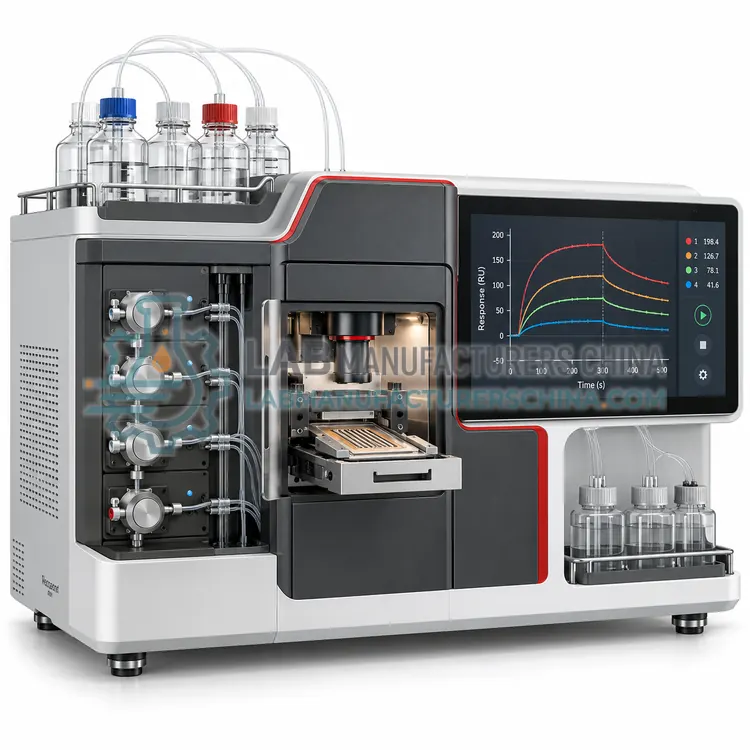
A surface plasmon resonance analyzer measures binding between molecules in real time by detecting mass changes at a sensor surface, giving association and dissociation rate constants and affinity. It is used for antibody characterisation, interaction screening and kinetic analysis.
What is the Surface Plasmon Resonance Analyzer?
A surface plasmon resonance analyzer measures binding between molecules in real time by detecting mass changes at a sensor surface, giving association and dissociation rate constants and affinity. It is used for antibody characterisation, interaction screening and kinetic analysis.
Overview
The instrument uses a sensor chip with a thin gold film on a glass prism. Polarised light undergoes total internal reflection at the gold surface, and the resonance angle depends on the refractive index just outside the metal, which rises as mass binds. One interaction partner is immobilised on a dextran or similar surface chemistry, the other flows over the chip as analyte, and the response in resonance units is recorded against time to give association and dissociation phases. Fitting these curves yields rate constants and the equilibrium dissociation constant, typically measurable from low millimolar to picomolar affinity. Buffer refractive index differences and non-specific binding are corrected with a reference channel. Throughput ranges from one channel to several hundred in array formats, and temperature is controlled to within 0.1 °C because binding rates are strongly temperature dependent.
How does it work?
Protein analyzers apply a physical or chemical measurement that responds to a specific property of the molecule. Amino acid analysis hydrolyses the protein and separates the released amino acids by ion exchange or reversed-phase chromatography with ninhydrin or fluorescence detection, giving composition in residues per molecule. Edman degradation removes one amino acid at a time from the N-terminus by phenylisothiocyanate chemistry and identifies each derivative chromatographically, giving the first 20–50 residues. Circular dichroism measures the difference in absorption of left- and right-circularly polarised light, and the far-UV spectrum reports alpha helix, beta sheet and random coil content. Thermal shift assays use a fluorescent dye that reports unfolding as temperature rises, giving a melting temperature that shifts when a ligand binds. Surface plasmon resonance detects mass binding at a sensor surface in real time, yielding association and dissociation rate constants.
What are the key features?
- Real-time monitoring of association and dissociation phases
- Affinity range from low millimolar to picomolar
- Reference channel subtraction for refractive index and nonspecific binding
- Multiple immobilisation chemistries including amine coupling and capture
- Temperature control within about 0.1 °C
- Kinetic fitting software with model quality statistics
What are the technical specifications?
A typical surface plasmon resonance analyzer configuration offers detection channels of 1–8 flow channels or array formats, affinity range of approx. 1 mM–10 pM (analyte dependent), association rate range of approx. 10^3–10^7 M⁻¹s⁻¹, baseline noise of below 0.1 resonance units (typical), temperature control of approx. 4–40 °C, within ±0.1 °C and flow rate of 1–100 µL/min. Values are indicative of the product class; the exact figures for each configuration are confirmed on the quotation and the calibration documents supplied with the instrument.
Which applications is it used for?
The Surface Plasmon Resonance Analyzer is used in antibody affinity and kinetics characterisation, biosimilar binding comparability, small molecule and fragment screening and protein-protein and protein-ligand interaction studies. Across the wider Protein Analyzers class, laboratories also deploy it for recombinant protein characterisation, biosimilar comparability studies and protein structure and folding research.
Which standards and certifications apply?
Relevant standards and methods include USP <1057>, Ph. Eur. 2.2.56, Ph. Eur. 2.2.25, ISO 17025, IEC 61010-1 and 21 CFR Part 11. Certification candidates for this model are CE, ISO 9001 manufacturing and IEC 61010-1 safety; each is to be confirmed for the specific configuration before shipment, and certificates are supplied only where they have been issued.
Sample purity and buffer composition dominate results, so prepare proteins in volatile, low-absorbing buffers for circular dichroism and avoid detergents and reducing agents that absorb in the far UV. Amino acid analysis needs complete hydrolysis, so ampoule sealing, vacuum and hydrolysis time must be controlled. Surface plasmon resonance sensors are sensitive to buffer refractive index differences, so running buffer and sample buffer should match and a reference channel should be included. Thermal shift assays need consistent dye concentration and controlled heating rates. Verify performance periodically with a reference protein such as bovine serum albumin or lysozyme, keep maintenance and calibration records, and store raw data, since circular dichroism and biosensor results are often re-analysed after method changes.
How do I select the right Surface Plasmon Resonance Analyzer?
Select a surface plasmon resonance analyzer when rate constants rather than endpoint binding values are needed, or when weak interactions must be detected label-free. Specify channel count, affinity range, temperature control, immobilisation chemistries and the kinetic analysis software with its model validation tools.
How does it compare with other Protein Analyzers variants?
Choose the analyzer that measures the property you must document. For composition or identity of a purified protein, amino acid analysis gives a quantitative profile; Edman sequencing provides N-terminal sequence but needs a pure, unblocked sample. Circular dichroism is the standard method for secondary structure comparison between batches and for folding studies, and it needs only 0.2–0.5 mg/mL in a low-absorbing buffer. Thermal shift assays screen buffer conditions and ligand binding quickly in 96-well format, making them useful early in development. Surface plasmon resonance quantifies affinity and kinetics, and it demands careful immobilisation chemistry and reference channel design. Compare sample consumption, sensitivity, throughput, buffer tolerance, temperature control and whether the software can export raw traces for independent analysis.
Full specifications
| Detection channels | 1–8 flow channels or array formats |
|---|---|
| Affinity range | approx. 1 mM–10 pM (analyte dependent) |
| Association rate range | approx. 10^3–10^7 M⁻¹s⁻¹ |
| Baseline noise | below 0.1 resonance units (typical) |
| Temperature control | approx. 4–40 °C, within ±0.1 °C |
| Flow rate | 1–100 µL/min |
| Sample volume | 50–200 µL per injection |
| Sensor chemistry | Carboxymethyl dextran, streptavidin or capture surfaces |
| Detection | Angle-resolved surface plasmon resonance |
| Dimensions (W x D x H) | approx. 600 x 500 x 400 mm |
Indicative values for this product class. Final specifications are confirmed on the quotation and in the calibration documents supplied with the instrument.
Applications
- Antibody affinity and kinetics characterisation
- Biosimilar binding comparability
- Small molecule and fragment screening
- Protein-protein and protein-ligand interaction studies
Key features
- Real-time monitoring of association and dissociation phases
- Affinity range from low millimolar to picomolar
- Reference channel subtraction for refractive index and nonspecific binding
- Multiple immobilisation chemistries including amine coupling and capture
- Temperature control within about 0.1 °C
- Kinetic fitting software with model quality statistics
Frequently asked questions about Surface Plasmon Resonance Analyzer
Affinity is the equilibrium dissociation constant, describing how tightly two molecules bind. Kinetics describes how fast they associate and dissociate. Two antibodies can share an affinity while having very different rate constants, which matters for how long a drug stays bound.
Regeneration removes bound analyte while preserving the immobilised partner, usually with a short pulse of acid, base or high salt. Conditions must be tested for each interaction because excessive regeneration degrades the surface and shifts the baseline.
Yes, but the response scales with molecular mass, so a 300 Da compound gives a much smaller signal than an antibody. High immobilisation density, low noise sensors and careful reference subtraction are needed for reliable small molecule kinetics.
For composition, amino acid analysis gives a quantitative residue profile. For N-terminal sequence, Edman sequencing identifies the first 20–50 residues but requires a pure sample with a free N-terminus. Mass spectrometry is usually added for molecular weight confirmation.
A typical far-UV measurement uses 200–400 µL of sample at 0.2–0.5 mg/mL in a 0.1 cm cuvette, which is about 40–200 µg of protein. Lower concentrations are possible with longer path length cells, but buffer absorbance then limits the usable wavelength range.
It reports the temperature at which half the protein unfolds in a given buffer. Comparing melting temperatures across conditions ranks buffer stability, and a shift to higher temperature on adding a ligand indicates binding, which makes the method useful for screening before more detailed studies.
Related models