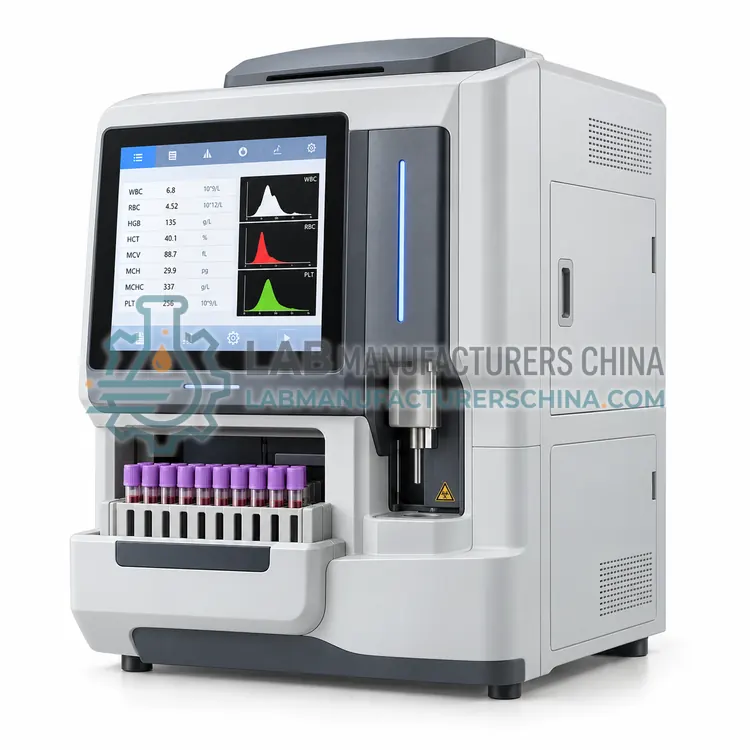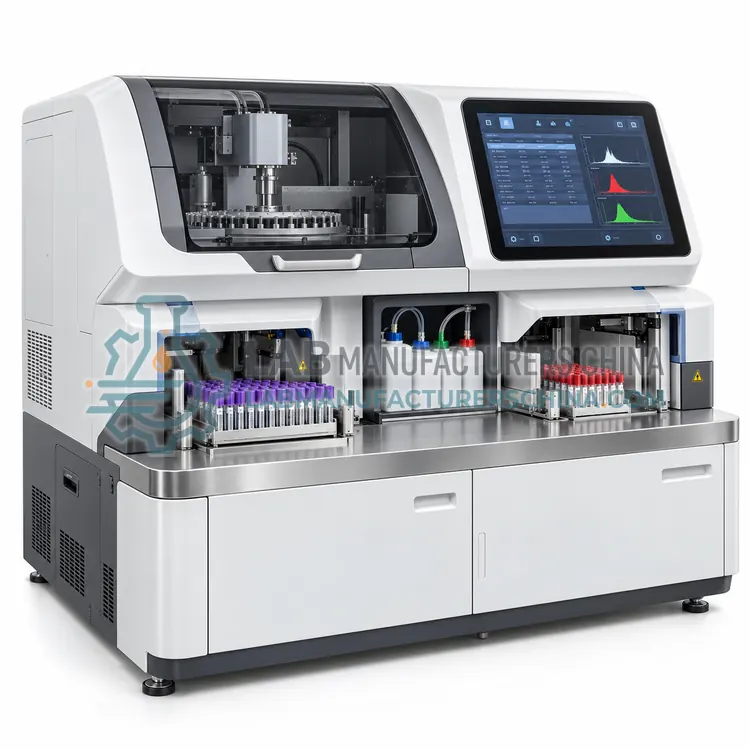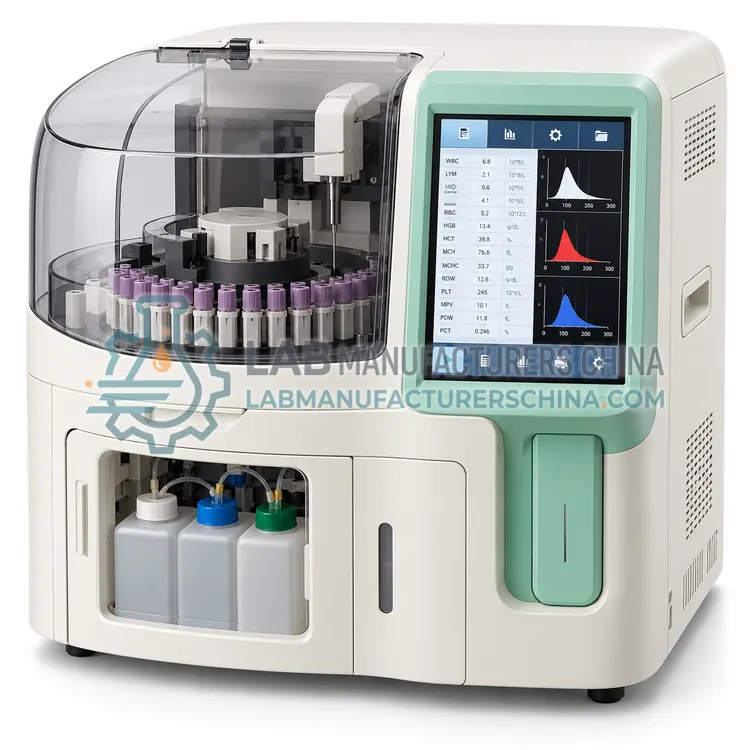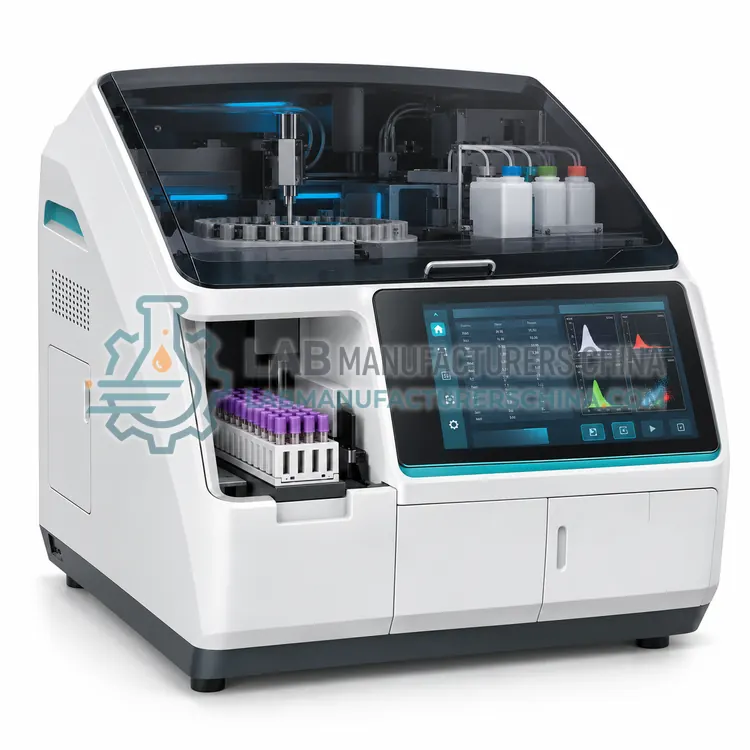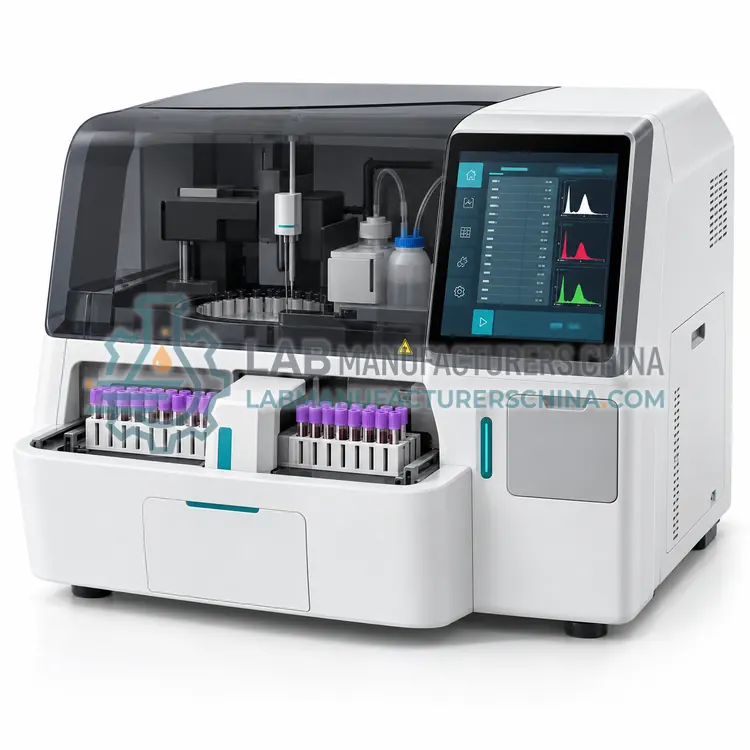
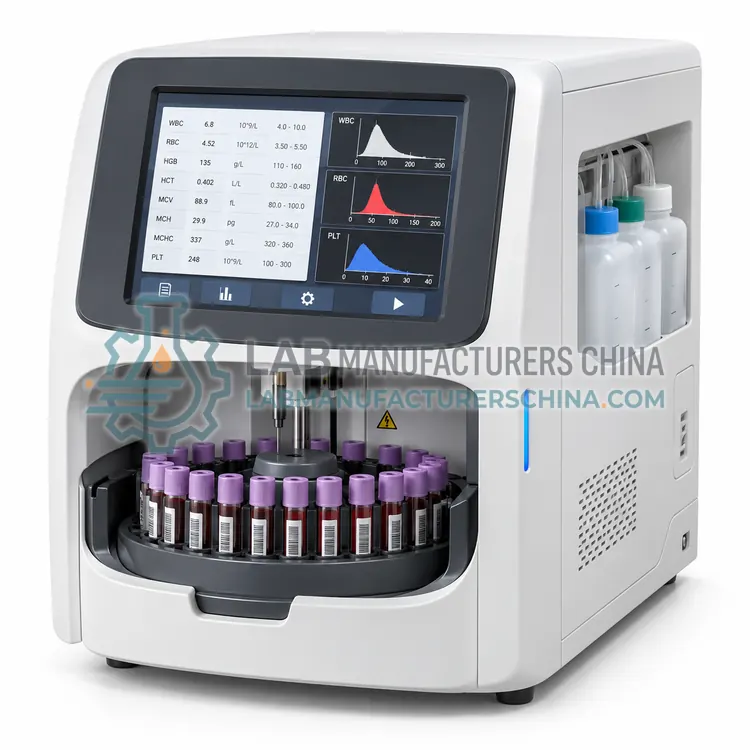
Compact 3-Part Hematology Analyzer
紧凑型三分群血液分析仪
- SKU PAA-0001
- 3-Part Analyzers
- CE (to be confirmed)
- ISO 13485 manufacturing (to be confirmed)
- NMPA class II registration (to be confirmed)
Price on request — FOB / CIF quoted per order
Prices depend on configuration, quantity and destination port.
Key specifications
| Throughput | 40–60 samples/h |
|---|---|
| Reportable parameters | 22 parameters including LYMPH%, MID%, GRAN% |
| Sample volume | 20 µL whole blood; 20 µL prediluted mode |
| WBC linear range | 0.3–99.9 ×10⁹/L |
| PLT linear range | 10–999 ×10⁹/L |
| Hemoglobin range | 0–250 g/L |
Request a quote Download brochure · to be provided
By Lab Manufacturers China Technical TeamLast reviewed Standards: ISO 15189, CLSI H26-A2, CLSI H20-A2
What is the Compact 3-Part Hematology Analyzer?
A compact 3-part hematology analyzer is a bench-top blood cell counter that produces a complete blood count with a three-part white cell differential from about 20 microliters of whole blood. It is the right choice for clinics and small laboratories that need dependable routine counts within a small footprint and budget.
What is the Compact 3-Part Hematology Analyzer?
A compact 3-part hematology analyzer is a bench-top blood cell counter that produces a complete blood count with a three-part white cell differential from about 20 microliters of whole blood. It is the right choice for clinics and small laboratories that need dependable routine counts within a small footprint and budget.
Overview
The analyzer uses impedance counting for red cells and platelets, and an impedance channel with lysing reagent for white cells. A size histogram is divided by two software thresholds into lymphocytes, a mixed monocyte and eosinophil population, and granulocytes. Hemoglobin is measured photometrically after conversion to a stable chromogen. Typical performance is 40 to 60 samples per hour with the full 22-parameter report, several thousand stored patient records, and printing or transmission through RS-232, USB or LAN ports. Calibration uses a commercial calibrator or fresh blood assigned by a reference laboratory, and two or three levels of control verify daily performance. A small reagent set, low sample volume and simple fluidics keep running costs low, which matters in clinics without an on-site engineer.
How does it work?
A 3-part analyzer aspirates a small volume of anticoagulated whole blood, then splits it into separate channels for dilution and measurement. Red cells and platelets are counted in an isotonic diluent by the Coulter principle, in which each cell passing a small aperture displaces conductive electrolyte and creates a voltage pulse proportional to cell volume. White cells are counted in a second channel where a lysing reagent destroys red cell membranes while leaving white cells intact for sizing. The analyzer sorts white cells into three populations using two software thresholds on the size histogram: lymphocytes, a mixed population of monocytes, eosinophils and basophils, and granulocytes. Hemoglobin is released by lysis and measured photometrically at about 540 nm after conversion to a stable chromogen. Software computes indices such as MCV, MCH and MCHC, applies quality control rules, and stores or transmits the report.
What are the key features?
- Impedance counting with automatic dilution and lysing of whole blood
- Three-part white cell differential shown as a size histogram
- Hemoglobin measured photometrically after conversion to a stable chromogen
- Aspiration volume around 20 microliters for venous or capillary samples
- Onboard storage of patient results with quality control charts
- RS-232, USB and LAN ports for printers or laboratory systems
What are the technical specifications?
A typical compact 3-part hematology analyzer configuration offers throughput of 40–60 samples/h, reportable parameters of 22 parameters including LYMPH%, MID%, GRAN%, sample volume of 20 µL whole blood; 20 µL prediluted mode, WBC linear range of 0.3–99.9 ×10⁹/L, PLT linear range of 10–999 ×10⁹/L and hemoglobin range of 0–250 g/L. Values are indicative of the product class; the exact figures for each configuration are confirmed on the quotation and the calibration documents supplied with the instrument.
Which applications is it used for?
The Compact 3-Part Hematology Analyzer is used in routine complete blood counts in clinics, anemia and infection screening and antenatal and pre-operative blood counts. Across the wider 3-Part Analyzers class, laboratories also deploy it for routine complete blood counts in community clinics, anemia and infection screening and pre-operative and antenatal blood counts.
Which standards and certifications apply?
Relevant standards and methods include ISO 15189, CLSI H26-A2, CLSI H20-A2, CLSI EP05, IEC 61010-1 and IEC 61010-2-101. Certification candidates for this model are CE, ISO 13485 manufacturing and NMPA class II registration; each is to be confirmed for the specific configuration before shipment, and certificates are supplied only where they have been issued.
Place the analyzer on a stable, level bench away from direct sunlight, strong vibration and large electrical motors, with a grounded outlet and a supply of clean, low-particulate water if the instrument needs it. Perform installation verification with the manufacturer or distributor, including background counts, precision, carryover and linearity checks with fresh or stabilized blood. Run two or three levels of quality control at the start of each working day and after reagent changes. Daily cleaning of the aspiration probe, weekly cleaning of the apertures and periodic replacement of pump tubing, seals and the peristaltic pump keep results stable. Treat all blood samples, waste and control material as potentially infectious and follow local biosafety rules for decontamination and disposal.
How do I select the right Compact 3-Part Hematology Analyzer?
Select this variant when daily workload is below about one hundred counts, when a three-part differential meets clinical needs, and when bench space and budget are limited. In an RFQ specify the minimum sample volume, whether reagents are open or proprietary, the presence of a barcode reader and LIS interface, and the control and calibrator supply. Also request the histogram printout and validation data for low white cell counts.
How does it compare with other 3-Part Analyzers variants?
Choose a 3-part analyzer when the clinicians served mainly need total counts, hemoglobin and a basic differential, and when the daily workload is low enough that a 5-part flow cytometry channel would not be used. Compare variants by throughput in samples per hour, minimum aspiration volume for capillary sampling, whether the reagent system is open or proprietary, and the quality of the histogram display. Confirm autoloader capacity if more than fifty samples arrive in a batch, check barcode and LIS connectivity, and review the calibration and control materials offered. Ask about the expected life of the shear valve and pump tubing, because these parts dominate maintenance cost, and about local service response time for a clinic without an in-house engineer.
Full specifications
| Throughput | 40–60 samples/h |
|---|---|
| Reportable parameters | 22 parameters including LYMPH%, MID%, GRAN% |
| Sample volume | 20 µL whole blood; 20 µL prediluted mode |
| WBC linear range | 0.3–99.9 ×10⁹/L |
| PLT linear range | 10–999 ×10⁹/L |
| Hemoglobin range | 0–250 g/L |
| Display | 7-inch color LCD with touch operation |
| Data storage | 10,000 patient records; 1,000 QC results |
| Interfaces | RS-232, USB, LAN |
Indicative values for this product class. Final specifications are confirmed on the quotation and in the calibration documents supplied with the instrument.
Applications
- Routine complete blood counts in clinics
- Anemia and infection screening
- Antenatal and pre-operative blood counts
Key features
- Impedance counting with automatic dilution and lysing of whole blood
- Three-part white cell differential shown as a size histogram
- Hemoglobin measured photometrically after conversion to a stable chromogen
- Aspiration volume around 20 microliters for venous or capillary samples
- Onboard storage of patient results with quality control charts
- RS-232, USB and LAN ports for printers or laboratory systems
Frequently asked questions about Compact 3-Part Hematology Analyzer
Typical throughput is 40 to 60 samples per hour for the full report, which covers a clinic workload of up to about one hundred to two hundred counts per day when quality control and repeats are included. Actual speed depends on whether the prediluted mode is used and on how often results trigger a repeat.
Yes, it uses an isotonic diluent, a lysing reagent and a cleaning solution. Reagent consumption is low, roughly 10 to 20 milliliters per sample across all channels. Confirm whether the instrument accepts third-party reagents or requires proprietary ones, since this affects long-term running cost.
A barcode reader is not essential for low volume, but it reduces transcription errors when sample identification is done manually and supports LIS connectivity. If the clinic plans to grow or to report through a laboratory information system, specifying a barcode reader and HL7 or ASTM interface at purchase is usually cheaper than retrofitting.
A three-part differential reports lymphocytes, a combined monocyte and eosinophil group usually labelled MID or mononuclear, and granulocytes, each as a percentage and absolute count. It gives total white cell count, red cell count, platelet count, hemoglobin, hematocrit and indices, which is sufficient for most routine screening.
Many models offer a prediluted or capillary mode that accepts 10 to 20 microliters of capillary blood collected in a diluent tube, which is useful for children and for patients with poor venous access. Confirm the minimum volume and validate the mode against venous samples before routine use.
Typical tasks are daily probe cleaning and background check, weekly cleaning of the aperture and reagent lines with a cleaning solution, monthly inspection of peristaltic pump tubing, and replacement of tubing, seals and syringe parts at intervals given in the manual. Annual preventive maintenance by a service technician is recommended.