ELISA and Lateral Flow Pathogen Reader
致病菌 ELSA 与侧向层析读数仪
- SKU MTE-0004
- Microbiology Testing
- CE (to be confirmed)
- ISO 9001 manufacturing (to be confirmed)
- AOAC performance-tested kit (to be confirmed)
Price on request — FOB / CIF quoted per order
Prices depend on configuration, quantity and destination port.
Key specifications
| Assay formats | Microplate ELISA and lateral flow |
|---|---|
| Detection wavelength | 450 nm for ELISA |
| Detection limit | 10^4–10^5 CFU/mL after enrichment |
| Enrichment time | 16–24 h standard, 6–8 h rapid broths |
| Assay time after enrichment | 15–60 min |
| Targets | Salmonella, Listeria, E. coli O157 |
Request a quote Download brochure · to be provided
By Lab Manufacturers China Technical TeamLast reviewed Standards: ISO 7218, ISO 6579, ISO 11290
What is the ELISA and Lateral Flow Pathogen Reader?
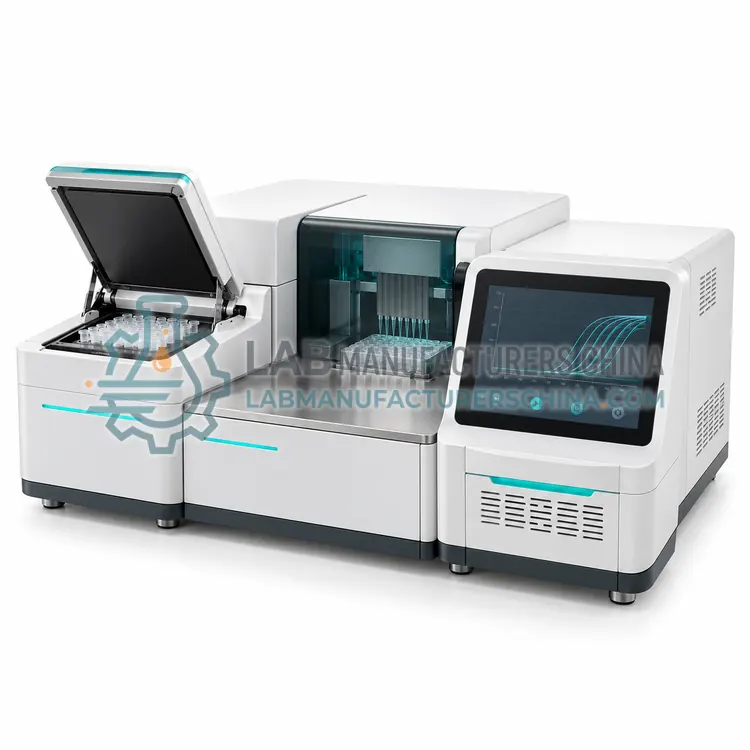
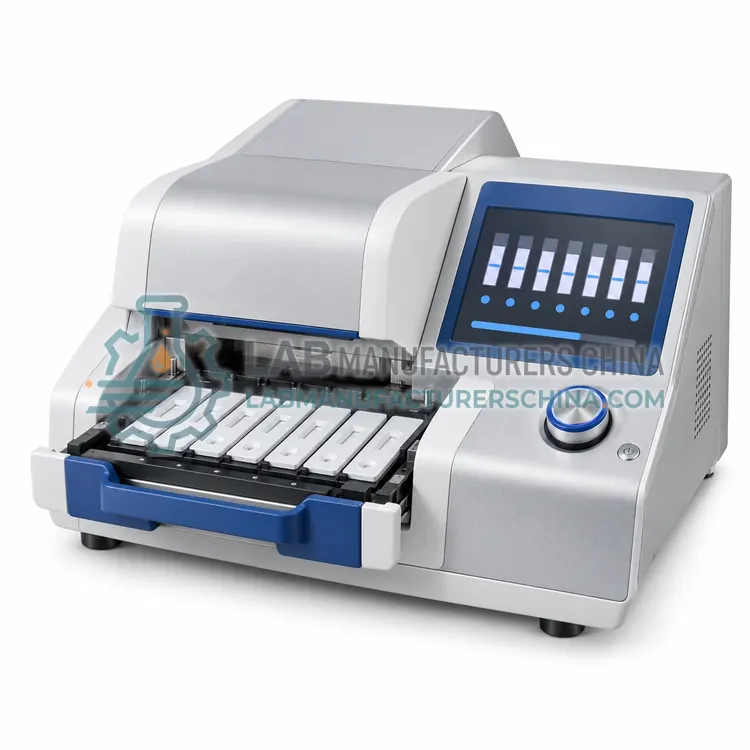
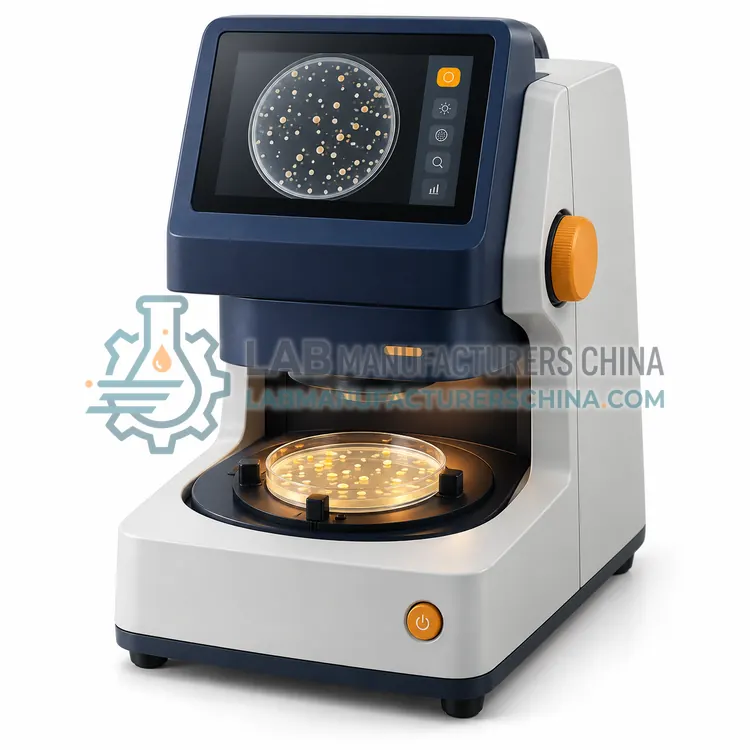
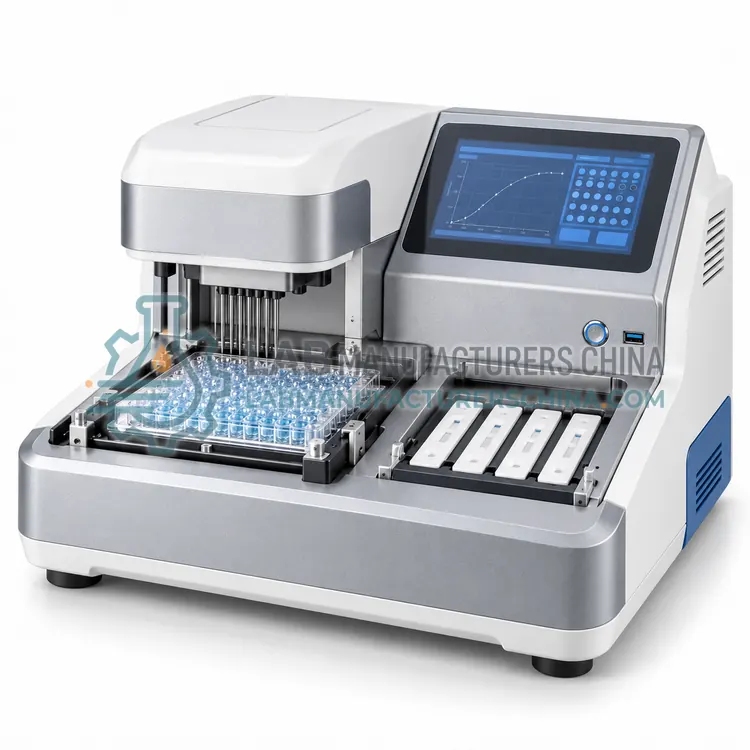
An ELISA and lateral flow reader detects pathogen antigens or toxins from enriched food samples using antibody-based assays. It offers a cost-effective, easy-to-run screening step between culture and PCR in food safety programmes.
What is the ELISA and Lateral Flow Pathogen Reader?
An ELISA and lateral flow reader detects pathogen antigens or toxins from enriched food samples using antibody-based assays. It offers a cost-effective, easy-to-run screening step between culture and PCR in food safety programmes.
Overview
The sample is enriched in a selective broth for a defined time, then tested either in a microplate ELISA or on a lateral flow strip. In the ELISA format, immobilised antibodies capture the antigen and an enzyme conjugate produces colour that is read photometrically and compared with a cutoff. The lateral flow format produces visible lines that a reader interprets optically for consistent cutoff application. Both approaches are simple and inexpensive, with results in 15–60 minutes after enrichment, and kits exist for Salmonella, Listeria, E. coli O157 and staphylococcal enterotoxin. They are screening methods, so positive results are confirmed by culture or PCR, and each new matrix requires validation of the enrichment step.
How does it work?
Culture-based methods remain the reference: a measured portion of sample is homogenised, enriched and plated on selective media, incubated at a set temperature, and colonies are counted and reported as colony-forming units per gram or millilitre. Rapid methods shorten the result time by detecting specific molecules. Real-time PCR amplifies pathogen DNA and reads fluorescence cycle by cycle. Immunoassays detect antigens or toxins with antibodies in microplate or lateral-flow formats. MALDI-TOF mass spectrometry identifies isolates from their protein fingerprints within minutes. ATP luminometry measures adenosine triphosphate as a general indicator of organic residue and microbial load on surfaces. Each rapid method must be validated against the cultural reference for the matrix in use.
What are the key features?
- Microplate ELISA and lateral flow strip formats
- Kits for Salmonella, Listeria and E. coli O157
- Results in 15–60 minutes after enrichment
- Photometric or optical line reading with stored cutoff
- Simple wash and incubation steps for routine staff
- Export of results for trend monitoring
What are the technical specifications?
A typical elisa and lateral flow pathogen reader configuration offers assay formats of Microplate ELISA and lateral flow, detection wavelength of 450 nm for ELISA, detection limit of 10^4–10^5 CFU/mL after enrichment, enrichment time of 16–24 h standard, 6–8 h rapid broths, assay time after enrichment of 15–60 min and targets of Salmonella, Listeria, E. coli O157. Values are indicative of the product class; the exact figures for each configuration are confirmed on the quotation and the calibration documents supplied with the instrument.
Which applications is it used for?
The ELISA and Lateral Flow Pathogen Reader is used in routine pathogen screening before confirmation, environmental swab screening, hygiene verification in small laboratories and supplier and incoming-material checks. Across the wider Microbiology Testing class, laboratories also deploy it for pathogen testing of ready-to-eat and raw foods, hygiene and environmental monitoring in food plants and shelf-life and challenge testing.
Which standards and certifications apply?
Relevant standards and methods include ISO 7218, ISO 6579, ISO 11290, ISO 16649, ISO 4833, ISO 21528 and ISO/IEC 17025. Certification candidates for this model are CE, ISO 9001 manufacturing and AOAC performance-tested kit; each is to be confirmed for the specific configuration before shipment, and certificates are supplied only where they have been issued.
Microbiology laboratories need separate clean and contaminated zones, controlled air flow, autoclave capacity and safe waste handling. Culture media and antibiotics have shelf life and must be stored correctly, and incubators require temperature mapping and monitoring. Rapid kits need positive and negative controls in every run, and results near the limit of detection should be confirmed by culture. Environmental monitoring programmes define sampling points, frequency and action levels. Keep validation records against ISO 7218 and the relevant organism standards, and confirm that suppliers provide training, proficiency-testing support and timely consumables.
How do I select the right ELISA and Lateral Flow Pathogen Reader?
Choose antibody-based screening when you need a low-cost, technician-friendly method with results faster than culture, and when you accept confirmation of positives by another technique. Verify that validated kits and enrichment broths exist for your organisms and matrices, and keep control samples in every run.
How does it compare with other Microbiology Testing variants?
Begin with the organisms and limits your regulation or customer specification names, then decide between cultural and rapid methods. Cultural methods are the accredited reference and cost less per test but take days, so they suit scheduled production and confirmatory work. PCR and immunoassay platforms give results within hours, which helps hold time-sensitive or short-shelf-life products, but they need validation, controls and staff training. MALDI-TOF identification reduces the time to identify isolates from days to minutes. Add ATP luminometry and air sampling for environmental and hygiene monitoring. Compare consumable cost per test, walkaway automation and local technical support.
Full specifications
| Assay formats | Microplate ELISA and lateral flow |
|---|---|
| Detection wavelength | 450 nm for ELISA |
| Detection limit | 10^4–10^5 CFU/mL after enrichment |
| Enrichment time | 16–24 h standard, 6–8 h rapid broths |
| Assay time after enrichment | 15–60 min |
| Targets | Salmonella, Listeria, E. coli O157 |
| Microplate format | 96-well strips |
| Strip incubation | 10–30 min |
| Controls | Positive and negative per run |
| Data management | Stored results, CSV export |
Indicative values for this product class. Final specifications are confirmed on the quotation and in the calibration documents supplied with the instrument.
Applications
- Routine pathogen screening before confirmation
- Environmental swab screening
- Hygiene verification in small laboratories
- Supplier and incoming-material checks
Key features
- Microplate ELISA and lateral flow strip formats
- Kits for Salmonella, Listeria and E. coli O157
- Results in 15–60 minutes after enrichment
- Photometric or optical line reading with stored cutoff
- Simple wash and incubation steps for routine staff
- Export of results for trend monitoring
Frequently asked questions about ELISA and Lateral Flow Pathogen Reader
Both need enrichment, and PCR generally detects lower levels after the same enrichment because it amplifies DNA rather than detecting antigen. Antibody methods are cheaper and simpler but slightly less sensitive and more prone to matrix interference.
Antibody tests can cross-react with related organisms and can detect non-viable cells. Regulatory and customer decisions therefore require confirmation by culture, PCR or another independent method before a batch is rejected or recalled.
Standard selective enrichment takes 16 to 24 hours. Rapid broths and combined enrichment steps can shorten this to 6 to 8 hours for some organisms, but the shortened protocol must be validated for each food matrix and target.
Culture methods are the validated reference against which rapid methods are compared, they detect viable organisms and they remain accepted for regulatory decisions. Their main drawback is the several days needed for enrichment, plating, incubation and confirmation.
PCR methods typically give a result within 12 to 24 hours including enrichment, and immunoassays in 20 minutes to several hours. They shorten holding time but still require pre-enrichment for most pathogens because the infectious dose is low.
An ATP swab measures adenosine triphosphate on a surface, which indicates organic residue or microbial contamination after cleaning. It is a rapid pass/fail indicator used to verify cleaning, but it does not identify organisms or replace microbiological monitoring.