
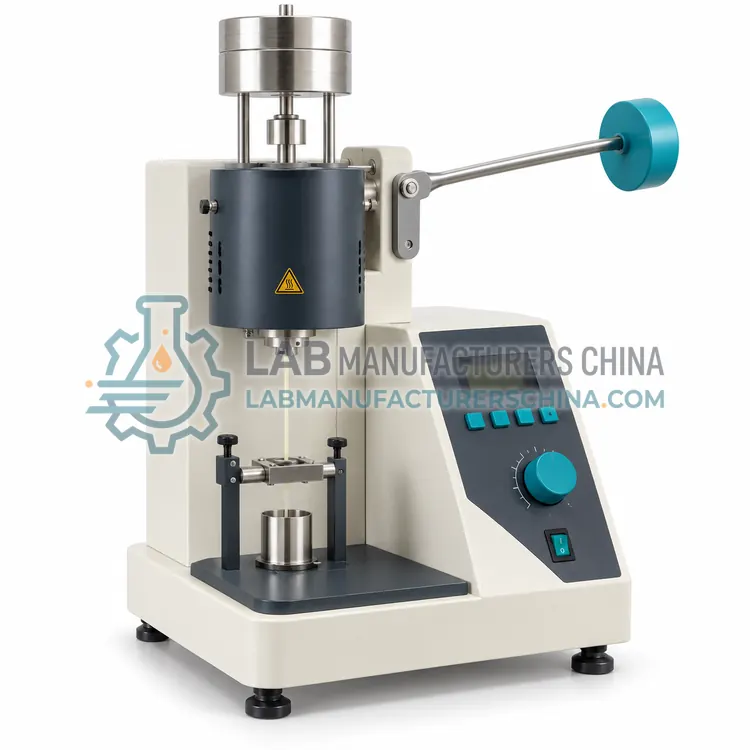
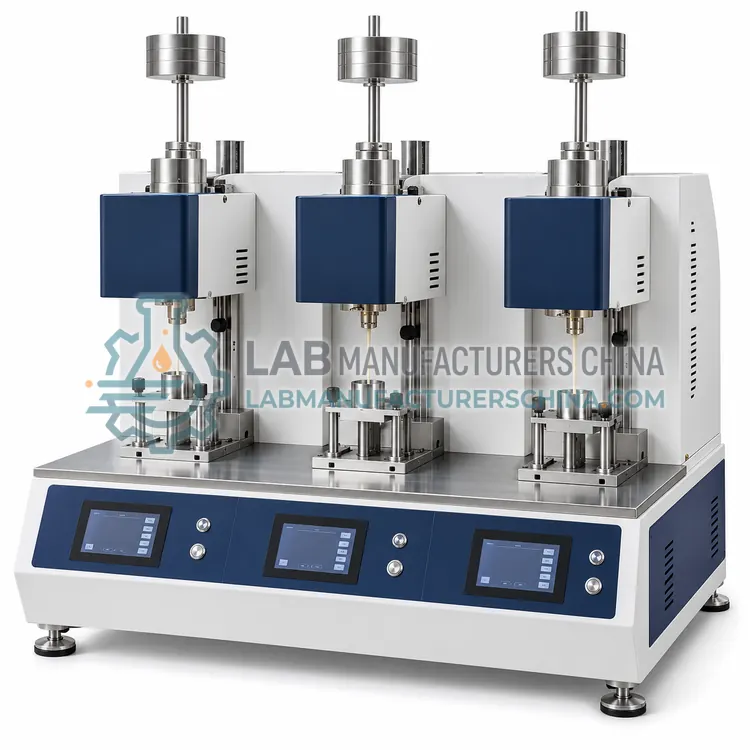
Multi-Station Melt Flow Index Tester
多工位熔融指数仪
- SKU MFT-0003
- Melt Flow Testers
- CE (to be confirmed)
- ISO 9001 manufacturing (to be confirmed)
Price on request — FOB / CIF quoted per order
Prices depend on configuration, quantity and destination port.
Key specifications
| Number of stations | 2–4 |
|---|---|
| Temperature range | 50–400 °C per station |
| Temperature accuracy | ±0.2 °C |
| Die dimensions | Ø 2.095 mm × 8.0 mm per station |
| Load weights | 1.2 / 2.16 / 5 / 10 / 21.6 kg |
| Throughput | Up to 4 samples per run |
Request a quote Download brochure · to be provided
By Lab Manufacturers China Technical TeamLast reviewed Standards: ISO 1133-1, ISO 1133-2, ASTM D1238
What is the Multi-Station Melt Flow Index Tester?
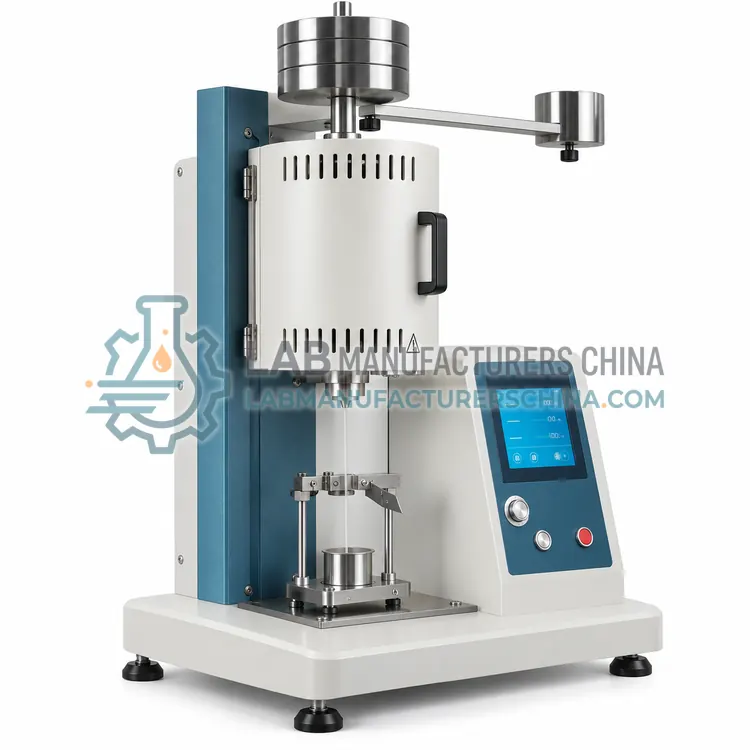
A multi-station melt flow index tester holds two to four independent barrels so several samples or grades can be conditioned and measured in one run. It suits polyolefin plants and large converters that compare many batches within a single shift.
What is the Multi-Station Melt Flow Index Tester?
A multi-station melt flow index tester holds two to four independent barrels so several samples or grades can be conditioned and measured in one run. It suits polyolefin plants and large converters that compare many batches within a single shift.
Overview
Each station of a multi-station tester has its own barrel, die, heater and temperature controller, so one station can run at 190 °C while another runs at 230 °C without interference. Stations are usually served by a common frame, a single control interface and, in the most automated versions, a shared robotic arm that loads pistons and cuts extrudate in sequence. The main benefit is throughput: four stations running in parallel can complete a batch of tests in roughly the time a single-barrel unit needs for one, which matters when certifying every production lot. Cross-talk between stations must be controlled by good insulation and independent control loops, and the laboratory should verify that a reference material gives the same result on every station.
How does it work?
A melt flow tester consists of a heated vertical barrel with a defined bore, a hardened steel die at the bottom, a piston and a set of certified weights. Polymer granules are loaded, compacted and held at the test temperature, then extruded through the die under a specified load. In method A, timed portions of extrudate are cut and weighed, and the result is expressed in grams per ten minutes. In method B, an encoder records piston displacement against time and the melt volume-flow rate is calculated in cubic centimetres per ten minutes, which can be converted to mass flow using the melt density. Temperature, load, die geometry and thermal equilibration time are all fixed by the method, because melt viscosity depends steeply on temperature and shear rate.
What are the key features?
- Two to four independently controlled barrels
- Separate temperature loops per station
- Parallel or sequential automatic cutting options
- Single touchscreen for all station methods
- Shared weight set with per-station lifting
- Station-by-station result comparison in software
What are the technical specifications?
A typical multi-station melt flow index tester configuration offers number of stations of 2–4, temperature range of 50–400 °C per station, temperature accuracy of ±0.2 °C, die dimensions of Ø 2.095 mm × 8.0 mm per station, load weights of 1.2 / 2.16 / 5 / 10 / 21.6 kg and throughput of Up to 4 samples per run. Values are indicative of the product class; the exact figures for each configuration are confirmed on the quotation and the calibration documents supplied with the instrument.
Which applications is it used for?
The Multi-Station Melt Flow Index Tester is used in production lot certification at resin plants, parallel comparison of several suppliers' grades, high-volume converter incoming inspection and raw material qualification studies. Across the wider Melt Flow Testers class, laboratories also deploy it for polyolefin resin production and grade certification, incoming inspection of polyethylene and polypropylene and recycled plastics quality screening.
Which standards and certifications apply?
Relevant standards and methods include ISO 1133-1, ISO 1133-2, ASTM D1238, GB/T 3682.1, GB/T 3682.2 and IEC 61010-1. Certification candidates for this model are CE and ISO 9001 manufacturing; each is to be confirmed for the specific configuration before shipment, and certificates are supplied only where they have been issued.
Install the tester on a level, vibration-free bench away from draughts, and allow the barrel to reach thermal equilibrium before the first test, which usually takes 15 to 30 minutes. Clean the barrel and die after every test or every material change, using purging compound for degraded polymer; never scrape the barrel bore with hardened tools. Verify temperature with an external thermometer in the bore at defined intervals, check die dimensions against the method tolerance, and keep weights traceable. Dry hygroscopic polymers before testing, discard any extrudate containing bubbles or voids, and repeat the test when a single cut deviates strongly from the others.
How do I select the right Multi-Station Melt Flow Index Tester?
Select a multi-station unit when the daily test count exceeds what one barrel can deliver, or when several grades at different temperatures must run in parallel. Specify station count against the number of distinct conditions you run, not simply the number of samples. Confirm that each station has its own controller and die, and ask for a station-comparison test with a reference polymer as part of acceptance.
How does it compare with other Melt Flow Testers variants?
Start from the standard your customer or specification cites, because ISO 1133 and ASTM D1238 fix different loads and procedures. Method A is sufficient for routine resin grading, while method B is preferable when the laboratory needs a fast result or the material is difficult to cut cleanly. Choose a high-temperature barrel when the scope includes engineering polymers such as polyamide, polysulfone or polyether ether ketone, and a corrosion-resistant barrel for PVC and fluoropolymers. Automatic units pay back where more than about ten tests per day are run, and multi-station units suit polyolefin plants that compare several production lines in one shift. Specify the load set, temperature range, data export format and cleaning accessories.
Full specifications
| Number of stations | 2–4 |
|---|---|
| Temperature range | 50–400 °C per station |
| Temperature accuracy | ±0.2 °C |
| Die dimensions | Ø 2.095 mm × 8.0 mm per station |
| Load weights | 1.2 / 2.16 / 5 / 10 / 21.6 kg |
| Throughput | Up to 4 samples per run |
| Preheat timer | 0–9999 s, per station |
| Data output | USB and laboratory network export |
| Power | 2–4 kW |
| Weight | 100–160 kg |
Indicative values for this product class. Final specifications are confirmed on the quotation and in the calibration documents supplied with the instrument.
Applications
- Production lot certification at resin plants
- Parallel comparison of several suppliers' grades
- High-volume converter incoming inspection
- Raw material qualification studies
Key features
- Two to four independently controlled barrels
- Separate temperature loops per station
- Parallel or sequential automatic cutting options
- Single touchscreen for all station methods
- Shared weight set with per-station lifting
- Station-by-station result comparison in software
Frequently asked questions about Multi-Station Melt Flow Index Tester
Each station is a separate measurement system, so each needs its own temperature check, die dimension inspection and reference-material test. Laboratories usually verify all stations on the same schedule, which is faster than verifying one barrel several times. Results should be recorded per station to show that no drift is station specific.
Yes, provided each station has independent heating and control. This is the main advantage for laboratories that test polyethylene at 190 °C and polypropylene at 230 °C in the same queue. Adjacent stations should be insulated well enough that a change of setpoint on one does not shift the temperature of another.
After levelling and warm-up, measure the temperature of every barrel with a calibrated probe at the test height, run a reference polymer on each station and compare the spread of results with the material's stated repeatability, then check that cutting timing and weight lowering match between stations. The acceptance record should list values per station.
MFR is the melt mass-flow rate in grams per ten minutes, obtained by weighing timed cuts of extrudate. MVR is the melt volume-flow rate in cubic centimetres per ten minutes, obtained from piston displacement and time. The two are related through melt density, so a laboratory can report MFR from method B data if it knows the melt density at test temperature.
Melt viscosity changes steeply with temperature, so a sample that has not reached the barrel temperature extrudes faster or slower than the specified condition. Methods therefore require a defined preheat time, typically four to six minutes, after the sample is compacted. Checking the barrel with an external probe at intervals confirms that the controller reading is accurate.
Clean the die and barrel after each test or whenever the material changes, because residual polymer degrades at test temperature and alters the next result. Disassemble the die while warm, wipe it with a soft cloth and approved solvent, and never use abrasive tools. For heavily degraded or crosslinked residues, run purging compound before manual cleaning.
Related models
Differential Scanning Calorimeter with Autosampler for Polymer QC
聚合物质控用自动进样差示扫描量热仪
- CE (to be confirmed)
- +1