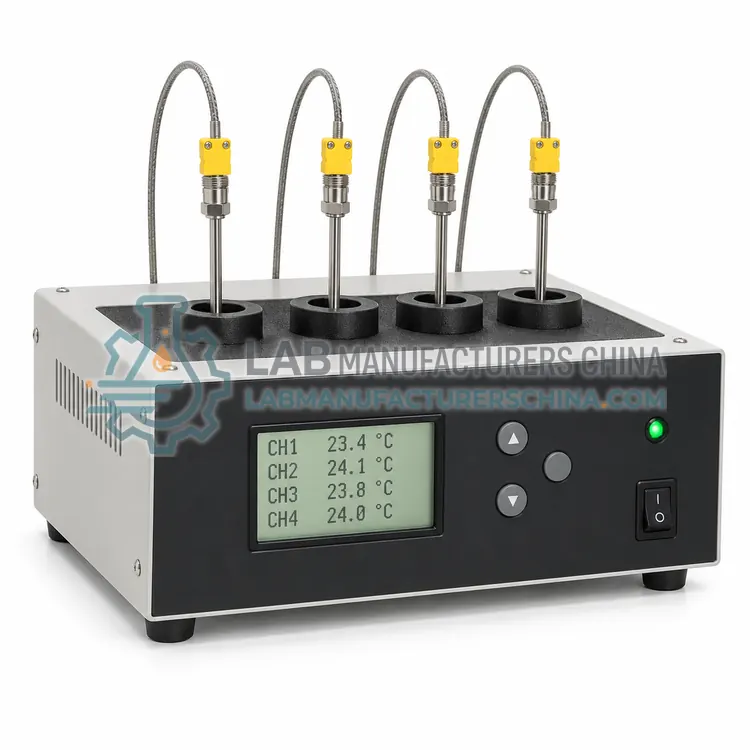
Multi-Channel Temperature Data Logger
多通道温度数据记录仪
- SKU MES-0003
- Measurement Systems
- CE (to be confirmed)
- RoHS (to be confirmed)
- ISO 9001 manufacturing (to be confirmed)
Price on request — FOB / CIF quoted per order
Prices depend on configuration, quantity and destination port.
Key specifications
| Number of channels | 4–64 |
|---|---|
| Input types | K, T, J, E, N thermocouples; Pt100 |
| Measuring range | −200 to 1300 °C (probe dependent) |
| Accuracy (Pt100) | ±0.1 °C |
| Accuracy (type K) | ±0.5 °C |
| Resolution | 0.01 °C |
Request a quote Download brochure · to be provided
By Lab Manufacturers China Technical TeamLast reviewed Standards: ISO/IEC 17025, ISO 10012, OIML R 76-1
What is the Multi-Channel Temperature Data Logger?
A multi-input recorder that logs temperature from thermocouples or Pt100 probes at set intervals with timestamps and alarms. It is the right choice for oven mapping, storage monitoring, process validation and thermal profiling.
What is the Multi-Channel Temperature Data Logger?
A multi-input recorder that logs temperature from thermocouples or Pt100 probes at set intervals with timestamps and alarms. It is the right choice for oven mapping, storage monitoring, process validation and thermal profiling.
Overview
A multi-channel temperature data logger accepts 4 to 64 inputs for thermocouples (types K, T, J, E and others) or Pt100 sensors, digitizes them with 16-bit or higher converters and stores readings at intervals from 1 second to hours. Accuracy for Pt100 inputs is typically 0.1 C, and for type K thermocouples about 0.5 C including cold junction compensation. Internal memory of several hundred thousand readings and USB, Ethernet or wireless transfer allow automatic download. Software displays curves, calculates mean, minimum, maximum and kinetics, and supports mapping reports for temperature uniformity under standards such as ISO 17025 style validations. Alarm limits trigger local indicators or emails. Probe placement, calibration of sensors and correct type selection are as important as the logger itself.
How does it work?
A measurement system converts a physical variable into an electrical signal with a sensor, conditions and digitizes that signal, applies calibration coefficients and displays or records the result. Electromagnetic force restoration balances compensate the load with a current through a coil. Strain-gauge or piezoresistive sensors turn pressure and force into bridge voltages. Platinum resistance thermometers and thermocouples produce resistance or voltage that varies with temperature. Capacitive polymer sensors change capacitance with relative humidity. The system accuracy combines sensor quality, amplifier stability, analog-to-digital resolution, temperature effects and calibration uncertainty. Traceability to national standards is established by periodic calibration with higher-accuracy references. Data loggers and software add time-stamped records, limit alarms and statistical analysis for quality documentation.
What are the key features?
- Selectable thermocouple and Pt100 inputs across 4 to 64 channels cover most applications.
- 16-bit analog-to-digital conversion and cold junction compensation deliver stable readings.
- Sampling intervals from 1 second to hours suit both fast profiling and long monitoring.
- Mapping software calculates uniformity, stability, minimum and maximum across probes.
- Programmable alarm limits trigger local indicators, relays or email notifications.
- Non-volatile memory retains data through power loss with USB, Ethernet or wireless download.
What are the technical specifications?
A typical multi-channel temperature data logger configuration offers number of channels of 4–64, input types of K, T, J, E, N thermocouples; Pt100, measuring range of −200 to 1300 °C (probe dependent), accuracy (Pt100) of ±0.1 °C, accuracy (type K) of ±0.5 °C and resolution of 0.01 °C. Values are indicative of the product class; the exact figures for each configuration are confirmed on the quotation and the calibration documents supplied with the instrument.
Which applications is it used for?
The Multi-Channel Temperature Data Logger is used in oven and furnace temperature mapping, cold room and refrigerator monitoring, sterilization and autoclave validation and process and curing profile recording. Across the wider Measurement Systems class, laboratories also deploy it for formulation and sample weighing, calibration of process gauges and storage and cold chain monitoring.
Which standards and certifications apply?
Relevant standards and methods include ISO/IEC 17025, ISO 10012, OIML R 76-1, OIML R 111-1, EURAMET cg-18, IEC 60751, ISO 7500-1 and JJG 1036. Certification candidates for this model are CE, RoHS and ISO 9001 manufacturing; each is to be confirmed for the specific configuration before shipment, and certificates are supplied only where they have been issued.
Install measurement systems in a stable environment appropriate to their accuracy class. Balances need a vibration-free table, level mounting and protection from drafts and temperature swings. Allow warm-up before use. Verify each instrument with check weights or reference devices on a routine schedule, and send it for full calibration at intervals defined by your quality system, typically annually. Keep calibration certificates, as-found and as-left data and uncertainty budgets. Protect sensors from overload, shock and incompatible media. Label instruments with calibration status and due dates, and remove those out of tolerance from service. Train operators on correct handling, such as using tweezers for weights and stabilizing before reading.
How do I select the right Multi-Channel Temperature Data Logger?
Choose a multi-channel logger when several points need simultaneous recording or mapping. Choose a single-channel stand-alone logger for simple monitoring. In an RFQ specify sensor types, channel count, range, accuracy, sampling rate, memory, alarms, connectivity, calibration certificates for probes and any compliance such as 21 CFR Part 11 for software.
How does it compare with other Measurement Systems variants?
Select the system by the variable, range and tolerance to be verified. Specify the resolution and accuracy needed at the working point, not only the full-scale value, and keep the instrument uncertainty to about one tenth to one third of the tolerance. For weighing, consider readability, capacity, repeatability and draft control. For pressure and temperature, check sensor type, media compatibility and environmental conditions. For monitoring, consider number of channels, logging interval, alarms and software features for audit trails. Confirm that calibration certificates are traceable and that calibration can be performed locally. Also consider ruggedness, battery life, display readability, connectivity and the ability to export data for regulatory or customer audits.
Full specifications
| Number of channels | 4–64 |
|---|---|
| Input types | K, T, J, E, N thermocouples; Pt100 |
| Measuring range | −200 to 1300 °C (probe dependent) |
| Accuracy (Pt100) | ±0.1 °C |
| Accuracy (type K) | ±0.5 °C |
| Resolution | 0.01 °C |
| Sampling interval | 1 s–24 h |
| Memory capacity | ≥500 000 readings |
| Interface | USB, Ethernet, Wi-Fi |
| Power supply | Mains with battery backup |
Indicative values for this product class. Final specifications are confirmed on the quotation and in the calibration documents supplied with the instrument.
Applications
- Oven and furnace temperature mapping
- Cold room and refrigerator monitoring
- Sterilization and autoclave validation
- Process and curing profile recording
Key features
- Selectable thermocouple and Pt100 inputs across 4 to 64 channels cover most applications.
- 16-bit analog-to-digital conversion and cold junction compensation deliver stable readings.
- Sampling intervals from 1 second to hours suit both fast profiling and long monitoring.
- Mapping software calculates uniformity, stability, minimum and maximum across probes.
- Programmable alarm limits trigger local indicators, relays or email notifications.
- Non-volatile memory retains data through power loss with USB, Ethernet or wireless download.
Frequently asked questions about Multi-Channel Temperature Data Logger
It depends on the chamber volume and the standard applied. Nine probes, one in each corner and one at the center, is a common minimum for small chambers, and larger ovens use more probes distributed in a grid.
Pt100 sensors offer higher accuracy and stability up to about 600 C, while thermocouples cover wider and higher ranges, respond faster and cost less. Choose by temperature range, required accuracy and sensor size.
Probes are calibrated by comparison with a reference thermometer in a dry-block or liquid bath at several points spanning the working range. Calibration corrections can be entered into the logger for improved accuracy.
They are calibrated instruments and data acquisition setups that measure basic variables such as mass, pressure, temperature, force and humidity. Their readings support process control, product verification and the calibration of other equipment.
Measurement uncertainty is a quantified range around a result within which the true value is expected to lie with stated confidence. It combines contributions from calibration, resolution, repeatability and environmental effects.
Most laboratories calibrate annually, then adjust the interval using drift history, usage and criticality. Critical instruments may be checked more often with check standards between full calibrations.