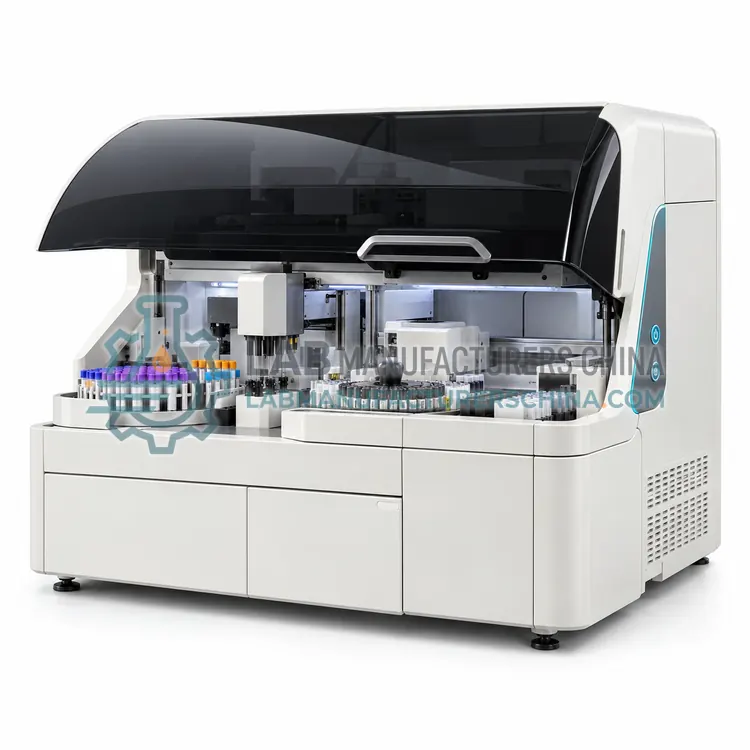
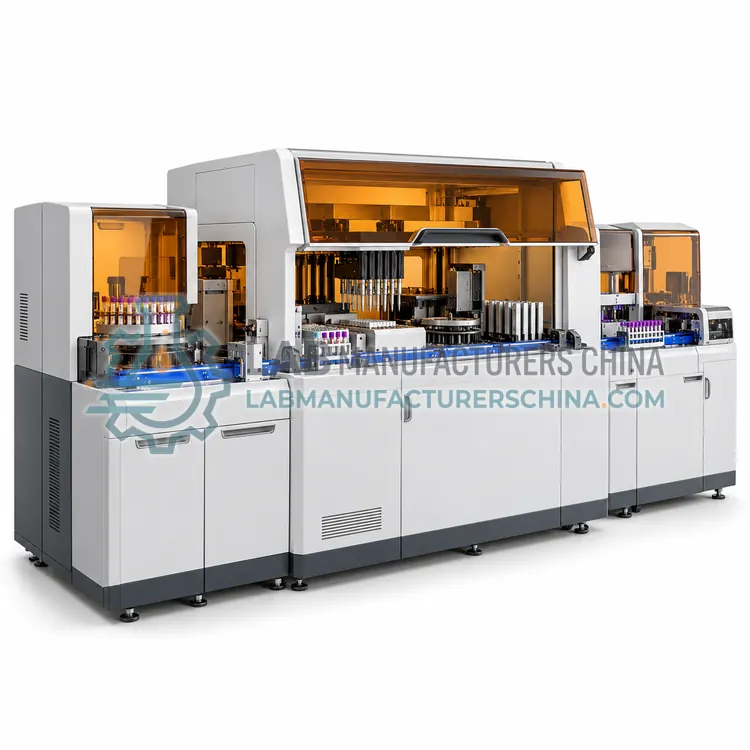
Track-Based Total Laboratory Automation System
轨道式全实验室自动化系统
- SKU LAA-0001
- Laboratory Automation
- CE (to be confirmed)
- ISO 9001 manufacturing (to be confirmed)
- ISO 13485 quality system (to be confirmed)
Price on request — FOB / CIF quoted per order
Prices depend on configuration, quantity and destination port.
Key specifications
| Throughput | 800–1,500 tubes/h (configuration dependent) |
|---|---|
| Tube types | Ø 13–16 mm, length 75–100 mm |
| Input capacity | 100–400 tubes |
| Connected analyzers | Up to 8–12 modules |
| Centrifuge module | Up to 4,000 × g, 20–48 tubes per cycle |
| Identification | 1D/2D barcode reader, optional RFID |
Request a quote Download brochure · to be provided
By Lab Manufacturers China Technical TeamLast reviewed Standards: CLSI AUTO01, CLSI AUTO03, CLSI AUTO04
What is the Track-Based Total Laboratory Automation System?
A track-based total laboratory automation system connects input, sorting, centrifugation, decapping, analyzers, resealing and storage with a conveyor, routing every tube automatically. It is the right choice for high-volume hospital and reference laboratories seeking to consolidate chemistry, immunoassay and other workflows.
What is the Track-Based Total Laboratory Automation System?
A track-based total laboratory automation system connects input, sorting, centrifugation, decapping, analyzers, resealing and storage with a conveyor, routing every tube automatically. It is the right choice for high-volume hospital and reference laboratories seeking to consolidate chemistry, immunoassay and other workflows.
Overview
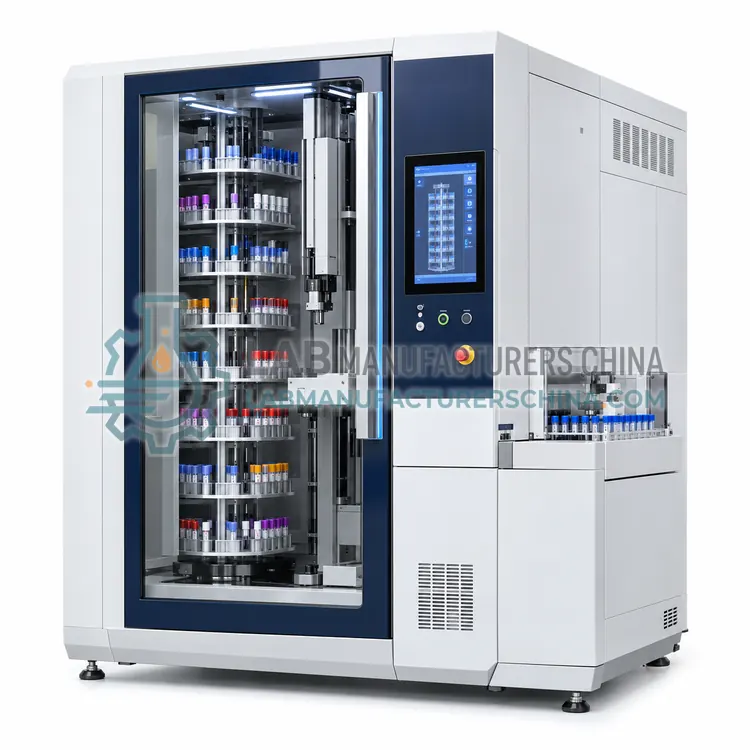
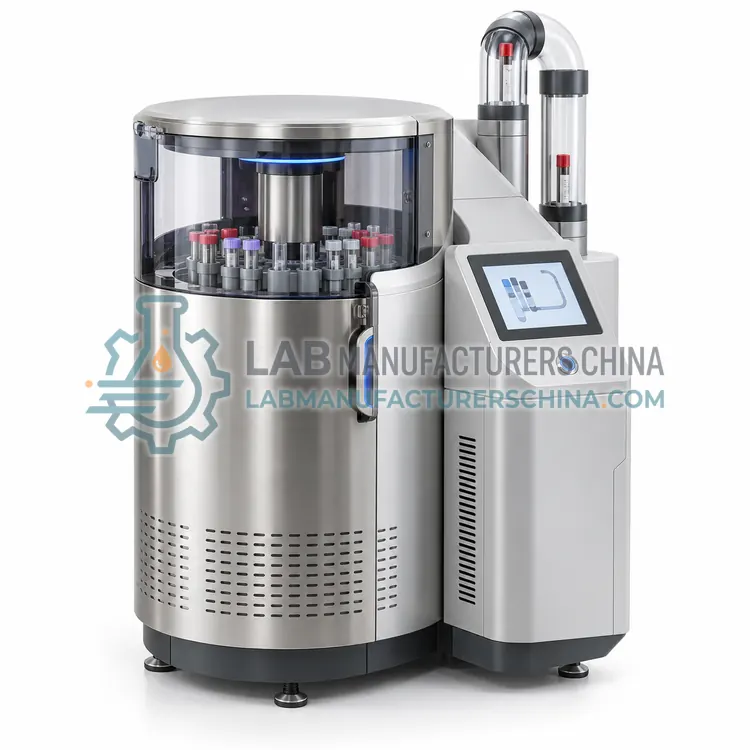
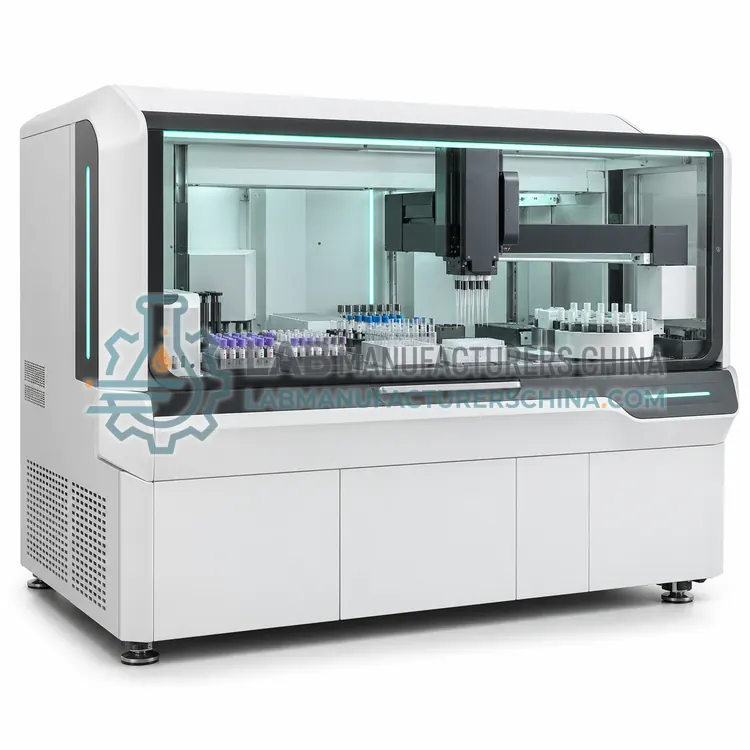
This variant is a fully integrated line built around a conveyor loop that carries single-tube carriers between modules. Input and output buffers accept racks or bulk loading, a camera-based station checks tube type, cap and fill level, and a centrifuge module with robotic loading spins tubes without manual intervention. Decapping, aliquoting and labeling modules prepare secondary tubes, and analyzers are docked along the track or served by robotic arms. Typical throughput reaches 800 to 1,500 tubes per hour depending on configuration, with STAT lanes bypassing queues. Middleware controls routing and autoverification, and a refrigerated storage unit completes the workflow. Installation needs substantial floor space, stable power, network integration and trained service engineers.
How does it work?
A laboratory automation system links modules through a transport layer, usually a conveyor track carrying individual tube carriers, or robotic arms and carts for smaller installations. Each carrier holds a tube that is identified by a barcode or RFID tag at input. Control software, often called middleware, queries the laboratory information system for the test orders, decides which instruments and modules the tube must visit, and routes it through decapping, centrifugation, aliquoting, analysis, resealing and storage. Sensors and cameras check tube type, cap, fill level and serum quality. Grippers handle tube formats of various diameters and lengths. Tracking data are logged, so each tube's location and status are always known, and urgent samples can be prioritized in the queue.
What are the key features?
- Conveyor loop with single-tube carriers and barcode or RFID identification
- Camera-based checks of tube type, cap presence and fill level
- Integrated centrifuge, decapper, aliquoter and resealer modules
- STAT lane that prioritizes urgent tubes through the workflow
- Middleware with rules-based routing and autoverification support
- Refrigerated storage and retrieval unit for retests and archiving
What are the technical specifications?
A typical track-based total laboratory automation system configuration offers throughput of 800–1,500 tubes/h (configuration dependent), tube types of Ø 13–16 mm, length 75–100 mm, input capacity of 100–400 tubes, connected analyzers of Up to 8–12 modules, centrifuge module of Up to 4,000 × g, 20–48 tubes per cycle and identification of 1D/2D barcode reader, optional RFID. Values are indicative of the product class; the exact figures for each configuration are confirmed on the quotation and the calibration documents supplied with the instrument.
Which applications is it used for?
The Track-Based Total Laboratory Automation System is used in central hospital laboratory, regional reference laboratory, emergency STAT workflow and health screening centers. Across the wider Laboratory Automation class, laboratories also deploy it for high-volume hospital laboratory workflows, reference laboratory specimen consolidation and emergency department STAT testing.
Which standards and certifications apply?
Relevant standards and methods include CLSI AUTO01, CLSI AUTO03, CLSI AUTO04, CLSI AUTO05, ISO 15189, IEC 61010-1, IEC 61010-2-101 and CLSI GP44. Certification candidates for this model are CE, ISO 9001 manufacturing and ISO 13485 quality system; each is to be confirmed for the specific configuration before shipment, and certificates are supplied only where they have been issued.
Automation needs a level floor with adequate load rating, stable power with UPS backup, network connectivity and, where pneumatic modules are used, compressed air. Plan the layout for operator access and service clearance. Validate the installation through functional testing, carryover and sample identification checks, and verify interfaces with the LIS and each analyzer. Establish downtime procedures so that testing can continue manually if the track stops. Schedule preventive maintenance for belts, grippers and sensors, and clean carriers regularly. Follow biosafety practice for decapped tubes and aerosol control, and document validation under ISO 15189. Train staff on error recovery and on loading rules for tube types.
How do I select the right Track-Based Total Laboratory Automation System?
Select a track-based system when daily tube volumes exceed roughly 1,000 and multiple analyzers must be consolidated. Specify target throughput, list of analyzers to connect, tube and cap types, STAT share, centrifuge count, storage capacity, LIS protocol and available floor plan in the RFQ, and request the validated connection list.
How does it compare with other Laboratory Automation variants?
Selection starts with daily tube volume, number of analyzers to connect and available floor plan. Small laboratories below a few hundred tubes per day may need only a pre-analytical module, while laboratories handling over 1,000 tubes benefit from a full track. Verify which analyzers the track can connect to, because open interfaces and third-party instrument support vary. Check tube formats and sizes, cap types, centrifuge capacity, urgent-sample handling, output buffer size and storage capacity. Confirm middleware functions such as rules-based routing, autoverification and reflex testing, and LIS interface protocols. Consider uptime, service response, spare parts, training, and the power, network and air requirements of the installation site.
Full specifications
| Throughput | 800–1,500 tubes/h (configuration dependent) |
|---|---|
| Tube types | Ø 13–16 mm, length 75–100 mm |
| Input capacity | 100–400 tubes |
| Connected analyzers | Up to 8–12 modules |
| Centrifuge module | Up to 4,000 × g, 20–48 tubes per cycle |
| Identification | 1D/2D barcode reader, optional RFID |
| LIS interface | HL7 / ASTM E1394, bidirectional |
| Power supply | 380 V three-phase or 220 V single-phase, 50/60 Hz |
| Footprint | 30–80 m² depending on layout |
| Operating temperature | 18–28 °C |
Indicative values for this product class. Final specifications are confirmed on the quotation and in the calibration documents supplied with the instrument.
Applications
- Central hospital laboratory
- Regional reference laboratory
- Emergency STAT workflow
- Health screening centers
Key features
- Conveyor loop with single-tube carriers and barcode or RFID identification
- Camera-based checks of tube type, cap presence and fill level
- Integrated centrifuge, decapper, aliquoter and resealer modules
- STAT lane that prioritizes urgent tubes through the workflow
- Middleware with rules-based routing and autoverification support
- Refrigerated storage and retrieval unit for retests and archiving
Frequently asked questions about Track-Based Total Laboratory Automation System
Typical installations occupy 30 to 80 square meters depending on the number of connected analyzers and module layout. Requirements also include service clearance, a level floor with adequate load rating, and space for input and output areas, so a site survey is recommended before ordering.
Most modular tracks can be extended by adding straight and curved conveyor sections and new analyzer docking positions. Expansion depends on the original design, controller capacity and middleware licensing, so confirm future expansion limits and cost structure in the original agreement.
Laboratories should maintain downtime procedures that allow manual loading of analyzers and continued testing. Many systems also allow direct racks to be loaded onto individual analyzers, and the middleware can reconcile results once the track returns to service.
Total laboratory automation links pre-analytical, analytical and post-analytical modules with a transport track and control software so that tubes move from reception to storage with minimal manual handling. It typically includes sorting, decapping, centrifugation, aliquoting, analyzers, resealing and refrigerated storage.
There is no fixed threshold, but laboratories processing roughly 500 to 1,000 tubes per day or more, especially with several analyzers and staffing constraints, usually see benefits. Smaller laboratories may gain more from a stand-alone pre-analytical module than from a full track.
Some tracks use open interfaces and can connect to third-party analyzers through adapters or standardized tube carriers, while others are limited to specific analyzer families. Always confirm the list of validated connections and any software driver development needed before purchase.
Related models