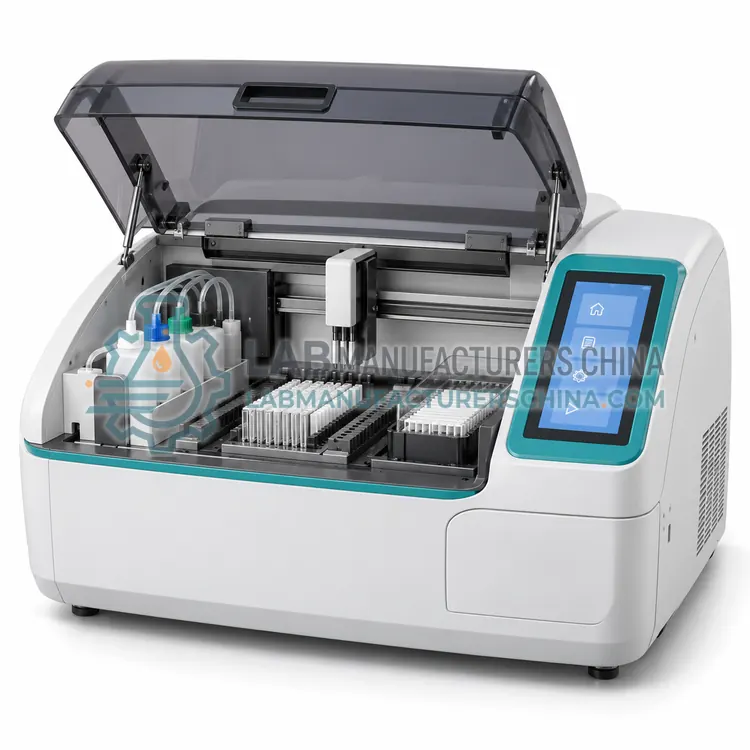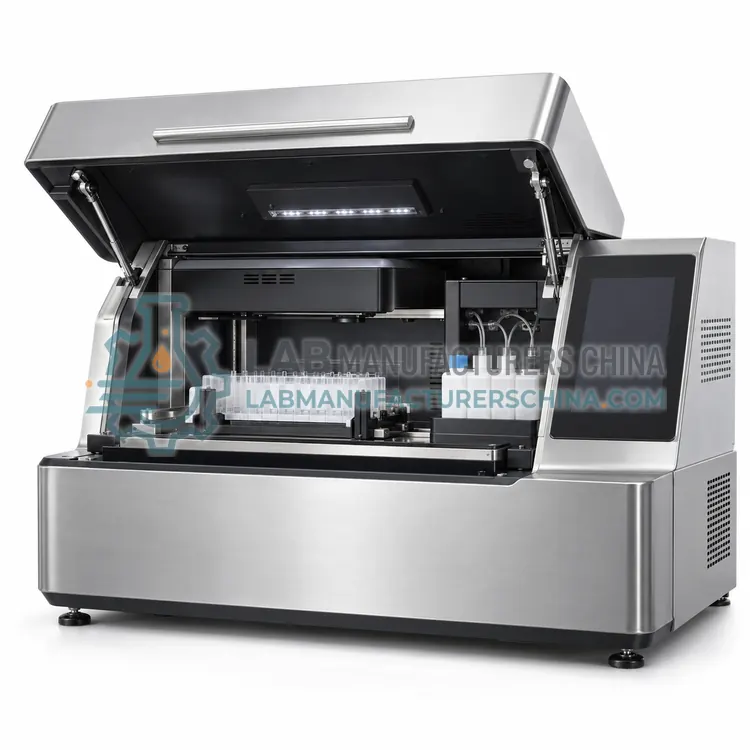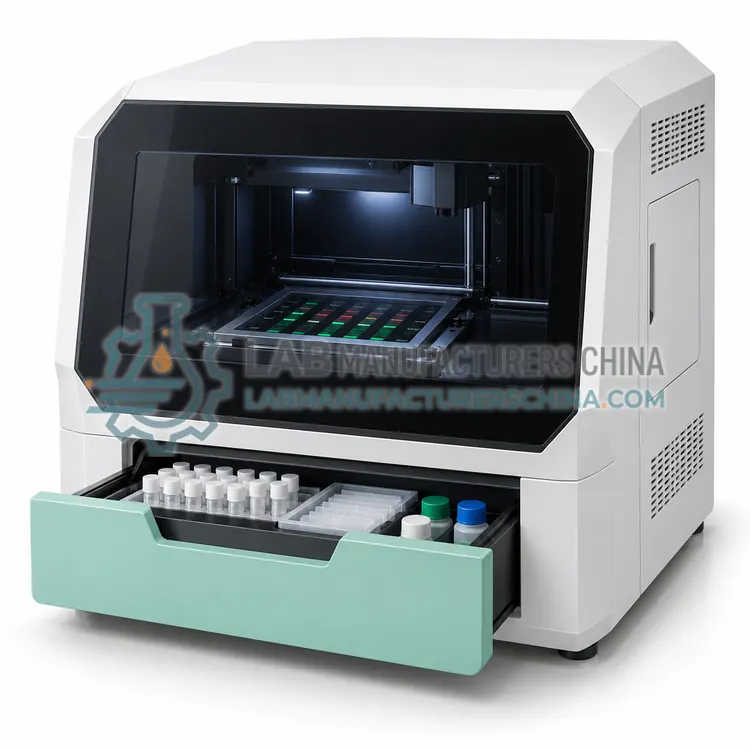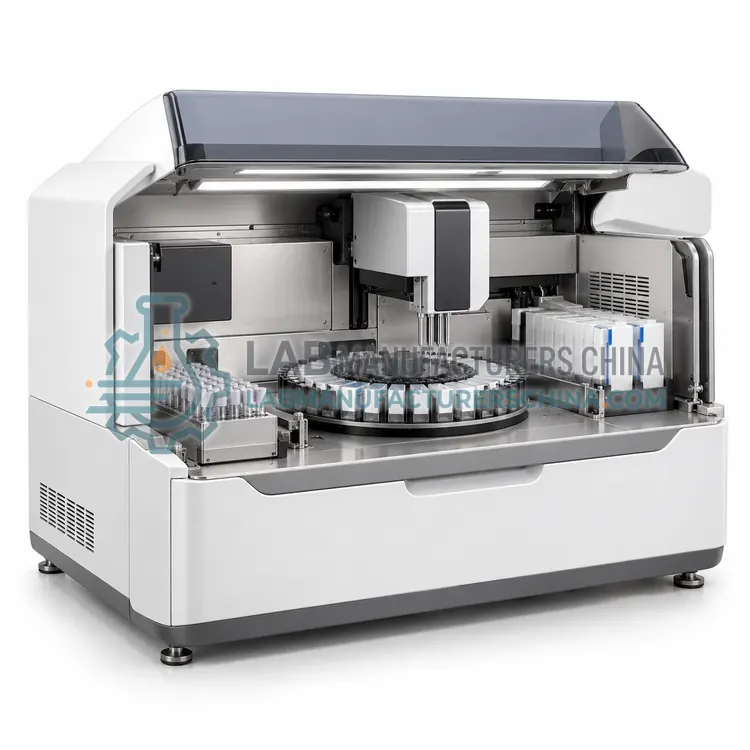
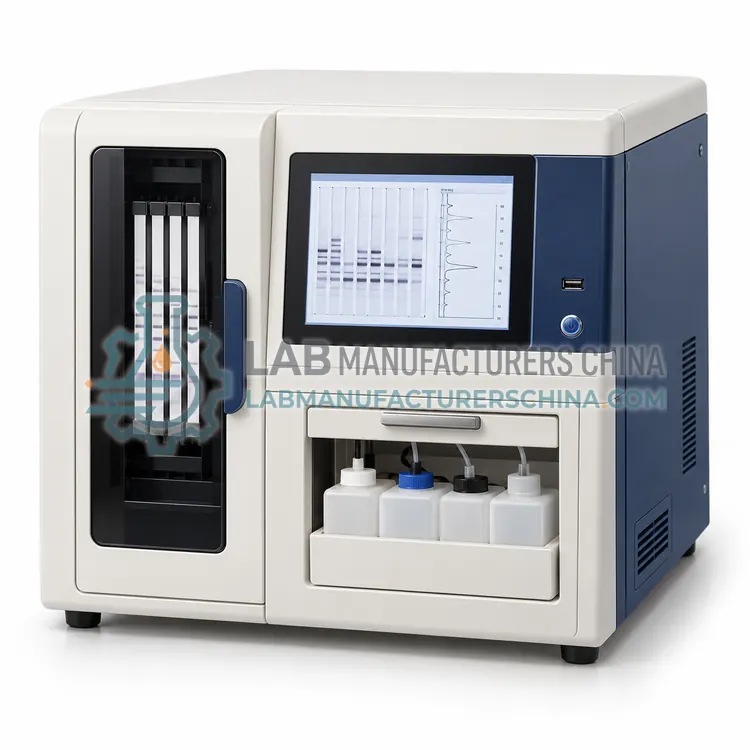
Immunoblot Strip Reader and Densitometer
免疫印迹条读取与光密度分析仪
- SKU IMU-0003
- Immunoblot Systems
- CE (to be confirmed)
- ISO 13485 manufacturing (to be confirmed)
- NMPA class II registration (to be confirmed)
Price on request — FOB / CIF quoted per order
Prices depend on configuration, quantity and destination port.
Key specifications
| Optical resolution | 600–1200 dpi for colourimetric strips |
|---|---|
| Dynamic range | 0–3.0 optical density |
| Illumination | Uniform LED array with calibration reference |
| Strip formats | Standard line immunoassay strips and membrane pieces |
| Throughput | Up to 50 strips per batch scan |
| Interpretation templates | Vendor and user-defined templates per assay |
Request a quote Download brochure · to be provided
By Lab Manufacturers China Technical TeamLast reviewed Standards: ISO 15189, CLSI M53, CLSI EP05
What is the Immunoblot Strip Reader and Densitometer?
This instrument scans stained or luminescent immunoblot strips, measures band intensity by densitometry and applies the manufacturer's interpretation criteria automatically. It suits laboratories that want objective, archived band readings instead of purely visual scoring.
What is the Immunoblot Strip Reader and Densitometer?
This instrument scans stained or luminescent immunoblot strips, measures band intensity by densitometry and applies the manufacturer's interpretation criteria automatically. It suits laboratories that want objective, archived band readings instead of purely visual scoring.
Overview
The scanner images each strip at controlled illumination and resolution, and the software identifies the strip type from a barcode or from the operator's selection. It then locates the band positions defined for that assay, measures integrated optical density against the strip background, normalizes the values to a control band and reports each band with a categorical score. Because the raw image is stored, a reviewer can re-examine the strip later, and discrepancies between operators can be resolved by reference to the same data set. Resolution, dynamic range and illumination uniformity determine performance, and the software must implement the exact cut-offs published by the kit manufacturer. Some instruments also read chemiluminescent blots with a cooled camera, which is covered by imaging systems rather than by densitometry.
How does it work?
Immunoblotting starts with proteins that are either separated by polyacrylamide gel electrophoresis and transferred to a membrane, or applied directly as discrete lines on a strip. The membrane is blocked to prevent non-specific binding, then incubated with diluted patient sample so that antibodies in the sample bind to their target antigens. After washing, an enzyme- or fluorophore-labelled anti-human antibody is added, and a substrate produces a visible, luminescent or fluorescent signal proportional to the bound antibody. Strips are read by eye, by a scanning densitometer or by a charge-coupled device camera, and each band is scored as absent, weak, moderate or strong, or quantified as an intensity ratio against a control band. Interpretation criteria for confirmatory assays are set by the manufacturer and by national guidance, and the pattern of reactive bands, not a single band, determines the reported result.
What are the key features?
- Scanning at controlled illumination with stored strip images
- Automatic band localization using assay-specific templates
- Integrated optical density normalized to a control band
- Categorical and quantitative band reports
- Re-examination of archived images for discrepancy resolution
- Barcode identification of strip type and lot
What are the technical specifications?
A typical immunoblot strip reader and densitometer configuration offers optical resolution of 600–1200 dpi for colourimetric strips, dynamic range of 0–3.0 optical density, illumination of Uniform LED array with calibration reference, strip formats of Standard line immunoassay strips and membrane pieces, throughput of Up to 50 strips per batch scan and interpretation templates of Vendor and user-defined templates per assay. Values are indicative of the product class; the exact figures for each configuration are confirmed on the quotation and the calibration documents supplied with the instrument.
Which applications is it used for?
The Immunoblot Strip Reader and Densitometer is used in HIV and hepatitis confirmatory readout, autoimmune profile strip reading, lyme disease immunoblot interpretation and archived review for quality and audit. Across the wider Immunoblot Systems class, laboratories also deploy it for HIV and hepatitis confirmatory testing, autoimmune antibody profile testing and lyme disease and syphilis confirmation.
Which standards and certifications apply?
Relevant standards and methods include ISO 15189, CLSI M53, CLSI EP05, CLSI EP17, WHO HIV testing strategy, IEC 61010-1 and IEC 61010-2-101. Certification candidates for this model are CE, ISO 13485 manufacturing and NMPA class II registration; each is to be confirmed for the specific configuration before shipment, and certificates are supplied only where they have been issued.
Work on a clean bench with gloves, since membranes are easily contaminated, and use only the buffers and dilutions specified in the kit, because salt concentration and pH change binding and washing efficiency. Keep incubation temperatures and times consistent, as band intensity varies with both, and avoid letting strips dry out between steps. Verify performance at installation with the kit's positive and negative controls and with a proficiency panel if available, and repeat the check with each new reagent lot. Clean the scanner or imaging optics regularly, keep the light source stable for fluorescence and luminescence work, and store images together with the patient identifier for the retention period required by local rules.
How do I select the right Immunoblot Strip Reader and Densitometer?
Specify a densitometer when objective band scoring, image archiving or multireader review is required, or when kit interpretation criteria are complex. In the RFQ confirm that the templates for your assays are supplied and validated, that images can be exported, and that the software version can be updated when a kit changes its criteria.
How does it compare with other Immunoblot Systems variants?
Decide first whether the laboratory processes strips manually or needs automated incubation and washing, because the processing step dominates hands-on time and reproducibility. Then choose the reading method: visual reading suits low volumes and is accepted for many line immunoassays, densitometry provides objective band intensity, and camera-based imaging supports chemiluminescence and multiplex fluorescence. Check that the instrument accepts the strip and membrane formats of your kits, that the software applies the manufacturer interpretation criteria, and that images and results are archived in a retrievable format. Confirm assay registration in your market, and the availability of controls, conjugates and substrates, since these consumables are kit specific and may have short shelf lives.
Full specifications
| Optical resolution | 600–1200 dpi for colourimetric strips |
|---|---|
| Dynamic range | 0–3.0 optical density |
| Illumination | Uniform LED array with calibration reference |
| Strip formats | Standard line immunoassay strips and membrane pieces |
| Throughput | Up to 50 strips per batch scan |
| Interpretation templates | Vendor and user-defined templates per assay |
| Image archive | Server or local storage with patient linkage |
| Interfaces | LAN with HL7 or ASTM, USB |
Indicative values for this product class. Final specifications are confirmed on the quotation and in the calibration documents supplied with the instrument.
Applications
- HIV and hepatitis confirmatory readout
- Autoimmune profile strip reading
- Lyme disease immunoblot interpretation
- Archived review for quality and audit
Key features
- Scanning at controlled illumination with stored strip images
- Automatic band localization using assay-specific templates
- Integrated optical density normalized to a control band
- Categorical and quantitative band reports
- Re-examination of archived images for discrepancy resolution
- Barcode identification of strip type and lot
Frequently asked questions about Immunoblot Strip Reader and Densitometer
No. It provides objective measurements and a stored image, but the interpretation still follows kit criteria, and trained staff must review flagged or borderline strips. Densitometry mainly improves consistency and makes review and audit easier.
Most software flags results whose band intensity falls close to a cut-off, and laboratory procedure should define a review step for these. Some kits specify repeat testing or a second method, and the algorithm applied with its version number should be recorded with the result.
600 dpi is adequate for colourimetric line strips, while higher resolution helps for closely spaced bands or membrane pieces. Dynamic range matters more than resolution for quantitative comparison, so verify that the instrument covers the optical density of strongly positive controls without saturation.
Only if it has the appropriate excitation source and emission filters; colourimetric densitometers cannot. Fluorescent and chemiluminescent blots are normally read on imaging systems with cooled cameras and specific optics, so select the instrument according to the detection mode of your kits.
Western blot separates proteins by electrophoresis and transfers them to a membrane, so bands are positioned by molecular weight. Line immunoassay applies purified or recombinant antigens as discrete lines on a strip. Both are read by band pattern, and kits indicate which interpretation criteria apply.
It is accepted for many confirmatory assays when the kit instructions define scoring categories and the laboratory documents reader training and periodic competency assessment. Densitometry or imaging adds objectivity and an archived record, which many laboratories prefer for traceability and for resolving discrepant readings.
ISO 15189 covers laboratory quality, CLSI M53 addresses criteria for laboratory testing and diagnosis of HIV, and national programmes publish their own testing strategies. Precision and detection limit studies follow CLSI EP05 and EP17, and instrument electrical safety follows IEC 61010-1 and IEC 61010-2-101.
Related models