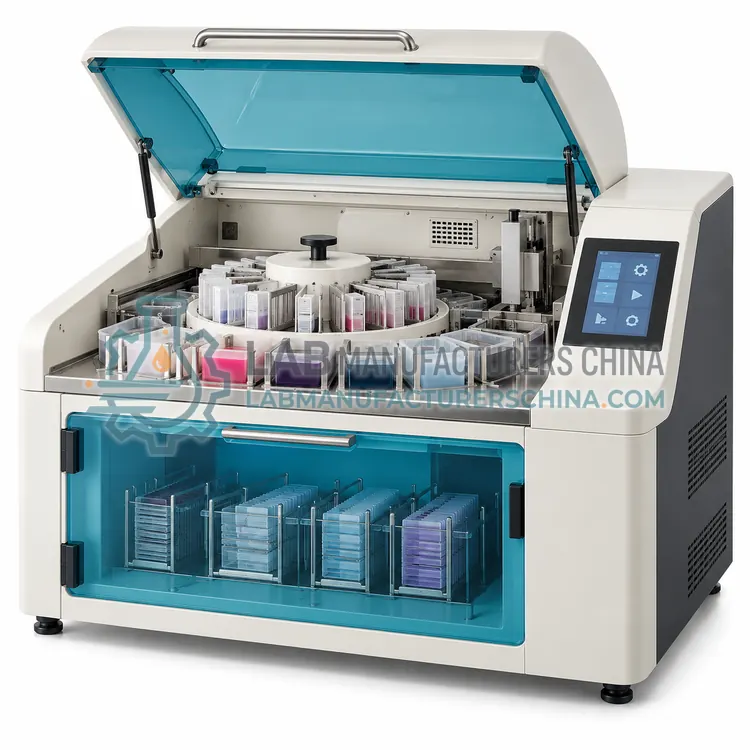
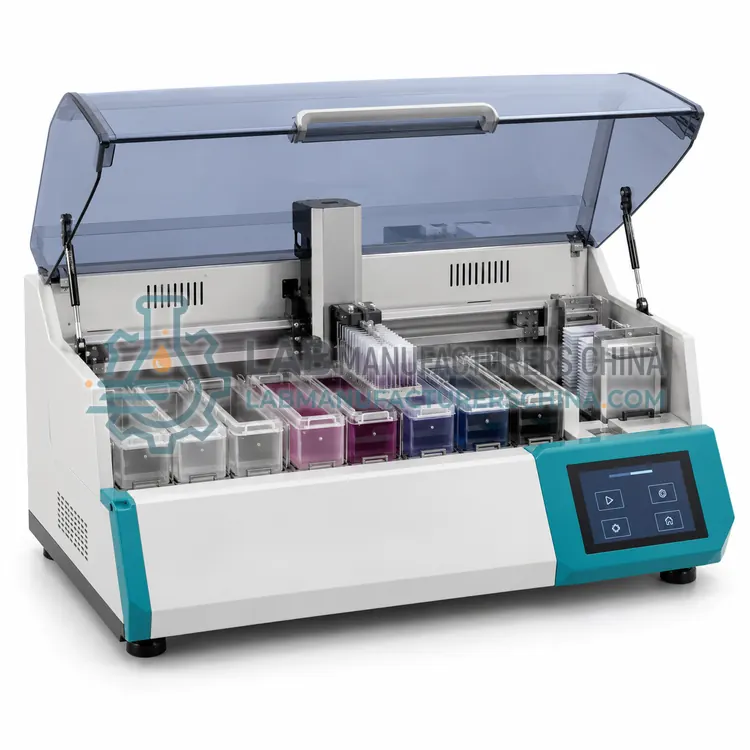
Linear Slide Stainer
线性玻片染色机
- SKU HIS-0002
- Histology Stainers
- CE (to be confirmed)
- IEC 61010-1 compliance (to be confirmed)
- ISO 13485 manufacturing (to be confirmed)
Price on request — FOB / CIF quoted per order
Prices depend on configuration, quantity and destination port.
Key specifications
| Rack capacity on track | 5–10 racks |
|---|---|
| Slide throughput | about 100–200 slides |
| Reagent stations | 12–24 stations |
| Bath volume | about 250–500 mL |
| Dwell time range | 10 s to 10 min per station |
| Heating | Selected stations to 40 °C |
Request a quote Download brochure · to be provided
By Lab Manufacturers China Technical TeamLast reviewed Standards: IEC 61010-1, IEC 61010-2-101, IEC 61326-1
What is the Linear Slide Stainer?
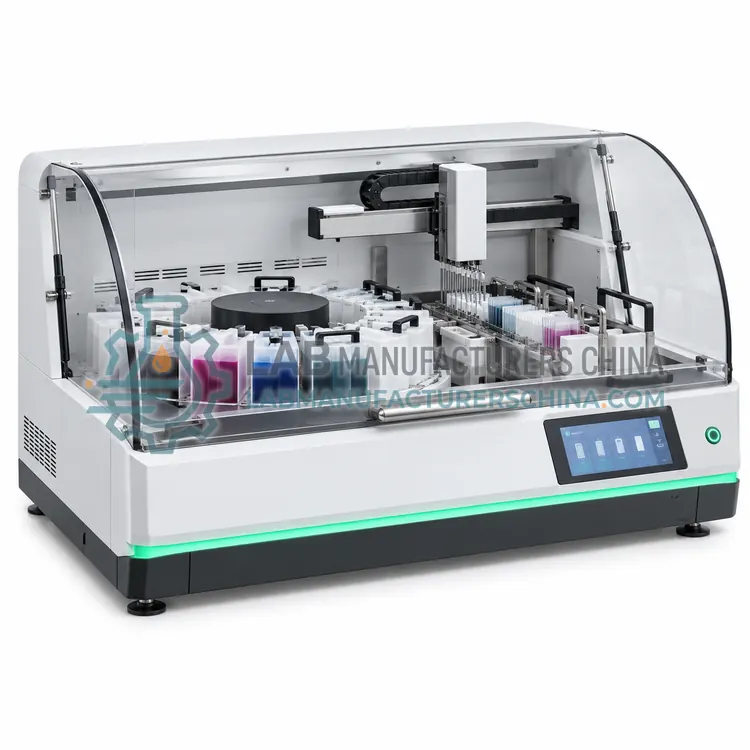
A linear slide stainer moves racks along a track through fixed reagent baths at set intervals, giving reproducible routine staining at moderate throughput. It is a common workhorse for H&E in medium-sized pathology laboratories.
What is the Linear Slide Stainer?
A linear slide stainer moves racks along a track through fixed reagent baths at set intervals, giving reproducible routine staining at moderate throughput. It is a common workhorse for H&E in medium-sized pathology laboratories.
Overview
The linear stainer holds slide racks and transports them along a track past a series of reagent baths, pausing at each for a programmed dwell time. Because transfer interval and dwell are mechanical, every rack follows the same sequence, which removes operator-to-operator variation in routine staining. Throughput depends on how many racks are on the track at once, typically 5 to 10 racks or 100 to 200 slides. Baths can be heated for some protocols, and a final rinse or clearing station prepares slides for coverslipping. Reagents are generally open baths, so evaporation and fume release must be controlled with covers or ventilation. Program flexibility is limited compared with fully automated instruments, but reliability, simplicity and low consumable cost make linear stainers popular for standard H&E.
How does it work?
A histology stainer automates the sequence of deparaffinisation, hydration, staining, differentiation, dehydration and clearing that a technician would perform by hand. Slides are held in racks or on a conveyor, and the instrument moves them between reagent baths for set dwell times, then transfers them to running water or a rinse station. Hematoxylin stains nucleic acids blue, eosin counterstains cytoplasm pink, and differentiation in acid alcohol tunes the contrast. Special stains such as Periodic Acid-Schiff, Masson trichrome or reticulin use different reagent sequences. Consistency comes from controlled dwell time, reagent concentration, agitation and temperature, while carryover is managed by draining and rinse stations. Automated coverslipping may follow on the same platform.
What are the key features?
- Track transport of racks through fixed baths
- Programmed dwell time at each station
- Throughput of about 100–200 slides at a time
- Heated baths for selected protocols
- Final rinse or clearing station before coverslipping
- Simple, reliable mechanism with low running cost
What are the technical specifications?
A typical linear slide stainer configuration offers rack capacity on track of 5–10 racks, slide throughput of about 100–200 slides, reagent stations of 12–24 stations, bath volume of about 250–500 mL, dwell time range of 10 s to 10 min per station and heating of Selected stations to 40 °C. Values are indicative of the product class; the exact figures for each configuration are confirmed on the quotation and the calibration documents supplied with the instrument.
Which applications is it used for?
The Linear Slide Stainer is used in routine H&E staining, medium-volume pathology laboratories, high-throughput biopsy services and counterstaining after immunostaining. Across the wider Histology Stainers class, laboratories also deploy it for routine H&E staining in pathology, special stains and immunohistochemistry counterstaining.
Which standards and certifications apply?
Relevant standards and methods include IEC 61010-1, IEC 61010-2-101, IEC 61326-1 and ISO 15189. Certification candidates for this model are CE, IEC 61010-1 compliance and ISO 13485 manufacturing; each is to be confirmed for the specific configuration before shipment, and certificates are supplied only where they have been issued.
Install the stainer near a water supply and drain if it needs running water, and on a level bench away from direct sunlight that fades dyes. Reagents degrade with use and evaporation, so set replacement schedules based on slide counts and monitor staining quality with control slides. Clean baths and tubing regularly to prevent precipitate and microbial growth, and check that the differentiation step gives reproducible contrast. Record reagent changes, quality control results and maintenance. Train staff on loading orientation, since misplaced slides cause uneven staining, and on safe handling of xylene, alcohol and carcinogenic dyes.
How do I select the right Linear Slide Stainer?
Choose a linear stainer for standard H&E at moderate volume where consistency matters more than protocol variety. Confirm the number of racks on the track, dwell time range, station count and whether heated stations are needed. If special stains or rapid turnaround dominate, a programmable or dedicated stainer may suit better.
How does it compare with other Histology Stainers variants?
Select a stainer by throughput, reagent menu and the level of walk-away automation required. Manual staining stations cost least and give full control for low volumes and teaching. Linear stainers move racks along a track through fixed baths and suit routine H&E at moderate volume. Fully automated H&E stainers program time, temperature and agitation, and can process hundreds of slides per hour. Special stain stainers handle individual protocols for trichrome, PAS, reticulin or Gram staining. Compact benchtop models fit small laboratories. Compare slides per run, reagent station count and volume, program capacity, carryover prevention and whether a coverslipper can be integrated. Confirm reagent compatibility and the cost of consumables.
Full specifications
| Rack capacity on track | 5–10 racks |
|---|---|
| Slide throughput | about 100–200 slides |
| Reagent stations | 12–24 stations |
| Bath volume | about 250–500 mL |
| Dwell time range | 10 s to 10 min per station |
| Heating | Selected stations to 40 °C |
| Cycle time | about 15–30 min per rack |
| Power supply | 220 V, 50 Hz, about 0.5 kW |
Indicative values for this product class. Final specifications are confirmed on the quotation and in the calibration documents supplied with the instrument.
Applications
- Routine H&E staining
- Medium-volume pathology laboratories
- High-throughput biopsy services
- Counterstaining after immunostaining
Key features
- Track transport of racks through fixed baths
- Programmed dwell time at each station
- Throughput of about 100–200 slides at a time
- Heated baths for selected protocols
- Final rinse or clearing station before coverslipping
- Simple, reliable mechanism with low running cost
Frequently asked questions about Linear Slide Stainer
Transfer interval and dwell time are set mechanically, so every rack spends the same time in each bath. This removes the timing variation that occurs when several people stain by hand, as long as reagents are fresh and volumes are adequate.
Selected stations can often be heated, which is useful for protocols that need warmer staining or clearing. Not all linear stainers offer this, so confirm heating capability and temperature range if your method requires it.
Program flexibility. All racks follow one sequence, so running different protocols simultaneously is difficult, and changes require moving baths or adjusting dwell times. Running both H&E and special stains usually needs separate instruments.
It applies routine or special stains to tissue sections by moving slide racks through timed reagent baths. It replaces manual dipping, giving consistent colours across large batches of slides in pathology and research laboratories.
Compact benchtop models handle about 20 to 60 slides per run, linear stainers often 100 to 200, and large automated platforms several hundred slides per hour. Choose capacity to match peak daily volume rather than average load.
Use adequate drainage time and rinse stations, keep reagent volumes above the minimum, and follow the manufacturer schedule for bath cleaning. Carryover shows up as weak or uneven staining, so monitor with control slides and change reagents at defined slide counts.
Related models