
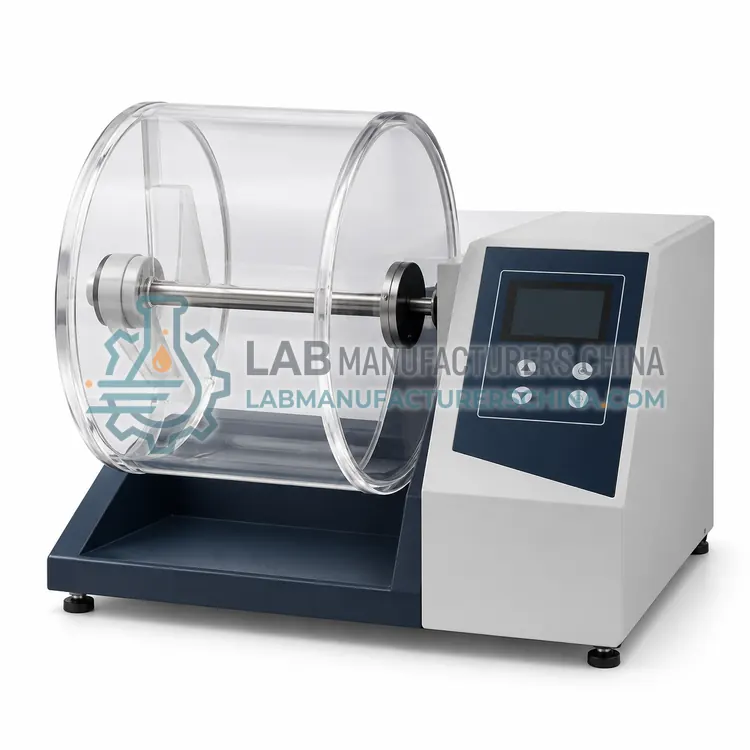
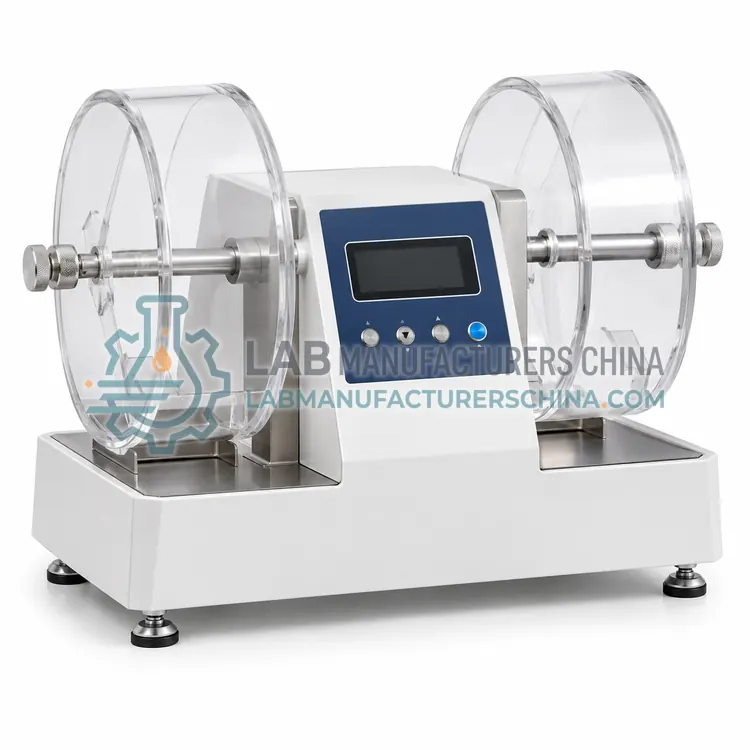
Dual-Drum Friability Tester
双转鼓脆碎度测试仪
- SKU FRT-0002
- Friability Testers
- CE (to be confirmed)
- ISO 9001 manufacturing (to be confirmed)
Price on request — FOB / CIF quoted per order
Prices depend on configuration, quantity and destination port.
Key specifications
| Number of drums | 2 |
|---|---|
| Drum inner diameter | approx. 287 mm |
| Drum depth | approx. 38 mm |
| Rotation speed | 25 ± 1 rpm |
| Revolution preset range | 1–9999 rev |
| Timer range | 1–99 min |
Request a quote Download brochure · to be provided
By Lab Manufacturers China Technical TeamLast reviewed Standards: USP <1216>, Ph. Eur. 2.9.7, JP 6.10
What is the Dual-Drum Friability Tester?
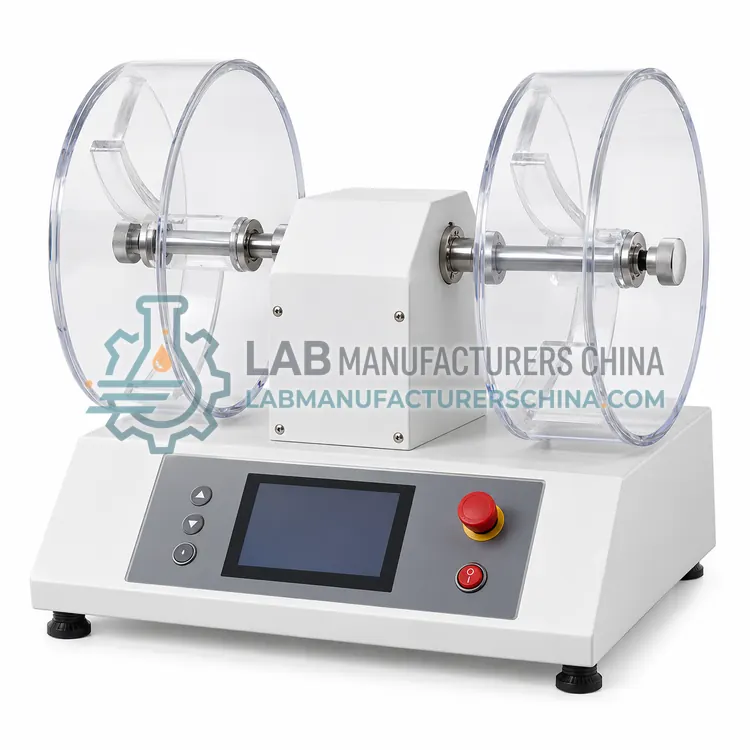
A dual-drum friability tester turns two standard drums on one shaft at 25 rpm, so two samples are tested under identical conditions in one run. It suits laboratories that perform duplicate tests or compare two formulations.
What is the Dual-Drum Friability Tester?
A dual-drum friability tester turns two standard drums on one shaft at 25 rpm, so two samples are tested under identical conditions in one run. It suits laboratories that perform duplicate tests or compare two formulations.
Overview
The dual-drum tester mounts two pharmacopoeial drums side by side on a common drive shaft, so both drums share the same speed, revolution count and start time. This removes run-to-run variation between duplicates and doubles throughput without a second instrument. Each drum has its own baffle and quick-release cover, and the controller presets revolutions for both drums. Laboratories often use one drum for the batch sample and the other for a duplicate, or test two different punch sets at once. Because the two drums turn together, the drive needs a higher torque motor, and the unit occupies slightly more bench space than a single-drum model. Verification is the same as for a single drum, but both drums must be inspected and cleaned separately.
How does it work?
A friability tester holds a transparent drum, usually 287 mm in diameter, on a horizontal axis and rotates it at 25 rpm. A curved radial baffle inside the drum lifts the tablets and drops them from a height of about 156 mm on every turn, so each tablet falls repeatedly onto the drum wall and onto other tablets. A pre-weighed sample, normally 6.5 g or 10 tablets, is run for 100 revolutions (4 minutes). Loose dust is removed and the tablets are weighed again. Friability is the percentage loss of mass, and the pharmacopoeias accept a value not above 1.0 percent for most products. The main components are the drum, drive motor, revolution counter and timer, and a speed control. Advanced models add automatic tablet counting, dust removal and an integrated balance.
What are the key features?
- Two pharmacopoeial drums on a common shaft for identical test conditions
- Shared controller with revolution and timer presets for both drums
- High-torque drive maintains speed with both drums fully loaded
- Independent quick-release covers for separate sample handling
- Doubles throughput in a compact benchtop housing
What are the technical specifications?
A typical dual-drum friability tester configuration offers number of drums of 2, drum inner diameter of approx. 287 mm, drum depth of approx. 38 mm, rotation speed of 25 ± 1 rpm, revolution preset range of 1–9999 rev and timer range of 1–99 min. Values are indicative of the product class; the exact figures for each configuration are confirmed on the quotation and the calibration documents supplied with the instrument.
Which applications is it used for?
The Dual-Drum Friability Tester is used in duplicate friability testing, comparing two formulations or punch sets, high-volume QC laboratories and method transfer studies. Across the wider Friability Testers class, laboratories also deploy it for pharmaceutical QC release testing, tablet formulation development and in-process control during compression.
Which standards and certifications apply?
Relevant standards and methods include USP <1216>, Ph. Eur. 2.9.7, JP 6.10 and IEC 61010-1. Certification candidates for this model are CE and ISO 9001 manufacturing; each is to be confirmed for the specific configuration before shipment, and certificates are supplied only where they have been issued.
Place the tester on a level, vibration-free bench, because vibration and tilt change the tablet fall pattern. Verify drum speed and revolution count at installation and at defined intervals using a calibrated tachometer or stopwatch. Inspect the drum and baffle for scratches, cracks and residue, and clean with a non-abrasive cloth to avoid altering the surface. Keep tablets dedusted with a soft brush and weigh on a balance of at least 0.1 mg readability. Ambient humidity influences hygroscopic tablets, so record the conditions. For regulated laboratories, document the installation, operational and performance qualification and, where software is used, evidence of audit trails and access control.
How do I select the right Dual-Drum Friability Tester?
Select the dual-drum model when you run duplicates routinely, compare formulations, or need about twice the throughput of a single-drum unit without adding a second instrument. In an RFQ, state drum dimensions to the required pharmacopoeia, speed tolerance, revolution preset range and whether independent drum covers are needed.
How does it compare with other Friability Testers variants?
The decisive choice is throughput versus automation. A single-drum unit suits low-volume QC laboratories, while a dual-drum unit tests two samples in parallel, which also supports duplicate testing for development work. Check that drum dimensions and speed match the pharmacopoeial specification of the target market, and that the speed is verified by a revolution counter and not just a dial setting. If the laboratory handles many batches a day, automatic counting, dust removal and balance integration reduce handling errors and operator time. For regulated sites, confirm that electronic records, audit trails and user access levels are available. Also consider drum material, because antistatic or polished acrylic drums reduce dust adhesion on some granulations. Finally, confirm the tester can accept large or oddly shaped tablets if the portfolio contains them.
Full specifications
| Number of drums | 2 |
|---|---|
| Drum inner diameter | approx. 287 mm |
| Drum depth | approx. 38 mm |
| Rotation speed | 25 ± 1 rpm |
| Revolution preset range | 1–9999 rev |
| Timer range | 1–99 min |
| Drum material | Transparent acrylic |
| Drive | High-torque synchronous motor |
| Power supply | 220 V, 50/60 Hz |
| Dimensions (W×D×H) | approx. 480 × 300 × 430 mm |
Indicative values for this product class. Final specifications are confirmed on the quotation and in the calibration documents supplied with the instrument.
Applications
- Duplicate friability testing
- Comparing two formulations or punch sets
- High-volume QC laboratories
- Method transfer studies
Key features
- Two pharmacopoeial drums on a common shaft for identical test conditions
- Shared controller with revolution and timer presets for both drums
- High-torque drive maintains speed with both drums fully loaded
- Independent quick-release covers for separate sample handling
- Doubles throughput in a compact benchtop housing
Frequently asked questions about Dual-Drum Friability Tester
Both drums share one drive shaft, so they turn at the same speed and revolution count by design. Speed should still be verified with a tachometer or stopwatch as part of routine calibration, because motor and belt wear can cause drift.
Yes, provided both samples need the same test conditions, namely 100 revolutions at 25 rpm. Keep the samples separate, label each drum, and weigh each sample before and after testing so results are not mixed up.
It is wider than a single-drum model, typically by about 150 mm, but uses the same depth. A level, vibration-free bench of roughly 500 mm width is usually sufficient, with clearance for opening both drum covers.
A friability tester is a pharmaceutical instrument that rotates tablets in a drum for a fixed number of turns and measures the mass lost as dust or fragments. It quantifies mechanical strength against chipping and abrasion during handling, packaging and transport.
Most pharmacopoeias accept a mass loss of not more than 1.0 percent for uncoated tablets after 100 revolutions at 25 rpm. Tablets that crack, split or break during the test fail regardless of mass loss, and a product monograph may specify a different limit.
For tablets with a unit mass up to 650 mg, a sample of about 6.5 g is used. For heavier tablets, ten whole tablets are used. The sample is dedusted and weighed before and after testing to an accuracy of 0.1 mg.
Related models
Multi-Parameter Tablet Tester (Hardness, Thickness, Diameter)
多参数片剂测试仪(硬度、厚度、直径)
- CE (to be confirmed)
- +1