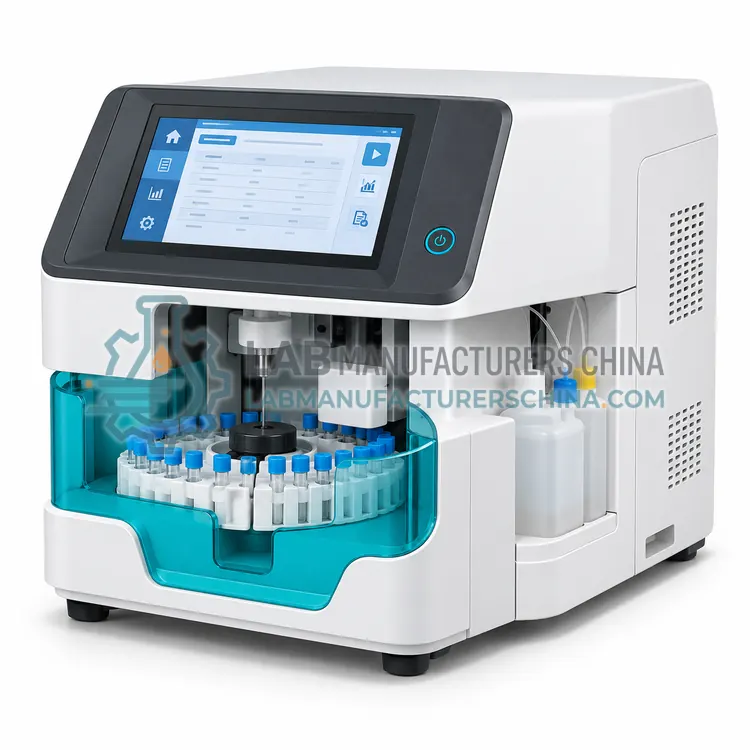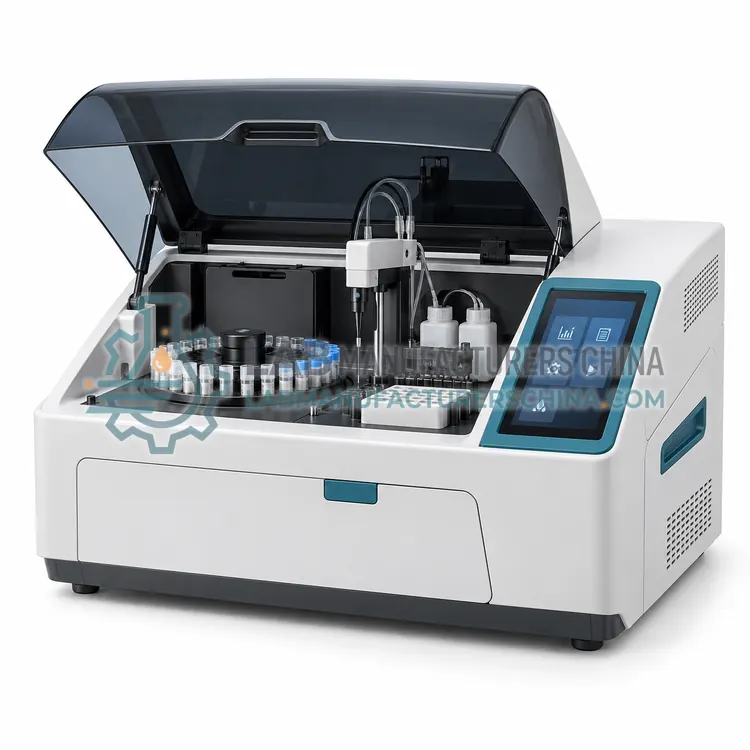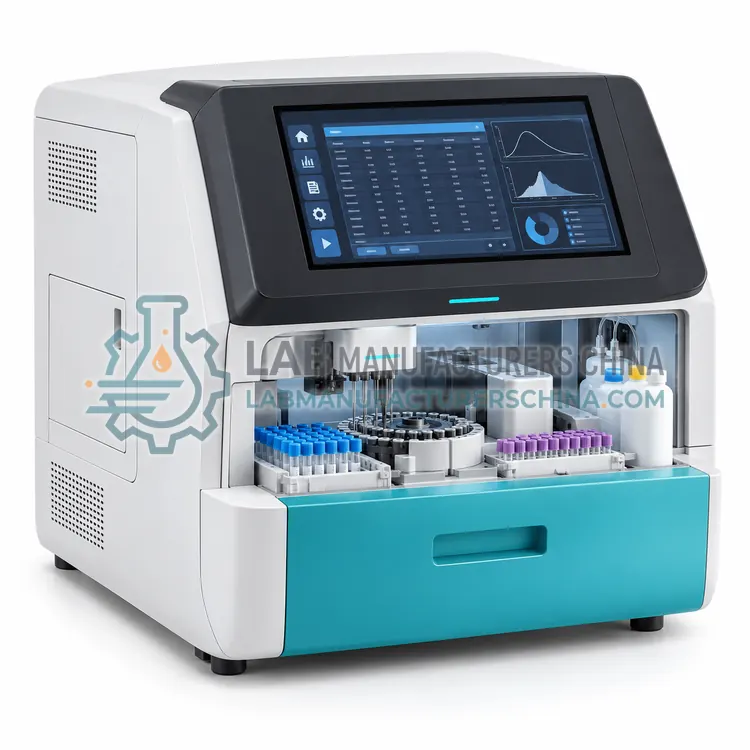
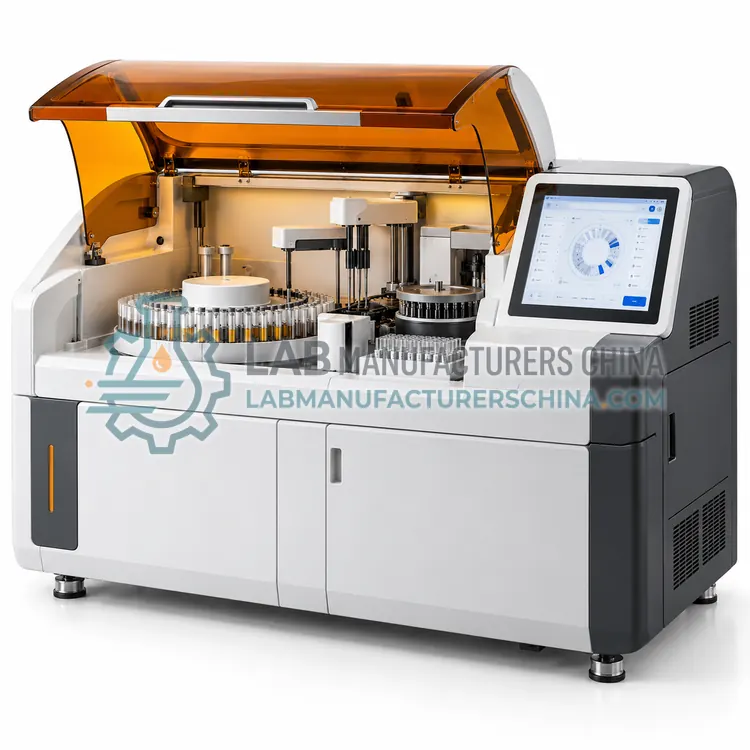
Benchtop Fully Automatic Chemistry Analyzer
台式全自动生化分析仪
- SKU FAA-0001
- Fully Automatic Analyzers
- CE (to be confirmed)
- ISO 13485 manufacturing (to be confirmed)
- NMPA class II registration (to be confirmed)
Price on request — FOB / CIF quoted per order
Prices depend on configuration, quantity and destination port.
Key specifications
| Throughput | 200–400 tests/h photometric |
|---|---|
| Wavelength range | 340–800 nm, 12 wavelengths |
| Sample positions | 60 sample positions with continuous loading |
| Reagent positions | 40 refrigerated positions at 4–10 °C |
| Sample volume | 2–35 µL per test |
| Reaction cuvettes | Reusable, 120 positions with automatic washing |
Request a quote Download brochure · to be provided
By Lab Manufacturers China Technical TeamLast reviewed Standards: ISO 15189, CLSI EP05, CLSI EP06
What is the Benchtop Fully Automatic Chemistry Analyzer?
A benchtop fully automatic chemistry analyzer provides random-access testing with automatic sample and reagent handling on a footprint of about one square meter. It suits clinics and mid-size hospital laboratories processing roughly 100 to 400 tests per hour.
What is the Benchtop Fully Automatic Chemistry Analyzer?
A benchtop fully automatic chemistry analyzer provides random-access testing with automatic sample and reagent handling on a footprint of about one square meter. It suits clinics and mid-size hospital laboratories processing roughly 100 to 400 tests per hour.
Overview
The instrument places a full chemistry system on a bench. Sample and reagent probes with liquid-level detection dispense microliter volumes into a reaction rotor held at 37 degrees Celsius, and a grating photometer reads absorbance at eight to twelve wavelengths between 340 and 800 nanometers. Reaction cuvettes are either reusable and washed in place or disposable. The software supports multi-point calibration, Levey-Jennings quality control, automatic dilution and rerun for out-of-range results, reagent inventory tracking with lot and expiry monitoring, and result transmission through HL7 or ASTM. Typical menus cover liver, kidney, lipid, glucose and protein assays, plus immunoturbidimetric specific proteins when the corresponding reagent channels are configured. Water consumption and reagent volumes are modest, which keeps running costs manageable for smaller sites.
How does it work?
A fully automatic analyzer moves tubes from a sample tray or rack to an aspiration station, where a probe with liquid-level and clot detection withdraws a measured volume. Reagent probes add the programmed volumes from refrigerated reagent positions, and the mixture is delivered into a reaction cuvette on a thermostatted rotor held at 37 degrees Celsius. A photometer with interference filters or a diffraction grating reads absorbance at several wavelengths, and the software applies the programmed calculation mode, converts the signal into concentration using the calibration curve and flags results that fall outside the linear range. Automatic dilution and rerun, carryover-free cuvette washing, onboard quality control with Levey-Jennings charts, and reagent inventory tracking are standard. Sample and reagent barcodes, patient demographics and test orders pass between the analyzer and the laboratory information system through HL7 or ASTM interfaces.
What are the key features?
- Random-access sample and reagent loading with STAT priority
- Grating photometer covering 340–800 nm at 8 to 12 wavelengths
- Reaction rotor thermostatted at 37 °C for endpoint and kinetic assays
- Automatic dilution and rerun for results outside the linear range
- Onboard quality control with Levey-Jennings charts and delta checks
- Barcode identification with HL7 or ASTM interface to the LIS
What are the technical specifications?
A typical benchtop fully automatic chemistry analyzer configuration offers throughput of 200–400 tests/h photometric, wavelength range of 340–800 nm, 12 wavelengths, sample positions of 60 sample positions with continuous loading, reagent positions of 40 refrigerated positions at 4–10 °C, sample volume of 2–35 µL per test and reaction cuvettes of Reusable, 120 positions with automatic washing. Values are indicative of the product class; the exact figures for each configuration are confirmed on the quotation and the calibration documents supplied with the instrument.
Which applications is it used for?
The Benchtop Fully Automatic Chemistry Analyzer is used in routine chemistry panels in mid-size hospitals, outpatient and small hospital laboratories, immunoturbidimetric specific protein testing and emergency department biochemistry. Across the wider Fully Automatic Analyzers class, laboratories also deploy it for hospital routine and emergency chemistry, metabolic, liver, kidney and lipid panels and specific protein measurement by immunoturbidimetry.
Which standards and certifications apply?
Relevant standards and methods include ISO 15189, CLSI EP05, CLSI EP06, CLSI EP07, CLSI C24, IEC 61010-1 and IEC 61010-2-101. Certification candidates for this model are CE, ISO 13485 manufacturing and NMPA class II registration; each is to be confirmed for the specific configuration before shipment, and certificates are supplied only where they have been issued.
The analyzer needs a stable, level floor or bench with adequate load capacity, a dedicated grounded power supply, controlled temperature and humidity, and purified water of consistent quality. Verify performance at installation with precision, linearity, carryover and method comparison studies following CLSI protocols, and validate the reference intervals against the local population. Daily tasks include checking water quality, reagents and waste, running two or three levels of control and reviewing the calibration status. Weekly and monthly maintenance covers probe cleaning, cuvette washing efficiency and photometer checks, and lamps, tubing and syringes are replaced on schedule. Instruments that handle patient samples must be decontaminated according to the manufacturer procedure before service, and all waste is treated as infectious.
How do I select the right Benchtop Fully Automatic Chemistry Analyzer?
Specify this variant when daily volume is between about two hundred and one thousand tests and bench space is available. In the RFQ state your test menu and the largest batch you run, the reagent format and whether channels must be open, the required minimum sample volume for pediatric work, and the water quality the instrument needs. Ask for the effective throughput on your own menu rather than the headline figure.
How does it compare with other Fully Automatic Analyzers variants?
Size the analyzer by daily and peak-hour test volume, then add thirty percent headroom for repeats and quality control. Determine whether you need open reagent channels for cost control or a closed system for convenience. Check the reaction cuvette type, because reusable cuvettes lower consumable cost but require a wash station, while disposable cuvettes simplify maintenance. Confirm the sample volume, which matters for pediatric work, and the reagent capacity per shift. Decide which integrated modules you need, such as ion-selective electrodes for sodium and potassium or immunoturbidimetry for specific proteins. Verify STAT access, first-result time, onboard water consumption and waste handling, LIS interface protocols, and the local availability of service, spare parts and application support before ordering.
Full specifications
| Throughput | 200–400 tests/h photometric |
|---|---|
| Wavelength range | 340–800 nm, 12 wavelengths |
| Sample positions | 60 sample positions with continuous loading |
| Reagent positions | 40 refrigerated positions at 4–10 °C |
| Sample volume | 2–35 µL per test |
| Reaction cuvettes | Reusable, 120 positions with automatic washing |
| Calibration stability | Up to 30 days depending on the assay |
| Water consumption | About 8 L/h during operation |
| Interfaces | LAN with HL7 or ASTM, USB, RS-232 |
Indicative values for this product class. Final specifications are confirmed on the quotation and in the calibration documents supplied with the instrument.
Applications
- Routine chemistry panels in mid-size hospitals
- Outpatient and small hospital laboratories
- Immunoturbidimetric specific protein testing
- Emergency department biochemistry
Key features
- Random-access sample and reagent loading with STAT priority
- Grating photometer covering 340–800 nm at 8 to 12 wavelengths
- Reaction rotor thermostatted at 37 °C for endpoint and kinetic assays
- Automatic dilution and rerun for results outside the linear range
- Onboard quality control with Levey-Jennings charts and delta checks
- Barcode identification with HL7 or ASTM interface to the LIS
Frequently asked questions about Benchtop Fully Automatic Chemistry Analyzer
A single benchtop analyzer with sample and reagent compartments typically occupies 1.0 to 1.5 square meters, and needs additional clearance at the front and rear for loading and service. Plan for a water purification unit and waste container nearby, plus room for a printer or monitor.
Reusable cuvettes reduce consumable cost per test and usually improve optical consistency, but they require an effective wash station and periodic replacement. Disposable cuvettes remove carryover concerns and washing maintenance at a higher running cost, and are often chosen for low-volume sites.
Yes, when the corresponding reagent channels and wavelengths are available, assays such as CRP, immunoglobulin and transferrin can be run photometrically. These assays need careful calibration and antibody lot control, and the laboratory should verify precision at low concentrations before reporting patient results.
Throughput is usually quoted as photometric tests per hour, and should be checked against the panel you actually run, because tests needing multiple reagent additions or long incubation reduce the effective rate. Also ask for the first-result time and the STAT insertion time, which matter more than peak throughput in emergency work.
An open system accepts reagents from any supplier once the channel parameters are programmed and validated, which lowers cost per test but places method validation with the laboratory. A closed system uses barcoded reagents from the platform supplier with presets, which simplifies operation and training.
Add the module when sodium, potassium, chloride or calcium are requested often enough to justify it, because it avoids a separate electrolyte analyzer and an extra sample tube. If electrolyte volume is low, or if blood gas analysis is already on site, a separate compact electrolyte analyzer may be more economical.
Related models
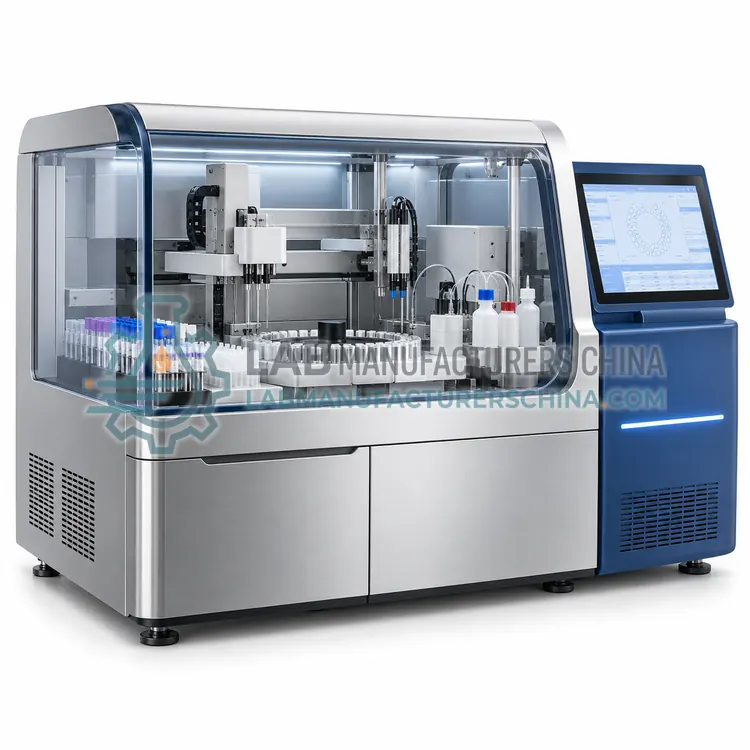
Random-Access Fully Automatic Chemistry Analyzer with STAT Priority
带急诊优先的随机存取全自动生化分析仪
- CE (to be confirmed)
- +2
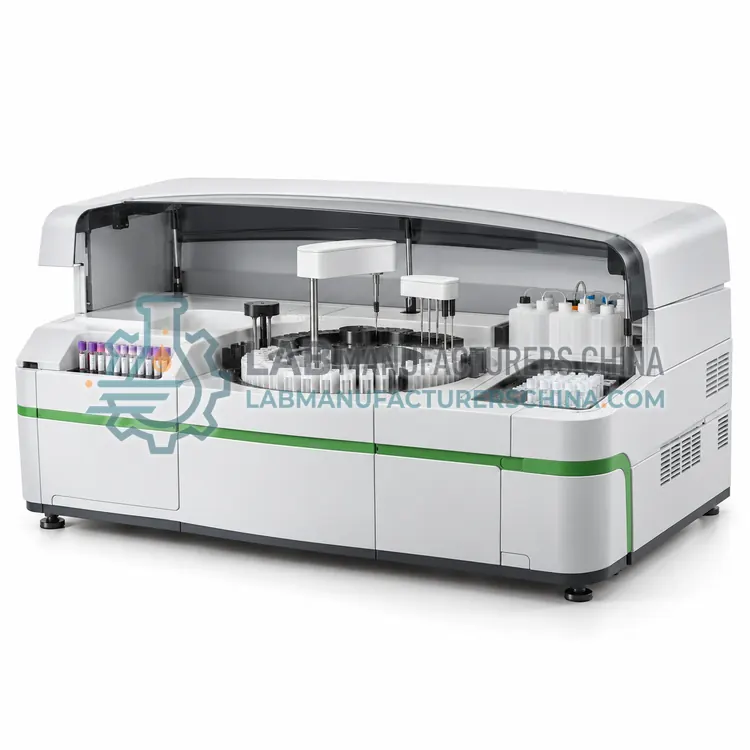
Fully Automatic Chemistry Analyzer with Integrated ISE Module
带集成离子选择电极模块的全自动生化分析仪
- CE (to be confirmed)
- +2
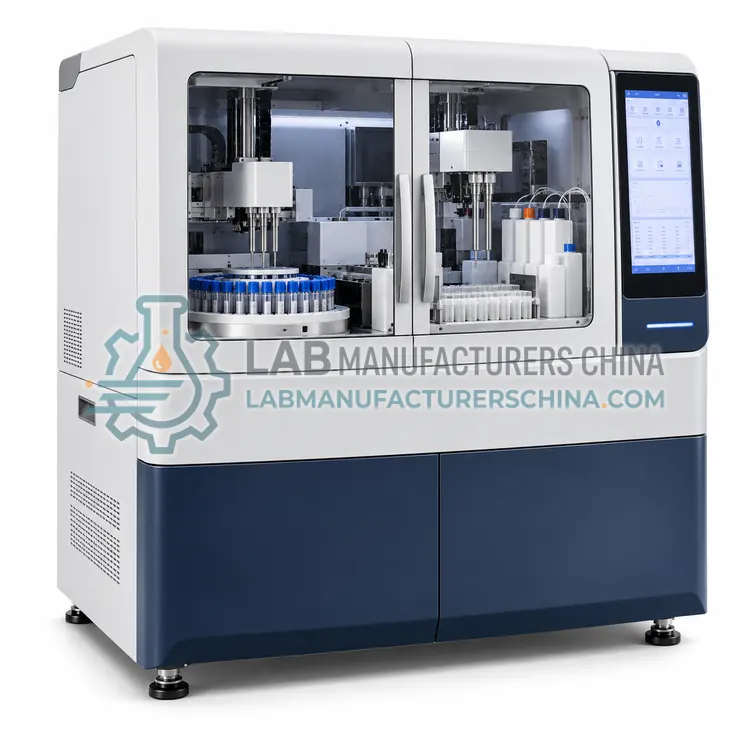
Fully Automatic Chemistry Analyzer with Immunoturbidimetry Module
带免疫比浊模块的全自动生化分析仪
- CE (to be confirmed)
- +2