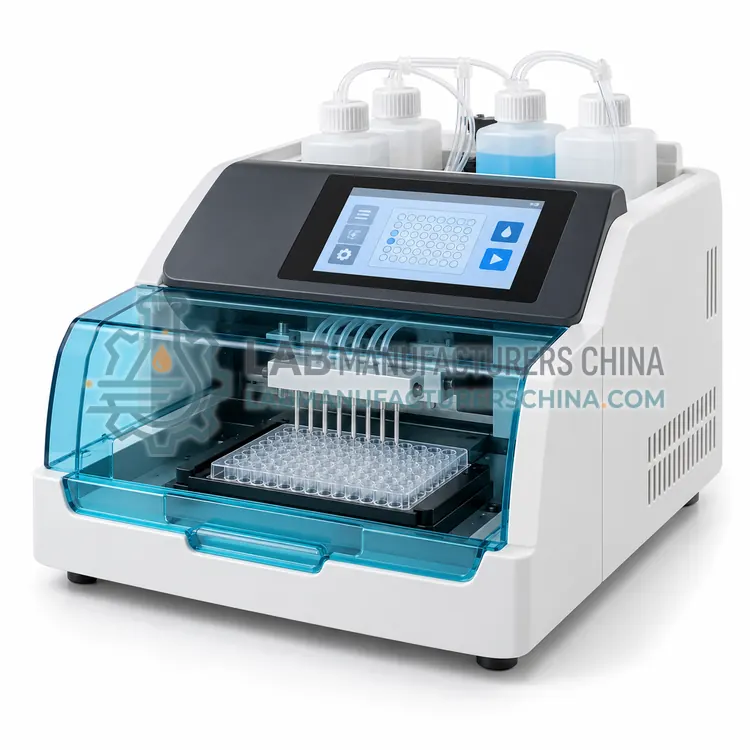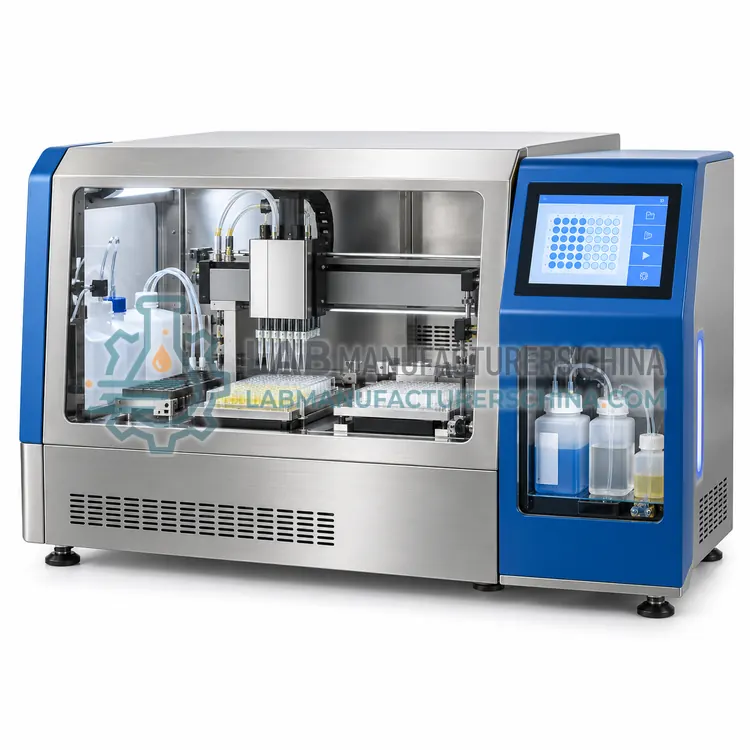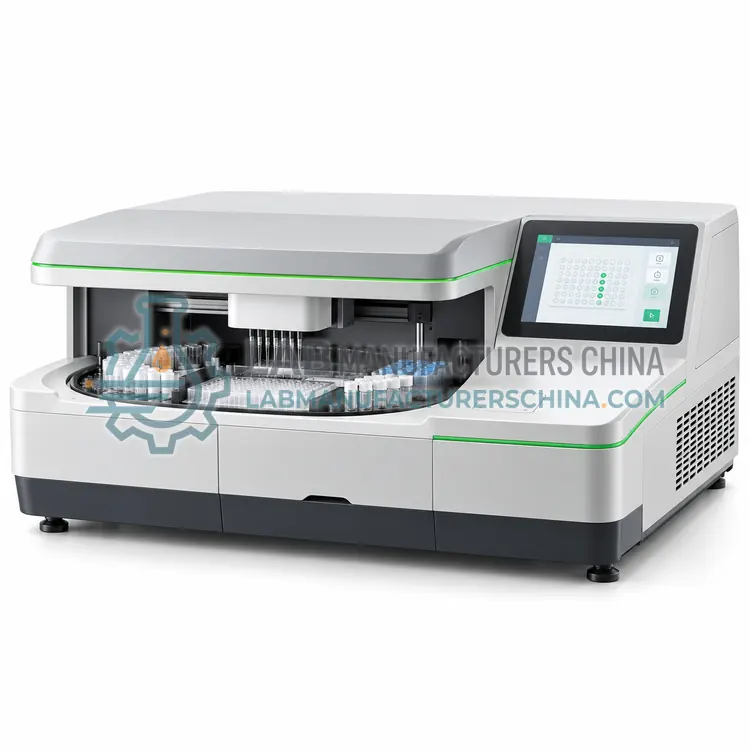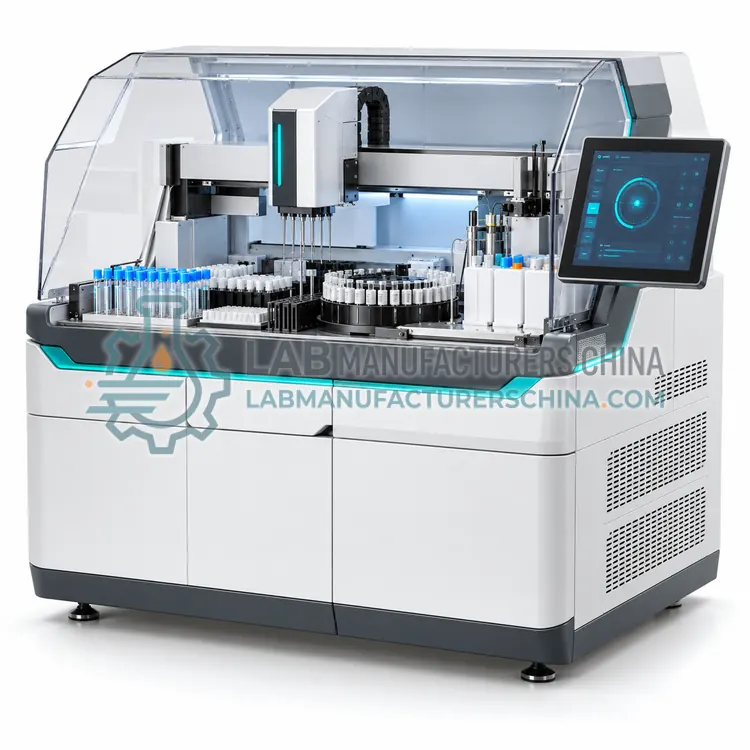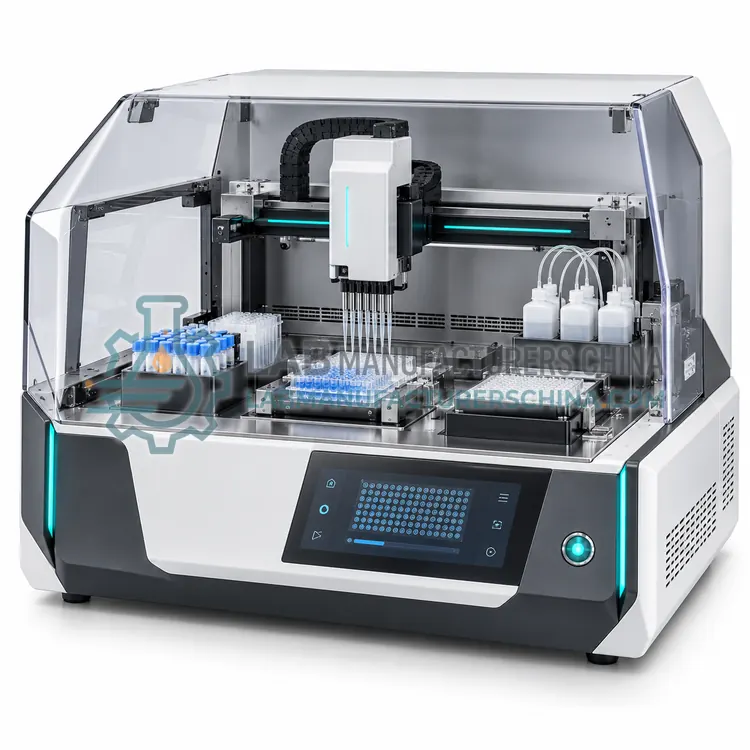
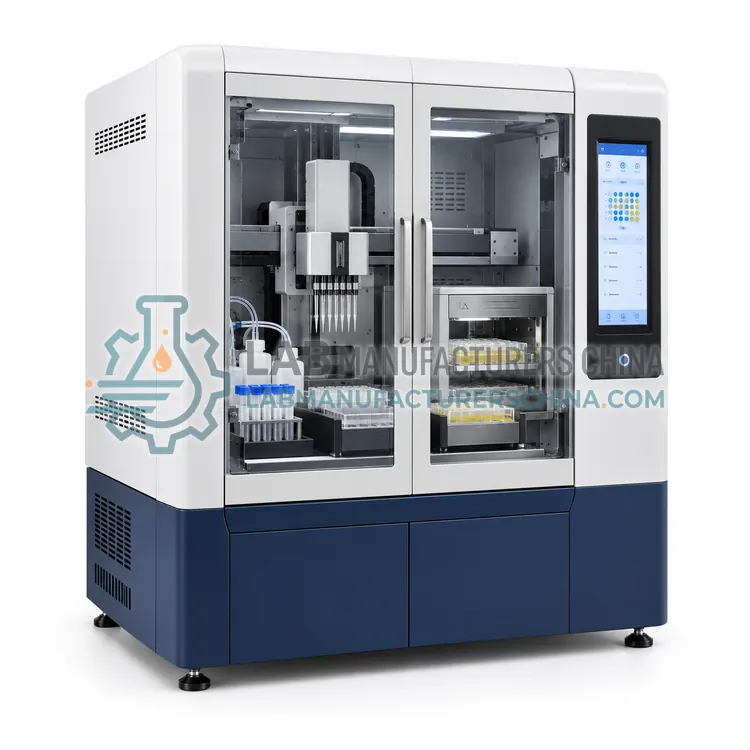
ELISA Workstation with Incubation and Shaking
带温育与振荡的酶免工作站
- SKU ELS-0005
- ELISA Systems
- CE (to be confirmed)
- ISO 13485 manufacturing (to be confirmed)
- NMPA class II registration (to be confirmed)
Price on request — FOB / CIF quoted per order
Prices depend on configuration, quantity and destination port.
Key specifications
| Temperature range | Ambient to 50 °C ±0.5 °C |
|---|---|
| Shaking | Orbital or linear, 100–900 rpm |
| Wavelength range | 400–750 nm with 4–6 filters |
| Plate capacity | 1–4 plates |
| Reading modes | End-point, kinetic and multi-point |
| Kinetic interval | From 30 s programmable |
Request a quote Download brochure · to be provided
By Lab Manufacturers China Technical TeamLast reviewed Standards: ISO 15189, CLSI EP05, CLSI I/LA20
What is the ELISA Workstation with Incubation and Shaking?
This workstation combines a microplate incubator with shaking and a reader in a single instrument, so temperature-dependent steps and reading occur under controlled conditions. It suits laboratories that run kinetic or temperature-sensitive assays and want to reduce manual handling between steps.
What is the ELISA Workstation with Incubation and Shaking?
This workstation combines a microplate incubator with shaking and a reader in a single instrument, so temperature-dependent steps and reading occur under controlled conditions. It suits laboratories that run kinetic or temperature-sensitive assays and want to reduce manual handling between steps.
Overview
The instrument provides a thermostatted chamber where plates are incubated with orbital or linear shaking, followed by transfer to the optical measurement position or by measurement inside the same chamber in some designs. Temperature control, typically from ambient to 45 or 50 degrees Celsius within half a degree, and shaking speed are programmed per assay, which reduces variability in reactions such as enzymatic colour development. Kinetic readings can be taken at intervals to follow reaction progress, and the software flags plates whose development rate differs from the reference. The workstation usually handles one to four plates and is chosen for flexibility rather than throughput, complementing a larger automated processor.
How does it work?
Enzyme-linked immunosorbent assay uses a plastic microplate whose wells carry a bound capture antibody or antigen. Sample is added, and any target present binds to the solid phase during incubation. After washing, a detection antibody conjugated to an enzyme such as horseradish peroxidase or alkaline phosphatase is added and binds to the captured target. A further wash removes unbound conjugate, then a substrate is added and the enzyme converts it into a coloured product. The reaction is stopped with acid or base and the absorbance is read at a defined wavelength, usually 450 nanometers with a reference wavelength between 600 and 650 nanometers. Absorbance is proportional to the amount of bound analyte, and a calibration curve, often four-parameter logistic, converts readings into concentrations or index values. Strict washing, incubation timing and temperature control determine the reliability of the result.
What are the key features?
- Thermostatted incubation chamber with orbital or linear shaking
- Temperature control to within ±0.5 °C up to 50 °C
- Programmable shaking speed and duration per assay
- Kinetic readings at intervals to follow colour development
- Flags for plates whose reaction rate differs from the reference
- Integrated reader with dual-wavelength measurement
What are the technical specifications?
A typical elisa workstation with incubation and shaking configuration offers temperature range of Ambient to 50 °C ±0.5 °C, shaking of Orbital or linear, 100–900 rpm, wavelength range of 400–750 nm with 4–6 filters, plate capacity of 1–4 plates, reading modes of End-point, kinetic and multi-point and kinetic interval of From 30 s programmable. Values are indicative of the product class; the exact figures for each configuration are confirmed on the quotation and the calibration documents supplied with the instrument.
Which applications is it used for?
The ELISA Workstation with Incubation and Shaking is used in temperature-sensitive colorimetric assays, kinetic enzyme and binding studies, assays requiring controlled shaking during incubation and research laboratories developing new ELISA protocols. Across the wider ELISA Systems class, laboratories also deploy it for infectious disease serology, allergy specific IgE testing and autoimmune antibody screening.
Which standards and certifications apply?
Relevant standards and methods include ISO 15189, CLSI EP05, CLSI I/LA20, CLSI M29, IEC 61010-1 and IEC 61010-2-101. Certification candidates for this model are CE, ISO 13485 manufacturing and NMPA class II registration; each is to be confirmed for the specific configuration before shipment, and certificates are supplied only where they have been issued.
Place the reader and washer on a level bench away from vibration and direct light, and keep the plate carrier and optical window free of dust. Verify performance at installation with a reference dye plate for optical accuracy and with controls for each assay. Daily tasks include checking the washer manifold for blockage, priming the wash lines and running controls at two or three levels. Plates should be read immediately after stopping the reaction, since colour continues to develop and delays bias results, and consistent timing across the plate matters more than absolute speed. Replace tubing and manifold pins when flow becomes uneven, and dispose of wash waste and plates as biohazardous material.
How do I select the right ELISA Workstation with Incubation and Shaking?
Specify this variant when incubation temperature and shaking affect your results, when kinetic readings are needed, or when the laboratory develops its own protocols. In the RFQ confirm temperature uniformity across the plate, the shaking modes available, the minimum kinetic reading interval, and whether the software exports full kinetic data for analysis.
How does it compare with other ELISA Systems variants?
Define the assays first, then decide how much automation is appropriate. Laboratories running fewer than one hundred wells per day can work with a reader and washer plus manual pipetting, while larger volumes justify an automated processor with plate handling, incubation and reporting. Compare readers by wavelength range, filter set, linearity, and whether they support kinetic and dual-wavelength measurement. For washers, check residual volume, the number of wash cycles programmable, and the manifolds for 96-well and strip formats. For automated systems, check plate capacity, walkaway time, whether the software handles assay protocols centrally, and the traceability of each step with lot numbers and operator identification. Confirm the assay registration status in your market, since ELISA kits are regulated separately from the instruments.
Full specifications
| Temperature range | Ambient to 50 °C ±0.5 °C |
|---|---|
| Shaking | Orbital or linear, 100–900 rpm |
| Wavelength range | 400–750 nm with 4–6 filters |
| Plate capacity | 1–4 plates |
| Reading modes | End-point, kinetic and multi-point |
| Kinetic interval | From 30 s programmable |
| Data output | PC software with kinetic curve display |
| Interfaces | USB, LAN with LIS option |
| Power supply | AC 100–240 V, 50/60 Hz |
Indicative values for this product class. Final specifications are confirmed on the quotation and in the calibration documents supplied with the instrument.
Applications
- Temperature-sensitive colorimetric assays
- Kinetic enzyme and binding studies
- Assays requiring controlled shaking during incubation
- Research laboratories developing new ELISA protocols
Key features
- Thermostatted incubation chamber with orbital or linear shaking
- Temperature control to within ±0.5 °C up to 50 °C
- Programmable shaking speed and duration per assay
- Kinetic readings at intervals to follow colour development
- Flags for plates whose reaction rate differs from the reference
- Integrated reader with dual-wavelength measurement
Frequently asked questions about ELISA Workstation with Incubation and Shaking
Gentle shaking keeps reagents well mixed, reduces the formation of concentration gradients near the well surface and improves well-to-well consistency, especially in assays with short incubation steps. Excessive speed can cause splashing and cross-contamination between wells, so the manufacturer range should be respected.
Kinetic readings are useful when the reaction rate is the measured quantity, when the substrate development must be checked before stopping, or when results must be obtained within a short window. They also help identify problem wells whose rate deviates from the plate mean.
Yes. Enzyme activity and binding kinetics both increase with temperature, so a chamber held half a degree higher or lower changes the development rate across a plate and can shift borderline results. Controlled incubation removes that variable and makes protocols transferable between sites.
It can support other microplate colorimetric and some fluorescent assays that use the same incubation and reading workflow, provided the wavelengths and temperature range are suitable. Assays needing other detection modes, such as luminescence, require a multi-mode instrument instead.
A reader only measures absorbance after the assay has been performed manually, while an automated system also handles sample and reagent pipetting, incubation, washing, substrate addition and timing. Readers suit low volumes and flexible menus; automated systems reduce variability and labour at higher volumes.
Reading at the assay wavelength and subtracting a reference wavelength between 600 and 650 nanometers corrects for scratches, dust and bubbles on the plate. It reduces well-to-well variation and is standard practice for quantitative ELISA, especially at low absorbance values where optical artefacts have more influence.
Check the manifold for blocked or misaligned pins before each run, and verify residual volume weekly with a gravimetric or dye test. Uneven aspiration leaves wash solution that carries over unbound conjugate, which raises background and reduces precision, so any change in background should prompt a washer check.
Related models