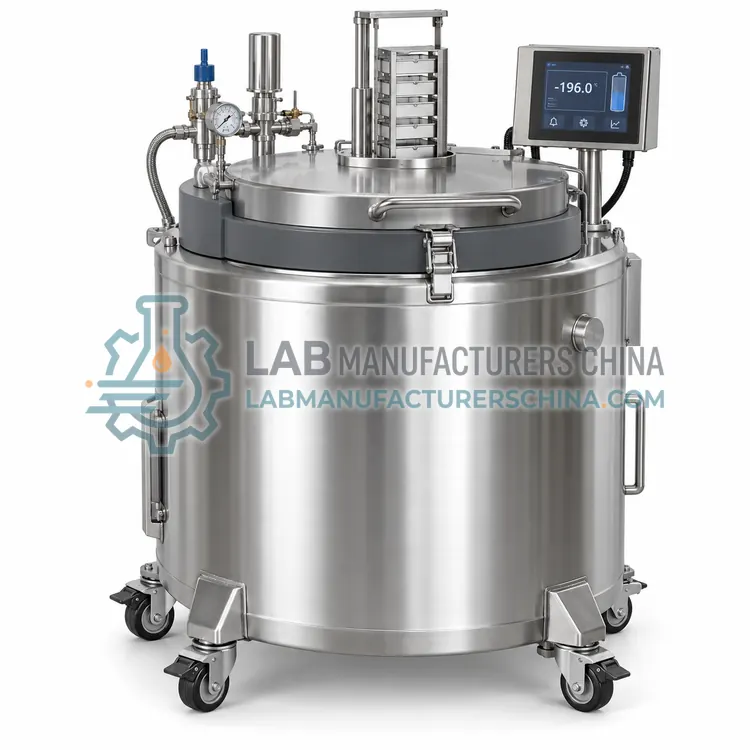
Vapor-Phase Liquid Nitrogen Storage System
气相液氮储存系统
- SKU CSS-0001
- Cryogenic Storage Systems
- CE (to be confirmed)
- ISO 9001 manufacturing (to be confirmed)
- PED 2014/68/EU conformity (to be confirmed)
Price on request — FOB / CIF quoted per order
Prices depend on configuration, quantity and destination port.
Key specifications
| Total volume | 200–500 L |
|---|---|
| Capacity (2 mL vials) | 10,000–30,000 vials |
| Storage temperature | −150°C to −190°C (vapor) |
| Rack format | 81 or 100 position boxes |
| Static evaporation rate | 2–6 L/day |
| Level control | Differential pressure or capacitance |
Request a quote Download brochure · to be provided
By Lab Manufacturers China Technical TeamLast reviewed Standards: ISO 21009-1, ISO 20387, IEC 61010-1
What is the Vapor-Phase Liquid Nitrogen Storage System?
A vapor-phase liquid nitrogen storage system keeps samples in cold nitrogen vapor above a controlled liquid pool, at about −150°C to −190°C. It is the right choice when cross-contamination through liquid contact must be avoided, as in clinical, cell therapy and biobank storage.
What is the Vapor-Phase Liquid Nitrogen Storage System?
A vapor-phase liquid nitrogen storage system keeps samples in cold nitrogen vapor above a controlled liquid pool, at about −150°C to −190°C. It is the right choice when cross-contamination through liquid contact must be avoided, as in clinical, cell therapy and biobank storage.
Overview
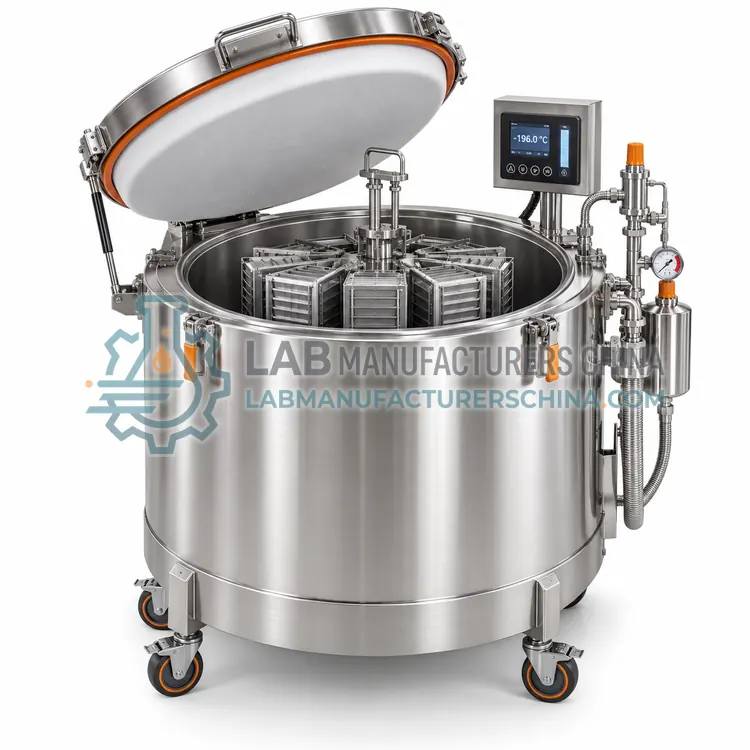
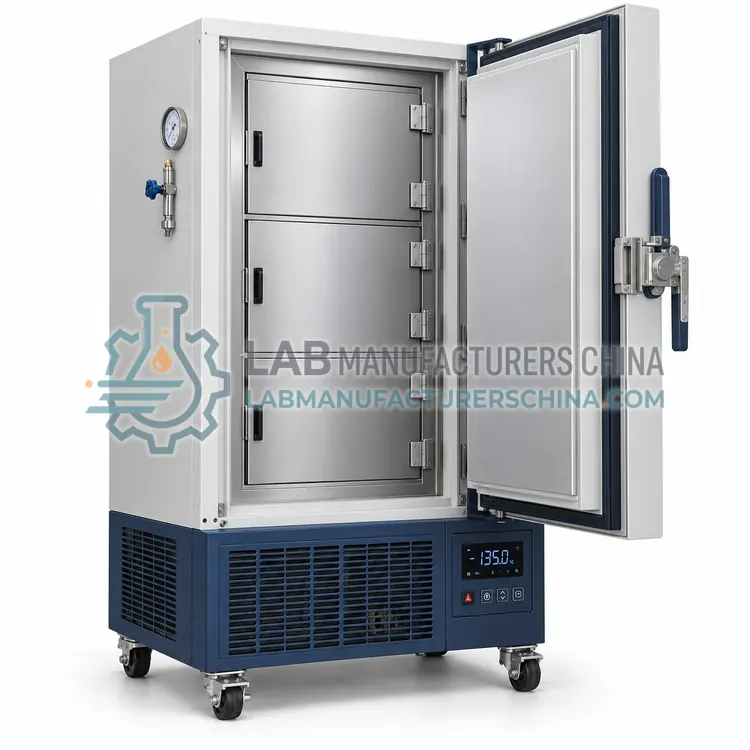
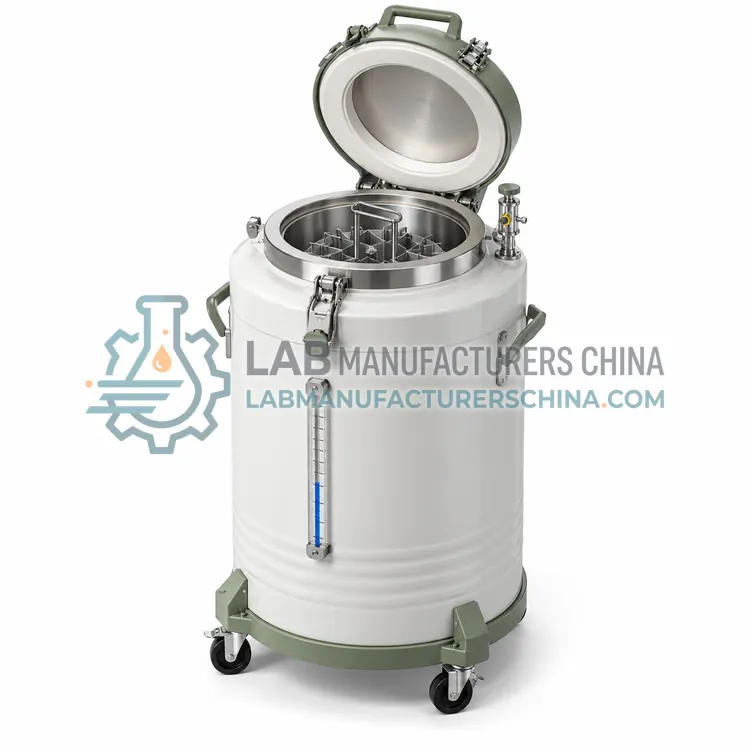
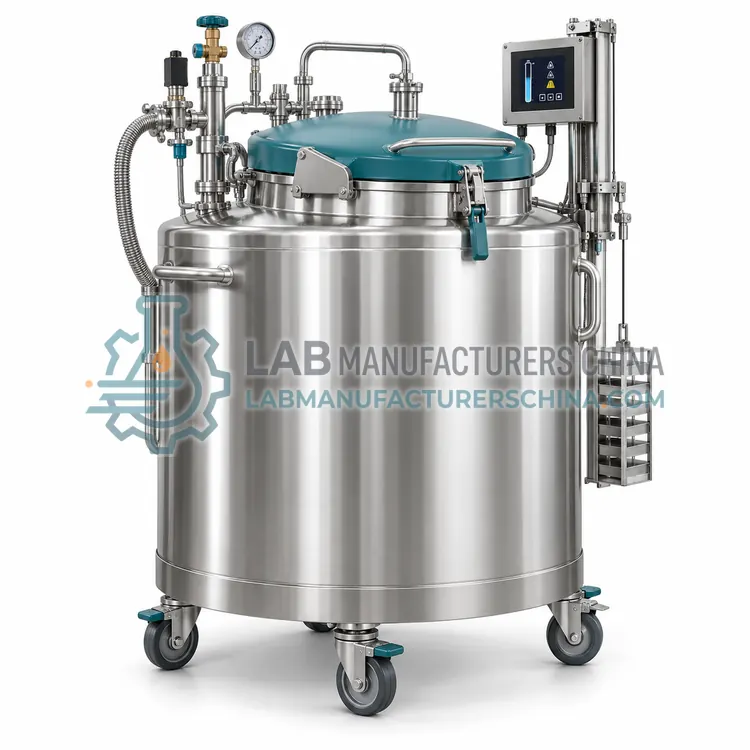
This is the most widely installed cryogenic storage configuration. A 200–500 L stainless steel vessel contains a rack system above a liquid pool kept at a fixed depth by a level controller and automatic fill valve. Racks carry boxes of 81 or 100 cryovials, with capacities of about 10,000 to 30,000 2 mL vials. Temperature is measured at the top and bottom of the rack, and the top position is normally held below −150°C. Because vials do not sit in liquid, exploding-vial risk and cross-contamination with pathogens are reduced. The trade-off is a vertical temperature gradient, usually 20–40°C from liquid to lid, and faster warming during access. Specify a multi-section lid, lockable design, inventory racks, remote alarm and data logger, and a nitrogen supply line with insulation.
How does it work?
A cryogenic storage system is a large vacuum-insulated liquid nitrogen vessel wrapped in control and safety instrumentation. Heat leaks through the vacuum jacket, lid and neck, and the resulting boil-off keeps the headspace near liquid nitrogen temperature. A level sensor, typically a differential pressure or capacitance probe, triggers a solenoid valve to admit liquid from a bulk supply and hold the level within a set band. In vapor-phase models, a rack holds boxes above the liquid, and temperature probes at several heights verify that the top box stays colder than −150°C. Isothermal designs use a vapor-tight inner liner so that the liquid is separated from the sample space and the vapor stays uniform. A controller logs temperature, level and lid-open events, and sends alarms through local sounders, relays or network connections.
What are the key features?
- Automatic fill controller holds liquid depth within a narrow band.
- Rack and box system organizes 10,000 or more vials for fast location.
- Multi-point temperature probes verify upper box temperature below −150°C.
- Multi-section insulated lid reduces heat entering during access.
- Alarm outputs for level, temperature, lid open and supply failure.
- Data logging with USB or network export supports audits.
What are the technical specifications?
A typical vapor-phase liquid nitrogen storage system configuration offers total volume of 200–500 L, capacity (2 mL vials) of 10,000–30,000 vials, storage temperature of −150°C to −190°C (vapor), rack format of 81 or 100 position boxes, static evaporation rate of 2–6 L/day and level control of Differential pressure or capacitance. Values are indicative of the product class; the exact figures for each configuration are confirmed on the quotation and the calibration documents supplied with the instrument.
Which applications is it used for?
The Vapor-Phase Liquid Nitrogen Storage System is used in cell therapy cell banks, clinical biobank storage, stem cell banking and vaccine seed lot storage. Across the wider Cryogenic Storage Systems class, laboratories also deploy it for biobank long-term storage, cell therapy master and working cell banks and cord blood and stem cell banking.
Which standards and certifications apply?
Relevant standards and methods include ISO 21009-1, ISO 20387, IEC 61010-1, GB/T 18442, EU Pressure Equipment Directive 2014/68/EU and ISO 21010. Certification candidates for this model are CE, ISO 9001 manufacturing and PED 2014/68/EU conformity; each is to be confirmed for the specific configuration before shipment, and certificates are supplied only where they have been issued.
Plan the installation before delivery: floor loading when filled can exceed one tonne, door and lift dimensions must pass the vessel, and a bulk liquid nitrogen line must be insulated and fitted with relief valves. Oxygen sensors should be located at low level and linked to an alarm and forced ventilation. Establish an alarm response plan and a backup vessel with spare capacity so that samples can be moved if a unit fails. Calibrate temperature and level probes at defined intervals, test alarms, and log all events. Minimize lid-open time during access and use inventory software to locate boxes before opening. Plan periodic vessel inspection and safety valve testing in line with local pressure-equipment rules.
How do I select the right Vapor-Phase Liquid Nitrogen Storage System?
Select vapor-phase storage for clinical or cell therapy material and any collection where vial leakage is a concern. Choose isothermal storage if a tighter temperature band is required. In an RFQ, specify vial count, rack and box format, top-box temperature limit, level and temperature sensor redundancy, alarm outputs and bulk supply connection.
How does it compare with other Cryogenic Storage Systems variants?
Define the required phase first: vapor-phase or isothermal for clinical and cell therapy material, liquid phase where the lowest possible temperature matters and contamination risk is managed. Size storage in vials with spare capacity of 20–30%, and confirm the rack design, because box format drives the real vial count. Compare evaporation rate and nitrogen consumption, then the supply: bulk tank connection, pressure and pipe length. Specify monitoring depth, including temperature probes at several levels, level redundancy, remote alarm, data logging and audit trail for GMP-type work. Consider automated retrieval for very large collections, since it reduces open-lid time and sample warming. Check room size, ceiling height, floor load and ventilation, and plan oxygen sensors and emergency exhaust.
Full specifications
| Total volume | 200–500 L |
|---|---|
| Capacity (2 mL vials) | 10,000–30,000 vials |
| Storage temperature | −150°C to −190°C (vapor) |
| Rack format | 81 or 100 position boxes |
| Static evaporation rate | 2–6 L/day |
| Level control | Differential pressure or capacitance |
| Temperature sensors | PT100, 2–4 points |
| Inner vessel material | Stainless steel |
| Supply pressure | 0.5–1.5 bar |
| Power supply | 100–240 V AC, 50/60 Hz, 100 W |
| Alarm outputs | Relay, sounder, network |
Indicative values for this product class. Final specifications are confirmed on the quotation and in the calibration documents supplied with the instrument.
Applications
- Cell therapy cell banks
- Clinical biobank storage
- Stem cell banking
- Vaccine seed lot storage
Key features
- Automatic fill controller holds liquid depth within a narrow band.
- Rack and box system organizes 10,000 or more vials for fast location.
- Multi-point temperature probes verify upper box temperature below −150°C.
- Multi-section insulated lid reduces heat entering during access.
- Alarm outputs for level, temperature, lid open and supply failure.
- Data logging with USB or network export supports audits.
Frequently asked questions about Vapor-Phase Liquid Nitrogen Storage System
With correct liquid level and a closed lid, the top box typically stays between −150°C and −180°C. During access it can rise quickly, so systems should log the top-box temperature and alarm if it passes the defined limit, commonly −150°C.
Vials do not contact liquid nitrogen, which removes the route for liquid-borne viruses or bacteria to pass between vials if a container leaks. It also avoids liquid entering a faulty vial and expanding violently when removed.
The vessel retains liquid, so a 500 L system typically holds safe temperatures for several days, depending on level and evaporation. Alarms should trigger at low level, and a response plan should include emergency delivery or transfer to a backup vessel.
A liquid nitrogen tank is mainly a passive insulated vessel, while a cryogenic storage system adds racks, level control, automatic filling, temperature monitoring and alarms for managed, traceable storage. Systems are designed for large, high-value collections rather than occasional use.
In isothermal storage, liquid nitrogen sits in a sealed jacket around the sample chamber, so vapor fills the space without direct liquid contact. Temperature differences are small, often within 10°C, and samples remain at about −190°C from top to bottom of the rack.
Consumption depends on size and opening frequency. A 200 L vapor-phase system typically uses roughly 1–3 L per day when lightly used, and large isothermal systems of 1,000+ L can use 10–30 L per day. Request the rated static rate and a typical usage estimate.
Related models
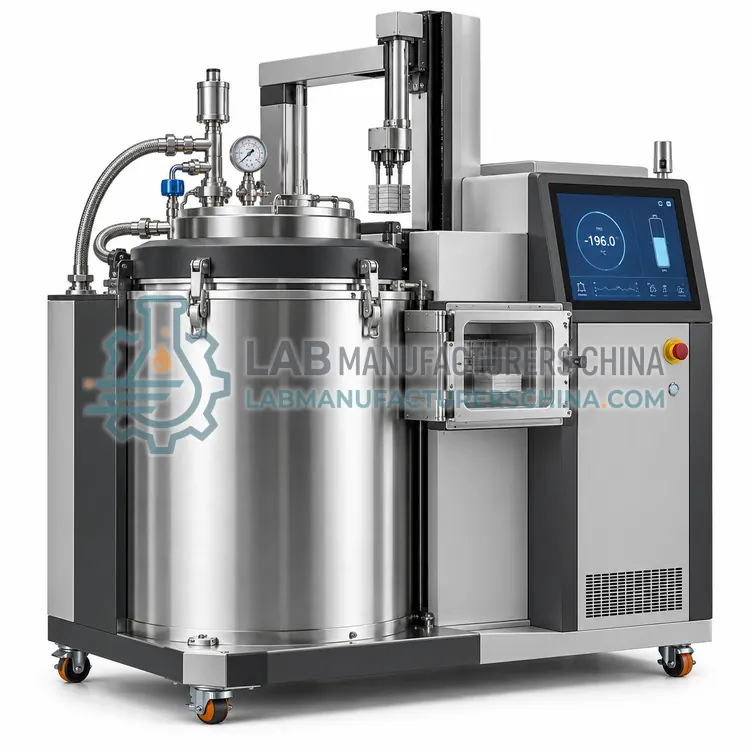
Automated Cryogenic Sample Storage System with Robotic Retrieval
带机器人取样的自动化低温样品储存系统
- CE (to be confirmed)
- +3