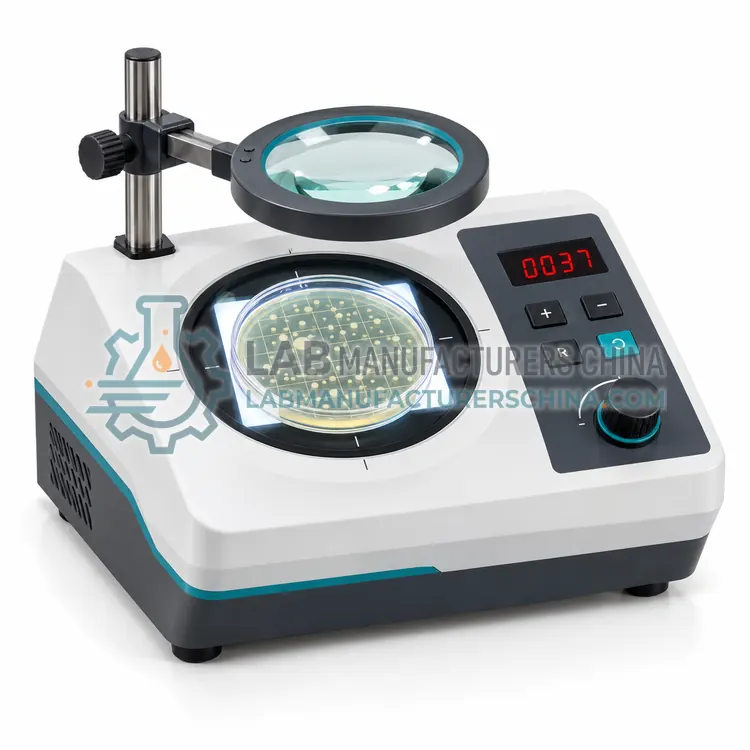
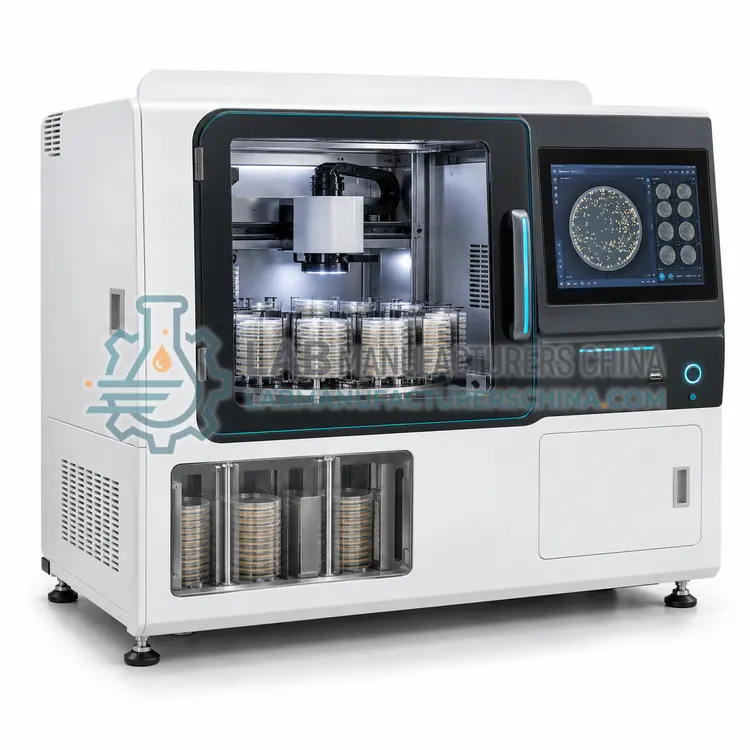
High-Throughput Colony Counter
高通量菌落计数器
- SKU COC-0005
- Colony Counters
- CE (to be confirmed)
- ISO 9001 manufacturing (to be confirmed)
- ISO 13485 manufacturing (to be confirmed)
Price on request — FOB / CIF quoted per order
Prices depend on configuration, quantity and destination port.
Key specifications
| Throughput | Up to 300–600 plates per hour |
|---|---|
| Plate capacity | 100–400 plates per run |
| Plate formats | 55 mm, 90 mm, 150 mm |
| Imaging channels | Visible; fluorescence optional |
| Barcode reading | 1D and 2D |
| Data output | CSV, image archive, LIMS interface |
Request a quote Download brochure · to be provided
By Lab Manufacturers China Technical TeamLast reviewed Standards: ISO 7218, ISO 4833-1, ISO 4833-2
What is the High-Throughput Colony Counter?
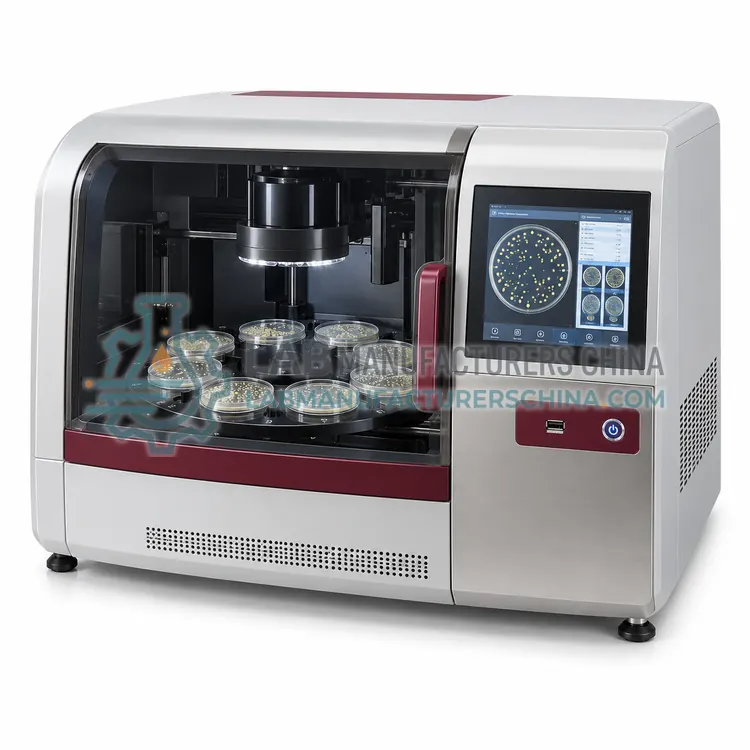
A high-throughput colony counter automates plate handling, imaging and data transfer so that hundreds of plates per run are processed with minimal operator time. It suits large food, pharmaceutical and contract laboratories with routine high-volume testing.
What is the High-Throughput Colony Counter?
A high-throughput colony counter automates plate handling, imaging and data transfer so that hundreds of plates per run are processed with minimal operator time. It suits large food, pharmaceutical and contract laboratories with routine high-volume testing.
Overview
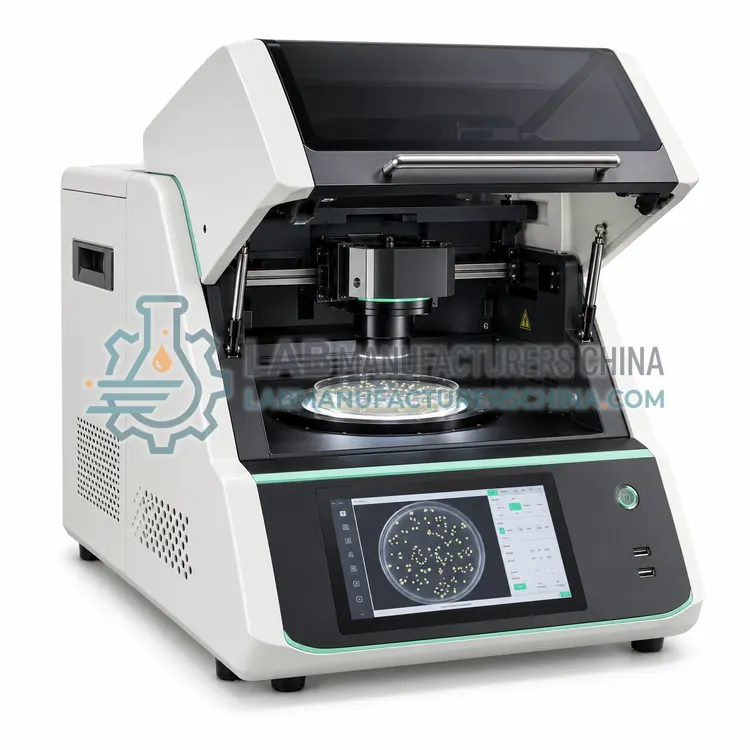
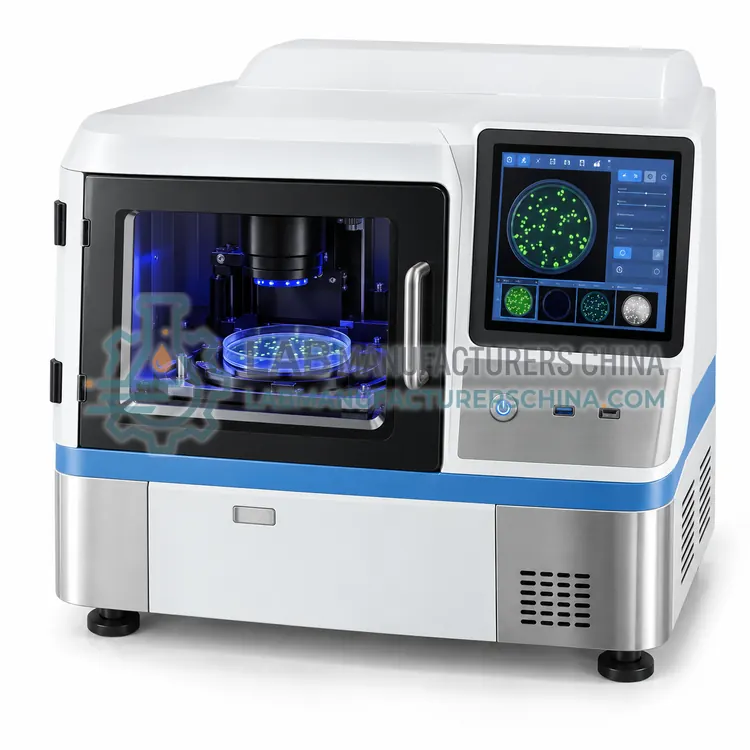
A high-throughput colony counter combines an imaging or scanning module with a robotic plate handler and scheduling software. Plates are stacked in magazines or loaded on a carousel, identified by barcode, imaged under controlled illumination and returned or discarded, while results are linked to sample identifiers in a LIMS. Because reading is unattended, laboratories can run batches overnight and reduce hands-on time per plate. The system typically supports several plate sizes and both visible and fluorescence channels, applies the same validated counting algorithms, and flags plates that need manual review. Throughput of several hundred plates per hour is achievable with fast imaging and multiple carriers. Data integrity features such as user accounts, audit trails and locked methods support regulated environments.
How does it work?
Automated colony counting replaces the naked-eye tally with a sensor and software. A plate is placed on a backlit or dark-field stage and a camera captures a high-resolution image. Software applies thresholding and brightness or color segmentation to separate colonies from the agar background, and size and circularity filters remove bubbles, dust and cracks. Counts are reported as colony-forming units and converted to CFU per millilitre or gram using the dilution. Laser counters scan with a moving beam and detect colonies by light attenuation, which avoids ambiguity from similar-colored growth, while fluorescence counters excite labeled or fluorogenic targets and read the emitted light. Many instruments estimate the number of merged colonies, flag plates outside the statistical counting range, and export images and results for review.
What are the key features?
- Robotic plate handling with barcode identification
- Unattended processing of hundreds of plates per run
- Combined visible and fluorescence imaging channels
- Direct LIMS export linked to sample identifiers
- Audit trails and user accounts for regulated laboratories
- Manual review queue for flagged plates
What are the technical specifications?
A typical high-throughput colony counter configuration offers throughput of Up to 300–600 plates per hour, plate capacity of 100–400 plates per run, plate formats of 55 mm, 90 mm, 150 mm, imaging channels of Visible; fluorescence optional, barcode reading of 1D and 2D and data output of CSV, image archive, LIMS interface. Values are indicative of the product class; the exact figures for each configuration are confirmed on the quotation and the calibration documents supplied with the instrument.
Which applications is it used for?
The High-Throughput Colony Counter is used in large food and beverage testing laboratories, pharmaceutical environmental monitoring, contract microbiology laboratories and water authority routine testing. Across the wider Colony Counters class, laboratories also deploy it for food and beverage microbiological testing, pharmaceutical environmental monitoring and water and wastewater analysis.
Which standards and certifications apply?
Relevant standards and methods include ISO 7218, ISO 4833-1, ISO 4833-2, ISO 11133, FDA BAM Chapter 3 and IEC 61010-1. Certification candidates for this model are CE, ISO 9001 manufacturing and ISO 13485 manufacturing; each is to be confirmed for the specific configuration before shipment, and certificates are supplied only where they have been issued.
Install the counter on a stable bench away from direct sunlight, which changes illumination and thresholds. Keep the stage and optics clean, and follow the manufacturer interval for lamp or LED output checks. Verify performance with reference plates or a printed counting template and record results, because a drifting camera or dirty lens shifts counts. Before routine use, compare automated results with manual counts on typical media and organisms. For regulated laboratories, define who reviews flagged images, retain original images with the reported count, and place software updates under change control. Electrical safety follows IEC 61010-1.
How do I select the right High-Throughput Colony Counter?
Choose a high-throughput system for routine testing of hundreds of plates per day. In an RFQ specify plate formats, required throughput, imaging channels, barcode type, LIMS interface and the qualification and validation documentation you need, and plan for a validation study on your own samples.
How does it compare with other Colony Counters variants?
Match the counter to your plate types and throughput before comparing prices. Low-volume work with standard 90 mm dishes is well served by an illuminated manual counter, while routine high volume justifies an automated system. Confirm the plate formats accepted, including 55 mm contact plates, 90 mm and 150 mm dishes, and any compact dry or film plates you use. Check the detection principle, because color-based imaging is fast while laser scanning better separates colonies of similar hue, and fluorescence is needed for chromogenic or fluorogenic media. Look for statistics that follow ISO 7218 and recognized compendial guidance, including counting-range limits and treatment of spreading growth. Consider image retention, LIMS export and validation against manual counts on your own plates.
Full specifications
| Throughput | Up to 300–600 plates per hour |
|---|---|
| Plate capacity | 100–400 plates per run |
| Plate formats | 55 mm, 90 mm, 150 mm |
| Imaging channels | Visible; fluorescence optional |
| Barcode reading | 1D and 2D |
| Data output | CSV, image archive, LIMS interface |
| Operating environment | 15–30 °C, 20–80% RH |
| Power supply | 100–240 V, 50/60 Hz |
| Configuration | Benchtop or floor-standing |
Indicative values for this product class. Final specifications are confirmed on the quotation and in the calibration documents supplied with the instrument.
Applications
- Large food and beverage testing laboratories
- Pharmaceutical environmental monitoring
- Contract microbiology laboratories
- Water authority routine testing
Key features
- Robotic plate handling with barcode identification
- Unattended processing of hundreds of plates per run
- Combined visible and fluorescence imaging channels
- Direct LIMS export linked to sample identifiers
- Audit trails and user accounts for regulated laboratories
- Manual review queue for flagged plates
Frequently asked questions about High-Throughput Colony Counter
Throughput ranges from about 300 to 600 plates per hour depending on plate size, number of imaging channels and whether fluorescence is used. Time for loading and unloading, incubation transfer and any manual review adds to the total turnaround for a batch.
Yes, plates can be pre-loaded in magazines and processed under scheduling software while the laboratory is closed, with results available the next morning. Operators should confirm that barcode reading, error handling and a review queue manage plates that fail imaging.
Most models provide user accounts, role-based permissions, audit trails and locked counting methods, which support 21 CFR Part 11 and EU GMP Annex 11 expectations. The laboratory must still validate the system, define review procedures and control software updates.
It counts microbial colonies on agar plates and reports the result as colony-forming units. Laboratories use it for aerobic plate counts, coliform and E. coli testing, environmental monitoring and research, converting the plate count to CFU per millilitre or gram with the dilution factor.
A manual counter is an illuminated magnifier with a tally pen, so the operator decides which colonies to count. An automatic counter images or scans the plate and applies software rules, which improves consistency and speed but relies on validated thresholds for each medium.
ISO 7218 gives general rules for microbiological examinations, and ISO 4833-1 and 4833-2 cover colony counts at 30 degrees Celsius. ISO 11133 addresses culture media. Food laboratories often follow the FDA Bacteriological Analytical Manual in addition to these standards.
Related models