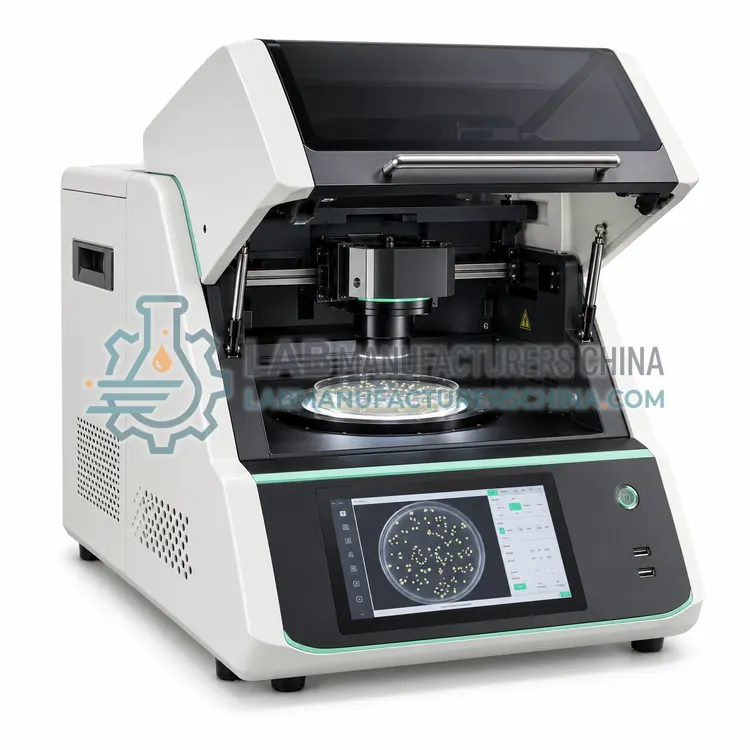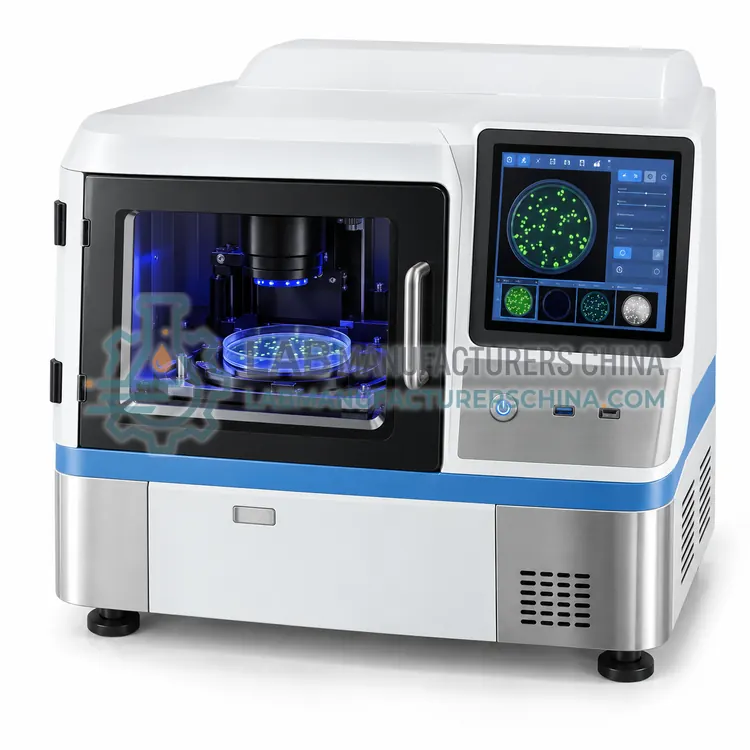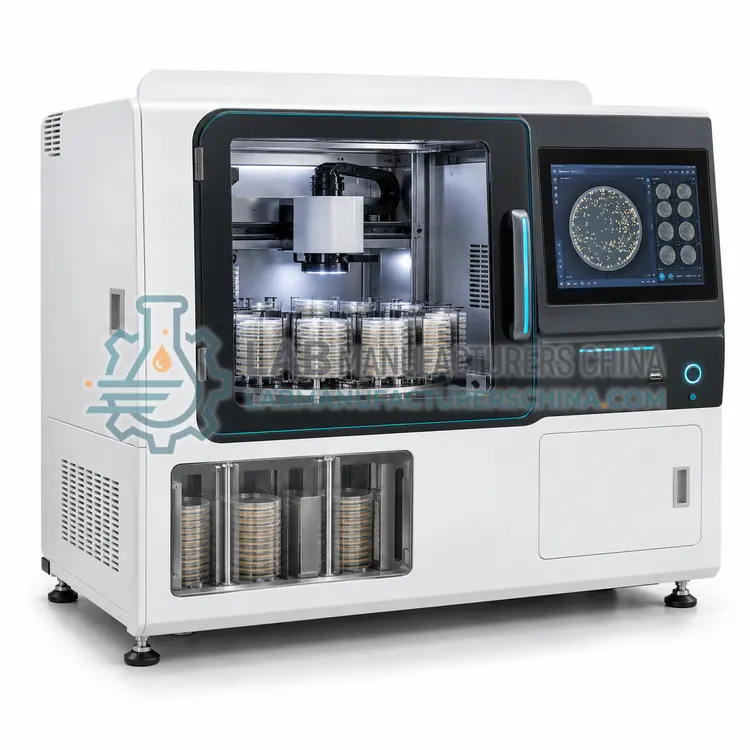
Manual Colony Counter
手动菌落计数器
- SKU COC-0001
- Colony Counters
- CE (to be confirmed)
- ISO 9001 manufacturing (to be confirmed)
- IEC 61010-1 compliance (to be confirmed)
Price on request — FOB / CIF quoted per order
Prices depend on configuration, quantity and destination port.
Key specifications
| Plate diameter | 55–90 mm |
|---|---|
| Illumination | Adjustable LED, bright-field or dark-field |
| Magnification | 1.5x–3x |
| Counting mechanism | Pressure-sensitive pen with digital tally |
| Display | 4-digit LED counter |
| Counting range | 0–9999 CFU |
Request a quote Download brochure · to be provided
By Lab Manufacturers China Technical TeamLast reviewed Standards: ISO 7218, ISO 4833-1, ISO 4833-2
What is the Manual Colony Counter?
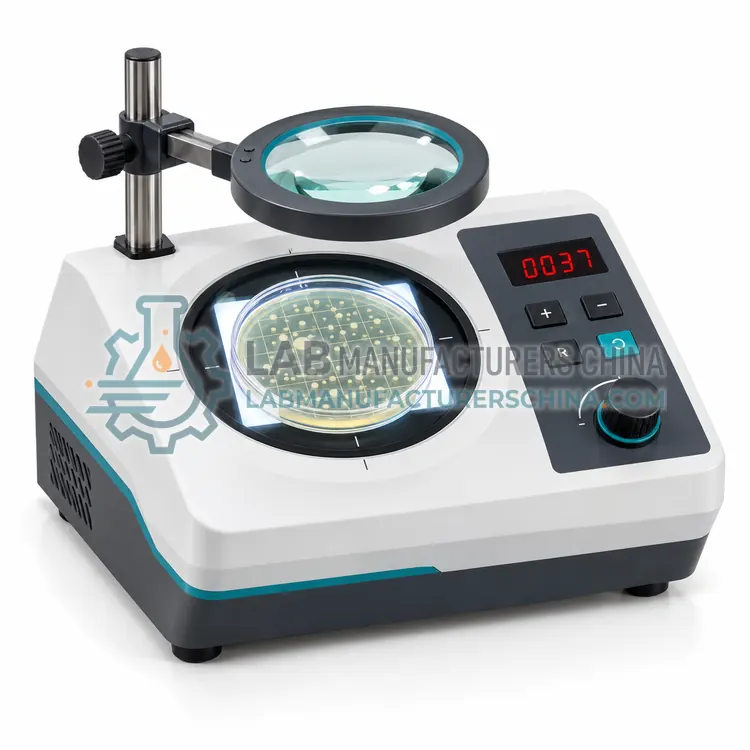
A manual colony counter is an illuminated magnifier with a ruled grid and a tally mechanism used to count colonies by eye. It suits low-volume laboratories that need a simple, low-cost and reliable way to enumerate plates.
What is the Manual Colony Counter?
A manual colony counter is an illuminated magnifier with a ruled grid and a tally mechanism used to count colonies by eye. It suits low-volume laboratories that need a simple, low-cost and reliable way to enumerate plates.
Overview
A manual colony counter provides a backlit, magnified view of an agar plate and a simple means of registering each colony counted. The stage may be bright-field or dark-field, and a magnifying lens improves visibility of pinpoint colonies. A grid or sector template lets the operator count progressively and avoid double counting. The tally is usually a pressure-sensitive pen connected to an electronic display, or a mechanical clicker, so each touch increments a counter, and some models add an audible confirmation and a marker light. Because the decision to count a colony rests with the operator, accuracy depends on training, defined counting rules and adequate magnification. Manual counters remain useful for atypical plates and mixed morphology.
How does it work?
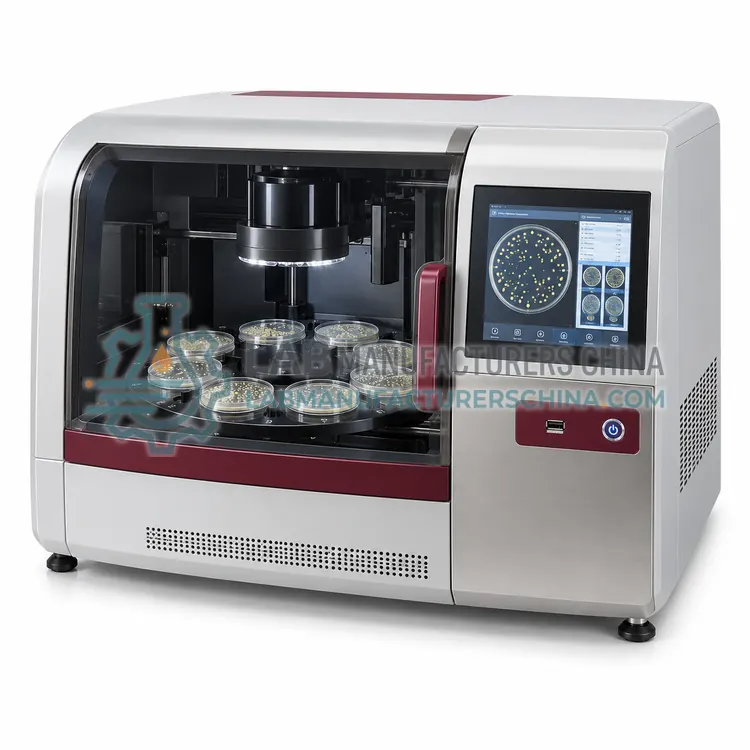
Automated colony counting replaces the naked-eye tally with a sensor and software. A plate is placed on a backlit or dark-field stage and a camera captures a high-resolution image. Software applies thresholding and brightness or color segmentation to separate colonies from the agar background, and size and circularity filters remove bubbles, dust and cracks. Counts are reported as colony-forming units and converted to CFU per millilitre or gram using the dilution. Laser counters scan with a moving beam and detect colonies by light attenuation, which avoids ambiguity from similar-colored growth, while fluorescence counters excite labeled or fluorogenic targets and read the emitted light. Many instruments estimate the number of merged colonies, flag plates outside the statistical counting range, and export images and results for review.
What are the key features?
- Backlit bright-field or dark-field illumination stage
- Adjustable magnifier with 1.5x to 3x magnification
- Sector grid template to prevent double counting
- Pressure-sensitive tally pen with audible confirmation
- Compatible with 55 mm and 90 mm Petri dishes
What are the technical specifications?
A typical manual colony counter configuration offers plate diameter of 55–90 mm, illumination of Adjustable LED, bright-field or dark-field, magnification of 1.5x–3x, counting mechanism of Pressure-sensitive pen with digital tally, display of 4-digit LED counter and counting range of 0–9999 CFU. Values are indicative of the product class; the exact figures for each configuration are confirmed on the quotation and the calibration documents supplied with the instrument.
Which applications is it used for?
The Manual Colony Counter is used in food and beverage microbiological testing, water and wastewater analysis, teaching and training laboratories and environmental monitoring. Across the wider Colony Counters class, laboratories also deploy it for food and beverage microbiological testing, pharmaceutical environmental monitoring and water and wastewater analysis.
Which standards and certifications apply?
Relevant standards and methods include ISO 7218, ISO 4833-1, ISO 4833-2, ISO 11133, FDA BAM Chapter 3 and IEC 61010-1. Certification candidates for this model are CE, ISO 9001 manufacturing and IEC 61010-1 compliance; each is to be confirmed for the specific configuration before shipment, and certificates are supplied only where they have been issued.
Install the counter on a stable bench away from direct sunlight, which changes illumination and thresholds. Keep the stage and optics clean, and follow the manufacturer interval for lamp or LED output checks. Verify performance with reference plates or a printed counting template and record results, because a drifting camera or dirty lens shifts counts. Before routine use, compare automated results with manual counts on typical media and organisms. For regulated laboratories, define who reviews flagged images, retain original images with the reported count, and place software updates under change control. Electrical safety follows IEC 61010-1.
How do I select the right Manual Colony Counter?
Choose a manual counter for low throughput, mixed colony morphology or where trained staff read results and budget is limited. In an RFQ specify plate diameters, illumination type, magnification, grid template and the tally output format.
How does it compare with other Colony Counters variants?
Match the counter to your plate types and throughput before comparing prices. Low-volume work with standard 90 mm dishes is well served by an illuminated manual counter, while routine high volume justifies an automated system. Confirm the plate formats accepted, including 55 mm contact plates, 90 mm and 150 mm dishes, and any compact dry or film plates you use. Check the detection principle, because color-based imaging is fast while laser scanning better separates colonies of similar hue, and fluorescence is needed for chromogenic or fluorogenic media. Look for statistics that follow ISO 7218 and recognized compendial guidance, including counting-range limits and treatment of spreading growth. Consider image retention, LIMS export and validation against manual counts on your own plates.
Full specifications
| Plate diameter | 55–90 mm |
|---|---|
| Illumination | Adjustable LED, bright-field or dark-field |
| Magnification | 1.5x–3x |
| Counting mechanism | Pressure-sensitive pen with digital tally |
| Display | 4-digit LED counter |
| Counting range | 0–9999 CFU |
| Power supply | 100–240 V, 50/60 Hz |
| Working surface | Glass stage with grid template |
Indicative values for this product class. Final specifications are confirmed on the quotation and in the calibration documents supplied with the instrument.
Applications
- Food and beverage microbiological testing
- Water and wastewater analysis
- Teaching and training laboratories
- Environmental monitoring
Key features
- Backlit bright-field or dark-field illumination stage
- Adjustable magnifier with 1.5x to 3x magnification
- Sector grid template to prevent double counting
- Pressure-sensitive tally pen with audible confirmation
- Compatible with 55 mm and 90 mm Petri dishes
Frequently asked questions about Manual Colony Counter
Accuracy depends on the operator and on following defined rules, such as counting only colonies within a set size range and handling spreading growth consistently. Trained analysts can reproduce counts closely, but manual counting is slower and more variable than validated automated imaging.
A sector grid divides the plate into areas so the analyst counts one region at a time, which reduces double counting and missed colonies. Analysts record subtotals per sector and add them for the plate total, improving consistency across operators and plates with many colonies.
Yes, many models offer both bright-field and dark-field modes. Dark-field improves contrast for translucent colonies and for small colonies on clear media, while bright-field is often easier for pigmented or opaque colonies on colored agar.
It counts microbial colonies on agar plates and reports the result as colony-forming units. Laboratories use it for aerobic plate counts, coliform and E. coli testing, environmental monitoring and research, converting the plate count to CFU per millilitre or gram with the dilution factor.
A manual counter is an illuminated magnifier with a tally pen, so the operator decides which colonies to count. An automatic counter images or scans the plate and applies software rules, which improves consistency and speed but relies on validated thresholds for each medium.
ISO 7218 gives general rules for microbiological examinations, and ISO 4833-1 and 4833-2 cover colony counts at 30 degrees Celsius. ISO 11133 addresses culture media. Food laboratories often follow the FDA Bacteriological Analytical Manual in addition to these standards.
Related models