Anaerobic Jar
厌氧罐
- SKU ANS-0001
- Anaerobic Systems
- CE (to be confirmed)
- ISO 9001 manufacturing (to be confirmed)
- Material biocompatibility (to be confirmed)
Price on request — FOB / CIF quoted per order
Prices depend on configuration, quantity and destination port.
Key specifications
| Chamber material | Polycarbonate or borosilicate glass |
|---|---|
| Plate capacity | 4–12 × 90 mm plates |
| Atmosphere | O2 below 1%, CO2 5–10% |
| Catalyst | Palladium catalyst, rechargeable |
| Sealing | Clamp or screw lid with gasket |
| Indicator | Methylene blue anaerobic indicator strip |
Request a quote Download brochure · to be provided
By Lab Manufacturers China Technical TeamLast reviewed Standards: ISO 15213, ISO 7937, ISO 11133
What is the Anaerobic Jar?
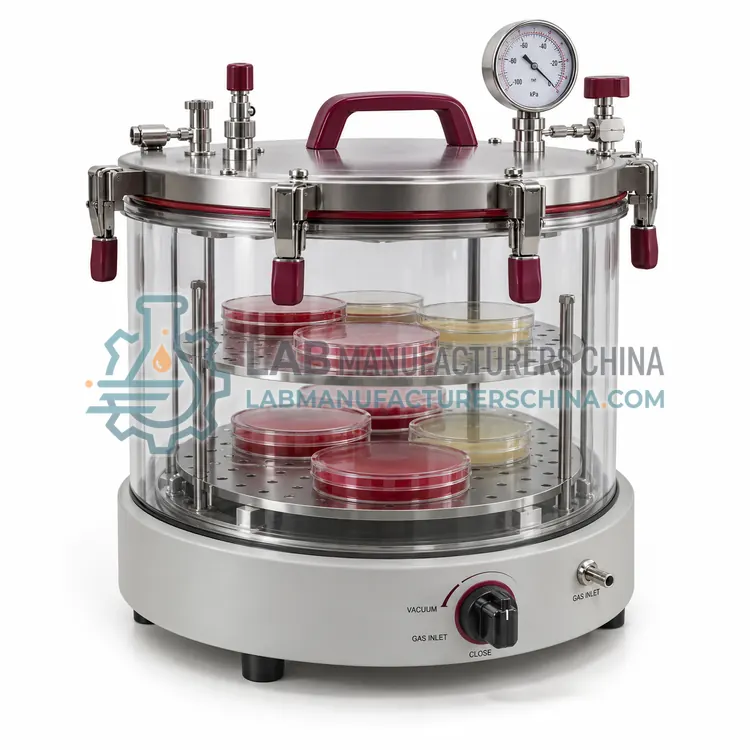
An anaerobic jar is a sealed container that holds plates under a reduced atmosphere generated by a gas sachet and a catalyst. It is the simplest, lowest-cost way to incubate small numbers of anaerobic culture plates.
What is the Anaerobic Jar?
An anaerobic jar is a sealed container that holds plates under a reduced atmosphere generated by a gas sachet and a catalyst. It is the simplest, lowest-cost way to incubate small numbers of anaerobic culture plates.
Overview
An anaerobic jar consists of a transparent polycarbonate or glass body with a gastight lid, a clamp or screw closure, a catalyst sachet holder and room for a stack of Petri dishes. Gas-generating sachets placed inside react with a few millilitres of water to consume oxygen and produce carbon dioxide and hydrogen, and a palladium catalyst converts residual oxygen and hydrogen into water. An indicator strip shows whether anaerobiosis was reached. Jars are inexpensive, easy to use in any incubator and suitable for batch culture of a few plates, but they cannot be opened during incubation and atmosphere quality depends on correct sealing, fresh catalyst and the right sachet size. Larger jars hold more plates but need correspondingly larger sachets and take slightly longer to reach the required atmosphere.
How does it work?
Anaerobic systems remove oxygen and hold a reduced environment. Sealed jars and flexible bags use a gas-generating sachet that reacts with water to consume oxygen and release carbon dioxide and hydrogen, while a palladium catalyst combines residual hydrogen with oxygen to form water. Larger chambers repeatedly flush the working volume with a nitrogen, hydrogen and carbon dioxide mixture and circulate the atmosphere through the catalyst to keep oxygen below a few parts per million. Methylene blue or resazurin indicators confirm anaerobiosis by color change, and an anaerobic incubator maintains both the atmosphere and a precise temperature. Airlocks let plates and samples enter without introducing air, and gloves or sleeves allow manipulation inside the chamber.
What are the key features?
- Transparent gastight body with clamp or screw lid
- Sachet holder for gas-generating envelope
- Palladium catalyst holder with sachet
- Indicator strip window for anaerobiosis check
- Stacking space for multiple 90 mm plates
What are the technical specifications?
A typical anaerobic jar configuration offers chamber material of Polycarbonate or borosilicate glass, plate capacity of 4–12 × 90 mm plates, atmosphere of O2 below 1%, CO2 5–10%, catalyst of Palladium catalyst, rechargeable, sealing of Clamp or screw lid with gasket and indicator of Methylene blue anaerobic indicator strip. Values are indicative of the product class; the exact figures for each configuration are confirmed on the quotation and the calibration documents supplied with the instrument.
Which applications is it used for?
The Anaerobic Jar is used in clinical anaerobic culture, food microbiology, teaching laboratories and small-batch environmental testing. Across the wider Anaerobic Systems class, laboratories also deploy it for clinical microbiology of anaerobic infections, food microbiology and spoilage testing and environmental and water analysis.
Which standards and certifications apply?
Relevant standards and methods include ISO 15213, ISO 7937, ISO 11133, CLSI M11 and IEC 61010-1. Certification candidates for this model are CE, ISO 9001 manufacturing and Material biocompatibility; each is to be confirmed for the specific configuration before shipment, and certificates are supplied only where they have been issued.
Place gas-generating jars and bags in an incubator at the required temperature and record the start time, because anaerobiosis develops over one to two hours. Check catalyst activity regularly, since saturated palladium stops working and must be regenerated by heating. Replace indicators each run and keep a log. For chambers and workstations, verify oxygen readings with an independent analyzer, monitor gas supply and pressure, replace gloves when they leak and schedule catalyst and filter service. Avoid introducing large volumes of air through the airlock too quickly. Include anaerobic systems in routine equipment qualification and follow IEC 61010-1 for electrical safety.
How do I select the right Anaerobic Jar?
Choose an anaerobic jar for occasional or small-batch anaerobic culture where cost and simplicity matter. In an RFQ specify plate capacity, jar material, catalyst and indicator supply, sachet size options and whether a rectangular stackable format is preferred.
How does it compare with other Anaerobic Systems variants?
Choose by the number of samples, the duration of work and how much manipulation is needed. Anaerobic jars and bag systems suit occasional plates and small batches at low cost, with jars supporting stacked plates and bags giving a single-use option. Anaerobic incubators handle routine plate volumes with temperature control but little access during incubation. Workstations and glove boxes allow continuous plating, subculture and identification under a controlled atmosphere, which is essential for clinical anaerobe work and for slow-growing organisms. Confirm the oxygen level achieved and how it is monitored, the catalyst and indicator system, temperature range and uniformity, airlock and port capacity, gas consumption, and whether an internal incubator is included. For regulated laboratories, ask for validation and calibration documentation.
Full specifications
| Chamber material | Polycarbonate or borosilicate glass |
|---|---|
| Plate capacity | 4–12 × 90 mm plates |
| Atmosphere | O2 below 1%, CO2 5–10% |
| Catalyst | Palladium catalyst, rechargeable |
| Sealing | Clamp or screw lid with gasket |
| Indicator | Methylene blue anaerobic indicator strip |
| Operating temperature | Up to 60 °C |
| Dimensions | Approx. 250 × 150 mm (model dependent) |
Indicative values for this product class. Final specifications are confirmed on the quotation and in the calibration documents supplied with the instrument.
Applications
- Clinical anaerobic culture
- Food microbiology
- Teaching laboratories
- Small-batch environmental testing
Key features
- Transparent gastight body with clamp or screw lid
- Sachet holder for gas-generating envelope
- Palladium catalyst holder with sachet
- Indicator strip window for anaerobiosis check
- Stacking space for multiple 90 mm plates
Frequently asked questions about Anaerobic Jar
Typical jars hold about 4 to 12 standard 90 mm plates depending on height and model. Larger jars exist for higher capacity. The number of gas-generating sachets must be matched to the jar volume so that the atmosphere becomes adequately anaerobic.
Palladium catalyst is regenerated by heating at about 160 degrees Celsius for two hours and typically used for a limited number of cycles before replacement. A saturated catalyst no longer removes residual oxygen, so laboratories regenerate or replace it on a defined schedule and log the action.
No. The jar is a sealed batch system, so all plates are loaded before incubation and read only after the specified period ends. Opening it early introduces air, disrupts anaerobiosis and invalidates the run for organisms that require strict anaerobic conditions.
It provides an oxygen-free environment for growing and handling obligate anaerobes such as Clostridium and Bacteroides. Uses include clinical cultures of anaerobic infections, food spoilage testing, environmental sulfite-reducing bacteria counts, sterility testing and research on gut microbiota.
A sachet or gas generator reacts with water to consume oxygen and release carbon dioxide and hydrogen, and a palladium catalyst combines the hydrogen with residual oxygen to form water. An indicator strip or solution turns colorless when the atmosphere is suitably reduced.
A jar is a sealed batch container used mainly for incubation, so plates are placed and read after incubation. A workstation or glove box is a larger chamber with an airlock and gloves that allows continuous plating, subculture and inspection while the atmosphere stays anaerobic.
Related models