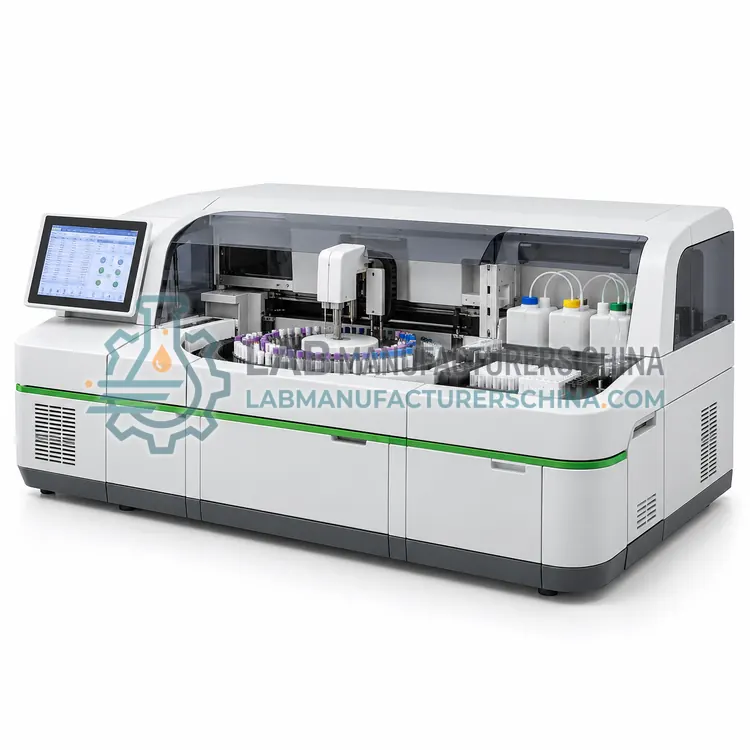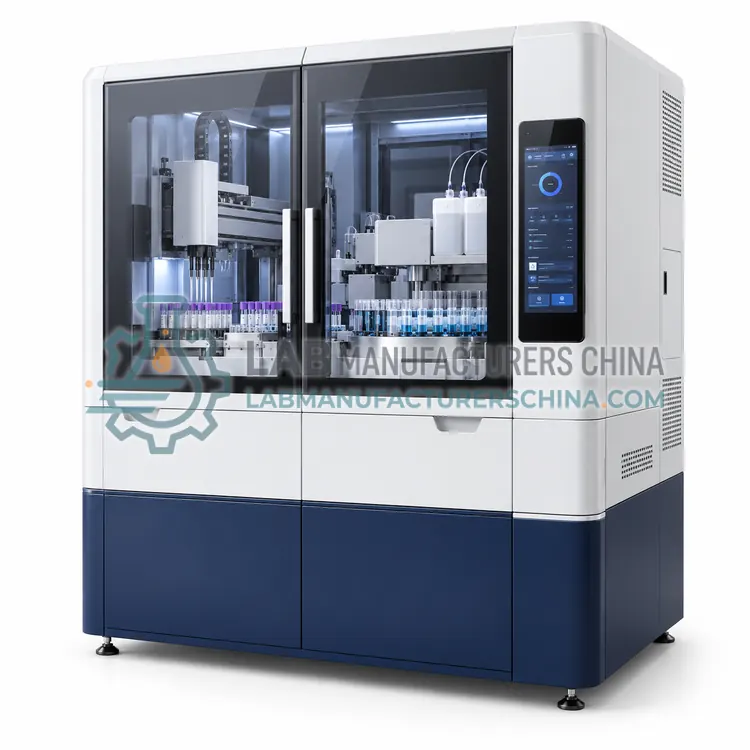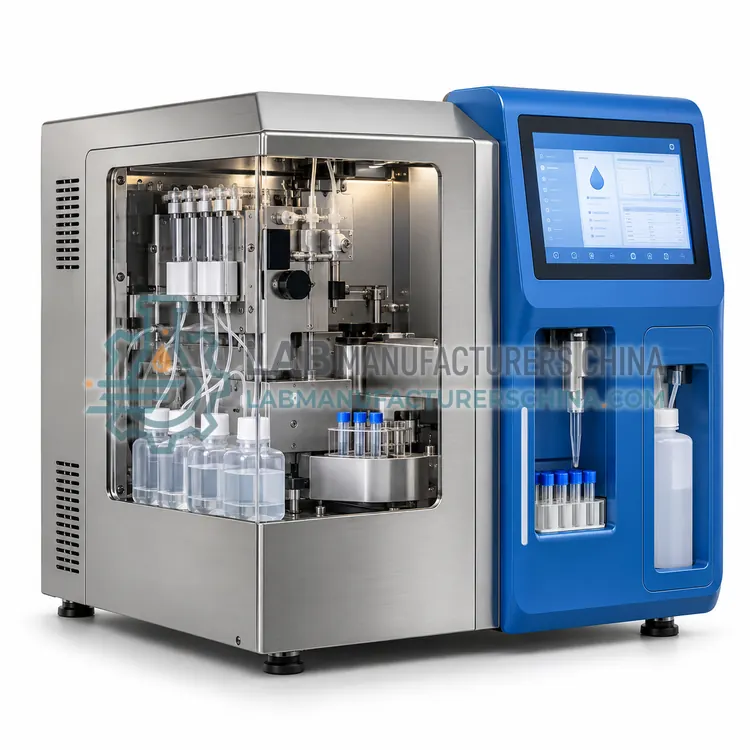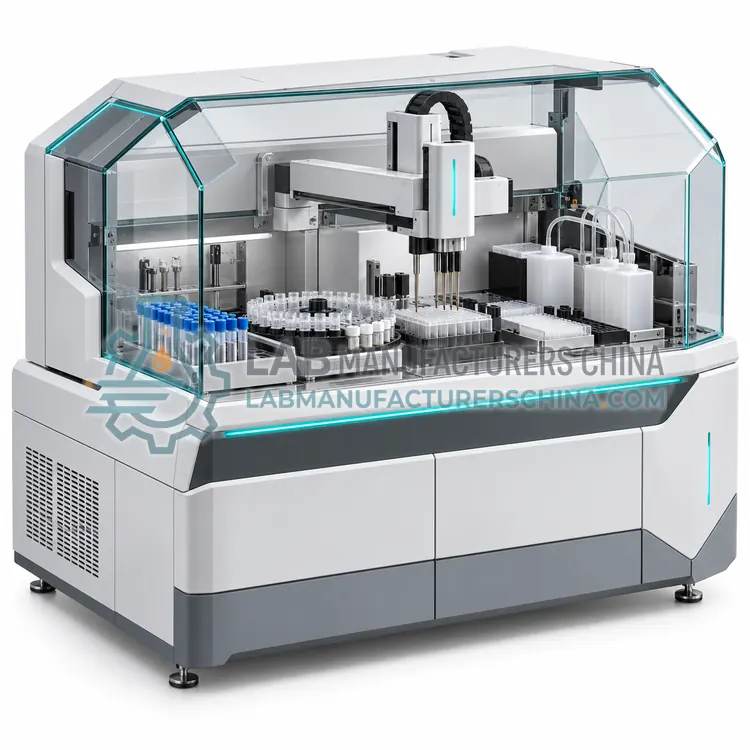
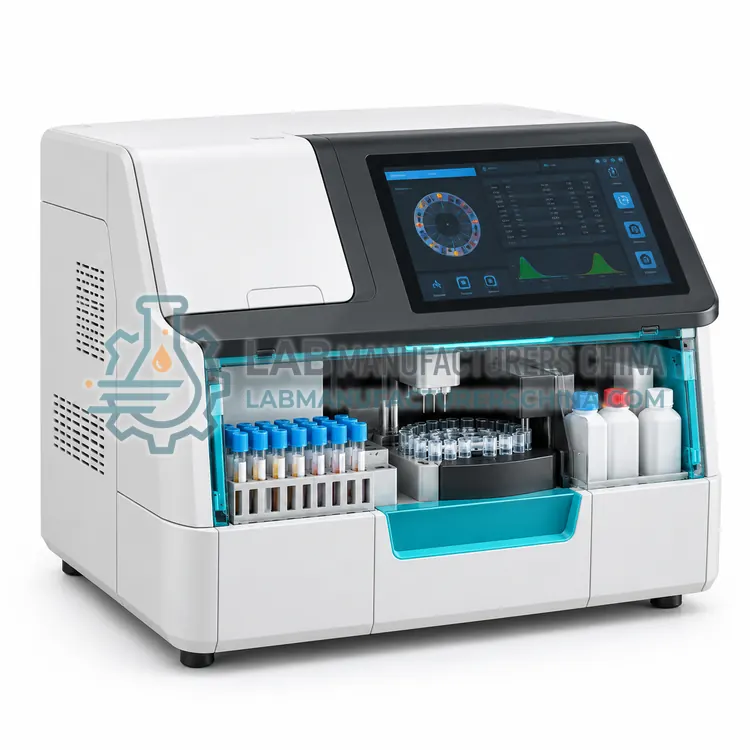
Modular Chemistry Workstation with Expandable Analyzer Units
可扩展模块化生化工作站
- SKU CHW-0002
- Chemistry Workstations
- CE (to be confirmed)
- ISO 13485 manufacturing (to be confirmed)
- NMPA class II registration (to be confirmed)
Price on request — FOB / CIF quoted per order
Prices depend on configuration, quantity and destination port.
Key specifications
| Units per system | 1–3 analyzer units plus shared loader |
|---|---|
| Throughput per unit | 400–600 tests/h photometric |
| Combined throughput | Up to 1800 tests/h with three units |
| Reagent positions per unit | 45 refrigerated positions |
| Sample loading | Shared rack loader with 80 positions |
| Work distribution | Rule-based with load balancing and failover |
Request a quote Download brochure · to be provided
By Lab Manufacturers China Technical TeamLast reviewed Standards: ISO 15189, CLSI AUTO10, CLSI EP05
What is the Modular Chemistry Workstation with Expandable Analyzer Units?
This workstation is built from identical analyzer units that can be added one at a time, sharing one software and one reagent concept. It suits laboratories that expect gradual volume growth and want to scale capacity in steps rather than replace the first instrument.
What is the Modular Chemistry Workstation with Expandable Analyzer Units?
This workstation is built from identical analyzer units that can be added one at a time, sharing one software and one reagent concept. It suits laboratories that expect gradual volume growth and want to scale capacity in steps rather than replace the first instrument.
Overview
Each analyzer unit carries its own reaction rotor, reagent compartment and probes, but all units report to one control computer and share sample loading positions or a common loader. Adding a unit roughly adds its throughput, so the laboratory can start with one analyzer and expand to two or three as demand grows, keeping the same assays, calibrators and reference intervals. Workload distribution rules decide how samples are assigned, and if one unit is stopped for maintenance the remaining units continue to process samples. Because the units are interchangeable, calibration and quality control can be harmonised, and maintenance windows can be staggered. The trade-off is a larger total footprint than a single consolidated analyzer and slightly more bench-level maintenance tasks.
How does it work?
A chemistry workstation is defined by integration rather than by a single measurement principle. Photometric modules using interference filters or gratings measure colorimetric and enzymatic reactions, ion-selective electrode modules measure sodium, potassium, chloride and calcium, and immunoturbidimetric modules measure specific proteins from the light scattered by antigen-antibody complexes. Around these analytical modules the workstation adds pre-analytical handling such as rack loading, tube inspection with cameras for volume and hemolysis assessment, sorting to the correct module, and post-analytical storage of the tubes in a refrigerated archive. Middleware coordinates sample routing, applies reflex and rerun rules, tracks reagent inventory across modules and manages quality control in one record set. Interfaces to the laboratory information system use HL7 or ASTM, so the workstation appears to the user as one analytical unit with a single worklist.
What are the key features?
- Identical analyzer units added one at a time
- Shared software, calibrators, controls and reagents across units
- Rule-based distribution of samples between units
- Continued operation on remaining units during maintenance
- Staggered maintenance windows to avoid full downtime
- Throughput scaling in defined steps
What are the technical specifications?
A typical modular chemistry workstation with expandable analyzer units configuration offers units per system of 1–3 analyzer units plus shared loader, throughput per unit of 400–600 tests/h photometric, combined throughput of Up to 1800 tests/h with three units, reagent positions per unit of 45 refrigerated positions, sample loading of Shared rack loader with 80 positions and work distribution of Rule-based with load balancing and failover. Values are indicative of the product class; the exact figures for each configuration are confirmed on the quotation and the calibration documents supplied with the instrument.
Which applications is it used for?
The Modular Chemistry Workstation with Expandable Analyzer Units is used in laboratories planning stepwise capacity growth, multi-shift hospital laboratories, sites needing redundancy without a track and teaching hospitals with variable workload. Across the wider Chemistry Workstations class, laboratories also deploy it for high-volume consolidated biochemistry testing, core laboratory workflows with automated sorting and multi-module specific protein and electrolyte testing.
Which standards and certifications apply?
Relevant standards and methods include ISO 15189, CLSI AUTO10, CLSI EP05, CLSI EP06, CLSI C24, IEC 61010-1 and IEC 61010-2-101. Certification candidates for this model are CE, ISO 13485 manufacturing and NMPA class II registration; each is to be confirmed for the specific configuration before shipment, and certificates are supplied only where they have been issued.
A workstation installation is a project rather than a single delivery: plan power distribution, network points, water supply and drainage, air conditioning and floor loading for every module in advance. Verify each analyzer module individually, then validate the integrated workflow for sorting accuracy, sample inspection results, middleware rules and archive retrieval. Build the reagent and consumable logistics for all modules into one inventory system, because running out of one reagent stops the affected channel without stopping the platform, which can mask the problem. Define and rehearse a partial-downtime procedure, clean sample paths and cameras daily, and monitor that middleware rules continue to match the clinical requirements after any software update.
How do I select the right Modular Chemistry Workstation with Expandable Analyzer Units?
Choose this configuration when growth is expected but the timing is uncertain, or when redundancy within one system matters. In the RFQ confirm the maximum number of units, whether units can be added without revisiting the LIS interface, and how workload distribution rules handle one unit being offline. Ask for the site plan showing the incremental space and utility needs of each unit.
How does it compare with other Chemistry Workstations variants?
Decide a workstation configuration only after mapping your test menu by module and your daily tube count, because the integrated platform pays back through reduced handling and consolidated reporting rather than raw speed. Compare candidate systems by which modules can be combined, whether sorting is barcode-driven, whether tube inspection for hemolysis and icterus is included, and how much refrigerated archive capacity is offered. Check that middleware can implement your review rules and that it communicates through a single LIS connection. Confirm the space, water, drainage and power requirements of each module plus the archive, and the validation workload at installation. Ask whether the configuration can be expanded with another module later, and whether the archive can be upgraded independently of the analyzers.
Full specifications
| Units per system | 1–3 analyzer units plus shared loader |
|---|---|
| Throughput per unit | 400–600 tests/h photometric |
| Combined throughput | Up to 1800 tests/h with three units |
| Reagent positions per unit | 45 refrigerated positions |
| Sample loading | Shared rack loader with 80 positions |
| Work distribution | Rule-based with load balancing and failover |
| Footprint per unit | 1.2–1.6 m² per unit including access |
| Quality control | Harmonised charts across all units |
| Interfaces | Single LIS connection through the control computer |
Indicative values for this product class. Final specifications are confirmed on the quotation and in the calibration documents supplied with the instrument.
Applications
- Laboratories planning stepwise capacity growth
- Multi-shift hospital laboratories
- Sites needing redundancy without a track
- Teaching hospitals with variable workload
Key features
- Identical analyzer units added one at a time
- Shared software, calibrators, controls and reagents across units
- Rule-based distribution of samples between units
- Continued operation on remaining units during maintenance
- Staggered maintenance windows to avoid full downtime
- Throughput scaling in defined steps
Frequently asked questions about Modular Chemistry Workstation with Expandable Analyzer Units
Units share calibrators, reagents and reference intervals, so results should be comparable, but the laboratory must verify comparability by running controls and split samples across all units. Any systematic bias should be investigated and corrected through calibration rather than by accepting different results from different units.
The control software assigns each sample to a unit according to rules, typically by the earliest available position, by test type, or by reserving one unit for urgent samples. Load balancing prevents queues on one unit while another is idle, and failover redirects work automatically when a unit is stopped.
Maintenance tasks are similar to a single analyzer but repeated per unit, so total labour is higher. Staggering preventive maintenance avoids a full shutdown, and standardising spare parts and consumables across units reduces inventory complexity and training time.
Some platforms allow the system to be connected to a laboratory automation track if the control software and mechanical interface support it. Confirm this option at purchase, because retrofitting requires interface software, floor changes and revalidation, and not all modular systems are designed for it.
Usually when daily biochemistry volume exceeds about one thousand tests, when several stand-alone analyzers operate separately, or when sample sorting and archiving consume staff time. Below that volume a single benchtop analyzer with a small archive module often gives better value.
Middleware receives test orders, assigns samples to modules, applies reflex and rerun rules, applies review rules before result release, tracks reagent and consumable inventory across modules, and presents one consolidated result set to the laboratory information system through a single interface.
Most modular workstations allow later addition of an analyzer or archive module if floor space, power and water capacity were planned with spare margin. Retrofitting costs more than ordering at the start, and the interface and workflow must be revalidated, so plan the growth path during the initial site survey.
Related models
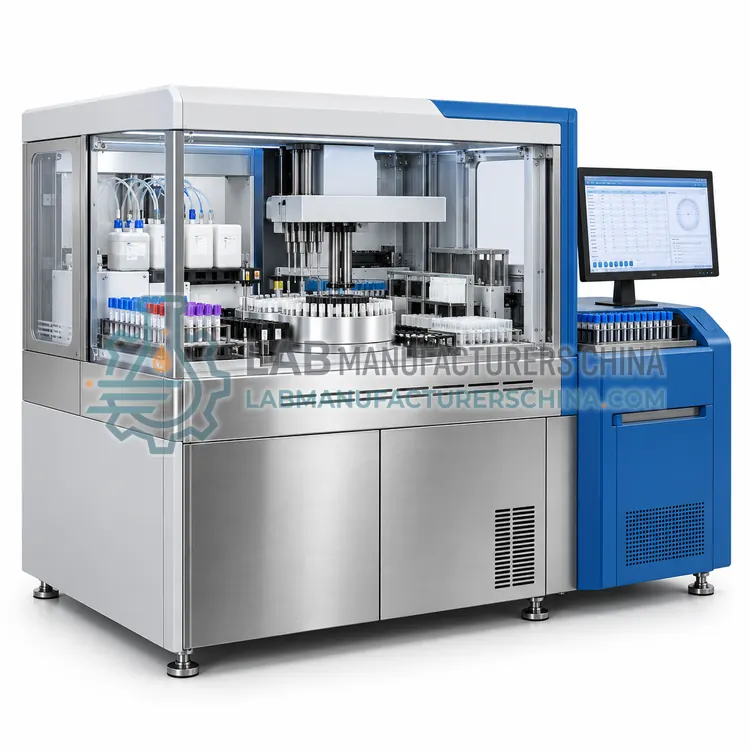
Automated Chemistry Workstation with Sample Sorter and Archiver
带样本分拣与归档的自动化生化工作站
- CE (to be confirmed)
- +2