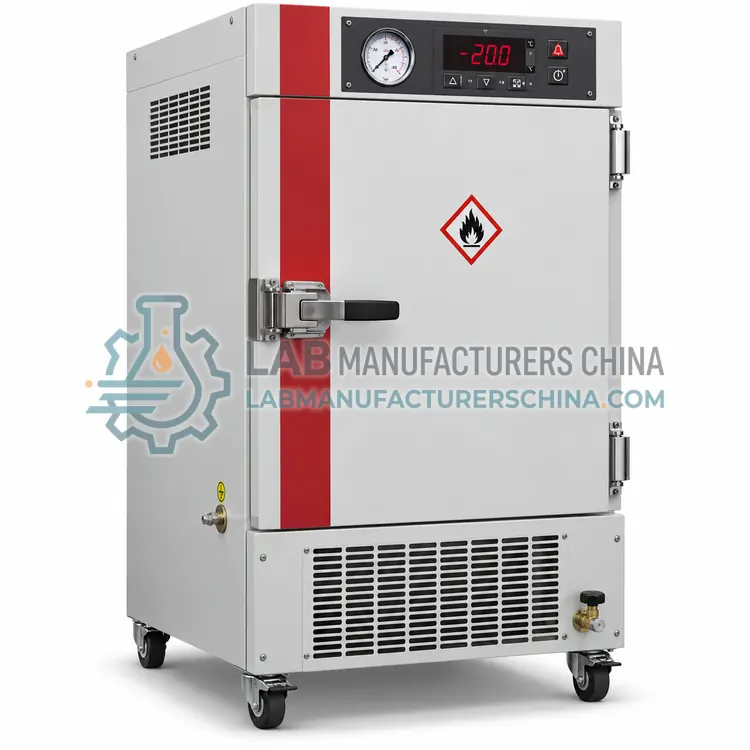
Spark-Free Flammable-Storage –20 °C Freezer
无火花易燃品储存 –20 °C 冷冻箱
- SKU CFR-0005
- -20°C Freezers
- CE (to be confirmed)
- ISO 9001 manufacturing (to be confirmed)
Price on request — FOB / CIF quoted per order
Prices depend on configuration, quantity and destination port.
Key specifications
| Temperature range | –10 to –25 °C |
|---|---|
| Net volume | 100–400 L |
| Interior ignition sources | None |
| Explosion-proof certification | Not certified; laboratory-safe design |
| Cooling method | Static, evaporator plates |
| Defrost | Manual |
Request a quote Download brochure · to be provided
By Lab Manufacturers China Technical TeamLast reviewed Standards: IEC 61010-1, IEC 61010-2-011, IEC 61326-1
What is the Spark-Free Flammable-Storage –20 °C Freezer?
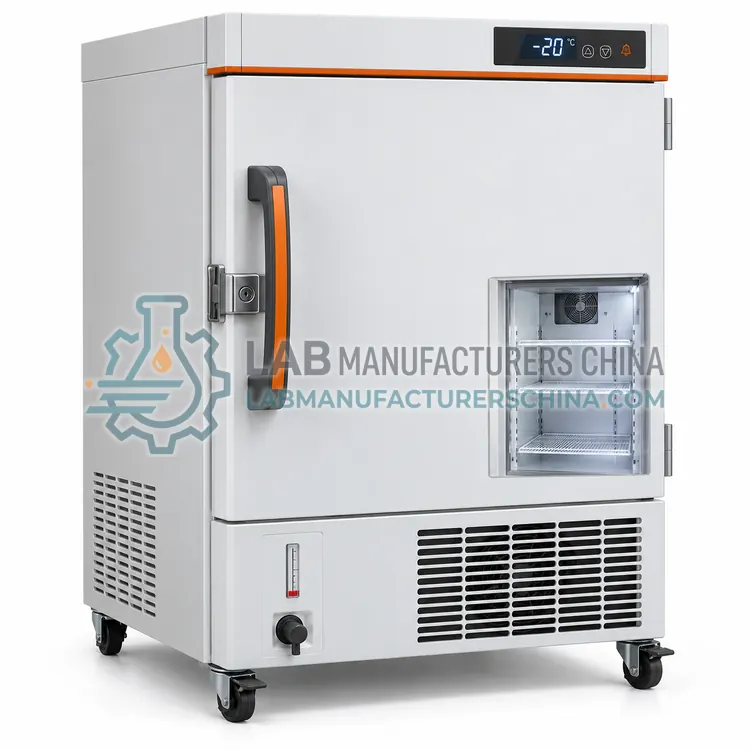
A –20 °C freezer with no sparking parts in the storage compartment, for sealed flammable liquids and reagents that need sub-zero storage. It is intended for chemical and pharmaceutical laboratories, not for certified hazardous zones.
What is the Spark-Free Flammable-Storage –20 °C Freezer?
A –20 °C freezer with no sparking parts in the storage compartment, for sealed flammable liquids and reagents that need sub-zero storage. It is intended for chemical and pharmaceutical laboratories, not for certified hazardous zones.
Overview
Flammable-storage freezers follow the same principle as flammable-storage refrigerators. Thermostats, switches, lights and fan motors are located outside the storage space or sealed, so no ignition source contacts vapours inside. Volume is typically 100–400 L, with a static evaporator and coated shelves resistant to solvents. The controller is mounted externally with a temperature display and alarms, and the door has a magnetic seal and lock. Defrost is manual to avoid heaters in the compartment. Although these freezers prevent ignition inside, they are not certified to IEC 60079 and must not be installed in a classified area. Containers should be sealed and compatible, and quantities must respect fire-code limits such as NFPA 45 and NFPA 30.
How does it work?
A –20 °C freezer uses a single-stage vapour-compression circuit with hydrocarbon refrigerant such as R600a or R290. The evaporator either lines the compartment as plates, giving static cooling with high stability and manual defrost, or sits behind a panel with a fan, giving forced-air cooling and automatic defrost. Polyurethane foam of 60–80 mm provides insulation, and magnetic gaskets limit air leakage. A microprocessor controller reads a sensor, sets the temperature between –10 and –25 °C and drives alarms. Higher-specification models add an independent alarm probe, battery backup and a data logger. Spark-free models relocate controls outside the compartment for flammable storage. The temperature reached is sufficient to slow chemical degradation and enzyme activity but does not stop them entirely.
What are the key features?
- Thermostat, switches and fan outside the storage compartment
- Static evaporator with solvent-resistant coated shelves
- Manual defrost avoids heaters inside the compartment
- External controller with digital display and alarms
- Magnetic door seal and lock
What are the technical specifications?
A typical spark-free flammable-storage –20 °c freezer configuration offers temperature range of –10 to –25 °C, net volume of 100–400 L, interior ignition sources of None, explosion-proof certification of Not certified; laboratory-safe design, cooling method of Static, evaporator plates and defrost of Manual. Values are indicative of the product class; the exact figures for each configuration are confirmed on the quotation and the calibration documents supplied with the instrument.
Which applications is it used for?
The Spark-Free Flammable-Storage –20 °C Freezer is used in sealed flammable reagent storage, synthesis and process laboratories, monomer and initiator storage and solvent standards. Across the wider -20°C Freezers class, laboratories also deploy it for enzyme and reagent storage, diagnostic kit storage and culture media and supplements.
Which standards and certifications apply?
Relevant standards and methods include IEC 61010-1, IEC 61010-2-011, IEC 61326-1, ISO 15189, NFPA 45 and ISO 9001. Certification candidates for this model are CE and ISO 9001 manufacturing; each is to be confirmed for the specific configuration before shipment, and certificates are supplied only where they have been issued.
Place the freezer on a level floor with clearance for ventilation as specified, away from heat and sunlight, and allow it to run for several hours before loading. Avoid overloading and block-free airflow in fan-assisted models. Defrost static units when frost reaches about 5 mm, and clean the condenser every few months. Calibrate probes and alarms at least annually, and map temperature where storage is regulated. Keep an emergency plan for power failure, including backup freezer space or a generator-backed circuit. Do not store flammable liquids unless the unit is specifically built for it.
How do I select the right Spark-Free Flammable-Storage –20 °C Freezer?
Choose this variant when sealed flammable materials must be stored at –20 °C in an unclassified laboratory. Specify volume, shelf finish, defrost, door lock and alarms. Where a classified zone or large volumes are involved, select a certified explosion-proof freezer instead.
How does it compare with other -20°C Freezers variants?
Choose by what is stored and how it tolerates temperature change. Enzymes and sensitive reagents favour static, manual-defrost cabinets, while general chemicals and media suit frost-free models. Regulated kits and calibrators need independent alarms and logging. Flammable materials require spark-free or explosion-proof designs. Then select capacity, from 100 L undercounter to 600 L upright, and compare temperature uniformity, recovery, drawer layout and lock. Check ambient range, electrical supply and noise. Consider whether –20 °C is sufficient, because many biological samples, nucleic acids and tissues are kept at –80 °C for long-term stability, and some vaccines need different storage.
Full specifications
| Temperature range | –10 to –25 °C |
|---|---|
| Net volume | 100–400 L |
| Interior ignition sources | None |
| Explosion-proof certification | Not certified; laboratory-safe design |
| Cooling method | Static, evaporator plates |
| Defrost | Manual |
| Shelves | Solvent-resistant coated |
| Refrigerant | R290 or R600a |
| Alarms | High temperature, door ajar |
| Power supply | 220–240 V, 50 Hz |
Indicative values for this product class. Final specifications are confirmed on the quotation and in the calibration documents supplied with the instrument.
Applications
- Sealed flammable reagent storage
- Synthesis and process laboratories
- Monomer and initiator storage
- Solvent standards
Key features
- Thermostat, switches and fan outside the storage compartment
- Static evaporator with solvent-resistant coated shelves
- Manual defrost avoids heaters inside the compartment
- External controller with digital display and alarms
- Magnetic door seal and lock
Frequently asked questions about Spark-Free Flammable-Storage –20 °C Freezer
Interior lights, switches and thermostats can spark, and flammable vapours can reach explosive concentrations inside a closed cabinet. Standard freezers have caused laboratory explosions, so use a unit built without ignition sources in the storage space.
No. Flammable-storage types only protect the interior, while explosion-proof types are certified, for example to IEC 60079 or GB 3836, so the whole unit can operate safely in a classified area. The certified type is more costly.
Automatic defrost uses electric heaters and fans that could create ignition sources or vapour circulation. Manual defrost avoids these, but stock must be removed and handled safely, and cabinets should be ventilated before and after cleaning.
A –20 °C laboratory freezer is a cabinet that holds contents at about –10 to –25 °C. It stores enzymes, reagents, kits, media and samples that need sub-zero storage but not the –80 °C used for long-term biological samples.
Typical contents are restriction enzymes, polymerases, antibiotics, reagent kits, media supplements, antibodies for short-term use and frozen chemical standards. Always follow the manufacturer's label, since some reagents require –80 °C or refrigeration.
Manual-defrost freezers hold temperature more stably, so they suit enzymes and sensitive reagents. Frost-free models are more convenient and uniform, but cycle temperature during defrost, which can harm sensitive contents. Choose according to what is stored.
Related models
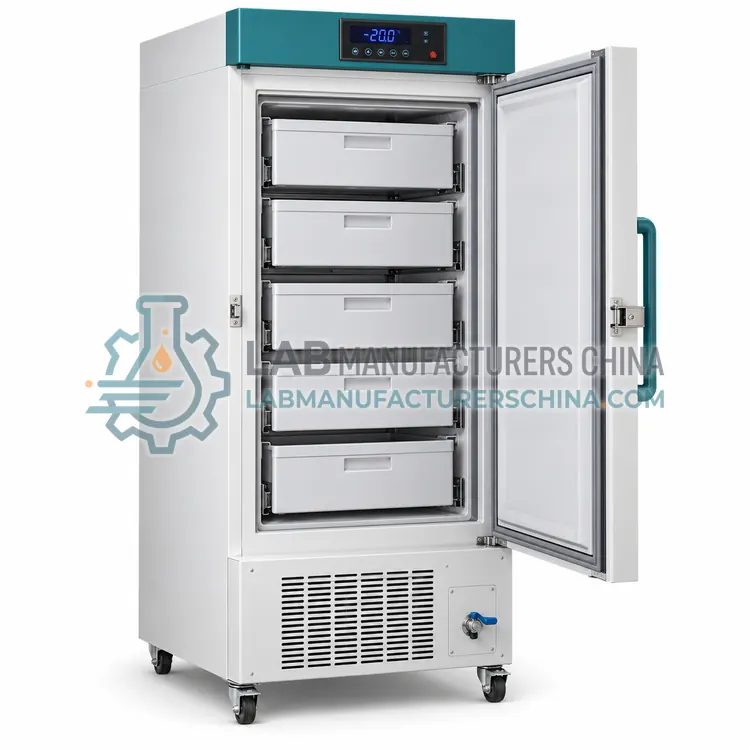
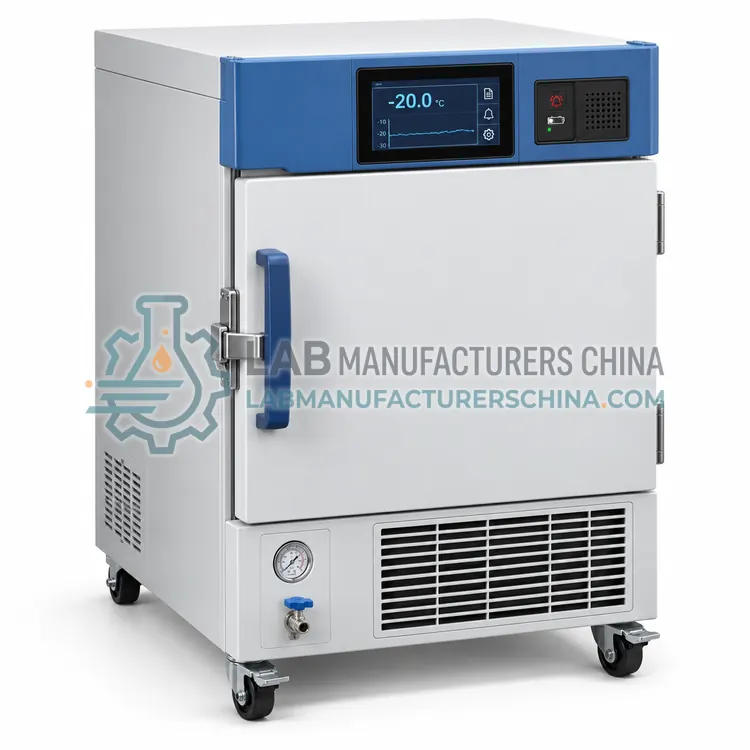
Biomedical –20 °C Freezer with Backup Alarm and Data Logging
带备用报警和数据记录的生物医学 –20 °C 冷冻箱
- CE (to be confirmed)
- +2