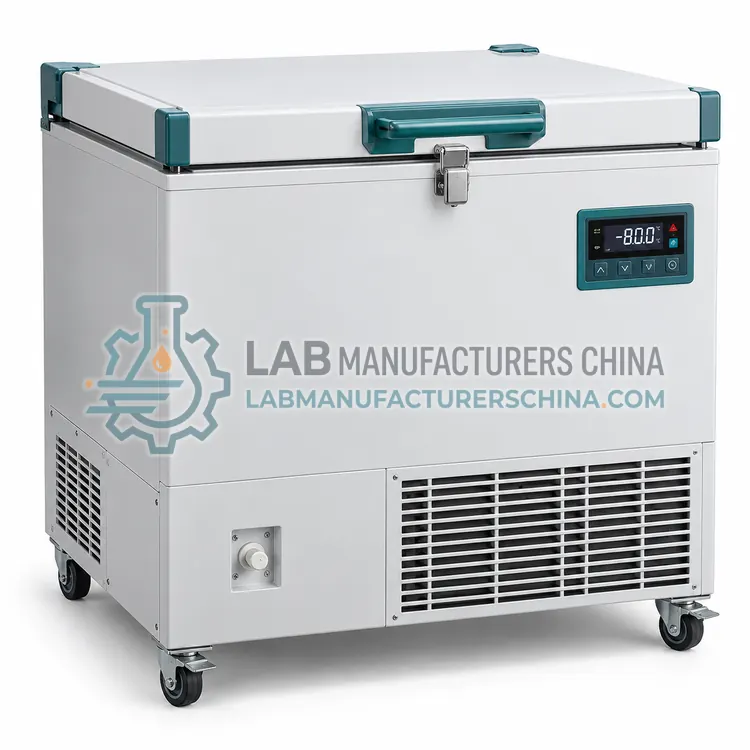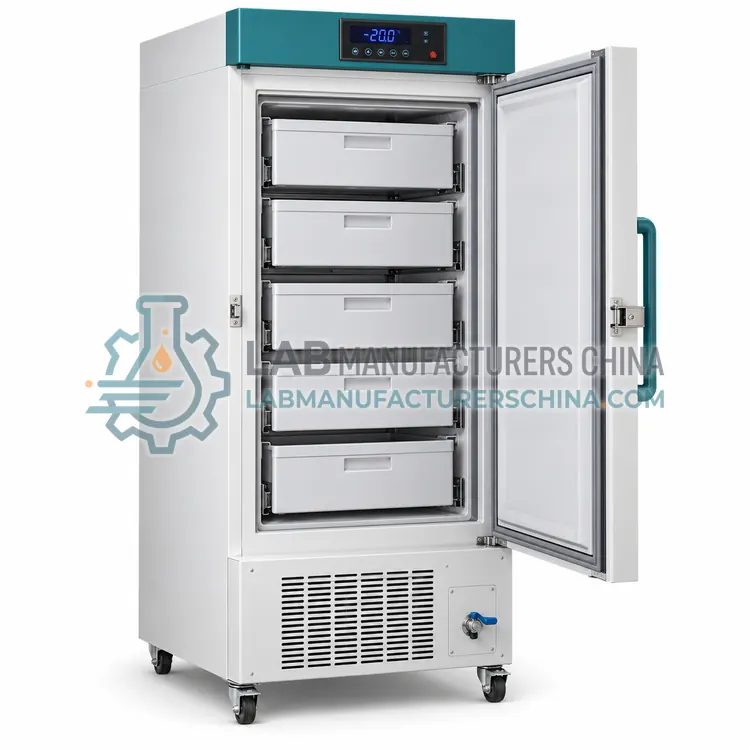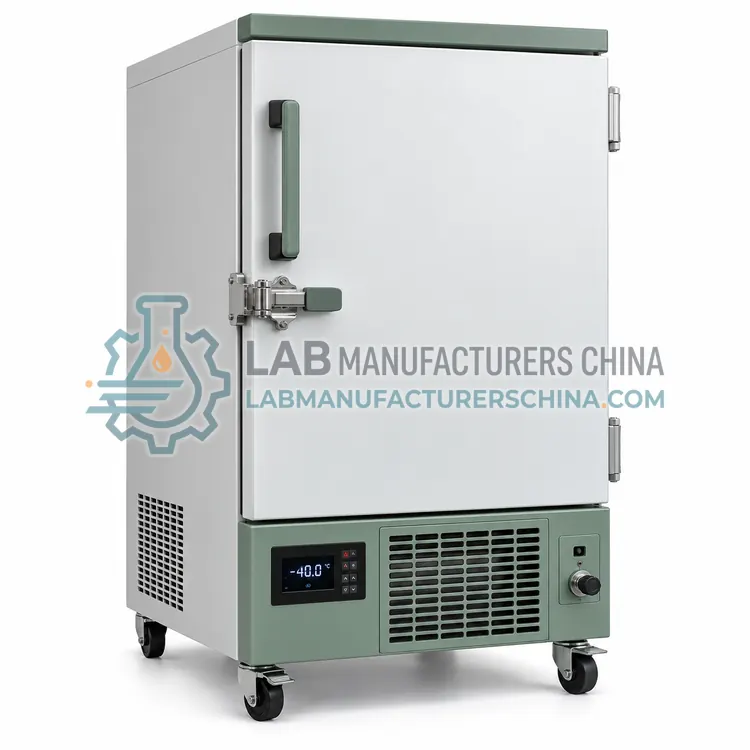
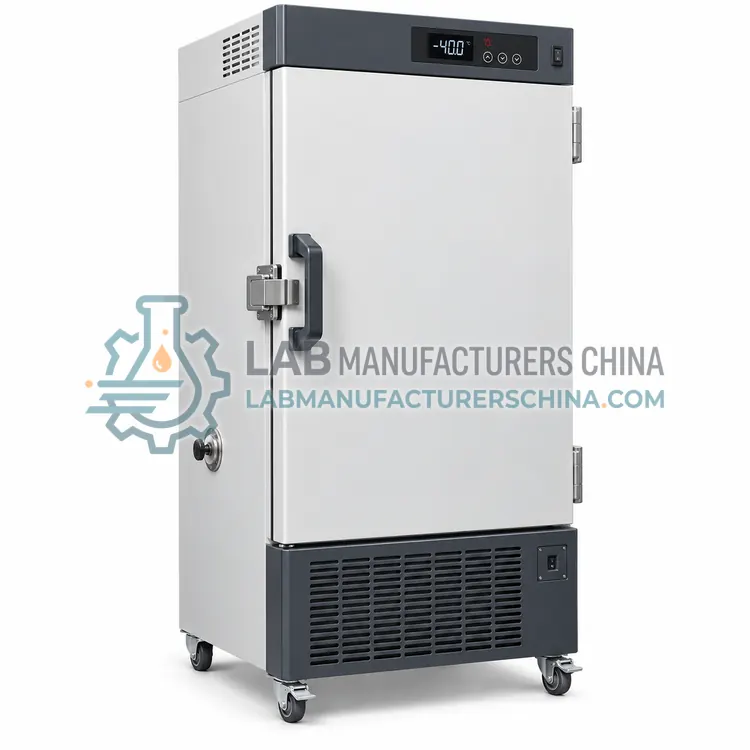
Upright -40 °C Laboratory Freezer
立式 -40 °C 实验室冷冻箱
- SKU CFE-0001
- -40°C Freezers
- CE (to be confirmed)
- ISO 9001 manufacturing (to be confirmed)
- IEC 61010-2-011 test report (to be confirmed)
Price on request — FOB / CIF quoted per order
Prices depend on configuration, quantity and destination port.
Key specifications
| Temperature range | -25 to -45 °C |
|---|---|
| Net capacity | 200-700 L |
| Cooling method | Forced air |
| Refrigerant | Hydrocarbon or HFC blend |
| Insulation thickness | About 90 mm polyurethane |
| Ambient rating | 10-32 °C |
Request a quote Download brochure · to be provided
By Lab Manufacturers China Technical TeamLast reviewed Standards: IEC 61010-2-011, IEC 60335-2-89, ISO 23953
What is the Upright -40 °C Laboratory Freezer?
An upright cabinet with shelves and a solid or glass door that holds contents at -25 to -45 °C. It is the standard choice when a laboratory needs easy shelf access to boxes of plasma, reagents or samples at a temperature below -20 °C.
What is the Upright -40 °C Laboratory Freezer?
An upright cabinet with shelves and a solid or glass door that holds contents at -25 to -45 °C. It is the standard choice when a laboratory needs easy shelf access to boxes of plasma, reagents or samples at a temperature below -20 °C.
Overview
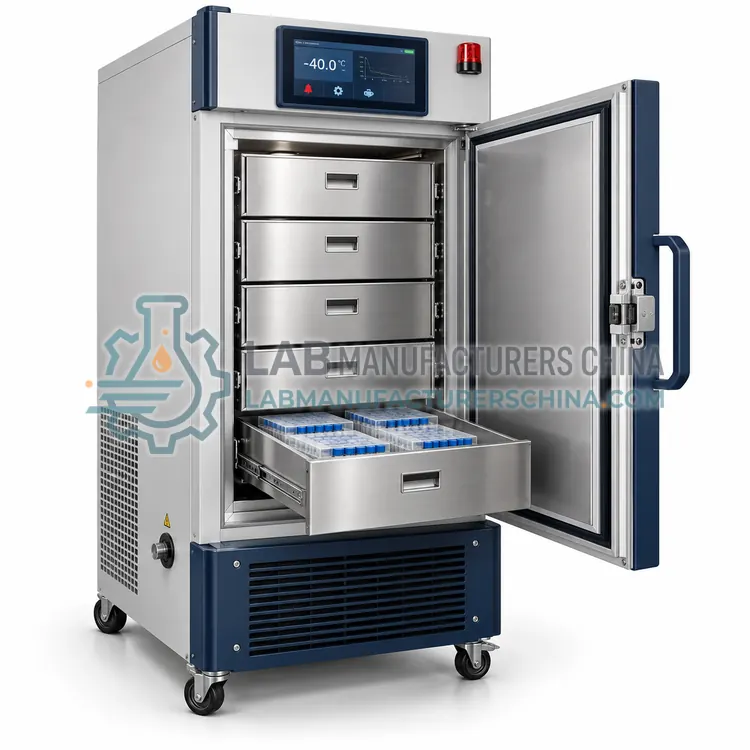
The upright -40 °C freezer combines a vertical footprint with adjustable shelves or drawers, so boxes can be organized by project or sample type and retrieved without bending. Capacities typically run from 200 to 700 L. Forced-air evaporators behind the rear wall distribute cold air, which keeps shelf-to-shelf differences within about 5 °C, and a heated door frame prevents gasket sticking. Foamed polyurethane walls of around 90 mm limit heat gain. Controllers show the cabinet temperature digitally, with high and low alarms, door-open alarm and power-failure indication. Because cold air falls out when the door opens, recovery time matters, and models with inner doors or split compartments reduce losses. This format suits laboratories with moderate access frequency and a need for organized inventory.
How does it work?
A -40 °C freezer removes heat through vapor-compression refrigeration. Reaching -40 °C from a 25 °C room needs a larger temperature lift than a -20 °C unit, so manufacturers use either a high-efficiency single-stage circuit with a low-temperature refrigerant blend or a compact two-stage cascade. The compressor moves refrigerant through a condenser, capillary or expansion valve and an evaporator mounted in the cabinet walls or behind the shelves. Polyurethane foam insulation of 80 to 100 mm and a magnetic or heated door gasket limit heat ingress, and a door heater prevents frost bonding. A microprocessor controller reads a platinum resistance sensor and cycles the compressor, while independent alarm circuits watch temperature, door status and power. Forced-air or direct-cooling shelves determine uniformity, with forced air giving a tighter distribution and direct cooling giving faster pull-down and lower energy use.
What are the key features?
- Adjustable shelves or drawers allow boxes to be organized by project or sample type.
- Forced-air circulation keeps shelf-to-shelf temperature differences within a few degrees.
- Heated door frame prevents gasket freezing and allows immediate reopening.
- Digital controller with high and low temperature and door-open alarms.
- Lockable door restricts access to stored samples.
- Remote alarm contact supports connection to a building monitoring system.
What are the technical specifications?
A typical upright -40 °c laboratory freezer configuration offers temperature range of -25 to -45 °C, net capacity of 200-700 L, cooling method of Forced air, refrigerant of Hydrocarbon or HFC blend, insulation thickness of About 90 mm polyurethane and ambient rating of 10-32 °C. Values are indicative of the product class; the exact figures for each configuration are confirmed on the quotation and the calibration documents supplied with the instrument.
Which applications is it used for?
The Upright -40 °C Laboratory Freezer is used in plasma and serum storage, research sample storage, reagent and kit storage and pharmaceutical stability samples. Across the wider -40°C Freezers class, laboratories also deploy it for fresh frozen plasma storage, tissue and enzyme preparation storage and stability sample storage.
Which standards and certifications apply?
Relevant standards and methods include IEC 61010-2-011, IEC 60335-2-89, ISO 23953, EN 15713, GB/T 21151 and WHO PQS E003. Certification candidates for this model are CE, ISO 9001 manufacturing and IEC 61010-2-011 test report; each is to be confirmed for the specific configuration before shipment, and certificates are supplied only where they have been issued.
Install the freezer on a level floor with at least 100 mm of clearance at the sides and 200 mm at the rear and top for airflow, in a room not exceeding the rated ambient, typically 32 °C. Use a dedicated circuit with a voltage stabilizer where mains quality is poor. Allow 24 hours after transport before switching on. Calibrate the controller display against a reference thermometer at installation and annually, and map temperature under load for regulated storage. Defrost direct-cooling models when frost exceeds 5 mm and clean condenser filters every one to three months. Keep the door open as briefly as possible and organize inventory to avoid searching. Connect alarm outputs to a monitoring system and test alarms and backup power quarterly.
How do I select the right Upright -40 °C Laboratory Freezer?
Select the upright format when several users need organized shelf access and floor space is limited. Compared with chest units it is easier to inventory but loses more cold when opened. Specify net volume, number of shelves or drawers, ambient temperature, alarm outputs, door lock, and whether glass or solid doors are needed.
How does it compare with other -40°C Freezers variants?
Choose a -40 °C freezer when -20 °C is not cold enough but -80 °C is unnecessary. Typical triggers are fresh frozen plasma storage, tissue and enzyme preparations that need to stay below the eutectic point of common buffers, and stability studies at -40 °C. Decide first on the format: under-counter for small volumes at the bench, upright for shelf access, chest for bulk storage, or combination units when one cabinet must also provide 2-8 °C. Next compare uniformity and recovery after door opening, since forced air gives a tighter spread and direct cooling a lower energy use. Check capacity against the inventory, ambient temperature rating, alarm features and data logging, and confirm that the lowest temperature is reachable at full load. If samples must stay below -60 °C, move to a -80 °C freezer instead.
Full specifications
| Temperature range | -25 to -45 °C |
|---|---|
| Net capacity | 200-700 L |
| Cooling method | Forced air |
| Refrigerant | Hydrocarbon or HFC blend |
| Insulation thickness | About 90 mm polyurethane |
| Ambient rating | 10-32 °C |
| Temperature uniformity | Within ±5 °C at steady state |
| Pull-down time | Under 4 h from 25 °C to -40 °C, empty |
| Power supply | 220 V, 50 Hz single phase |
| Power consumption | About 3-6 kWh/day |
Indicative values for this product class. Final specifications are confirmed on the quotation and in the calibration documents supplied with the instrument.
Applications
- Plasma and serum storage
- Research sample storage
- Reagent and kit storage
- Pharmaceutical stability samples
Key features
- Adjustable shelves or drawers allow boxes to be organized by project or sample type.
- Forced-air circulation keeps shelf-to-shelf temperature differences within a few degrees.
- Heated door frame prevents gasket freezing and allows immediate reopening.
- Digital controller with high and low temperature and door-open alarms.
- Lockable door restricts access to stored samples.
- Remote alarm contact supports connection to a building monitoring system.
Frequently asked questions about Upright -40 °C Laboratory Freezer
A 400 L cabinet typically holds 100 to 130 standard 2-inch cryoboxes or similar, depending on shelf layout. Always confirm with the drawing, because usable volume is lower than the gross figure.
Cold air spills from the top of an upright unit, so temperature can rise several degrees within a minute. Good recovery, inner doors and short opening times limit the effect on samples.
No. A standard laboratory freezer contains ignition sources such as thermostats and lights. Flammable material needs a purpose-built explosion-proof or flammable-storage freezer.
They store fresh frozen plasma, tissue, enzymes, buffers, reagents and stability samples that need colder conditions than -20 °C. They suit applications below the eutectic point of common solutions but without the long-term preservation demand that calls for -80 °C.
No. Nucleic acids, proteins and cell lines for long-term retention are normally stored at -80 °C or lower, and some protocols require it. A -40 °C freezer cannot reach those temperatures and should not be used for them.
Forced air gives a tighter temperature distribution and faster recovery after door opening. Direct cooling uses less energy and avoids airflow over samples but can show larger gradients. Choose based on whether uniformity or efficiency matters more to your inventory.
Related models
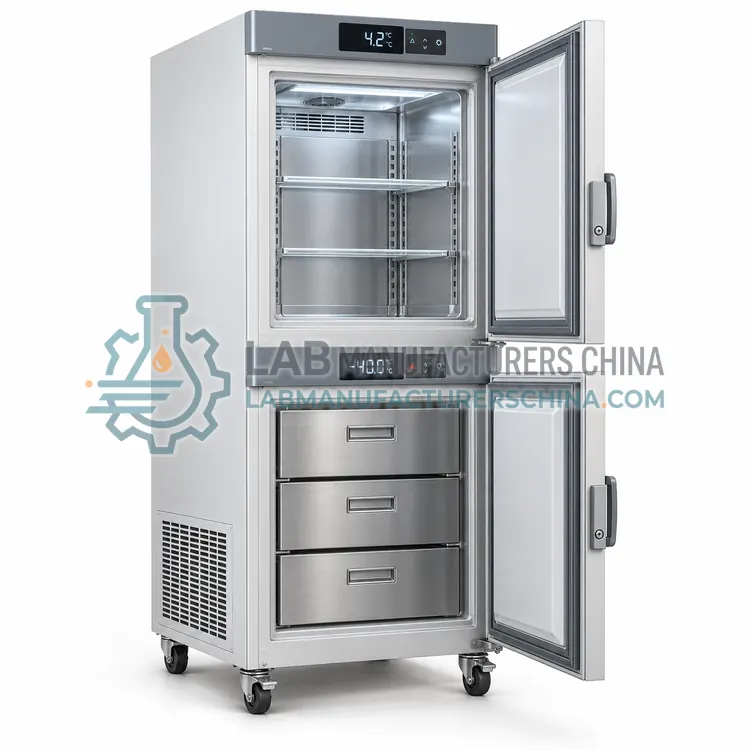
Dual-Zone -40 °C Freezer and 2-8 °C Refrigerator Combination
-40 °C 冷冻与 2-8 °C 冷藏双温区组合柜
- CE (to be confirmed)
- +2